


Your lead generation budget is draining away, but your pipeline isn’t growing. You’re spending more than ever on marketing, but you can’t tell which channels are profitable and which are just burning cash.
Without a firm grip on your Cost Per Lead (CPL), you’re flying blind. You might be celebrating a channel that delivers cheap leads, not realizing they never convert, while underfunding the channel that delivers expensive leads who become your best customers. This inefficiency stalls growth and puts your revenue goals in jeopardy.
This guide will turn you into a CPL expert. We’ll provide the latest 2025 benchmarks across industries and channels, show you exactly what to include in your calculations, and reveal 7 actionable strategies—including AI-powered tactics—to dramatically lower your lead costs while improving lead quality.
What Are Lead Costs Per Lead?
Cost Per Lead (CPL) is a metric that measures exactly how much each B2B lead costs your business. It allows you to gauge your marketing campaigns’ efficacy and return on investment. The standard way to calculate CPL is by using a lead formula, which takes into account all relevant costs and the number of leads generated.
Lead generation is an essential step of the sales process. Skilled sales and marketing professionals know several ways to generate leads, including email campaigns, using sales intelligence platforms, hosting events, focusing on content creation, or using direct messaging. To accurately measure and compare CPL across different channels and campaigns, businesses often use a lead calculator or lead calculators. If your team can properly identify and nurture leads, they’ll be well on their way to sales success.
How Do You Calculate Cost Per Lead?
You calculate your CPL by dividing your total lead generation costs (including total costs and other costs such as account executive expenses and commissions) by the number of new leads. For example, if your B2B SaaS startup spent $20,000 in acquiring 100 sales leads through paid LinkedIn ads and blog content, your CPL would be $200.
Understanding what to include in your total lead generation costs is critical for an accurate calculation. Lead costs can have a significant influence on your sales and marketing strategy. Average costs for lead generation can vary widely depending on the industry, region, and sales development expenses such as hiring and training. Understanding different types of leads, their associated costs, and how to optimize your resources is instrumental in driving more revenue for your company.
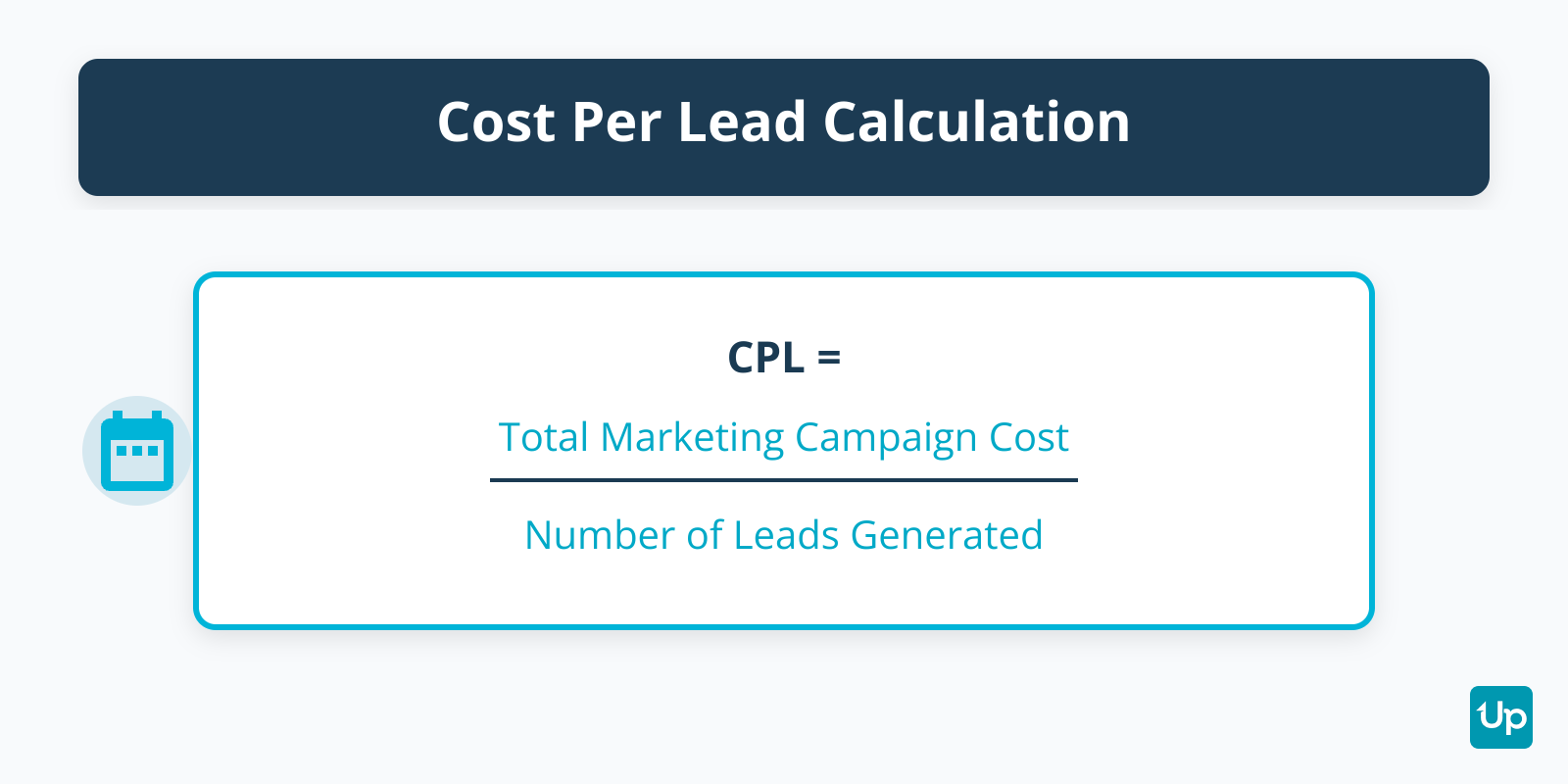
The CPL formula should account for all relevant components of CPL, including ad spend, creative development, technology, agency fees, labor, and list purchases. Cost influencing factors such as industry, company size, marketing channels, and targeted efforts can all impact the final CPL calculation.
What Costs Should Be Included in Your CPL Calculation?
The costs that should be included in your CPL calculation are both direct and indirect costs associated with lead generation.
Direct Costs:
- Ad spend on platforms such as Google Ads, Facebook, and LinkedIn
- Content creation costs for blogs, white papers, and videos
- Email marketing platform fees
- Website content and landing page development
Indirect Costs:
- A portion of marketing team salaries and benefits
- Subscriptions for marketing software and tools (CRM, analytics, sales automation tools, marketing automation software)
- Agency fees for outsourced marketing services, which may include payments to a marketing agency for campaign management and strategy
- Marketing department overhead
- Sales team compensation related to lead follow-up
Allocating Indirect Costs:
For costs like salaries or software subscriptions not 100% dedicated to a single campaign, determine the percentage of time or resources dedicated to lead generation activities and allocate that percentage. For example, if a marketing manager spends 40% of their time on lead generation campaigns, 40% of their salary should be included.
Overhead Expenses:
- Sales-related travel
- Trade show participation
- Operational overhead tied to customer acquisition
The fully loaded CPL formula is: Total Marketing Spend (including prorated direct and indirect costs) / Total New Leads Generated. By measuring CPL accurately, your sales and marketing team can track performance over time and make informed decisions about future campaigns and investments.
What Are the Key Factors That Influence Lead Costs?
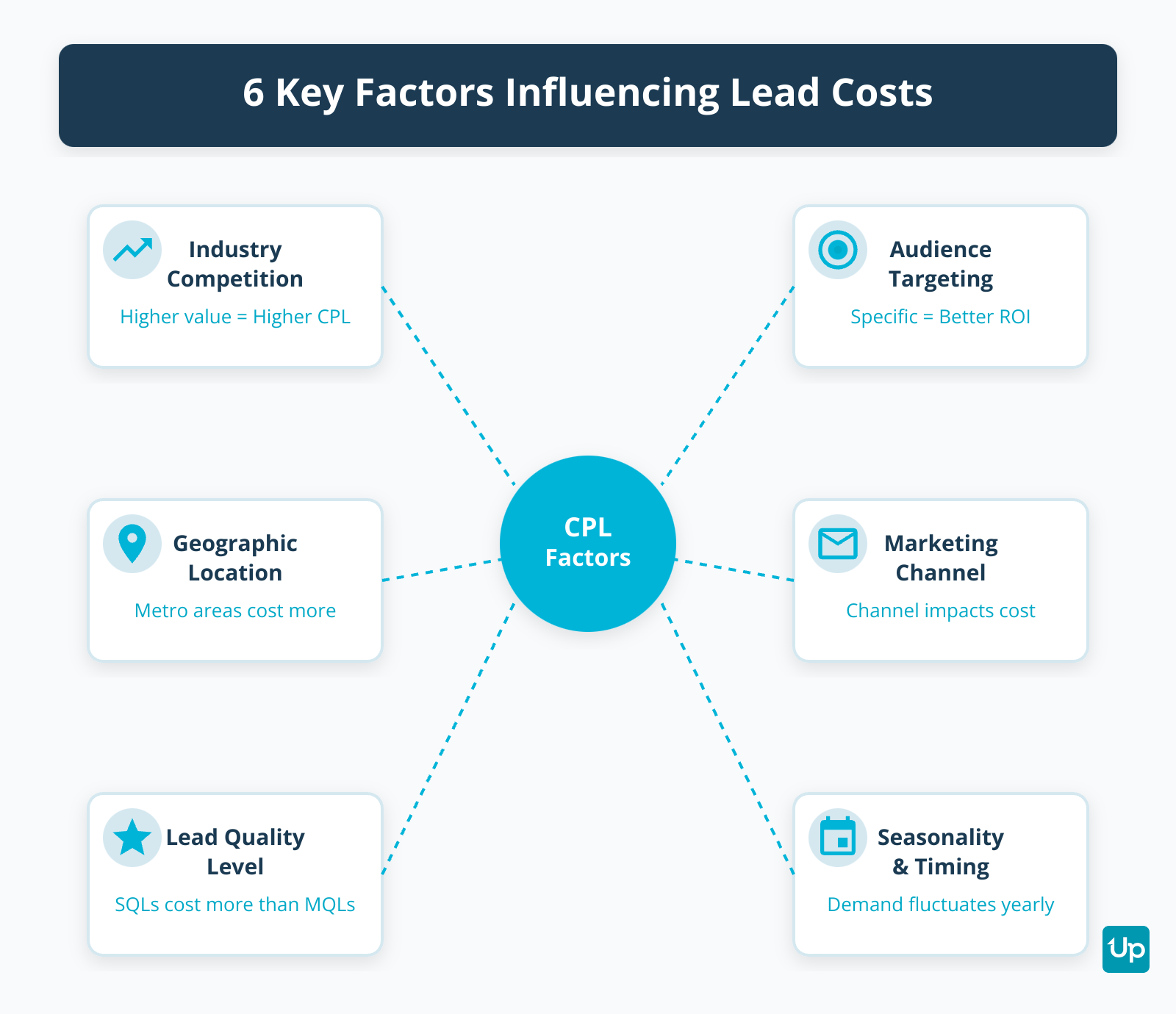
The key factors that influence lead costs are industry competition, audience targeting, geographic location, marketing channel, lead quality level, and seasonality. Understanding these variables helps you interpret CPL benchmarks and set realistic expectations for your campaigns. Evaluating the cost effectiveness of different marketing campaigns, especially by understanding your target audience and measuring CPL, enhances the efficiency and return on investment of your lead generation efforts.
Industry Competition: The single greatest determinant of lead cost is the industry vertical. Industries with higher customer lifetime value and more competition have higher CPLs. Legal services average $131.63 per lead, while automotive repair averages $28.50, reflecting the difference in service value and competitive intensity.
Audience Targeting: More specific audiences cost more to reach but deliver better results. Campaigns shifting to psychographic targeting saw 40% CPL reduction because they reached prospects more likely to convert, despite narrower reach.
Geographic Location: Metropolitan areas cost more than rural markets due to increased competition. Targeting prospects in major cities like New York or San Francisco drives higher CPLs than smaller markets.
Marketing Channel: Google Ads search campaigns average $70.11 per lead, while organic SEO can deliver leads at lower costs once content gains traction. The channel you choose impacts your cost structure.
Lead Quality Level: SQLs (Sales Qualified Leads) requesting product demos cost more than MQLs (Marketing Qualified Leads) downloading educational guides, but they convert at much higher rates. Higher-quality leads justify higher acquisition costs.
Seasonality: Demand fluctuates throughout the year in many industries. HVAC contractors can lower CPL by 30% by shifting winter air conditioning ads to heater maintenance campaigns, aligning with seasonal customer needs.
Lead Generation Strategies
Developing effective lead generation strategies is essential for businesses aiming to attract potential customers and convert them into paying customers. The foundation of successful lead generation lies in understanding your target market and crafting marketing campaigns that resonate with your ideal audience. By leveraging a mix of channels—such as social media marketing, content marketing, and paid advertising—you can generate leads that are more likely to become qualified leads and drive company revenue.
To maximize efficiency and reduce lead generation costs, businesses should focus on personalized marketing efforts that speak directly to the needs and interests of their target audience. This might include creating tailored content, running targeted ad campaigns, or engaging with prospects on the platforms they use most. The ultimate goal of any lead generation strategy is to increase the number of high quality leads entering your sales funnel, ensuring that your marketing efforts translate into measurable business growth.
By continuously refining your lead generation strategies and monitoring performance, you can optimize your approach, lower your average lead cost, and generate more leads that are primed for conversion.
Why Is Lead Quality More Important Than Lead Cost?
Lead quality is more important than lead cost because cheap leads that never convert waste your sales team’s time and damage your ROI. Focusing on qualified leads and qualified prospects increases the likelihood of achieving a closed deal and turning a lead into a converting customer. A low CPL means nothing if those leads don’t turn into customers.
MQLs (Marketing Qualified Leads) are prospects who have shown interest by engaging with marketing content like downloading ebooks or attending webinars, but aren’t ready for direct sales conversation. SQLs (Sales Qualified Leads) demonstrate strong buying intent and are ready for sales engagement through actions like requesting demos or contacting sales directly. The key difference is readiness to buy and purchase intent level.
Here’s a concrete example of why quality trumps cost:
Campaign A: Generates 100 MQLs at $30 per lead ($3,000 total cost) with 13% MQL-to-SQL conversion (13 SQLs) and 15% close rate = 2 deals at $10,000 each = $20,000 revenue (567% ROI).
Campaign B: Generates 15 MQLs at $200 per lead ($3,000 total cost) with 35% MQL-to-SQL conversion (5 SQLs) and improved 30% close rate = 1.5 deals = $15,000 revenue (400% ROI).
Campaign A delivered better ROI despite having higher volume because the conversion rates were lower. However, Campaign B’s higher-quality leads still delivered strong returns at a much higher cost per lead. The lesson: evaluate CPL in context of conversion rates and customer lifetime value.
Data from 2024 shows 70% of B2B marketers use lead conversion as a key performance metric and 37% name high-quality pipeline as their top priority. Companies focusing on lead quality report closing ratios up to 40% compared to just 11% with unqualified leads.
Cost benchmarks show MQLs cost $65-$250 while SQLs cost $300-$800+, representing a 2x to 5x cost increase justified by higher conversion rates. When you factor in the time your sales team saves by working qualified opportunities, the economics favor quality over volume.
What Is the Average Cost Per Lead in 2025?
The average cost per lead in 2025 is around $198. However, this number can vary between industries, channels, and company sizes. Average costs can fluctuate significantly depending on the industry and region.
Highly competitive sectors such as legal and financial services typically have higher CPLs due to fierce bidding for ad space.
Factors such as the size of your company or customer base and the duration and complexity of your campaigns should be considered when setting cost expectations. While CPL can also depend on external conditions beyond your control, such as market trends or competition levels, taking the time to do research and identify industry-specific metrics can help you form effective and realistic plans for controlling costs.
What Is the Average CPL by Industry?
The average CPL by industry varies from $28.50 in automotive repair to $595 in software development. On average, leads are more expensive in certain fields, such as IT and healthcare, than in other industries, such as education and retail. The following breakdown of average CPLs by industry is a starting point for understanding what a good CPL might look like for your type of business.
However, this data alone shouldn’t be used as a defining factor when allocating resources or setting your sales budget. Other factors, such as your pricing model and niche, can influence what a good CPL benchmark might look like for your organization. Note that CPL varies based on marketing channel, lead quality, and data source methodology.
| Industry | Cost Per Lead (2025) | Source |
| Legal Services | $131.63 | WordStream (Google Ads) |
| IT & Managed Services | $501 | Sopro (Multi-channel B2B) |
| Software Development | $595 | Sopro (Multi-channel B2B) |
| B2B SaaS | $188 | Sopro (Multi-channel B2B) |
| Healthcare | $162 | Industry Average |
| Financial Services | $160 | Industry Average |
| Media & Publishing | $108 | Industry Average |
| Consumer Products | $105 | Industry Average |
| Marketing | $99 | Industry Average |
| Education | $55 | Industry Average |
| Automotive Repair | $28.50 | WordStream (Google Ads) |
What Is the Average CPL by Marketing Channel?
The average CPL by marketing channel ranges from $46.87 for SEO to $811 for events and trade shows. Different lead generation channels involve varying costs, so it makes sense that your cost per lead will differ depending on which method you use. It’s important to analyze each lead generation channel to understand the specific costs and ROI, allowing you to optimize your marketing strategy and improve efficiency. Despite the cost of events and trade shows being higher than other lead generation channels, they remain popular because live events offer the opportunity to foster engaging conversations.
Traditional mediums such as TV/radio advertising and print media are powerful methods of scaling brand awareness, albeit at a more expensive average cost per lead. On the other hand, digital marketing solutions can provide businesses with further reach at a lower cost. Social media, email marketing, SEO, and LinkedIn ads are some of the most widely used digital marketing methods. Lead generation cost can vary significantly by channel, so evaluating and comparing these costs is essential for effective budgeting and strategic planning.
According to WordStream’s 2025 report, the overall average CPL in Google Ads is $70.11, a 5.13% increase from 2024’s $66.69. Multi-channel campaigns show 31% lower CPL than single-channel efforts. For LinkedIn Ads, the average CPL ranges from $90 to $150+, depending on the industry and targeting specifics, with North America averaging around $230.
| Channel | Average Cost Per Lead (2025) |
|---|---|
| Events & Trade Shows | $811 |
| Traditional Advertising (offline) | $619 |
| LinkedIn Ads | $90-$230 |
| Note: LinkedIn is frequently the most expensive platform for B2B lead generation, with costs roughly 57% higher than search networks. | |
| Search Engine Marketing (Google Ads) | $70.11 |
| Note: Google Ads often have a higher CPL because they capture users with high intent, while social media ads can vary. | |
| Webinars | $72 |
| Social Media Ads | $58 |
| Email Marketing | $53 |
| SEO (Organic) | $46.87 |
What Is the Average CPL for Paid vs. Organic Leads?
The average CPL for organic and inbound leads is 61-62% less than paid and outbound leads. This cost advantage makes a significant difference in your marketing budget and overall ROI.
SEO campaigns achieve an average CPL of $46.87 compared to PPC at $70.11 or higher. Beyond the cost savings, recent 2025 data shows inbound leads convert at nearly double the rate of outbound leads (13% vs 7%). Inbound strategies are 10x more effective for lead conversion, and 59% of marketers state inbound generates higher-quality leads.
The key advantage of organic lead generation is that prospects find you when they’re actively searching for solutions, making them more qualified and ready to engage. While organic strategies require upfront investment in content creation and SEO, the long-term cost efficiency and higher conversion rates make them a smart choice for businesses looking to balance cost and impact.
What Is the Average CPL by Company Size?
The average CPL by company size ranges from $147 for companies with 2-50 employees to $349 for companies with 1,001+ employees. Larger enterprises have a higher average CPL than their smaller counterparts because bigger companies tend to sink more marketing dollars into their lead-generation efforts.
On the other hand, smaller companies have fewer resources at their disposal and must develop effective strategies that don’t require hefty investments. Companies trying to scale with limited finances strive for lower average CPLs by implementing low-cost lead-generation solutions.
| Company Size | Average Cost Per Lead |
| 1,001+ employees | $349 |
| 201-1,000 employees | $212 |
| 51-200 employees | $180 |
| 2-50 employees | $147 |
Revenue and Cost Per Lead
Understanding the relationship between revenue and cost per lead is crucial for optimizing your lead generation efforts. Every dollar spent on generating leads should be evaluated against the revenue those leads bring in. To calculate your cost per lead, it’s important to account for all expenses tied to your marketing campaign, including advertising spend, labor, and any agency fees. This comprehensive view helps you determine your average cost per lead and assess the effectiveness of your marketing strategies.
Regularly tracking and analyzing lead generation costs allows you to identify which campaigns and channels deliver the best return on investment for your target market. By comparing the revenue generated from each lead to the cost of acquiring that lead, you can make informed decisions about where to allocate your marketing budget. This data-driven approach ensures that your lead generation efforts are both cost effective and aligned with your company’s revenue goals, helping you scale your business efficiently.
How Can You Lower Your Lead Generation Costs?
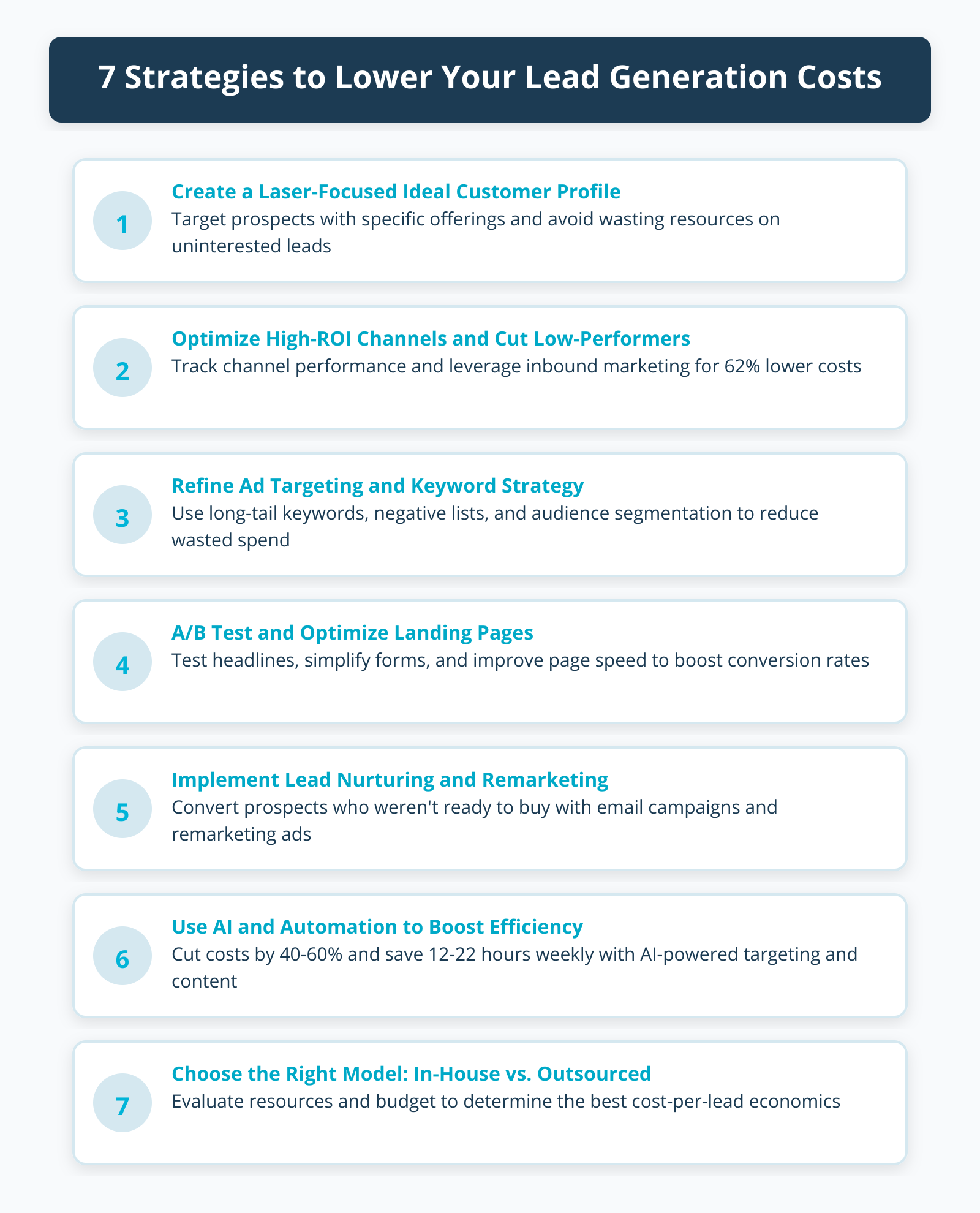
You can lower your lead generation costs by creating a laser-focused ideal customer profile, optimizing high-ROI channels, refining ad targeting, A/B testing landing pages, implementing lead nurturing campaigns, using AI and automation, and choosing the right in-house or outsourced model. Optimizing your lead gen efforts and regularly evaluating your lead gen strategies for cost efficiency are also crucial for reducing costs and improving results. Below are actionable ways to reduce the cost of leads without sacrificing quality and help your sales team unlock greater success from the same budget.
Outsourcing lead generation to a professional agency can sometimes be more effective than generating leads in-house, especially for growing businesses. Poor website performance can drive up lead costs by lowering the conversion rate of paid traffic. High-quality, engaging content requires higher investment in professional production to stand out in saturated markets. Sales-ready leads that need less nurturing are more expensive than cold leads. Stricter privacy regulations like GDPR and CCPA have increased lead generation costs by requiring more compliance investment.
Maximizing marketing driven deals and marketing driven revenue requires focusing on high-quality leads and aligning sales and marketing teams. By targeting the right audience and ensuring that marketing and sales are working together, you can increase the proportion of marketing driven deals and boost marketing driven revenue, making your lead gen efforts more effective and cost-efficient.
Create a Laser-Focused Ideal Customer Profile
Creating an ideal customer profile (ICP) is a powerful way to lower the cost of acquiring leads. Building your ICP helps you target prospects with a more specific offering and avoid wasting resources on leads that might not be interested in your offering.
When building an ICP, you should consider key factors such as the prospect’s industry, budget, location, and job function. Consider your ideal customer’s challenges as well; it will help you present a solution to their pain points. Keeping an ideal customer profile at the center of your lead acquisition process ensures you’re not wasting time and money on the wrong leads.
Optimize High-ROI Channels and Cut Low-Performers
Studies from Mashable have found that inbound marketing leads are 62% less expensive than outbound marketing leads. Your inbound marketing content will most likely appeal to people already interested in your offering. They are more likely to be marketing qualified leads and are, therefore, more likely to enter your sales funnel.
Some of the most common inbound marketing tactics include:
- Blog posts
- E-books
- White papers
- SEO
- Social media
Tracking and optimizing channel performance allows for a more strategic marketing approach. You can reduce costly investments while boosting ROI by leveraging data-driven insights on each channel and crafting campaigns tailored to your target audience’s preferences. Digital tools can assist in the lead generation and management process and make tracking leads throughout the customer journey easier. Overall, tracking which channels perform best—and why—will help your team optimize their budget and achieve maximum conversion rates.
Refine Ad Targeting and Keyword Strategy
Improving your ad targeting and keyword strategy can reduce wasted spend and lower your CPL. Here are specific tactics to implement:
Focus on long-tail keywords: Target longer, more specific phrases of three or more words. Users with higher purchase intent use these terms, leading to less competition and lower CPL.
Utilize negative keyword lists: Prevent ads from showing for irrelevant searches to stop wasteful spending on clicks that won’t convert. Review search term reports and add non-converting terms to your negative keyword list.
Leverage audience segmentation: Use demographics, in-market segments, and behavioral data to narrow your targeting. More precise audience targeting reduces CPL by reaching prospects more likely to convert.
A/B Test and Optimize Landing Pages for Conversion
Your landing page conversion rate impacts your CPL. Small improvements in conversion can reduce your cost per lead. Implement these optimization tactics:
A/B test headlines: Compare two versions to see which performs better in click-through rate and conversions. Headlines are the first thing visitors see and have an outsized impact on conversion.
Simplify form fields: Reduce the number of fields to lower cognitive energy and decrease abandonment rates. Only ask for essential information needed to qualify the lead.
Ensure your CTA is clear and compelling: Use action-oriented language that communicates the value of taking the next step.
Optimize for page load speed: A one-second delay can reduce conversions by 7%, while every 1-second improvement can increase conversions by 2%. Fast-loading pages keep prospects engaged and reduce bounce rates.
Implement Lead Nurturing and Remarketing Campaigns
Not every lead converts on the first interaction. Lead nurturing and remarketing campaigns help you extract more value from your initial lead generation investment by converting prospects who weren’t ready to buy.
Email marketing is an effective approach to reach out to customers at low cost. Developing organic content around key topics can help establish your business as an expert. When done well, attracting leads can be even more powerful than direct selling.
Remarketing ads target people who have already visited your website or engaged with your content, making them more cost-effective than cold outreach. These warm prospects convert at higher rates, lowering your overall CPL.
Use AI and Automation to Boost Efficiency
AI is lowering lead generation costs in three key areas: efficiency, targeting, and content production.
Efficiency: Early AI adopters cut sales-related operational costs by 40-60% and save 12-22 hours per week by automating research, outreach, and administrative tasks. AI increases sales productivity by 15-47%, with high-performing reps 1.9x more likely to use AI tools.
Targeting: AI can lower CPL by 20-50% through improved lead scoring and predictive analytics. Companies see 20-30% rise in conversion rates and up to 70% improvement in lead conversion when using AI-powered targeting.
Content: Generative AI makes content production 400% faster while cutting costs by 50% per article. Personalized outreach powered by AI increases email open rates by 42% and meeting bookings by 31%.
AI-powered platforms like Outreach.io position themselves as AI Revenue Workflow Platforms with features like AI Agents for autonomous plays, Kaia for conversation intelligence, and Smart Data Enrichment for lead generation. These tools help sales teams work smarter and generate more qualified leads at lower costs.
Choose the Right Model: In-House vs. Outsourced
Deciding between building an in-house lead generation team and outsourcing to an agency or service provider impacts your CPL structure. In-house teams offer more control and brand alignment but require upfront investment in hiring, training, and tools.
Outsourced lead generation can provide expertise and scalability without the overhead of full-time employees. However, outsourced leads may cost more per unit and require careful vetting to ensure quality matches your standards.
Evaluate your current resources, growth timeline, and budget to determine which model delivers the best cost-per-lead economics for your business. Many companies find a hybrid approach works best, handling strategic campaigns in-house while outsourcing specialized tactics or overflow capacity.
Service Providers for Lead Generation
Partnering with service providers for lead generation can be a game-changer for businesses looking to scale their marketing campaigns and generate high quality leads. These providers specialize in developing and executing lead generation strategies tailored to your business goals, whether that means managing social media advertising, optimizing your website for search engine optimization, or crafting targeted content to attract your ideal customers.
By outsourcing lead generation efforts, companies can tap into the expertise and resources of professionals who understand how to reach and engage your target audience. This not only frees up your internal team to focus on converting leads into paying customers but also helps ensure that your marketing campaigns are optimized for maximum impact. Service providers can offer valuable insights into industry best practices, help reduce lead generation costs, and deliver a steady stream of qualified leads to fuel your sales pipeline.
Inbound Marketing Methods to Generate Leads
Inbound marketing methods are a powerful way to generate leads by attracting potential customers through valuable content and engaging experiences. Techniques such as content marketing, social media marketing, and search engine optimization are designed to build trust and credibility with your target audience, making it easier to generate high quality leads who are genuinely interested in your offerings.
By focusing on inbound marketing, businesses can create a sales funnel that nurtures leads from initial interest to conversion, supporting sustainable growth and reducing reliance on paid advertising. These methods not only help lower lead generation costs over time but also ensure that your marketing efforts are reaching potential customers who are actively seeking solutions. As a result, inbound marketing can deliver more leads, higher conversion rates, and a stronger foundation for long-term business success.
What Are Related Sales and Marketing Metrics?
Related sales and marketing metrics include Customer Acquisition Cost (CAC), LTV:CAC ratio, and various conversion rates throughout the funnel. Understanding these metrics helps you see the complete picture of your customer acquisition economics.
Additionally, understanding gross profit is essential for evaluating the true profitability of customer acquisition and marketing campaigns.
What Is the Difference Between Cost Per Lead and Customer Acquisition Cost?
The difference between Cost Per Lead and Customer Acquisition Cost is that CPL measures the cost to acquire a potential customer (lead) while CAC measures the total cost to acquire a paying customer.
Cost Per Lead (CPL) uses the formula: Total Marketing Campaign Cost / Number of Leads Generated.
Customer Acquisition Cost (CAC) uses the formula: (Total Sales Costs + Total Marketing Costs) / Number of New Customers Acquired.
CAC includes broader expenses than CPL: full sales and marketing salaries, software and tools (CRM, automation platforms), creative and production costs, and overhead expenses. It’s crucial to distinguish CPL from CAC because CPL occurs at the lead stage while CAC measures the cost to get a paying customer, which is much higher than CPL.
Many businesses track both CPL and CAC on a monthly basis to monitor trends and adjust their strategies accordingly.
The LTV:CAC ratio benchmark is 3:1. For every $1 spent acquiring a customer, the business should generate $3 in lifetime value. Ratios below 3:1 signal inefficiency, while ratios above 5:1 may indicate underinvestment in growth.
How Many Leads Does Your Business Need to Hit Revenue Goals?
When creating your sales process, it’s important to consider how many leads your business needs within a given timeframe. Having a clear, quantifiable goal in mind will help focus your efforts and ensure you have realistic expectations for a successful outcome. Calculating the number of leads needed to achieve revenue goals requires understanding specific company data elements.
Before you calculate, understand that conversion rates vary by industry and lead source. B2B conversion rates vary: Visitor-to-Lead averages 2.3%, Lead-to-MQL ranges 31-41%, MQL-to-SQL averages 13-20%, SQL-to-Opportunity ranges 30-59%, and Opportunity-to-Close falls between 22-36%. For B2B SaaS, lead-to-opportunity averages 12%, while legal services can see lead-to-customer rates of 5-20% depending on practice area.
Use the factors below to calculate how many leads you need to reach your revenue goals:
- Target Revenue: Your revenue goal for a given period
- Average Sales Price (ASP) or Average Contract Value (ACV): Total amount of money earned per sale or signed contract
- Opportunity Win Rate: Ratio of opportunities that turn into customers
- Lead-to-Opportunity Conversion Rate: Ratio of leads that turn into opportunities (prospects with a high likelihood of conversion)
Now, let’s work through an example together:
- Let’s say you have a target revenue of $300,000 for the quarter.
- Your ASP or ACV for the quarter is $10,000.
- Take your target revenue and divide by your ASP or ACV to get the number of deals you need to meet your revenue goal: $300,000 / $10,000 = 30.
- Let’s say your opportunity win rate is evaluated as 1 in 8, which means out of every 8 highly qualified leads (opportunities), you can turn 1 into a customer.
- Take your opportunity win rate and multiply it by your number of deals to get the number of opportunities you need: 8 x 30 = 240.
- Let’s say your lead-to-opportunity conversion rate is 5, which means that out of every 5 leads, you can convert 1 into an opportunity. For every one lead, only a certain percentage will progress through each stage of the funnel. Take your opportunities and multiply it by your lead-to-opportunity conversion rate: 240 x 5 = 1,200.
- As a result of this calculation, you know that to reach $300,000 in your target revenue for the quarter, you need about 1,200 leads or more.
If a company needs 1,000 new leads and the historical CPL is $25, they must budget $25,000 to meet that goal.
Remember that these are example numbers. Use your own historical data for an accurate calculation specific to your business and industry.
FAQs About Lead Costs
Below are a few of the most frequently asked questions about the cost of generating leads.
What is a cost-per-lead example?
Determining your CPL can be useful when comparing the costs and returns associated with different campaigns and platforms. For example, you launched two email marketing campaigns targeting existing customers and potential prospects. Imagine that each had a total cost of $1000. If the first campaign generated 20 leads and the second only 10, your CPL was $50 for the successful campaign and $100 for the less successful one.
What should my cost per lead be?
Generally speaking, a lower cost per lead usually indicates a more efficient marketing campaign, but the ideal CPL will vary depending on your business goals and industry standards. It can be difficult to determine what your CPL should be. The truth is that there’s no definitive answer—the right number depends on a variety of factors, such as your industry, your company’s pricing model, how many marketing channels you use, the size of your company, and its overall revenue.
Lower Your CPL With High-Quality Data From UpLead
When analyzing your lead generation costs, it is essential to consider the unique elements of your business model. Factors such as industry, company size, and desired revenue must be considered to determine what works best for your business.
Several ways to decrease your CPL include creating an ideal customer profile (ICP), optimizing high-ROI channels like SEO, refining your ad targeting, A/B testing landing pages, implementing AI-powered automation, and choosing the right in-house or outsourced model.
Prospecting tools like UpLead will help you automate the lead generation process by providing high-quality leads at the scale you need. With UpLead, you can decrease your lead generation costs by unlocking verified, actionable contacts worldwide. The platform’s reliable database includes over 200 million B2B contacts.
Your team can leverage UpLead’s filtering capabilities to zero in on the leads who are most likely to be interested in your product, ensuring you’re not wasting time or money on low-quality leads. Plus, with the platform’s 95% data accuracy guarantee achieved through real-time email verification at download, you can trust that your leads come with valid and complete contact information. This focus on data quality helps businesses lower their CPL by reducing wasted outreach on inaccurate data and improving sender reputation.
You can reduce your CPL while generating the leads that are most likely to convert. Try UpLead for free today.