

Your sales team dials numbers and sends emails every day, and a large share of that effort still lands on contacts who were never real buyers. Verified B2B leads exist to fix exactly that problem: business contacts whose email and phone number have been checked against live data, with job titles confirmed too.
Every day, your reps waste precious hours chasing ghosts. They dial disconnected numbers, send carefully crafted emails that bounce, and try to personalize outreach with outdated job titles. Each dead-end lead sinks morale and burns through your budget, while your competitors engage qualified prospects who are ready to buy. Studies show sales reps can spend a third of their day grappling with bad data, and 41% report it as a major challenge, leading directly to lost deals and a damaged brand reputation.
This guide shows you how to find and verify B2B leads you can trust, then buy more of them with confidence. You’ll get the exact verification mechanics behind the scenes, four proven ways to build a pipeline of verified B2B leads, and a current, line-by-line comparison of the tools built for the job.
What Are Verified B2B Leads?
Verified B2B leads are business contact records, typically an email address and phone number with a job title attached, that have been checked and confirmed accurate. The person behind them still has to be active and working at that company. A verification system weeds out fake or stale leads by automatically testing each piece of information to determine whether it’s genuine.
Once a lead has gone through verification and comes back authenticated, your sales team can contact it knowing there’s a real person at the other end of the line, still holding the job title your outreach is written for.
Lead verification can save you money by ensuring salespeople don’t waste time with invalid leads. You can also save money on hosting your lead list and make your marketing efforts far more effective since invalid email addresses or phone numbers don’t weigh you down.
What Is the Difference Between Lead Verification, Lead Validation, and Lead Qualification?
Lead verification, lead validation and lead qualification sound similar, but they are three distinct processes that work together in your sales funnel. Lead verification is the process of confirming the accuracy and authenticity of a lead’s contact information, checking if details such as email addresses and phone numbers are valid, and confirming any physical address belongs to a real person.
Validation goes a step beyond accuracy, assessing whether a lead is a good fit for your business by checking its attributes against your Ideal Customer Profile (ICP), the same targeting concept account-based marketing (ABM) programs build around. This process evaluates factors like company size and industry, plus budget range and decision-making authority.
Qualification determines a lead’s sales-readiness and potential to become a customer, often using frameworks like BANT (Budget, Authority, Need, Timeline). A lead is often considered qualified if they meet at least three of the four BANT criteria.
What Types of Verified B2B Leads Are There?
Sales teams use the phrase “verified leads” for more than one audience, and this guide covers the B2B kind specifically: a company or named representative confirmed reachable and worth your reps’ time. Here’s where that fits among the broader lead categories you might run into.
Verified B2B Leads
This type covers B2B leads identified as potential customers who have already passed email and phone verification. They’re the focus of the rest of this guide: a named contact at a target company, confirmed reachable, with a job title your outreach can actually be written for.
Sales and marketing teams also use “verified leads” for audiences outside B2B. Real estate leads are people shopping for property with an agent’s help. Travel leads want transportation or lodging booked quickly and tend to buy from whoever answers first with the best price. Franchise leads are researching a business to buy into, mortgage leads are shopping a large loan against a property, and auto leads are comparing vehicles before a purchase. None of those behave like a B2B buying committee evaluating a vendor, so the rest of this guide stays focused on verified B2B leads.
Why Are Verified B2B Leads Important for Business Growth?
Verified B2B leads directly affect efficiency, conversion rates and overall ROI. Sales reps can spend up to 27.3% of their time dealing with inaccurate or incomplete prospect data.
By focusing on verified leads, sales teams can shorten the sales cycle, as they engage with prospects who have genuine interest and confirmed contact details. While a general B2B lead-to-opportunity conversion rate averages around 10-15%, high quality leads convert significantly better.
Organizations that use data-driven marketing strategies see an average 15% increase in ROI, and personalized campaigns, which rely on accurate data, can deliver six times higher conversion rates than generic campaigns. That translates directly to faster revenue growth and more predictable sales outcomes.
What Is the Financial Cost of Not Verifying B2B Leads?
The financial cost of not verifying B2B leads is steep. Gartner’s long-standing estimate shows that bad data costs businesses an average of $12.9 to $15 million annually. Businesses can lose 12-25% of their revenue due to poor data quality.
Data decay is a major factor, with B2B email databases decaying by around 23% annually, and a recent analysis shows monthly decay rates as high as 3.6%. Data teams often spend 50% of their time on remediation, fixing data issues instead of on value-adding tasks.
The ‘1-10-100 Rule’ illustrates the compounding cost: it costs $1 to prevent a data error, $10 to correct it, and $100 if the error is not caught and leads to failure. On top of that, 41% of sales reps report bad data as a major challenge, leading directly to lost deals and damaged brand reputation.
How Are B2B Leads Verified? The Technical Process
B2B leads get verified through a layered technical process: an email passes a syntax check, a domain and mailbox check, and often a live SMTP handshake, while a phone number passes a carrier lookup that confirms it’s active. Lead verification filters potential customers through these specific criteria. It removes temporary addresses and bogus phone numbers, screening out spambots and other invalid leads along the way.
Some large companies have a dedicated team of lead verifiers who personally follow up with each lead to confirm its validity. Other companies have sophisticated algorithms that allow them to perform email verification and phone verification automatically in real time.
You can also use verification systems on your lead capture form, asking people to click on an email verification message or use their email addresses to activate their accounts.
Finally, you can buy leads that are already verified, so you don’t have to worry about performing the verification yourself.
Email Verification Process
The technical email verification process is a multi-step method to determine if an email address is valid and can receive messages, without actually sending an email. The process generally includes three main stages:
Syntax Check: This is the first line of defense, where the email address format is checked against established rules (RFC standards). It looks for common errors such as missing or multiple ‘@’ symbols, illegal characters (like spaces or certain special symbols), and ensures the domain part includes a top-level domain (e.g., ‘.com’). An address like ‘john.doe example.com’ would be flagged as invalid here.
Domain/MX Record Check: After passing the syntax check, the domain part of the email (e.g., ‘example.com’) is inspected. This involves querying the Domain Name System (DNS) to verify two things. First, that the domain exists. Second, that it has Mail Exchange (MX) records. An MX record is a specific DNS entry that tells the internet which mail servers are designated to accept emails for that domain. If no MX records are found, the domain isn’t configured to receive email, and the address is marked invalid.
SMTP Handshake (Mailbox Ping): This final step checks if the specific user’s mailbox (the part before the ‘@’) exists on the server. The verification tool connects to the mail server identified in the MX record check and initiates a conversation using the Simple Mail Transfer Protocol (SMTP). The key exchange involves these commands: HELO/EHLO (the tool introduces itself to the server), MAIL FROM (it specifies a sender address), and RCPT TO (it asks the server if it will accept a message for the target email address). Whatever the server answers to RCPT TO, that’s what determines validity.
Phone Number Verification Process
Phone number verification is a multi-step technical process. The first step is a basic syntax check to ensure the number is in a valid format (correct number of digits, country code). The second step, and the bigger factor, is a database lookup to determine the number’s status and line type.
An HLR (Home Location Register) lookup handles this, querying the mobile carrier’s live database to check if contact numbers are active, disconnected, or temporarily unreachable (e.g., roaming). This lookup also identifies the line type: mobile, landline or Voice over IP (VoIP). This matters because landlines can’t receive SMS, and VoIP numbers can sometimes be flagged as higher risk.
Third, a real time check confirms the user actually holds the number. The most common method is SMS-based One-Time Password (OTP) verification, where a unique, time-sensitive code is sent to the number, which the user must enter to prove ownership. It’s a solid confirmation of active possession, but it doesn’t scale well for cleaning large lists.
How to Get Verified B2B Leads: 4 Proven Methods
Here are four proven methods to build a pipeline of verified B2B leads for your business:
Method 1: Use Real-Time Verification APIs on Your Forms
Real time email verification APIs validate email addresses instantly as users enter them into web forms, such as signup, newsletter, or contact forms. This process involves an API connecting to an email verification service that checks the email’s syntax and domain validity. It then confirms mailbox existence and overall deliverability. This typically happens within 100-500 milliseconds, giving immediate feedback to the user and the application.
Returned as ‘valid’, ‘invalid’, ‘risky’, or ‘undeliverable’, that status lets the web form either accept the submission, prompt the user for corrections, or block invalid data entirely. Some advanced APIs also identify and block disposable email addresses and spam traps, flag blacklisted domains, plus offer typo correction suggestions.
Real time verification APIs earn their keep by catching bad data at the point of capture, before it ever reaches your database. This cuts down typos and invalid entries, and for B2B teams specifically, it means your pipeline fills with verified sales leads instead of placeholder addresses typed in to get past a gate.
Method 2: Partner with a Verified Lead Provider
Partnering with a verified lead provider gives you access to pre-verified contact databases without building verification infrastructure yourself. B2B data platforms such as UpLead, ZoomInfo or Apollo maintain large databases of verified business contacts, complete with real time email verification and firmographic data.
These platforms combine automated checks with human validation to keep data accurate. UpLead, for example, backs its data with a 95%+ accuracy guarantee and verifies emails in real time right before you download them.
Immediate access to hyper-targeted, pre-qualified prospects is the main advantage, and it’s a real time-saver for reps. You can filter by job title and company size. Narrow further by industry or technology usage to build focused lead lists that match your ideal customer profile.
Method 3: Implement a Multi-Stage Internal Verification Process
A multi-stage verification workflow combines automated and manual checks to balance speed and accuracy. The process can be structured in four main stages:
Automated Real-Time Checks (Stage 1, At Point of Entry): As a lead submits a form, automated tools and APIs perform instant checks including data validation, deliverability checks, phone verification via OTP, and duplicate checks.
Scoring and Triage, Automatically (Stage 2): Once basic data is validated, an automated system scores the lead against predefined criteria, assigning points based on firmographics and demographics, as well as behavior.
A Double Opt-In Confirms Interest (Stage 3, for MQLs): For Marketing Qualified Leads, a double opt-in email asks the lead to click a confirmation link to keep receiving communications. This verifies genuine interest and documents proof of consent.
Manual Review for High-Value Leads (Stage 4, Sales Accepted Leads): High-scoring leads go to a sales development representative (SDR) for manual qualification, including a LinkedIn profile review and a qualification call using a framework like BANT.
Method 4: Leverage Your Network and Referrals
Referral leads tend to be high quality because of pre-existing trust and a better fit. 92% of consumers trust recommendations from people they know over any other form of advertising, and in a B2B context, 84% of decision makers start their buying journey with a referral.
Referrals convert at a rate 3-5x higher than other marketing channels, with conversions as high as 30% compared to 1-3% for cold leads. Referred customers show a 16-25% higher lifetime value and 37% higher retention rates.
Simple tactics include asking for referrals at the right time, when customers express satisfaction on a call or in a LinkedIn Sales Navigator message, plus launching incentive-based referral programs with meaningful rewards for both the referrer and the new customer. Companies also encourage these leads through referral reward systems and by attending conventions and other events of interest.
Why Data Accuracy Matters More Than Database Size
A bigger database sounds like an advantage, until your reps actually start dialing it. Two providers can both advertise hundreds of millions of contacts, and only one of those lists will reliably reach real people. UpLead backs its own data with a 95%+ accuracy guarantee precisely because raw size doesn’t predict deliverability.
Database-size claims are also harder to compare than they first look. ZoomInfo’s own marketing pages have stated contact-database figures ranging from roughly 265 million to more than 500 million at different times. Those numbers come from the vendor itself and aren’t independently audited, so a reader comparing providers on database size alone is really comparing self-reported totals, not a verified standard.
Accuracy is what determines what actually happens after you hit send:
- A verified list keeps your bounce rate low, which protects your sender reputation and keeps future campaigns out of the spam folder.
- Fewer dead contacts means your reps spend the day talking to real decision-makers instead of chasing disconnected numbers.
- Clean, current job titles let you personalize outreach instead of guessing it.
When you compare lead providers, ask for the accuracy guarantee and how it’s verified. That question, non-negotiable in any real evaluation, matters more than the headline contact count.
Best Lead Verification & Generation Tools for 2026
UpLead, ZeroBounce, and Hunter are among the strongest lead verification and generation tools for B2B sales teams right now, each verifying contacts in a different way and at a different price. Accuracy matters outright, and so do database size and price: these are the three things worth weighing before you commit to a provider. Here’s the full lineup, with current pricing as of this guide:
| Tool | Best For | Key Features | Pricing | Accuracy |
|---|---|---|---|---|
| UpLead | B2B lead generation with real time verification | 200M+ leads, 95%+ accuracy guarantee, real time email verification, 50+ filters | From $74/month (billed annually) or $99/month | 95%+ guaranteed |
| ZeroBounce | Email verification and deliverability | 99.6% accuracy, spam trap detection, API integration | From $39 pay-as-you-go (2,000 credits) or $99/month subscription | 99.6% |
| Hunter | Email finder and verification | Email finder, domain search, confidence scores | From $49/month ($34/month billed annually) | 90-95%+ confidence recommended |
| ZoomInfo | Enterprise-level B2B data | Self-reported 500M+ contacts (vendor figures vary by page), AI-powered insights, intent data | Custom, quote-based | Enterprise-grade, self-reported |
| NeverBounce | Bulk email list cleaning | Roughly 6 billion email reference database, 3% bounce guarantee | From $8/1,000 emails | 3% bounce guarantee (conditions apply) |
| Lusha | Chrome extension prospecting | 280M+ contacts, GDPR compliant, API access | From $49.90/month ($37.45/month billed annually) | GDPR and CCPA compliant |
| Saleshandy | Cold email outreach with verification | 852M+ contacts, 42M+ companies, email automation, unified inbox | From $34/month billed annually (Pro $76/month, most popular) | Multi-service verification |
UpLead
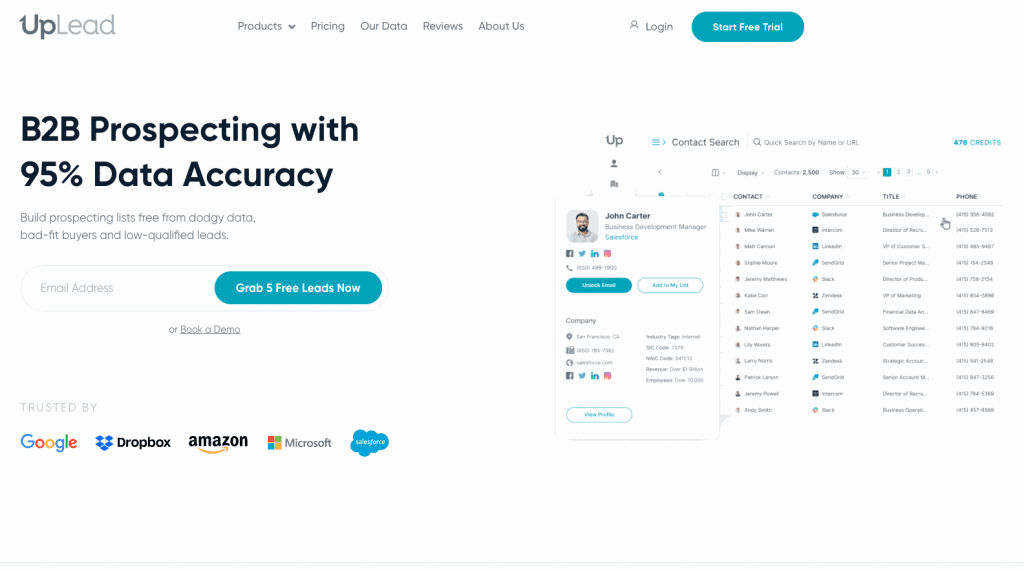
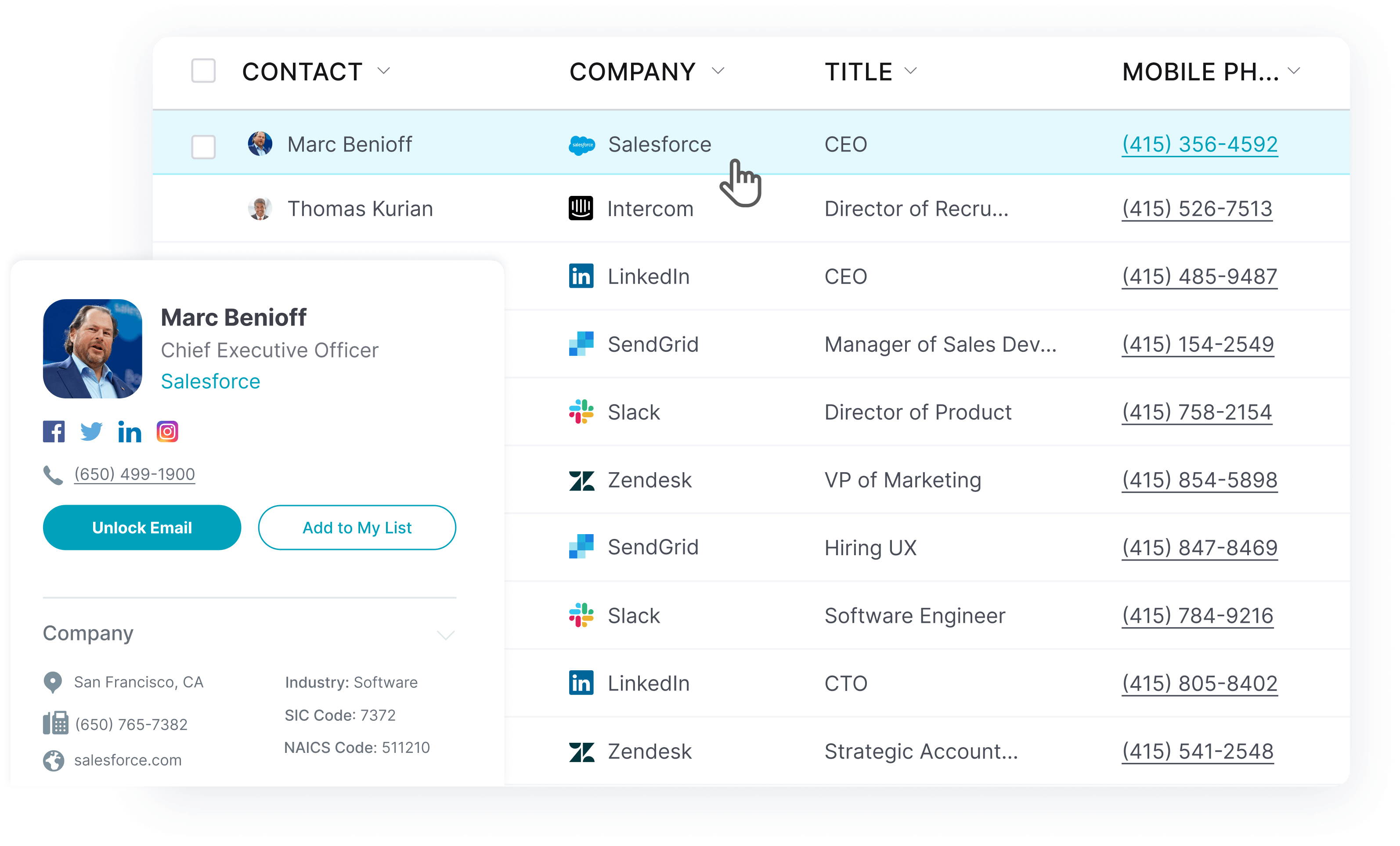
UpLead is a B2B data and lead generation platform providing verified contact and company information with a 95%+ accuracy guarantee. Founded in 2017, it serves customers globally, including in the US market, positioning itself as a direct and more affordable competitor to ZoomInfo.
UpLead focuses on data quality with real time email verification. Key features include a database of 200M+ leads and 50+ search filters. Technographics, buyer intent data, a Chrome extension, and CRM integrations with Salesforce or HubSpot round out the platform. Unlike many list building software providers, UpLead backs its data with a 95%+ accuracy guarantee and verifies emails in real time right before you download them.
Try UpLead today and see if it’s a good fit for you.

ZeroBounce
ZeroBounce was founded in 2015 and is headquartered in Santa Barbara, Florida. It’s a market leader in email verification and deliverability. The platform serves over 500,000 clients globally with 99.6% accuracy in identifying invalid or spam-trap email addresses, along with other risky ones. Pricing runs from pay-as-you-go credits starting at $39 for 2,000 credits to a $99/month subscription for 10,000 credits, with a free plan providing 100 credits per month.
Hunter
Hunter is an all-in-one email outreach platform founded in 2015. More than 7 million people use it globally, including major US companies such as Google, IBM or Microsoft. Hunter provides an Email Finder and Email Verifier, a Domain Search tool, plus cold email campaigns. The Email Verifier performs multi-step verification and provides confidence scores, with Hunter’s own documentation treating a score of 90-95% or higher as a high, though not guaranteed, chance of deliverability.
ZoomInfo
ZoomInfo Technologies Inc. is a publicly traded company (NASDAQ: ZI) headquartered in Vancouver, Washington. It provides a go-to-market intelligence platform for sales and marketing teams, along with recruiting teams, reporting full-year 2025 revenue of $1,249.5 million. ZoomInfo states it employs a multi-faceted data verification process combining AI-powered web crawling and third-party partnerships, backed by a team it describes as more than 300 human researchers. That’s a vendor claim, though, and its contact-database size varies across the company’s own marketing pages, so it isn’t independently audited.
NeverBounce
NeverBounce is an email verification solution that ZoomInfo Technologies acquired in 2018. The company offers real time email verification and list cleaning services designed to help businesses improve deliverability and reduce bounce rates, backed by a guarantee that bounce rates will stay under 3% on a cleaned list, conditions apply. NeverBounce checks emails against a reference database reported at around 6 billion email addresses, using methods like mail server validation and domain health checks.
Lusha
Lusha is a B2B sales intelligence platform founded in 2016 with its main US headquarters in Boston, MA. The service provides access to contact and company data through a web extension, a prospecting platform or an API, with a database containing over 280 million verified contacts. Lusha states it’s compliant with both GDPR and CCPA, with compliance validated by third-party auditors.
Saleshandy
Saleshandy is a cold email outreach platform founded in 2015 that includes a B2B lead finder with over 852 million contacts across 42 million companies. The platform offers email automation, a deliverability suite and a unified inbox, with integrations to major CRMs like HubSpot, Pipedrive or Zoho. Saleshandy uses multiple email verification services to categorize each address as ‘Valid’, ‘Risky’, or ‘Invalid’.
What Are the Best Practices for Maintaining a Verified B2B Lead Database?
Maintaining a high quality lead database is an ongoing process, not a one-time fix. Here are three best practices to keep your verified B2B leads accurate and valuable:
1. Establish a Data Governance Policy: Create a formal framework of rules and roles, plus the processes for managing data assets. This includes defining who can access and modify data, setting data quality standards, then creating accountability for accurate data across your organization.
2. Standardize Data Entry and Formats: Create consistent formats for all data fields. That covers phone numbers and addresses, as well as job titles and company names. Doing this prevents duplicate entries and makes data easier to search and analyze.
3. Conduct Regular Data Audits and Cleansing: CRM data can decay by over 30% annually, so schedule quarterly audits to find and remove outdated, duplicate, or incorrect information. Use automated tools to flag potential issues and prioritize manual review of high-value accounts.
Put these practices in place and your sales and marketing teams benefit from stronger client relationships built on accurate data. That helps your sales team focus on qualified prospects with real interest, which leads to better ROI and insights your team can act on.
What Is the Future of B2B Lead Verification: AI and Predictive Analytics?
AI is reshaping lead verification through several functions that change how companies identify and qualify prospects:
Predictive Lead Scoring: AI uses machine learning models to analyze large amounts of historical and real time data, spotting patterns that correlate with conversion and assigning dynamic scores that predict a lead’s likelihood to buy. These models keep learning and improving over time.
Automated Qualification and Verification: AI-powered chatbots and voice agents engage leads around the clock using Natural Language Processing (NLP) to understand user intent and ask qualifying questions. They verify contact details in real time, gathering qualification data as they go.
Real Time Data Enrichment: AI tools automatically enrich profiles by appending missing data points from public and private sources, keeping your lead database current without manual work.
Behavioral Analysis and Intent Signals: AI continuously tracks a lead’s digital footprint, analyzing signals to spot buying intent in real time. Some platforms analyze over 100,000 data sources daily to detect these signals, giving sales teams a clearer read on which prospects have shown real interest.
Frequently Asked Questions and Answers On Verified B2B Leads
Here are the answers to common questions on verified B2B leads:
<!– wp:yoast/faq-block {"questions":[{"id":"faq-question-1688003564028","question":[{"type":"strong","props":{"children":["What is a verified B2B lead?"]}}],"answer":["A verified B2B lead is a business contact that's already been validated and scored, so your sales team can contact it right away without worrying about a bounced email or an invalid phone number."],"jsonQuestion":"What is a verified B2B lead?“,”jsonAnswer”:”A verified B2B lead is a business contact that’s already been validated and scored, so your sales team can contact it right away without worrying about a bounced email or an invalid phone number.”},{“id”:”faq-question-1688003570003″,”question”:[{“type”:”strong”,”props”:{“children”:[“How do you get verified B2B leads?”]}}],”answer”:[“You can get verified B2B leads through referrals from your network and current customers, or by building a list and running it through lead verification yourself. Lead generation companies that only sell pre-verified leads are a third option. Some lead generation companies even let you “,{“type”:”a”,”props”:{“href”:”https://www.uplead.com/free-leads/”,”children”:[“generate leads for free”]}},” to test their platform.”],”jsonQuestion”:”How do you get verified B2B leads?“,”jsonAnswer”:”You can get verified B2B leads through referrals from your network and current customers, or by building a list and running it through lead verification yourself. Lead generation companies that only sell pre-verified leads are a third option. Some lead generation companies even let you generate leads for free to test their platform.”},{“id”:”faq-question-1728384001001″,”question”:[{“type”:”strong”,”props”:{“children”:[“What is the difference between verified sales leads and verified email leads?”]}}],”answer”:[“Verified sales leads describes a full business contact that’s passed verification and fits your target profile, while verified email leads refers more narrowly to an email address that’s passed a deliverability check. Most providers verify both together, but the terms point at different parts of the same process: the sales lead is about fit, and the email lead is about reachability.”],”jsonQuestion”:”What is the difference between verified sales leads and verified email leads?“,”jsonAnswer”:”Verified sales leads describes a full business contact that’s passed verification and fits your target profile, while verified email leads refers more narrowly to an email address that’s passed a deliverability check. Most providers verify both together, but the terms point at different parts of the same process: the sales lead is about fit, and the email lead is about reachability.”},{“id”:”faq-question-1728384001002″,”question”:[{“type”:”strong”,”props”:{“children”:[“How much do verified B2B leads cost?”]}}],”answer”:[“Pricing depends on the provider and how deep the verification goes. Pay-per-contact platforms like UpLead and Lusha start around $70 to $100 a month for a few hundred verified contacts, enterprise databases like ZoomInfo are quote-only and can run into five figures a year, and pure email-verification tools such as ZeroBounce charge per credit, often starting under $40 for a few thousand checks.”],”jsonQuestion”:”How much do verified B2B leads cost?“,”jsonAnswer”:”Pricing depends on the provider and how deep the verification goes. Pay-per-contact platforms like UpLead and Lusha start around $70 to $100 a month for a few hundred verified contacts, enterprise databases like ZoomInfo are quote-only and can run into five figures a year, and pure email-verification tools such as ZeroBounce charge per credit, often starting under $40 for a few thousand checks.”},{“id”:”faq-question-1728384001003″,”question”:[{“type”:”strong”,”props”:{“children”:[“Can you verify leads yourself instead of buying a list?”]}}],”answer”:[“Yes, you can verify leads yourself with a real-time verification API on your own forms or a dedicated email and phone verification tool, instead of relying only on a pre-verified list. Many teams combine both: they buy a verified B2B leads list for net-new prospecting and run their own verification on inbound form fills.”],”jsonQuestion”:”Can you verify leads yourself instead of buying a list?“,”jsonAnswer”:”Yes, you can verify leads yourself with a real-time verification API on your own forms or a dedicated email and phone verification tool, instead of relying only on a pre-verified list. Many teams combine both: they buy a verified B2B leads list for net-new prospecting and run their own verification on inbound form fills.”},{“id”:”faq-question-1728384001004″,”question”:[{“type”:”strong”,”props”:{“children”:[“Is it legal to buy verified B2B leads?”]}}],”answer”:[“Buying verified B2B leads is legal in most markets when the provider sources public or properly consented business contact data, but the exact rules depend on your country and industry, plus how you plan to contact people. Check your provider’s data sources and compliance claims, and confirm your own outreach follows regulations like GDPR or CAN-SPAM before you buy.”],”jsonQuestion”:”Is it legal to buy verified B2B leads?“,”jsonAnswer”:”Buying verified B2B leads is legal in most markets when the provider sources public or properly consented business contact data, but the exact rules depend on your country and industry, plus how you plan to contact people. Check your provider’s data sources and compliance claims, and confirm your own outreach follows regulations like GDPR or CAN-SPAM before you buy.”}]} –>A verified B2B lead is a business contact that’s already been validated and scored, so your sales team can contact it right away without worrying about a bounced email or an invalid phone number.
You can get verified B2B leads through referrals from your network and current customers, or by building a list and running it through lead verification yourself. Lead generation companies that only sell pre-verified leads are a third option. Some lead generation companies even let you generate leads for free to test their platform.
Verified sales leads describes a full business contact that’s passed verification and fits your target profile, while verified email leads refers more narrowly to an email address that’s passed a deliverability check. Most providers verify both together, but the terms point at different parts of the same process: the sales lead is about fit, and the email lead is about reachability.
Pricing depends on the provider and how deep the verification goes. Pay-per-contact platforms like UpLead and Lusha start around $70 to $100 a month for a few hundred verified contacts, enterprise databases like ZoomInfo are quote-only and can run into five figures a year, and pure email-verification tools such as ZeroBounce charge per credit, often starting under $40 for a few thousand checks.
Yes, you can verify leads yourself with a real-time verification API on your own forms or a dedicated email and phone verification tool, instead of relying only on a pre-verified list. Many teams combine both: they buy a verified B2B leads list for net-new prospecting and run their own verification on inbound form fills.
Buying verified B2B leads is legal in most markets when the provider sources public or properly consented business contact data, but the exact rules depend on your country and industry, plus how you plan to contact people. Check your provider’s data sources and compliance claims, and confirm your own outreach follows regulations like GDPR or CAN-SPAM before you buy.
Final Thoughts
Verified B2B leads make your sales efforts faster and more accurate. Wasted time and resources drop away. They give your sales team, and later your support team, the information needed to build trust with potential customers.
Pick whichever approach from this guide fits your team’s size and budget, then stick with it long enough to see the pipeline build. Done consistently, that work turns into a predictable flow of high quality B2B prospects ready to convert, with your team focused on the right companies and decision makers who have shown genuine interest in your business.
If you want to generate lead lists and verify email addresses from existing lists, try UpLead for free today.