

Most B2B teams spend hours chasing leads only to hit a snag with outdated or missing details.
This is what data enrichment tools solve by providing verified, real-time data and insights, allowing teams to focus on closing sales instead of cleaning data.
If you’re ready to improve the quality and accuracy of your leads’ data, here are the 21 best B2B data enrichment tools on the market right now.
What Are Data Enrichment Tools?
Data enrichment tools update existing contact and account records with missing details such as job titles, firmographics, technographics and intent signals. They pull verified data from external sources so your CRM stays accurate and your sales and marketing teams can focus on the right leads.
These platforms add or update information to existing contacts and company records. They make sure that you don’t miss out on important details like job titles, firmographic data, email addresses, phone numbers and technographic insights.
Data enrichment enables B2B companies to create more accurate customer profiles, personalize outreach and minimize wasted effort on incomplete or outdated records. The result is improved quantity and quality of your business databases, leading to better decisions throughout sales cycles and customer interactions.
These platforms also provide data cleansing—refining inaccuracies and inconsistencies in data—to standardize existing information and enhance data visualization and reporting.
What Are the Best Data Enrichment Tools?
The best data enrichment tools are UpLead for high-accuracy B2B contact data with real-time verification, ZoomInfo for enterprise sales intelligence, Apollo.io for all-in-one enrichment and outreach, Cognism for phone-verified mobile numbers, Lead411 for intent-driven direct dials, Breeze Intelligence for HubSpot-native enrichment, Clay for waterfall enrichment across multiple sources and Lusha for LinkedIn-based prospecting.
The best lead enrichment tools are UpLead, ZoomInfo, Apollo.io, Cognism, Lead411, Snov.io, Breeze Intelligence (formerly Clearbit), Clay, Lusha, Datanyze, 6sense, Seamless.AI, Hunter.io, RocketReach, Adapt.io, Kaspr, FullContact, Crunchbase, Demandbase, Seamless.ai and Leadspace.
| Tool | Best for | Pricing |
|---|---|---|
| UpLead | High-accuracy B2B data with real-time email verification (95%+ accuracy) | From $74/month (billed annually) |
| ZoomInfo | Enterprise sales intelligence platform | From $14,995/year |
| Apollo.io | All-in-one prospecting and outreach | From $49/month |
| Cognism | Phone-verified mobile numbers | Custom pricing |
| Lead411 | Accurate contact data re-verified every 90 days | From $75/month |
| Snov.io | Email automation and cold outreach campaigns | From $39/month |
| Breeze Intelligence | HubSpot-native data enrichment | From $45/month |
| Clay | Waterfall enrichment from multiple sources | From $149/month |
| Lusha | LinkedIn-based prospecting | From $29.90/user/month |
| Datanyze | Technographic data and company insights | From $29/month |
| 6sense | AI-powered account intelligence and intent data | Custom pricing |
| Seamless.AI | Real-time B2B contact discovery | From $147/month |
| Hunter.io | Email finding and verification | From $49/month |
| RocketReach | Large contact database with phone numbers | From $69/month |
| Adapt.io | Cost-effective prospecting for SMBs | From $49/month |
| Kaspr | LinkedIn Chrome extension with generous free plan | From $45/month |
| FullContact | Identity resolution API for developers | From $99/month |
| Crunchbase | Company funding and investor data | From $29/month |
| Demandbase | Enterprise ABM and account intelligence | From $65,000/year |
| Seamless.ai | AI-powered real-time search engine | From $147/month |
| Leadspace | Enterprise B2B data unification | From $25,000/year |
1. UpLead
Best for: B2B teams needing 95% accurate, verified contact data with real-time email verification and comprehensive firmographic insights.
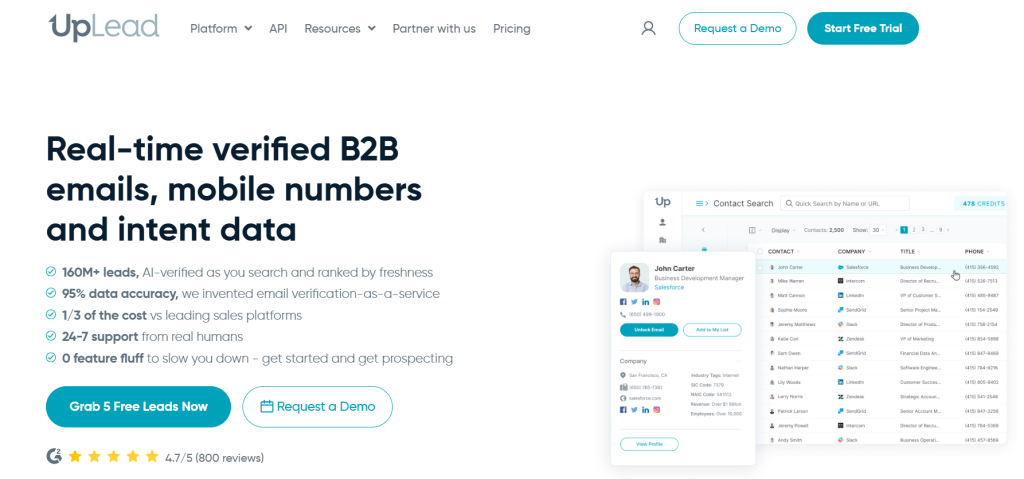
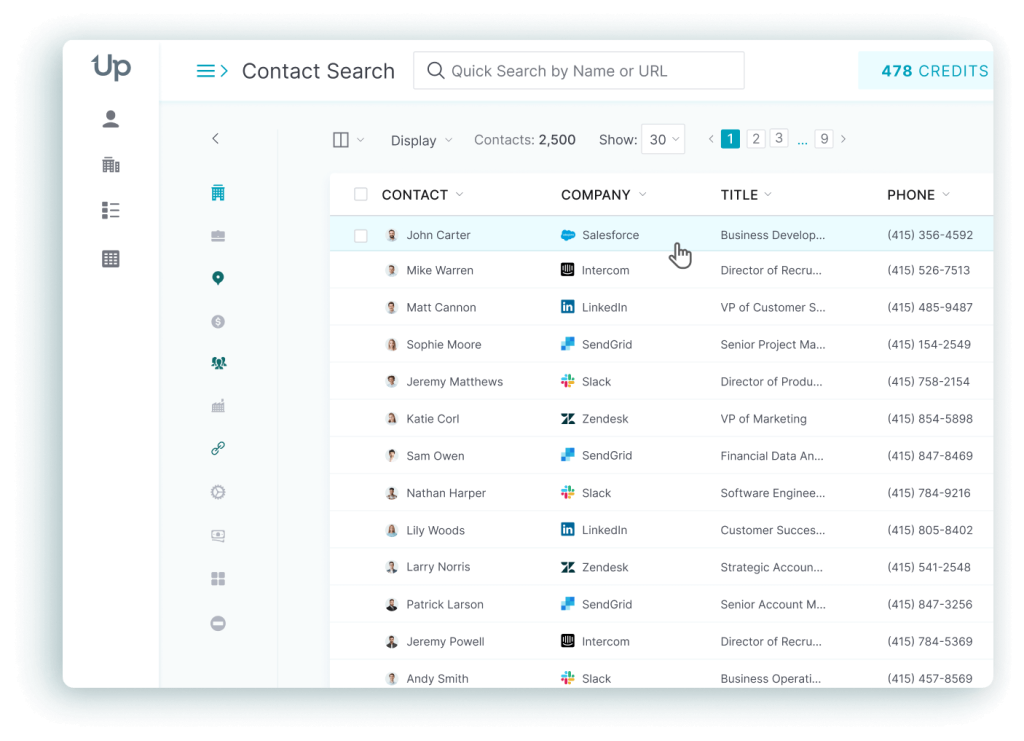
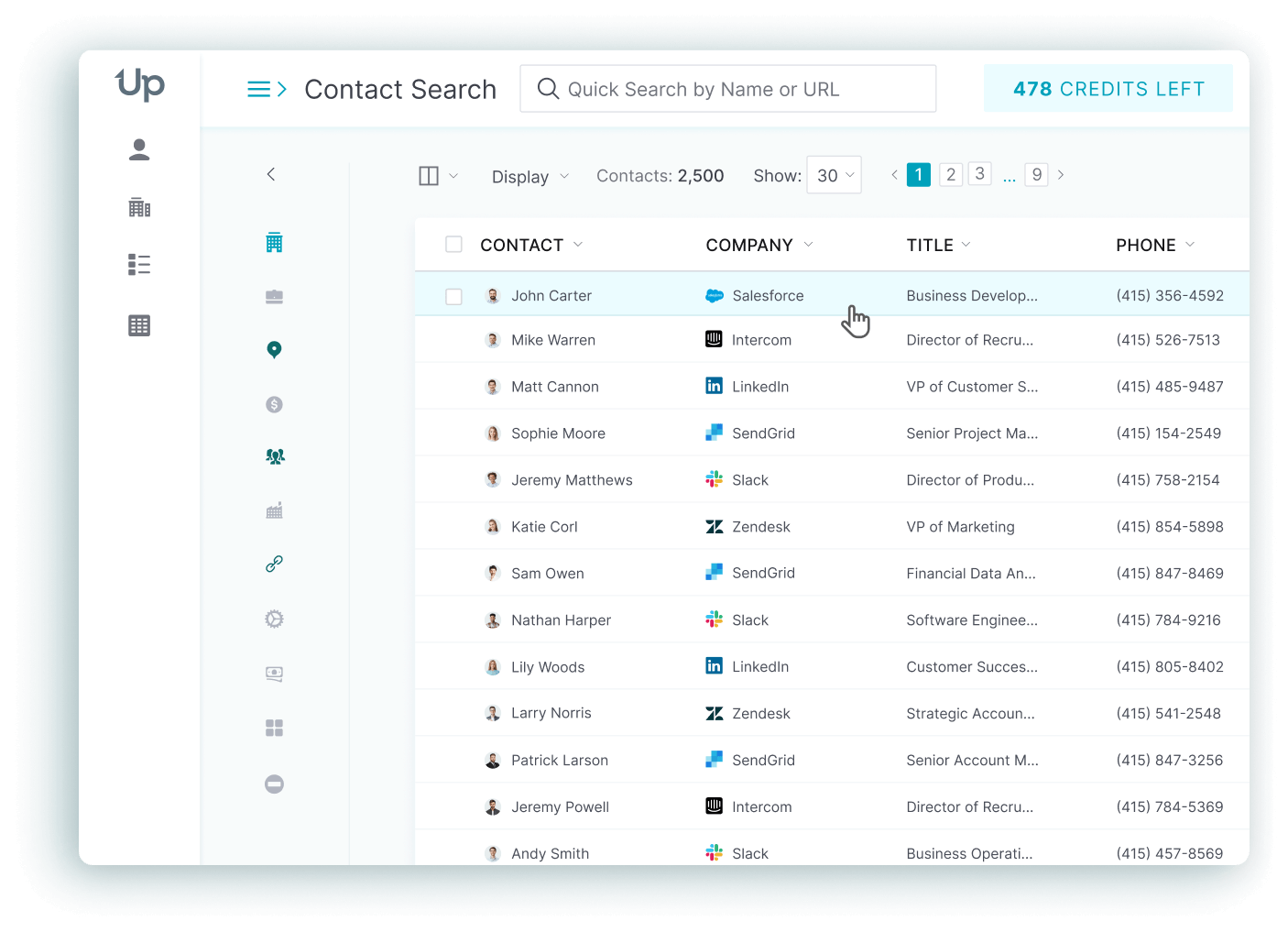
UpLead is a B2B data enrichment tool that provides verified emails, mobile numbers and company data for sales professionals. With a focus on quality, simplicity and value, UpLead allows teams to launch faster outreach campaigns without outdated databases. Every email is verified before download, and the UI is streamlined—with no feature bloat—to maximize efficiency.
Key Features:
- Prospector Tool – Get 95% data accuracy and search up to 160 million contacts with real-time prospecting.
- Data Enrichment – Fix outdated, missing or incorrect information with an accurate B2B data enrichment platform.
- Enrichment API – Automate enrichment workflows by connecting with your internal systems.
- Intent Data – Identify B2B companies searching for solutions like yours, so you can reach out at the right time.
- Email Finder – Research and discover verified B2B email addresses using a variety of filters.
- Email Verifier – Check email addresses in real-time before downloading them, reducing bounce rates and improving email deliverability.
Pricing: From $74/month (Essentials plan, billed annually), Plus plan at $149/month (billed annually), Professional and Enterprise plans with custom pricing.
Pros:
- 95% data accuracy guarantee backed by credit refunds
- Real-time email verification reduces bounce rates
- Clean, intuitive interface without feature bloat
- Competitive pricing at 1/3 the cost of enterprise alternatives
- 24/7 support from real humans
Cons:
- Smaller database compared to ZoomInfo or Apollo
- Limited social media data compared to specialized tools
Integrations: Salesforce, HubSpot, Pipedrive, Marketo, Outreach and 1000+ apps via Zapier. Robust API for custom integrations.
Why I picked UpLead: UpLead stands out with its 95% accuracy guarantee and real-time email verification, ensuring you never waste credits on bad data. The platform’s focus on simplicity and efficiency makes it easy to use, while its competitive pricing delivers value. For teams prioritizing data quality over database size, UpLead is the clear winner.
2. ZoomInfo
Best for: Large enterprises needing comprehensive sales intelligence with advanced technographic data and website visitor identification.
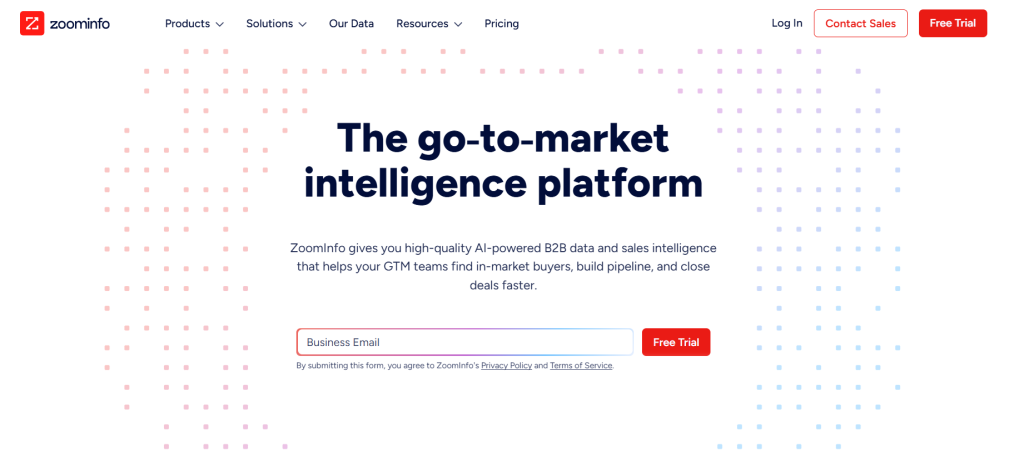
ZoomInfo gives sales and marketing teams a leg up by filling customer records with verified technographic data, job titles, direct dials and more. It integrates with major CRM and marketing platforms, allowing teams to update customer data profiles instantly.
Key Features:
- Data Management – Ingest high-quality, enriched customer data into your internal systems.
- Advanced Segmentation – Filter B2B emails by job function, industry, company size and more.
- Data Enrichment – Fill gaps in CRM by updating customer records with accurate, real-time contact data.
- Website Visitor Tracking – Identify individual visitors on your website at the right time to improve outreach efforts.
Pricing: From $14,995/year.
Pros:
- Massive database with comprehensive company profiles
- Advanced technographic and intent data capabilities
- Strong enterprise-grade integrations and API
- Website visitor identification features
Cons:
- Expensive pricing makes it unsuitable for small businesses
- Complex interface with steep learning curve
- Data accuracy can vary, especially for smaller companies
Integrations: Salesforce, HubSpot, Marketo, Pardot, Microsoft Dynamics, Outreach, Salesloft and 300+ other platforms.
Why I picked ZoomInfo: ZoomInfo excels as an enterprise-grade solution with unmatched database breadth and advanced features like website visitor tracking. While expensive, its comprehensive data coverage and filtering make it ideal for large organizations with complex prospecting needs and substantial budgets.
3. Apollo.io
Best for: Sales teams wanting an all-in-one platform combining prospecting, enrichment and email outreach automation.
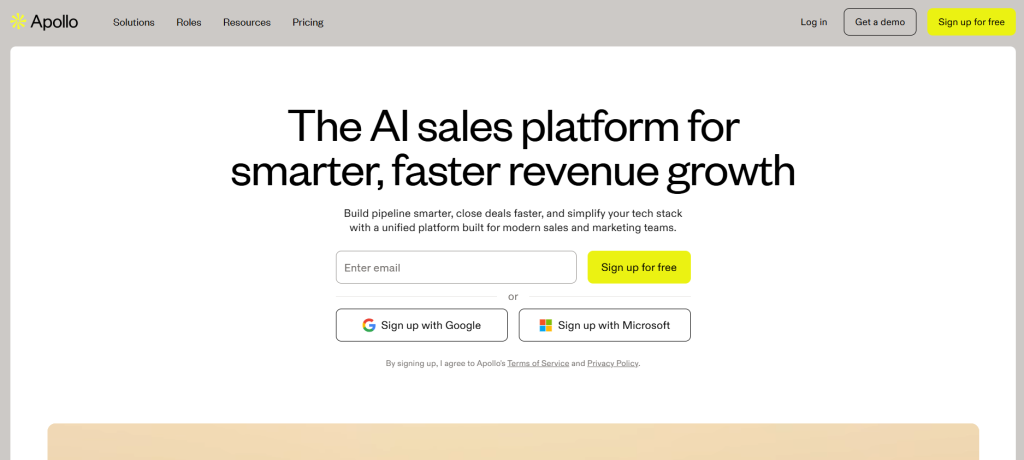
Apollo.io offers data enrichment, prospecting and sales engagement in one place. It helps teams find potential leads with key firmographic details and then reach out through automated email sequences. Apollo.io offers verified B2B emails and direct dials to connect with the right decision-makers.
Key Features:
- Prospect and Outreach – Search through multiple B2B contacts, then reach out from Apollo.
- Data Enrichment – Auto-fill missing fields in your CRM with accurate and up-to-date data.
- Email Tracking – Track opens, clicks and replies in real time to optimize follow-ups.
- API – Enrich contacts and sync data through Apollo’s API, which integrates with any system.
Pricing: From $49/month.
Pros:
- All-in-one platform combining prospecting and outreach
- Generous free plan with useful features
- Large database with good coverage
- Strong email automation capabilities
Cons:
- Data accuracy can be inconsistent
- Interface can feel cluttered with many features
- Customer support response times vary
Integrations: Salesforce, HubSpot, Pipedrive, Outreach, Salesloft, Slack and 5000+ apps via Zapier.
Why I picked Apollo.io: Apollo.io provides value as an all-in-one solution, eliminating the need for separate prospecting and outreach tools. Its generous free plan and comprehensive feature set make it ideal for growing teams that want to streamline their sales process in one platform.
4. Cognism
Best for: Sales teams prioritizing phone outreach with phone-verified mobile numbers and strong compliance features.
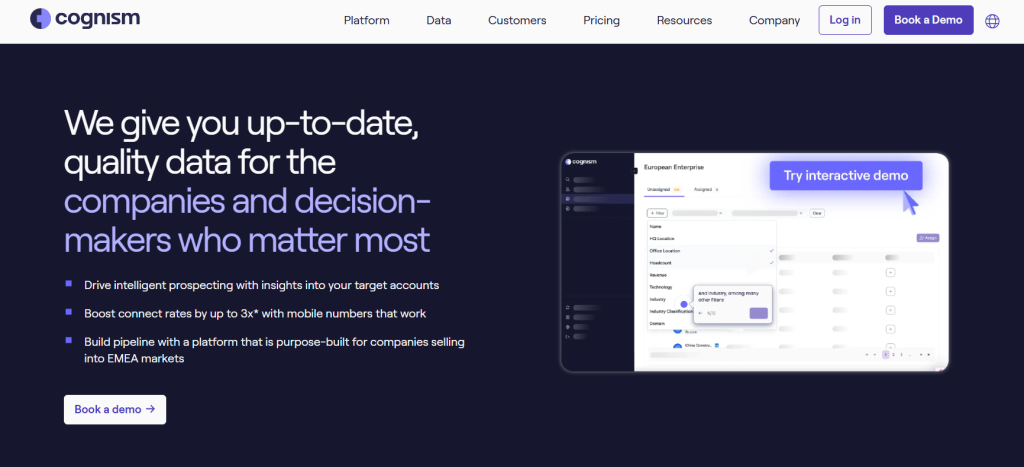
Cognism is a sales intelligence and data enrichment platform that helps sales teams find reliable B2B contacts. It offers data hygiene and enrichment tools to support better workflow and lead management. Cognism provides insights for your CRM, enabling effective prospecting and outreach campaigns.
Key Features:
- Enrichment API – Automate your enrichment process across CRMs and sales platforms.
- Signal Data – Identify accounts that signal a high interest in products like yours for better outreach timing.
- Customer Profiling – Create accurate customer profiles using high-quality data and sales intelligence.
- Email Tracking and Outreach – Engage ideal prospects with personalized email campaigns.
Pricing: Custom pricing.
Pros:
- Phone-verified mobile numbers with 87% connection rate
- Strong GDPR compliance and global Do-Not-Call list management
- High-quality intent data for better timing
- Data coverage in European markets
Cons:
- No transparent pricing available
- Can be expensive for smaller teams
- Limited coverage outside major markets
Integrations: Salesforce, HubSpot, Pipedrive, Outreach, Salesloft, Microsoft Dynamics and major sales engagement platforms.
Why I picked Cognism: Cognism’s Diamond Data® with phone-verified mobile numbers is unmatched for teams prioritizing phone outreach. Its strong compliance features and European market coverage make it ideal for global organizations needing reliable, regulation-compliant contact data.
5. Lead411
Best for: Sales teams needing accurate contact data with regular verification and real-time buyer intent signals.
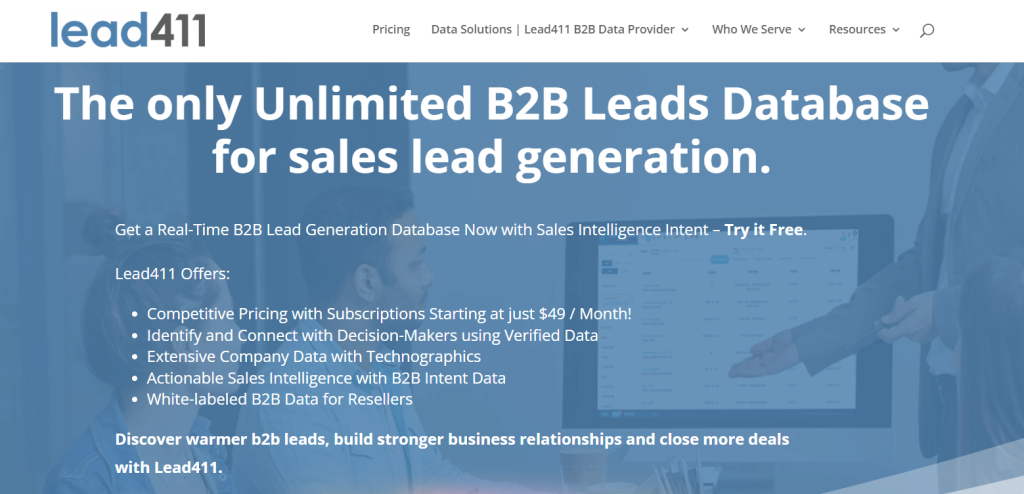
Lead411 is known for accurate contact data, re-verified every 90 days. It combines real-time buyer intent signals, reliable email verification and sales engagement features—perfect for B2B growth teams needing trustworthy, timely insights to drive outreach campaigns.
Key Features:
- Lead Prospecting – Get targeted prospect lists using a comprehensive B2B contact database.
- Data Verification – Get reliable email and phone information, as all contact data is re-verified.
- Lead Scoring – Rank prospects based on intent signals and engagement data to prioritize high-converting leads.
- AI-Powered Data Enrichment – Auto-fill your CRM records with firmographic and technographic data.
Pricing: From $75/month.
Pros:
- Contact data re-verified every 90 days for high accuracy
- Strong buyer intent data capabilities
- Good lead scoring and prioritization features
- Reliable customer support
Cons:
- Smaller database compared to major competitors
- Limited international coverage
- Higher pricing for advanced features
Integrations: Salesforce, HubSpot, Pipedrive, Marketo, Pardot and popular CRM platforms.
Why I picked Lead411: Lead411’s commitment to re-verifying all contact data every 90 days ensures accuracy that many competitors can’t match. Combined with strong buyer intent signals, it’s perfect for teams that prioritize data quality and want to focus their efforts on the most promising prospects.
6. Snov.io
Best for: Small B2B teams looking for affordable email automation and basic data enrichment with strong email verification.
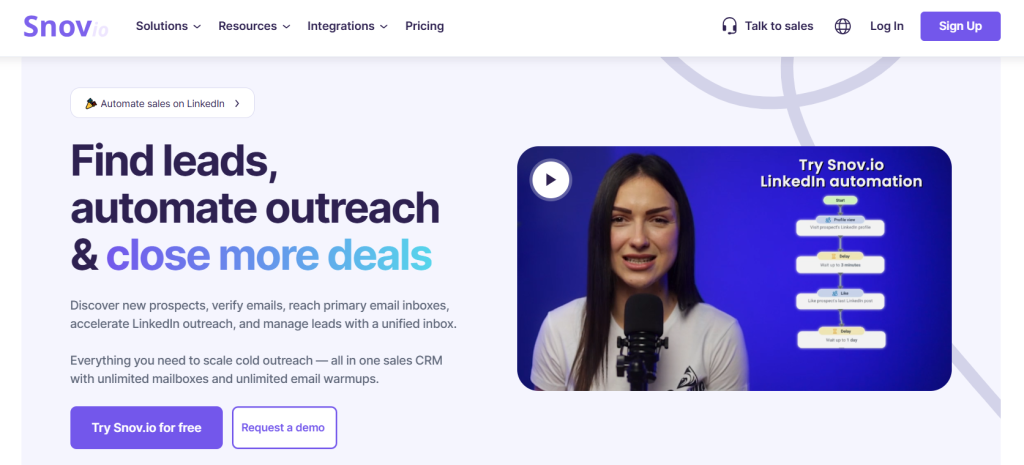
Snov.io is a sales automation platform that combines lead generation, email outreach and basic data enrichment features. It’s best suited for small B2B teams looking to run cold email campaigns with verified emails and simple CRM integrations. However, it lacks strong data enrichment capabilities for large-scale companies.
Key Features:
- Email Verifier – Get reliable email addresses with high deliverability.
- Multichannel Outreach – Create automated, multi-step email sequences to engage potential leads.
- Lead Scoring – Identify promising leads based on behavior and engagement.
- Lead Prospecting – Search and filter a large B2B contact database to build targeted lists.
Pricing: From $39/month.
Pros:
- Strong email verification and deliverability
- Good automation features for cold email campaigns
- Affordable pricing for small teams
- User-friendly interface
Cons:
- Limited data enrichment capabilities
- Smaller database compared to dedicated enrichment tools
- Credit-based pricing can become expensive at scale
Integrations: Salesforce, HubSpot, Pipedrive, Zapier, Gmail, Outlook and popular email platforms.
Why I picked Snov.io: Snov.io excels as an affordable, all-in-one solution for small teams that need basic enrichment alongside strong email automation. While not as comprehensive as dedicated enrichment tools, its simplicity and cost-effectiveness make it ideal for startups and SMBs focused on email outreach.
7. Breeze Intelligence (formerly Clearbit)
Best for: HubSpot users wanting native data enrichment with integration and automated form enhancement.
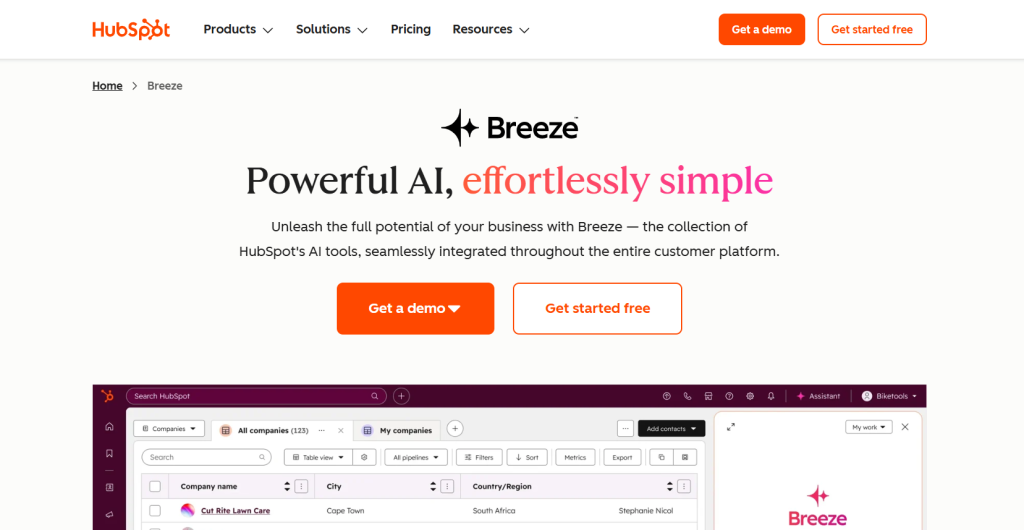
Breeze Intelligence (formerly Clearbit) enriches your customer records with firmographic details, company revenue and more to generate leads. Whether it’s a form submission or a website visit, Breeze Intelligence fills in missing information using its enrichment capabilities within the HubSpot ecosystem.
Key Features:
- Visitor Dashboard – Identify companies that match your ideal customer profile for focused outbound efforts.
- Form Shortening – Capture a wider breadth of users from shorter, more accessible form submissions.
- Native HubSpot Integration – Enrich HubSpot records with no additional setup required.
- Buyer Intent Signals – Get buyer info and intent signals from website metrics and engagement data.
Pricing: From $45/month.
Pros:
- Deep native integration with HubSpot ecosystem
- Automatic enrichment of form submissions and contacts
- Strong company data and firmographic insights
- No additional platform to learn or manage
Cons:
- Only available to HubSpot customers on paid plans
- Credit-based pricing can become expensive
- Limited to HubSpot ecosystem only
Integrations: Native HubSpot integration only (CRM, Marketing Hub, Sales Hub, Service Hub).
Why I picked Breeze Intelligence: For HubSpot users, Breeze Intelligence offers unmatched convenience with its native integration that enriches contacts and form submissions. While limited to the HubSpot ecosystem, its operation and powerful form shortening capabilities make it the obvious choice for HubSpot-centric organizations.
8. Clay
Best for: Advanced users wanting waterfall enrichment from multiple data sources with custom automation workflows.
Clay is built for B2B sales reps who want to automate lead workflows and combine data from multiple sources. It supports lead scoring and CRM updates. While Clay is a valuable tool, it requires some technical expertise to set up for full utilization.
Key Features:
- Lead Scoring – Rank promising leads using custom rules to prioritize high-fit accounts.
- TAM Sourcing – Define and build your total addressable market using filters.
- Waterfall Enrichment – Get data from multiple sources in a sequence for accurate customer profile records.
- Data Integrations – Pull quality-enriched data from LinkedIn, Apollo and more in real time.
Pricing: From $149/month.
Pros:
- Powerful waterfall enrichment from multiple sources
- Customizable workflows and automation
- Strong data accuracy through source redundancy
- Good for complex, multi-step enrichment processes
Cons:
- Steep learning curve requires technical expertise
- Can be expensive for high-volume usage
- Complex setup may overwhelm simple use cases
Integrations: Apollo, ZoomInfo, LinkedIn, Salesforce, HubSpot, Outreach and 50+ data providers and CRMs.
Why I picked Clay: Clay’s waterfall enrichment approach ensures maximum data coverage by querying multiple sources until complete profiles are built. While complex, this makes it powerful for advanced users who need the highest possible data completeness and are willing to invest time in setup.
9. Lusha
Best for: Sales professionals and recruiters focused on LinkedIn prospecting with real-time contact extraction.
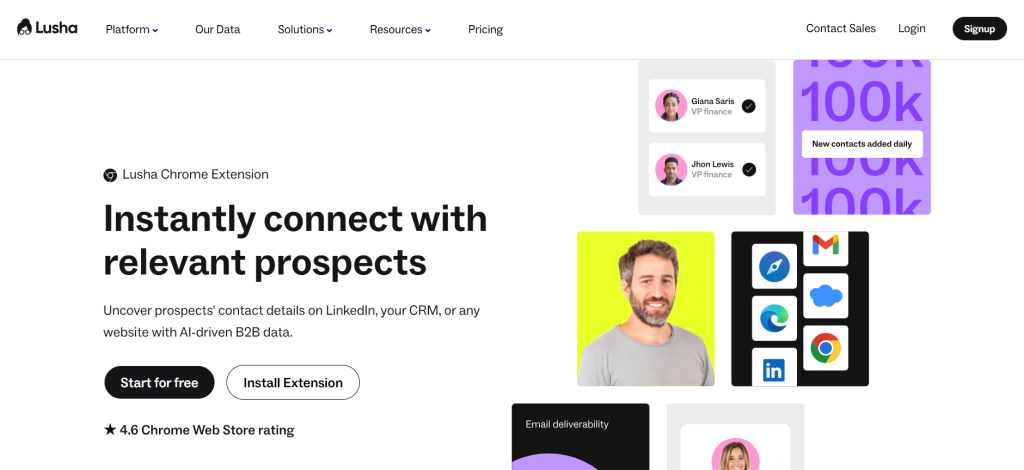
Lusha is a sales intelligence platform and company research tool that helps outbound teams find reliable B2B emails, phone numbers and company details. Lusha is available on the web and as a Chrome extension, allowing users to enrich contacts from LinkedIn, company websites or CRMs.
Key Features:
- Prospecting Tool – Create targeted lead lists using a range of filters for fast outreach.
- Lusha API – Enrich CRM records and automate data workflows with B2B emails and direct dials.
- Lead Scoring and Filtering – Rank and filter leads to see only those that match your ideal customer profile.
- CRM Integration – Sync enriched data with tools like Salesforce and HubSpot.
Pricing: Free plan with up to 70 credits/month, Pro from $29.90/user/month (with lower equivalent pricing on annual plans), Premium from $69.90/user/month, Scale with custom pricing.
Pros:
- Chrome extension for LinkedIn prospecting
- Good data accuracy for European contacts
- Generous free plan for testing
- Strong GDPR compliance features
Cons:
- Credit limits can be restrictive for high-volume users
- Phone number data sometimes outdated
- Limited bulk enrichment capabilities
Integrations: Salesforce, HubSpot, Pipedrive, Outreach, Salesloft and popular CRM platforms via Zapier.
Why I picked Lusha: Lusha’s Chrome extension is efficient for LinkedIn-based prospecting, making it ideal for sales professionals whose workflows center on social selling. Its strong European data coverage and GDPR compliance make it valuable for global teams targeting European markets.
10. Datanyze
Best for: Sales teams needing detailed technographic data and company tech stack insights for targeted outreach.
Datanyze is a B2B data enrichment tool that provides quick insights on company tech stacks and contact details. It provides teams with instant access to verified contact and technographic data, facilitating smooth sales cycles. Datanyze is helpful for manual research and analyzing key information like B2B emails.
Key Features:
- Technographic Data – Identify the tools and technologies a company uses to refine its sales pitch.
- Instant Contact Info – Get verified B2B emails and phone numbers from company websites.
- Icebreakers – Access recent news, company updates and social insights to personalize outreach.
- Export to CSV – Save enriched contact data and upload it into your CRM or outreach platform.
Pricing: From $29/month.
Pros:
- Technographic data and tech stack insights
- Good for identifying technology adoption patterns
- Useful icebreaker information for personalization
- Affordable pricing for basic plans
Cons:
- Limited database size compared to major competitors
- Credit limits can be restrictive
- Less comprehensive than full-featured platforms
Integrations: Salesforce, HubSpot, Pipedrive and basic CRM integrations via CSV export.
Why I picked Datanyze: Datanyze excels at providing detailed technographic insights that help sales teams understand a prospect’s technology environment. This makes it valuable for B2B tech companies selling complementary or competitive solutions, enabling targeted and relevant outreach based on current tech stack usage.
11. 6sense
Best for: Enterprise organizations implementing comprehensive Account-Based Marketing with AI-powered account intelligence and intent data.
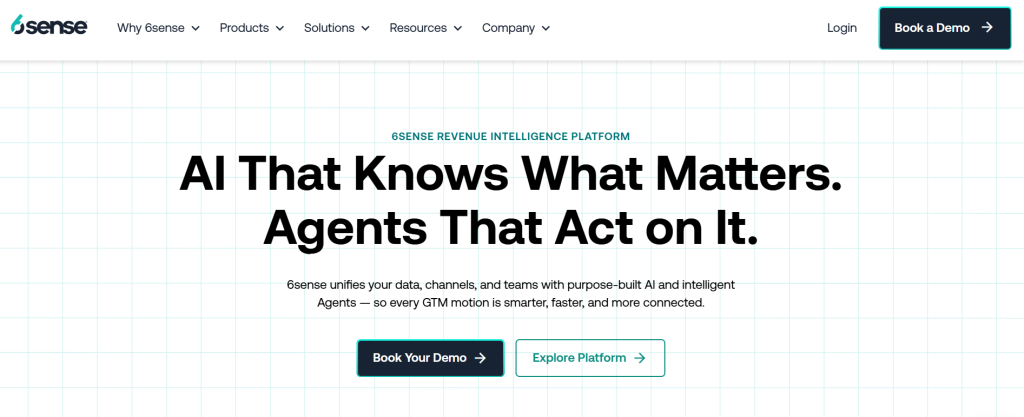
6sense is a B2B marketing intelligence platform that prioritizes and scores accounts to provide detailed insights into buying behavior. This tool utilizes AI and behavioral data to identify potential leads even before they contact your business. However, 6sense’s pricing and features may not suit smaller teams with limited budgets.
Key Features:
- Predictive Lead Scoring – Use AI to rank accounts based on sales potential and buying stage.
- Buyer Intent Data – See which accounts are researching solutions like yours.
- Smart Form Fill – Enrich partial form submissions with firmographic and contact data.
- Audience Builder – Create targeted prospect lists using filters and technographic data.
Pricing: Custom pricing.
Pros:
- Advanced AI-powered account intelligence and scoring
- High-quality intent data for precise targeting
- Comprehensive ABM platform capabilities
- Strong enterprise-grade integrations
Cons:
- Expensive, unsuitable for small businesses
- Complex platform with steep learning curve
- Intent data signal strength can vary
Integrations: Salesforce, HubSpot, Marketo, Eloqua, Microsoft Dynamics, major ad networks and ABM platforms.
Why I picked 6sense: 6sense provides unmatched AI-powered account intelligence that can identify buying intent before prospects even engage. While expensive, its predictive capabilities and comprehensive ABM features make it valuable for enterprise organizations with complex, high-value sales cycles who can justify the investment.
12. Seamless.AI
Best for: Sales teams needing real-time B2B contact discovery with AI-powered search and automated lead generation.
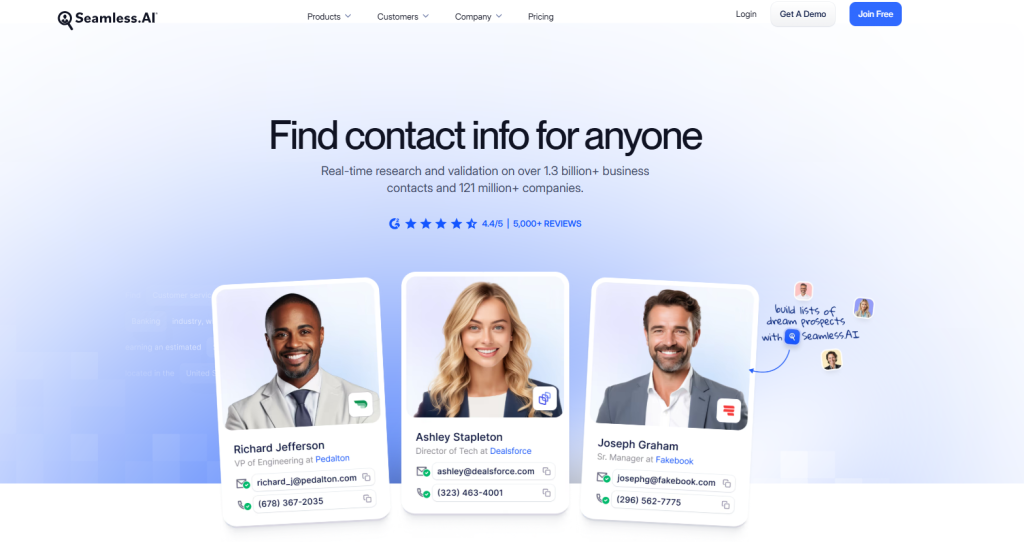
Seamless.AI offers real-time data discovery and enrichment. It helps teams build targeted prospect lists, find accurate emails and boost their email marketing efforts. Seamless.AI is best for outbound campaigns and reps who need up-to-date, high-quality data.
Key Features:
- AI-Based Enrichment – Enrich leads with firmographic and contact data.
- Autopilot – Automate lead generation by finding and enriching new contacts.
- Buyer Intent Data – Identify potential leads who are searching for your solutions.
- Integrations – Integrate with CRM and sales platforms to sync enriched data with your existing workflows.
Pricing: Free plan with a limited number of credits, Basic at $147/user/month (billed annually), Pro and Enterprise on custom pricing. Exact Pro and Enterprise costs are available only via quote.
Pros:
- Real-time data search provides up-to-date information
- User-friendly interface with easy adoption
- More affordable than enterprise competitors like ZoomInfo
- Extensive CRM integrations
Cons:
- Data accuracy can be inconsistent with 20-30% bounce rates reported
- Credit-based system can be confusing and lead to unexpected costs
- Customer support and billing practices criticized
Integrations: Salesforce, HubSpot, Microsoft Dynamics, Pipedrive, Outreach, Salesloft and 6000+ apps via Zapier.
Why I picked Seamless.AI: Seamless.AI’s real-time search engine approach provides fresh contact data that many competitors can’t match. While data accuracy can vary, its combination of user-friendly interface, competitive pricing and extensive integrations makes it a popular choice for teams wanting to scale their prospecting efforts.
13. Hunter.io
Best for: Sales and marketing teams focused on finding and verifying professional email addresses for cold outreach campaigns.
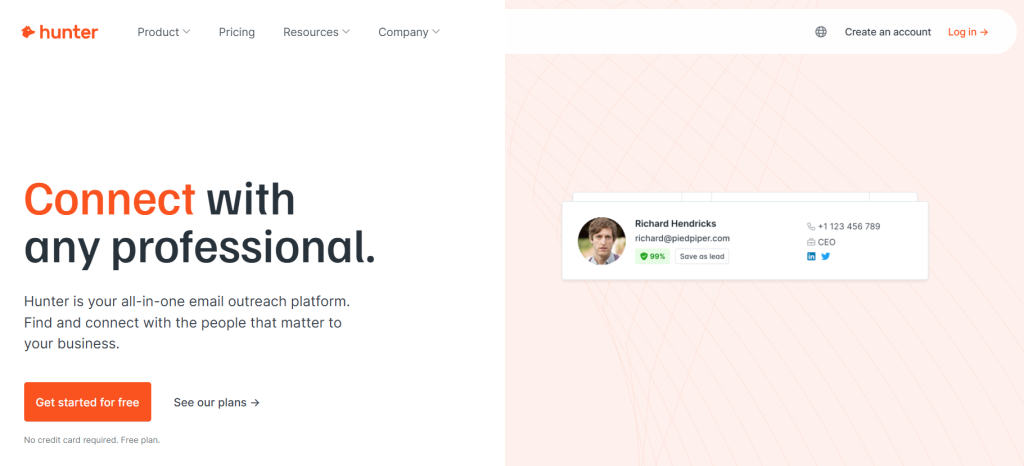
Hunter.io is an all-in-one cold email outreach platform that helps users find and verify professional email addresses, discover leads and send personalized email campaigns at scale. Its simplicity and speed make it efficient for sales and marketing teams building targeted outreach lists.
Key Features:
- Email Finder – Find professional emails using full name and company domain with high accuracy
- Domain Search – List available emails for specific domains with names and job titles
- Email Verifier – Check validity and deliverability with syntax, domain and server response checks
- Campaigns – Built-in cold email sequences with Gmail/Outlook integration and performance tracking
Pricing: Free plan ($0 – 25 searches & 50 verifications), Starter at $49/month or $34/month when billed annually, Growth at $149/month or $104/month when billed annually, Scale at $299/month or $209/month when billed annually. Annual billing offers around 30% discount.
Pros:
- High email finding and verification accuracy
- Simple and intuitive interface
- Fast performance for single and bulk searches
- Generous free plan for testing
Cons:
- Expensive compared to alternatives for higher volumes
- Lacks direct phone number lookups
- Database can prioritize executives over other roles
Integrations: Salesforce, HubSpot, Pipedrive, Zoho CRM, Gmail, Outlook, Google Sheets, Zapier.
Why I picked Hunter.io: Hunter.io excels at its core function of finding and verifying professional email addresses with accuracy. Its streamlined approach and inclusion of cold email campaign tools provide a complete workflow from prospecting to outreach, making it ideal for teams prioritizing email-focused outreach over comprehensive data enrichment.
14. RocketReach
Best for: Sales and recruiting professionals needing access to a large, diverse database with both email and phone number coverage.
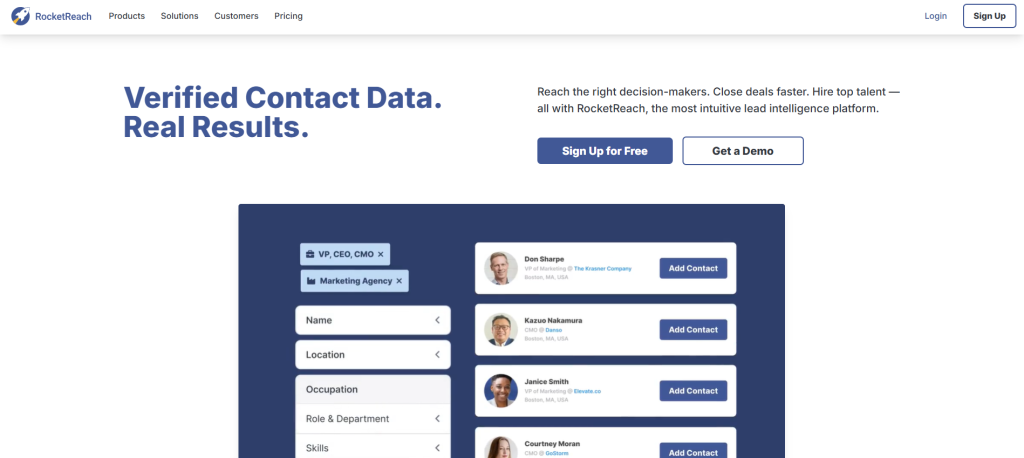
RocketReach is a sales intelligence platform with a contact database of over 700 million professionals across 60 million companies, allowing users to find verified emails, phone numbers and social profiles through advanced search filters, browser extension and API access.
Key Features:
- Extensive Database – 700+ million professional profiles across 60+ million companies worldwide
- Advanced Search – 100+ filters including job title, industry, location, company size, technographics, skills
- Email and Phone Lookup – Verified personal/professional emails, direct dial and mobile numbers
- Browser Extension – Chrome extension for LinkedIn profiles and company websites
Pricing: From $69/month.
Pros:
- Massive database of 700+ million contacts provides extensive reach
- Provides both emails and phone numbers
- More affordable than enterprise competitors like ZoomInfo
- Clean interface with helpful browser extension
Cons:
- Data accuracy can be inconsistent with outdated information
- Lookup credits on monthly plans can be restrictive
- Expensive for individuals needing phone numbers
Integrations: Salesforce, HubSpot, Outreach, Salesloft, Bullhorn, Zapier.
Why I picked RocketReach: RocketReach’s database size is among the largest available, making it powerful for casting a wide net during prospecting. Its ability to provide both email addresses and phone numbers on a single platform makes it versatile for multi-channel outreach, striking a balance between comprehensive data and affordability.
15. Adapt.io
Best for: B2B sales and marketing teams looking for a cost-effective, unified platform to build targeted prospect lists and enrich data.
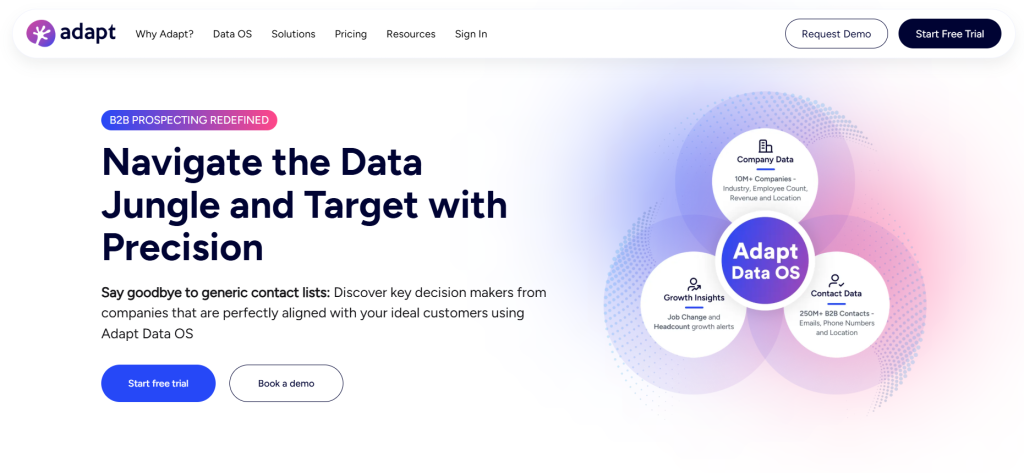
Adapt.io is a B2B sales intelligence platform providing access to a database of over 250 million business contacts, designed to help sales, marketing, and recruiting professionals find, connect with, and engage prospects through Lead Builder, Prospector Chrome extension, and data enrichment features.
Key Features:
- Lead Builder – Build targeted prospect lists using advanced filters like industry, firmographics, revenue, location
- Prospector Chrome Extension – Extract verified contact information from LinkedIn profiles and websites
- Data Enrichment – Enhance existing records with 50+ attributes and real-time updates
- CRM Integration – One-click integrations with popular CRMs to sync verified data
Pricing: From $49/month.
Pros:
- Large B2B contact database with 250+ million contacts
- User-friendly interface with smooth onboarding
- Integration with major CRMs
- Functional free plan for basic prospecting
Cons:
- Data accuracy can be inconsistent for smaller companies
- Credit limits restrictive for high-volume outreach
- Platform can sometimes be slow or cause browser lag
Integrations: Salesforce, HubSpot, Pipedrive, Zoho, Marketo, Outreach.
Why I picked Adapt.io: Adapt.io provides strong value for teams needing comprehensive B2B database access with robust filtering capabilities. Its unified platform combining lead builder with Chrome extension makes prospecting efficient, while competitive pricing and a functional free plan make it accessible for smaller teams testing data enrichment tools.
16. Kaspr
Best for: Sales professionals and recruiters who rely on LinkedIn for prospecting and need accurate contact data extraction.
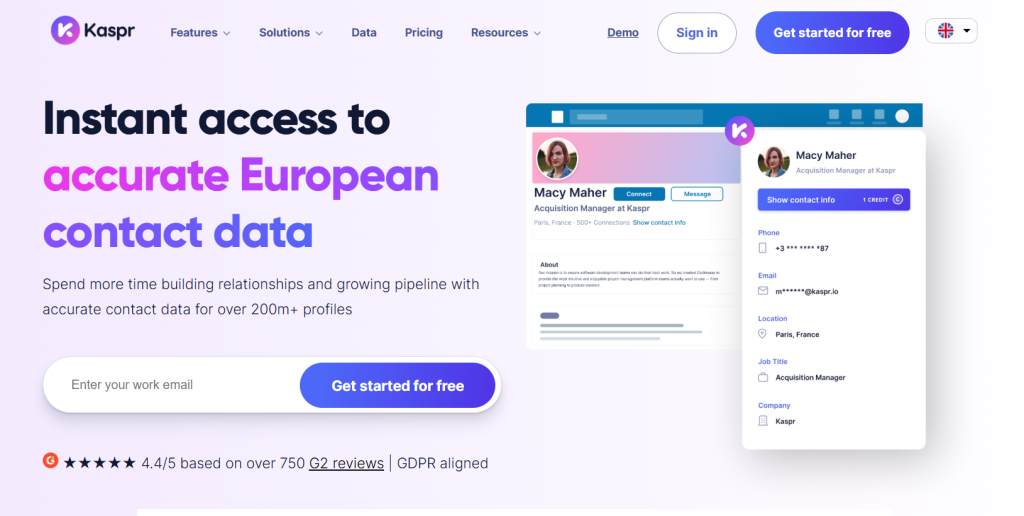
Kaspr is an all-in-one prospecting tool specializing in providing real-time, verified B2B contact information from LinkedIn profiles. It operates through a LinkedIn Chrome Extension supported by a web dashboard for lead management and automation, emphasizing GDPR and CCPA compliance.
Key Features:
- LinkedIn Chrome Extension – Instant contact detail retrieval from LinkedIn profiles, groups, events
- Real-Time Data Verification – Checks data against 150+ sources for high accuracy
- Lead Management Dashboard – Organize leads into lists, add notes, manage outreach
- Workflow Automation – Create automated sequences like LinkedIn connection requests
Pricing: From $45/month.
Pros:
- Chrome extension for LinkedIn prospecting
- Strong data accuracy for European contacts
- Generous free plan with unlimited B2B emails
- Simple setup with no extensive onboarding required
Cons:
- Phone number data can be outdated or unavailable
- Credit limits might be restrictive for high-volume users
- CRM integration capabilities rated lower than competitors
Integrations: Salesforce, HubSpot, Pipedrive, Zapier, Zoho CRM, Brevo, Lemlist, Ringover, Aircall.
Why I picked Kaspr: Kaspr is ideal for LinkedIn-centered workflows with its efficient Chrome extension for real-time contact extraction. The generous free plan offering unlimited B2B emails provides value for testing, while its focus on data accuracy and compliance makes it reliable for modern prospecting needs.
17. FullContact
Best for: Developers and marketers needing to unify fragmented customer data from multiple channels into enriched profiles in real-time.
FullContact is an API-focused identity resolution platform that recognizes anonymous website visitors, matches various identifiers to a persistent PersonID and appends over 900 personal and professional attributes to profiles. The platform is built around a real-time RESTful API for creating a 360-degree customer view.
Key Features:
- Identify – Recognizes anonymous website visitors for lead generation
- Resolve – Matches various identifiers to a persistent PersonID for unified customer view
- Enrich – Appends over 900 personal and professional attributes to profiles
- Real-time API – RESTful API architecture for instant data processing
Pricing: From $99/month.
Pros:
- Powerful identity resolution across multiple channels
- Enables real-time personalization and ad targeting
- Privacy-safe approach to data enrichment
- Comprehensive API for developers
Cons:
- Lack of transparent pricing is a major drawback
- Requires developer support for setup
- Some user reviews mention occasional data staleness
Integrations: Google Tag Manager, Segment, Tealium, Lytics, Front, Workato, EngageBay.
Why I picked FullContact: FullContact excels as an API-first identity resolution engine for businesses with developer resources. Its ability to resolve customer identities from disparate signals and enrich them with 900+ attributes makes it ideal for companies needing personalized marketing and analytics based on unified customer profiles.
18. Crunchbase
Best for: Sales teams, marketers and investors conducting market research or due diligence on companies, particularly startups and private firms.
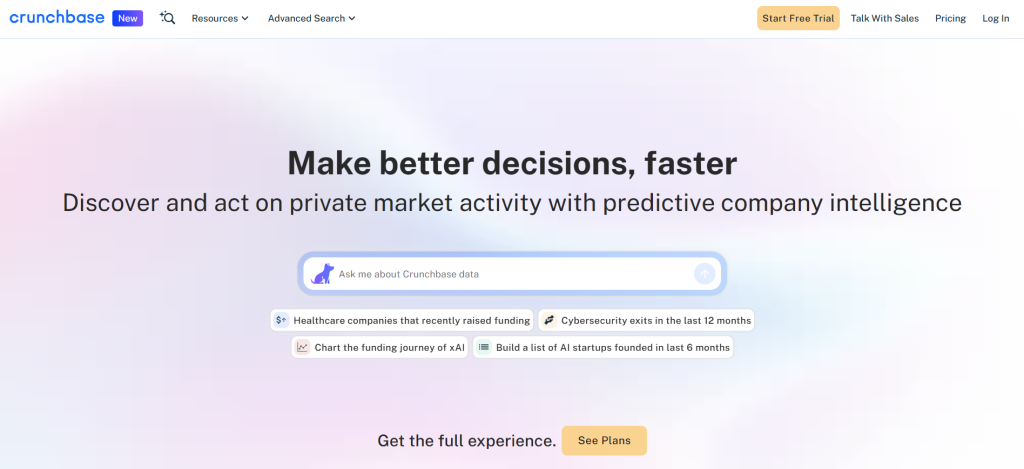
Crunchbase is a leading platform for firmographic data on private and public companies, providing access to a database of companies, investors and funding rounds with advanced search capabilities and data export functionality, particularly strong for startup ecosystem intelligence.
Key Features:
- Company Database – Database of companies, investors and funding rounds
- Advanced Search – Granular filters for company research and prospecting
- Contact Data – Decision-maker contact information for key companies
- API Access – Programmatic access for data enrichment and integration
Pricing: From $29/month.
Pros:
- Unparalleled source for private company funding and investor data
- Powerful search and filtering capabilities
- Essential for startup ecosystem research
- Strong integrations with major CRMs
Cons:
- Full data export restricted to expensive Enterprise tier
- Lower-tier export limits can be restrictive
- Focused mainly on company data rather than individual contacts
Integrations: Salesforce, HubSpot, Zapier, Outreach, Clay, Pipedrive.
Why I picked Crunchbase: Crunchbase is the definitive tool for firmographic data enrichment when deep company intelligence is needed. It’s essential for anyone prospecting within the startup ecosystem or needing comprehensive information about companies’ funding history, investors, leadership and growth trajectory.
19. Demandbase
Best for: Medium to large B2B organizations implementing comprehensive Account-Based Marketing strategies with tight sales and marketing alignment.
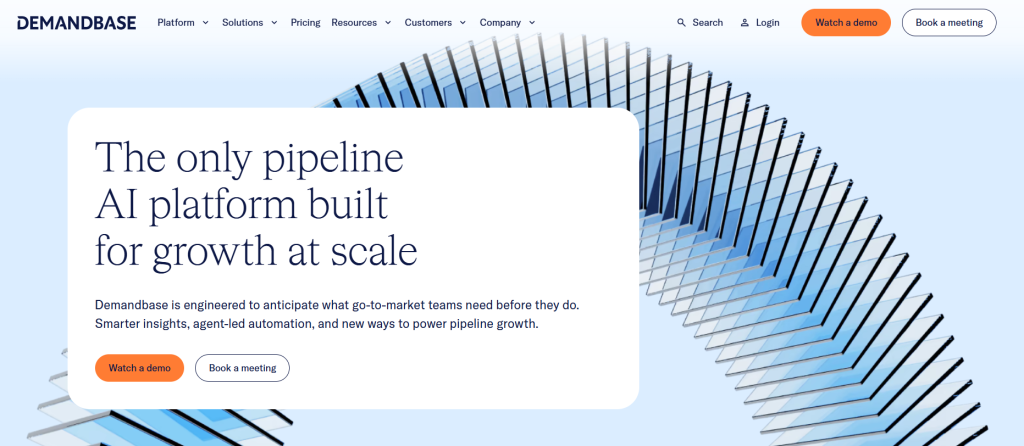
Demandbase One is a comprehensive, AI-powered Account-Based Marketing platform designed to help B2B companies manage their go-to-market funnel. It unifies first-party and third-party data to provide complete account views and enables personalized engagement across multiple channels.
Key Features:
- Account Intelligence – Unifies data sources to create single account view with AI scoring
- B2B Advertising – Targeted display advertising campaigns for specific decision-makers
- Website Personalization – Identifies anonymous visitors and delivers personalized content
- Sales Intelligence – Provides insights on account engagement and talking points
Pricing: From $65,000/year.
Pros:
- Comprehensive all-in-one ABM platform
- High-quality intent data for account targeting
- Powerful personalization and advertising features
- Strong integration with major CRM and marketing platforms
Cons:
- Steep learning curve due to complexity
- High pricing is unsuitable for small businesses
- Intent data signal strength can vary
Integrations: Salesforce, HubSpot, Microsoft Dynamics, Marketo, Eloqua, Pardot, Slack, Gong, Salesloft, Outreach, major ad networks.
Why I picked Demandbase: Demandbase excels as a market-leading, end-to-end ABM platform that unifies disparate data sources into Account Intelligence. For businesses implementing full-funnel ABM strategy, its ability to combine account identification, multi-channel engagement and analytics in one platform provides advantages over multiple point solutions.
20. Seamless.ai
Best for: Sales teams of all sizes needing a cost-effective, easy-to-use platform for real-time B2B contact discovery and list building.
Seamless.ai is a real-time, AI-powered B2B search engine for sales intelligence that helps users find and verify contact information across a database of over 1.7 billion contacts and 150 million companies. The platform automates prospect list building and integrates with CRM and sales tools.
Key Features:
- Real-Time Contact Search – Search engine for verified B2B contact details from 1.7+ billion contacts
- Chrome Extension – Find contact information from LinkedIn profiles and company websites
- Data Enrichment – Append missing contact and company data to CRM records
- AI Writer and Pitch Intelligence – AI-powered tools for personalized outreach messages
Pricing: Free plan with a small number of credits, Basic at $147/user/month (billed annually), Pro and Enterprise available on custom pricing only.
Pros:
- User-friendly interface with easy adoption
- Real-time data search provides current information
- More affordable than enterprise competitors
- Extensive integrations with CRMs and sales tools
Cons:
- Data accuracy inconsistent with 20-30% bounce rates reported
- Credit-based system can be confusing
- Customer support and billing practices criticized
Integrations: Salesforce, HubSpot, Microsoft Dynamics, Zoho, Salesloft, Outreach, Pipedrive, 6,000+ apps via Zapier.
Why I picked Seamless.ai: Seamless.ai serves a broad market with its accessible real-time search engine and user-friendly interface. While data accuracy varies, its combination of flexible pricing, extensive integrations and free entry point makes it popular for teams wanting to scale prospecting without enterprise-level costs.
21. Leadspace
Best for: Enterprise B2B companies requiring data unification to improve targeting for Account-Based Marketing and sales initiatives.
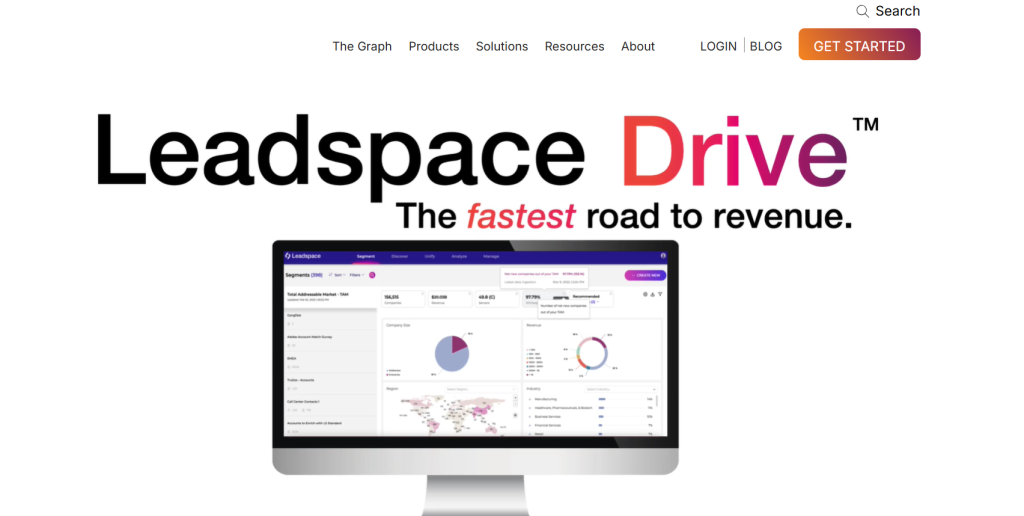
Leadspace unifies first-party customer data with third-party information from over 30 sources to create a complete ‘B2B Graph’. It uses AI to provide insights, enabling sales and marketing teams to identify, segment and prioritize high-value accounts and personas for large organizations.
Key Features:
- Data Unification and Enrichment – Combines 1st and 3rd-party data with 100+ company fields
- AI-Powered Scoring – Predictive ‘Fit’ and ‘Intent’ models for account prioritization
- Persona and TAM Discovery – Identify ideal customer profiles and lookalike audiences
- Lead-to-Account Matching – AI-powered engine for accurate lead routing
Pricing: From $25,000/year.
Pros:
- High-quality data unification and enrichment capabilities
- Powerful AI and predictive modeling for scoring
- Deep integration with enterprise CRM and marketing platforms
- Strong focus on enterprise-level B2B challenges
Cons:
- Pricing not transparent and likely high
- Complex implementation with 2-month average setup time
- Learning curve for new users
Integrations: Salesforce, Marketo Engage, Oracle Eloqua, HubSpot, Microsoft Dynamics 365, SalesLoft, Adobe Campaign, Google Ads.
Why I picked Leadspace: Leadspace’s ‘B2B Graph’ unifies disparate data sources to create a single source of truth for go-to-market teams. Its ability to solve complex data fragmentation problems for large enterprises through AI-driven insights makes it powerful for organizations with data challenges and substantial budgets.
What Are the Different Types of Data Enrichment?
Data enrichment has four primary types that help B2B teams build complete customer profiles. Firmographic Data describes company-level attributes like industry (SaaS, Healthcare, Finance), company size measured by employees or annual revenue and location details. Technographic Data provides insights into a company’s technology stack, including software like CRM systems and marketing platforms, hardware infrastructure and technology adoption rates.
Demographic Data refers to information about individuals within target companies, including job titles, function levels, seniority and direct contact information. Intent Data captures signals of purchase intent through topic-based web activity, website engagement like visits to pricing pages and specific keyword searches that indicate buying behavior.
What’s the Difference Between Data Enrichment and Data Cleansing?
Data cleansing (also known as data cleaning or data scrubbing) is the process of finding and correcting errors, inconsistencies and inaccuracies from existing datasets. This includes fixing typos, removing duplicates, standardizing formats, and deleting outdated information to ensure accuracy and reliability.
Data enrichment is the process of enhancing existing internal data by adding information from external third-party sources. The key difference: cleansing fixes existing data, while enrichment adds new data to it. Data cleansing should almost always precede data enrichment, as attempting to enrich ‘dirty’ data can lead to failed matching and wasted resources.
How Do Data Enrichment Solutions Work?
Data enrichment follows four main stages. First, the tool takes a unique identifier like email, company domain or phone number and uses it to find corresponding records in internal databases or third-party sources. Second, the tool queries external data sources through either real-time API processing for instant results or batch processing for large volumes at scheduled intervals.
Third, new data attributes like company size, industry, job titles, and technographics are added to the original record in your CRM. Finally, the enriched data is integrated and synced with destination systems like CRMs or marketing platforms, with validation steps to ensure accuracy and proper formatting.
Why Data Enrichment Is Essential for B2B
Incomplete or outdated contact data can slow down your outreach, waste your time and bring down your conversion rates.
Data enrichment tools update and expand your customer records with real-time information from trusted B2B data providers so you can focus on the right leads and communicate your needs more effectively. Data enrichment is now standard for B2B teams that want reliable outreach.
Here is why data enrichment is essential for any B2B strategy:
- High Quality and Up-to-date Data – Get updated contact and company details so that your sales and marketing teams can secure reliable outreach with fewer bounced emails.
- Improved Customer Targeting – Add missing firmographic and technographic data like industry, revenue and tech stack to identify ideal customers and segment lists more precisely.
- Better Lead Qualification – Enriched data identifies job titles, decision-maker status and company size, helping you qualify leads based on fit and buying potential.
- Stronger Personalization – With accurate details in place, marketing teams can tailor email campaigns and outreach efforts to each contact’s role, industry or pain points.
- Informed Decision Making – Enriched data and data visualization gives your team information to spot trends and identify the right prospects, helping you make smarter decisions.
- Cleaner CRM Records – Data cleansing removes duplicates, fixes inaccurate records, and fills in key fields.
- Better Alignment Across Teams – Shared access to enriched, high-quality data keeps the sales team and marketing team aligned on who to target and how to engage them.
How to Choose the Best B2B Data Enrichment Tool
Choosing the right data enrichment tool can impact your sales and marketing efforts. However, with so many tools available, it can be a challenge to find and settle on one that best suits your business needs.
Here are the key factors to consider when choosing the right data enrichment tool for your teams:
Data Accuracy and Coverage
Look for a tool that provides high-quality, verified data across the database of multiple industries and company types. If your B2B sells internationally, then it’s important to have a tool that provides global coverage.
Multiple Data Fields
Your tool should support multiple types of data, including firmographic details, technographic data, buyer intent, direct dials, and other information.
Ease of Use and Simple Setup
Data enrichment tools should be easy to use and not require technical expertise to implement. Save time and effort for your sales reps and marketing teams: always look for clean dashboards and simple filters that support your current sales process.
Integrations and API Access
Ensure the platform integrates with your CRM, customer data platform or other sales tools. An enrichment API can automate updates and reduce manual tasks for your teams, freeing them up to spend more time on high-value work.
Pricing and Scalability
It’s good to have a tool that meets your current needs, but it should also be able to grow with your team. Compare pricing models, including credit-based, tiered or custom quotes, to ensure that potential features can scale with your team’s needs
Customer Support and Reliability
Select a tool that provides responsive customer support and updates its data.
Is Data Enrichment Compliant with GDPR and CCPA?
For B2B data enrichment, the most common legal basis under GDPR is ‘Legitimate Interest’, meaning companies can process data without explicit consent if processing is necessary for business purposes and this interest isn’t overridden by individual privacy rights. Companies must perform Legitimate Interest Assessments and ensure outreach is relevant to job roles.
Under CCPA, the B2B data exemption has expired, meaning B2B contacts have the same rights as other consumers. The primary requirement is to provide clear opt-out options for ‘sale’ or ‘sharing’ of personal information. Businesses must ensure third-party data providers are also compliant and have proper Data Processing Agreements.
How We Picked the Best Data Enrichment Tools
We focused on B2B data enrichment platforms that help real sales and marketing teams work with cleaner, more complete customer records. To build this list, we reviewed each tool’s core capabilities, data sources and coverage and how well it supports typical B2B workflows.
Data accuracy and verification came first. We looked at how each vendor validates contact data, how often they refresh their databases and whether they offer email verification, phone verification or guarantees like credit refunds for bad data. Platforms that state clear accuracy claims and show how they source and clean data ranked higher.
Next, we evaluated data depth and coverage. That includes firmographic, technographic and intent data, global coverage and support for different industries and company sizes. Tools that go beyond basic email and job title and support richer profiling and segmentation earned a place on this list.
We also considered how well each tool fits into an existing tech stack. Native integrations with major CRMs and sales engagement tools, a usable API and simple enrichment workflows were all key factors. Platforms that require extensive customization to get basic enrichment up and running did not make the cut.
Finally, we weighed pricing and suitability for different team sizes. Some tools here are best for startups and small teams that need a simple, affordable way to enrich leads. Others are aimed at large enterprises with complex Account-Based Marketing programs and big budgets. Wherever possible, we included entry pricing so you can see which tools match your budget and stage.
What Are the Common Use Cases for Data Enrichment?
Data enrichment powers five key B2B strategies that drive business results.
First, improved lead scoring and prioritization helps sales teams focus on high-value prospects by enriching leads with firmographic and demographic data to create accurate scoring models that identify leads matching your Ideal Customer Profile.
Second, enhanced personalization enables sales and marketing teams to tailor messaging using enriched details like prospect’s role, tech stack or recent company news, leading to higher response rates.
Third, Total Addressable Market analysis helps refine market segmentation by layering firmographic and technographic data over existing customer bases for clearer, data-driven market views.
Fourth, efficient event lead follow-up processes incomplete contact lists collected at events by appending missing details like job titles and verified emails, enabling personalized outreach while engagement is warm.
Finally, reviving cold leads updates stale CRM data by running ‘closed-lost’ lead lists through enrichment tools to identify if prospects moved to new target accounts, creating new pipeline opportunities without additional lead generation costs.
How Do You Measure the ROI of Data Enrichment?
ROI calculation follows the standard formula: ROI = [(Financial Gain – Investment Cost) / Investment Cost] × 100. Costs include software fees, implementation resources and personnel time for tool management.
Companies with enriched data experience up to 66% higher conversion rates and 25% increases in sales productivity after implementation. Recent B2B studies on data quality and conversion rates show similar gains.
Hard metrics include 30% reductions in sales cycle time and 50% more sales-ready leads at 33% lower costs for businesses excelling at lead enrichment. One ROI model showed a $37,000 enrichment investment yielding revenue increases from $262k to $1.4M, representing 6x to 46x ROI.
Soft metrics include reduced sales team attrition, better decision-making with complete data, enhanced customer satisfaction, and improved brand reputation by avoiding data errors.
Leveraging Enriched Data in Your Strategy
Once businesses enrich their customer records with accurate data, the real value lies in how they leverage it.
Strategizing with enriched data means integrating comprehensive and refined data in a way that improves your B2B sales and marketing efforts. From identifying the right prospects to personalizing campaigns, enriched data helps teams work faster, target better and close more deals.
Here are some key examples of how you can use enriched data in your strategy:
Create Targeted Prospect Lists
Enriched data enables you to filter leads based on company size, industry, tech stack or revenue, creating targeted lists for outbound campaigns.
Improve Lead Scoring
You can use firmographic and behavioral data to prioritize leads that match your ideal customer profile and are more likely to convert.
Personalize Outreach Campaigns
With enriched job titles, company details and intent data, B2B teams can tailor their email outreach, LinkedIn messages or sales calls to each contact’s specific relevance and pain points.
Optimize Ad Campaigns
Make use of enriched customer data in ad platforms to create custom audiences and improve your ROI through retargeting or account-based marketing campaigns.
Shorten the Sales Cycle
Enriched data provides sales reps with complete profiles that include verified contact details and buyer intent signals. This avoids the hassle of manual research and focuses on meaningful conversations, saving time and budgets.
Clean and Segmented CRM Records
Data enrichment helps fix gaps, duplicates and outdated fields in your CRM. This improves segmentation and supports your sales productivity tools and campaigns.
Enhance Reporting and Forecasting
With reliable data on hand, your marketing and sales managers can track performance more accurately and plan strategies based on real insights and information.
Enriched data is crucial for focused, efficient and effective B2B strategies.
Take Your Data Enrichment Further With UpLead
UpLead is one of the best data enrichment tools, helping B2B teams enhance contact and company records through streamlined workflows. It provides real-time, verified data, including firmographics, technographics, direct dials and more.
Unlike platforms that give you outdated lists, UpLead verifies every email before download and supports enrichment via API, Chrome extension and CRM integrations.
UpLead is 1/3 the cost of other leading sales platforms and offers 24/7 support from real humans. The platform has zero feature fluff, so you can get started easily and focus on prospecting without distractions.
Start your data enrichment journey with UpLead for more effective and targeted campaigns. Get started for free!
Frequently Asked Questions
The best data enrichment tool is UpLead because it provides real-time, verified data with flexible filters, CRM integrations and a user-friendly platform, making it ideal for B2B sales and marketing teams.
An example of data enrichment is adding missing information like job titles, direct dials and company revenue data to a lead’s profile by using an enrichment platform like UpLead.
AI data enrichment uses artificial intelligence to update, correct and enhance customer records by pulling data from multiple external sources.
CRM data enrichment is the process of enhancing your existing CRM records with accurate, up-to-date details, including email addresses, firmographics and behavioral insights. It involves adding new information to existing CRMs and removing outdated or incorrect data.
What You Need to Remember About Data Enrichment Tools
Data enrichment tools help B2B teams enhance lead quality, personalize outreach and streamline CRM records. With the right tool, you get real-time, verified data that supports better targeting, faster sales cycles and improved marketing efforts. Never waste time and effort on incomplete or outdated information with data enrichment.