


UpLead Quick Take
Apollo vs ZoomInfo: Summary
- Apollo suits SMBs and cost-conscious teams: transparent self-service pricing, built-in outreach tools, and a free forever plan make it easy to get started.
- ZoomInfo is built for enterprise buyers: its database is deeper and its intent signals are more advanced, but pricing starts around $15,000 per year with opaque contract terms.
- If neither fits your budget or use case, UpLead delivers verified contact data at transparent pricing with no hidden credit surprises.
Every sales team needs reliable contact data. But picking the wrong platform means burning through credits on bounced emails, locking into expensive multi-year contracts and watching reps waste hours chasing dead leads.
Both Apollo and ZoomInfo are the platforms most sales teams start comparing. On the surface they look similar. In practice, they’re built for very different buyers at very different price points. Choose the wrong one and it shows up fast in your pipeline.
This guide breaks down data quality, intent signals, pricing, credit systems and integrations side by side, so you can pick the right tool without second-guessing it six months later.
Apollo vs ZoomInfo: Quick Comparison
Here’s how the two platforms stack up at a glance across the dimensions that matter most for sales and marketing teams.
| Feature | Apollo.io | ZoomInfo |
|---|---|---|
| Starting Price | $49/user/month (annual) | ~$14,995/year (market estimate) |
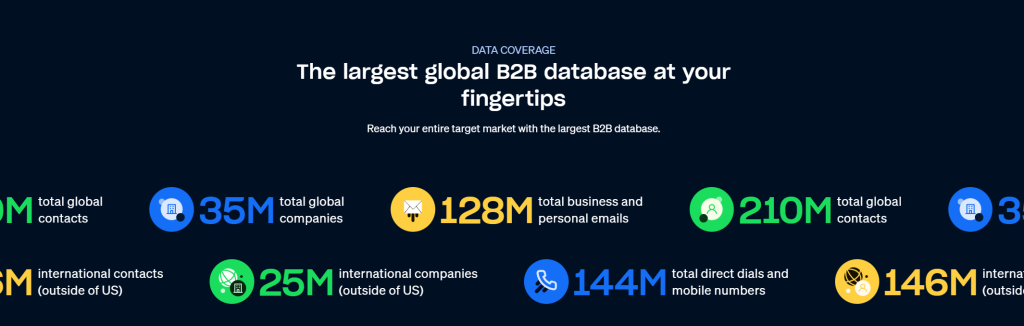
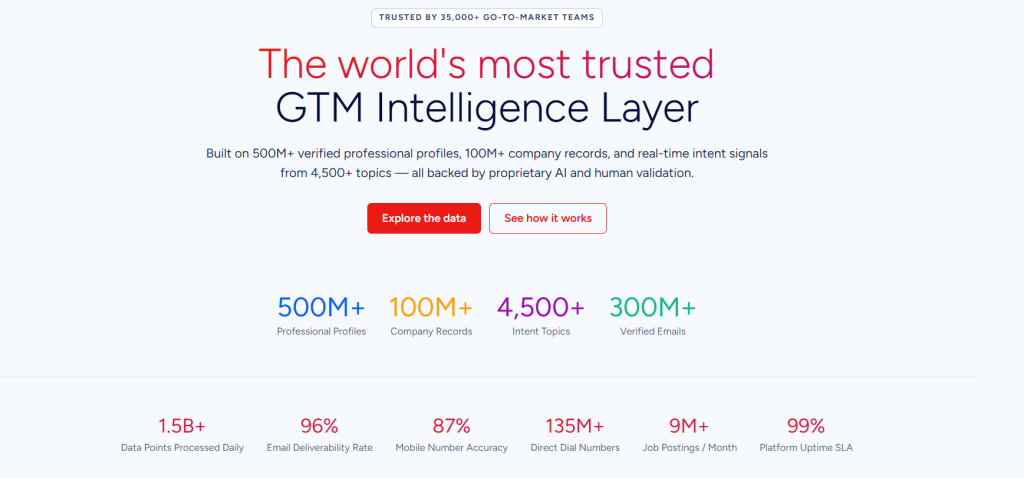
| Database Size | 275M+ contacts | 300M+ professional profiles |
| Free Tier | Yes (limited credits) | No |
| Pricing Model | Transparent self-service | Custom quote-based |
| Best For | SMBs, cost-conscious teams | Enterprise, complex sales orgs |
| Sales Engagement | Built-in (email, calls, sequences) | Limited (data-first platform) |
| Intent Data | Basic (Bombora partnership) | Advanced (streaming intent) |
| CRM Integration | 50+ integrations | Deep native integrations |
| Credit System | Shared pool, rolls over | Per-user credits, annual reset |
| GDPR Compliant | Yes (ISO 27001, SOC 2) | Yes (with governance tools) |
What is Apollo.io?
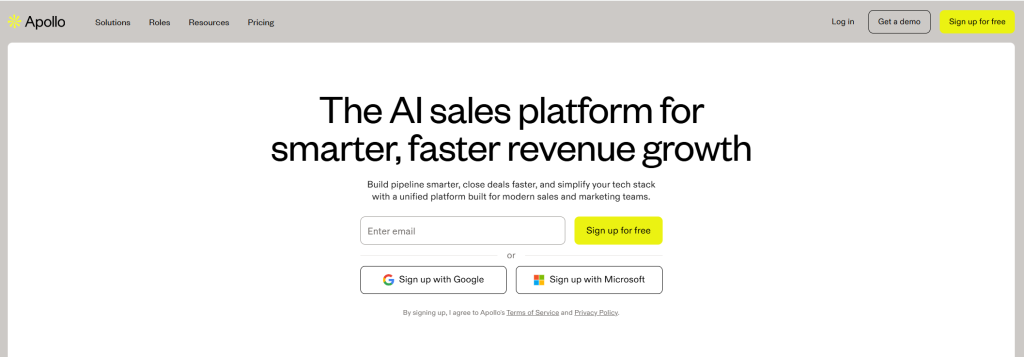
Apollo.io is an all-in-one B2B sales engagement platform that combines a large contact database with built-in outreach and automation tools. It gives sales reps access to over 275 million contacts across 73 million companies, filterable by 65+ attributes including job title, company size, funding stage and hiring intent.
Where Apollo stands out is in its end-to-end approach. You can build a targeted lead list, launch an email sequence, make calls through its built-in dialer and track engagement all within the same platform. Apollo also syncs bi-directionally with your CRM, so records stay current without manual updates. It’s designed for high-velocity outbound sales at a price point that works for teams that aren’t running on enterprise budgets.
What is ZoomInfo?
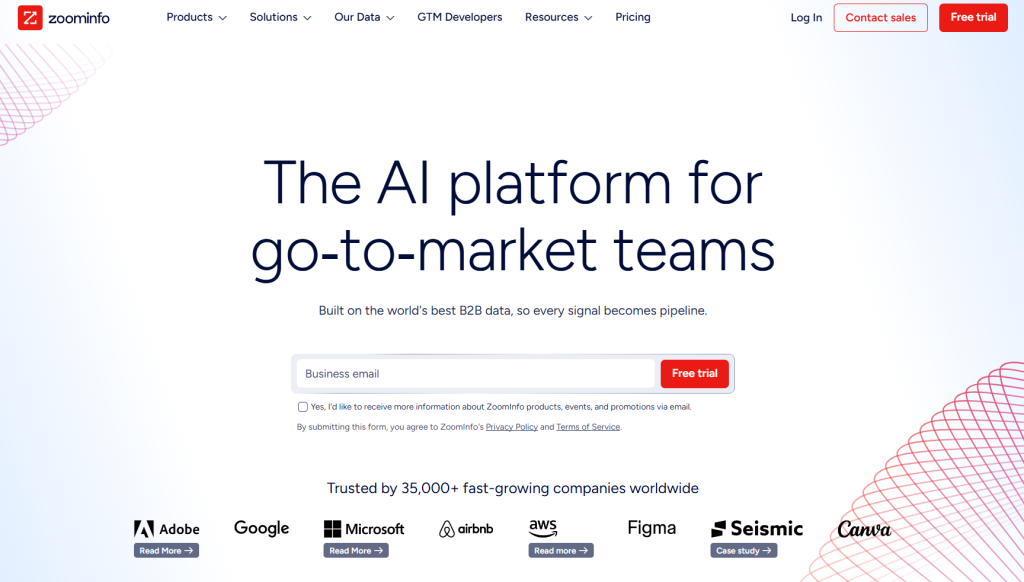
ZoomInfo is a business intelligence platform built for sales, marketing and recruiting teams that need deep, accurate data on companies and decision-makers. It maintains an extensive database of over 300 million professional profiles packed with firmographic data, technographic details, org charts and buying signals.
ZoomInfo’s primary strength is data depth, not outreach. It’s built for organizations running account-based marketing, complex enterprise sales cycles or talent acquisition at scale. Teams use it to enrich data in their CRM, identify high-intent accounts and build precisely segmented lists. The platform integrates seamlessly with Salesforce, HubSpot, Marketo and other enterprise marketing tools. It’s the platform most large revenue orgs go to when data quality is non-negotiable and budget isn’t the primary constraint.
Key Features: Apollo vs ZoomInfo
Both platforms offer contact data, search filters and CRM integrations. The key differences show up in how they’re packaged, what engagement data each captures and what’s included at each price point.
Apollo.io Key Features
- Contact database: 275M+ contacts with 65+ advanced search filters covering job title, seniority, company size, industry, funding, technology stack, and job change signals.
- Sales engagement: Built-in email sequences, a power dialer, SMS, LinkedIn tasks, and AI-assisted message writing. Apollo handles the full outreach workflow without needing a separate tool.
- Workflow automation: Rule-based triggers for lead routing, task creation, and sequence enrollment based on prospect behavior or CRM field changes.
- CRM sync: Bi-directional sync with Salesforce and HubSpot, plus 50+ additional integrations through native connectors and Zapier.
- Data enrichment: Auto-enriches existing CRM contacts with updated emails, phone numbers, and firmographic data on a rolling basis.
- Compliance: GDPR-compliant, ISO 27001-certified, SOC 2 Type II-certified.
ZoomInfo Key Features
- Contact and company database: 300M+ professional profiles with org charts, direct dials, technographics, and hierarchical company data. US data coverage is particularly strong.
- Intent data (Streaming Intent): Real-time buying signals from website visitors and content consumption across ZoomInfo’s publisher network. Identifies accounts actively researching solutions in your category.
- Data enrichment: Automatically fills and refreshes CRM fields with updated contact info, firmographics, and technology install data.
- Sales automation (Engage): Email sequencing and dialer tools, though these are add-ons rather than core features and are less developed than Apollo’s built-in suite.
- Advanced analytics: Account scoring, pipeline forecasting, and campaign performance tracking for enterprise GTM teams.
- Integration depth: Native connectors for Salesforce, Microsoft Dynamics 365, HubSpot, Marketo, and Slack with enterprise-grade custom field mapping.
Data Quality and Coverage
Database size gets the most attention when comparing ZoomInfo and Apollo, but it’s the wrong metric to lead with. What matters more is how often a contact data point is accurate when you actually try to reach them.
Apollo.io Data Quality
Apollo sources data from email engagement monitoring, public web crawling, third-party B2B data providers and its user network. The platform reports refreshing records monthly with real-time updates triggered by buying signals or job change events.
In independent performance testing across 450 real leads, Apollo showed a 13.3% verifier bounce rate (emails flagged as invalid before sending) and a 1.8% campaign bounce rate during live sends. Reply rates came in at 5.1%, slightly ahead of ZoomInfo’s equivalent test.
Apollo’s coverage is strongest for SMB and mid-market contacts in North America. Coverage for senior enterprise decision-makers, direct phone numbers and European markets is thinner than ZoomInfo’s database. Actual users consistently flag email verification accuracy as solid while noting some gaps in mobile number completeness.
ZoomInfo Data Quality
ZoomInfo uses a contributory data network (first-party submissions from its user base), proprietary web crawling and machine learning to build and maintain its database. It’s known for having the strongest direct dial and mobile number coverage among US-focused data providers, which translates to higher connect rates when targeting enterprise buyers.
In the same performance test referenced above, ZoomInfo showed a 15.3% initial verifier bounce rate but only a 0.8% campaign bounce rate during live sends. That gap suggests ZoomInfo’s data holds up better under real sending conditions, even if its raw verification pass rate looks slightly lower.
ZoomInfo’s coverage gaps show up in non-US markets, particularly Europe, where GDPR constraints limit data depth. Teams prospecting heavily into the EU or UK should factor that in before committing to ZoomInfo’s enterprise price point.
Intent Data: Apollo vs ZoomInfo
Intent data tells you which companies are actively researching solutions in your category right now, so your team can prioritize lead generation efforts on accounts already in a buying cycle. When comparing ZoomInfo vs Apollo on this dimension, the two platforms take very different approaches.
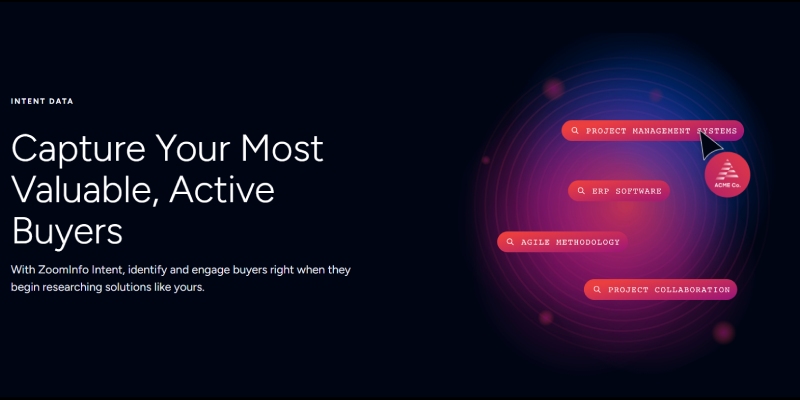
ZoomInfo’s intent offering is more advanced. Its Streaming Intent feature monitors website visitors and content consumption in near real time across ZoomInfo’s publisher network, surfacing accounts showing buying signals before a competitor does. ZoomInfo also uses proprietary machine learning to identify high-intent patterns from behavioral data. For enterprise teams running account-based marketing, this depth of intent coverage is one of ZoomInfo’s clearest advantages.
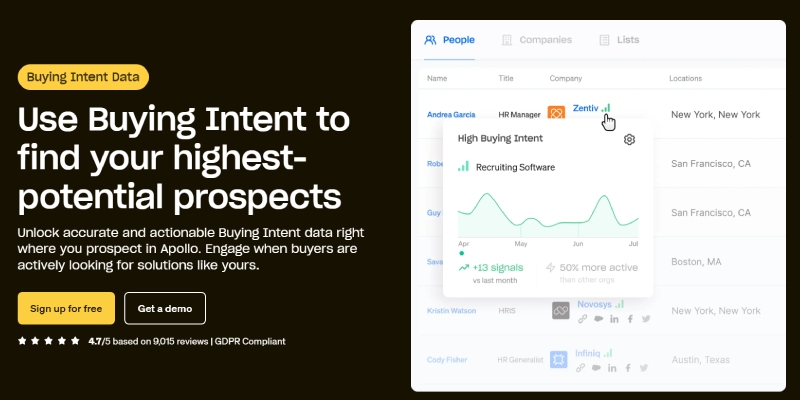
Apollo partners with Bombora and LeadSift for intent data, surfacing signals from public web content including forums, blogs, research sites and hiring boards. It’s functional for basic intent-based prioritization, but it’s not as granular or real-time as ZoomInfo’s streaming intent. Apollo’s intent is better suited to smaller teams that want a rough signal for outreach prioritization rather than a full account-based buying-signal system.
If intent data is central to your GTM strategy, ZoomInfo wins this category flat-out.
Plans and Pricing
Pricing is where Apollo and ZoomInfo diverge most sharply. Apollo publishes its prices openly. ZoomInfo doesn’t.
Apollo.io Pricing
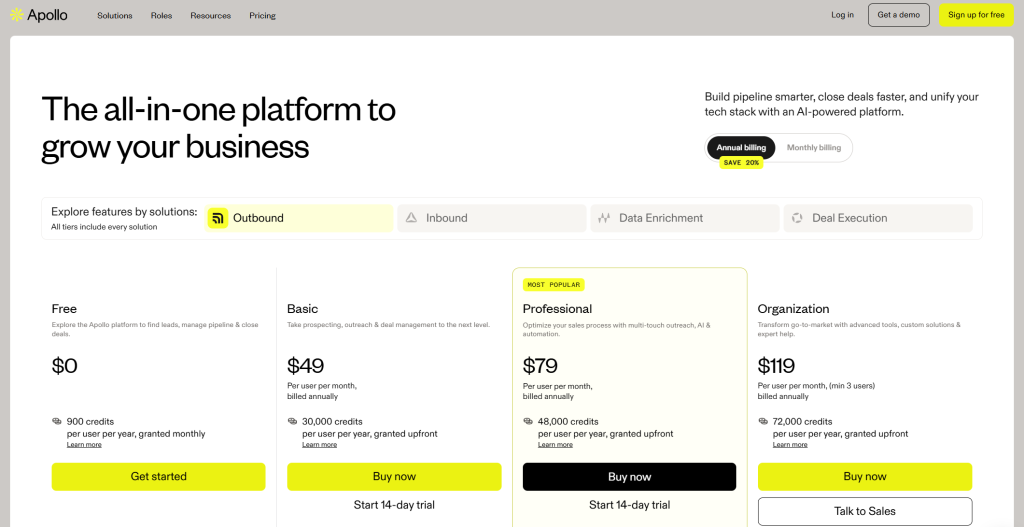
Apollo’s pricing follows a transparent self-service model with four tiers, all publicly listed on its pricing page.
- Free: $0. Limited monthly credits, basic search filters, and email sequencing. Good for individual reps validating the platform before committing.
- Basic: $49/user/month (billed annually). Includes expanded credits, advanced search filters, CRM integrations, and core outreach features.
- Professional: $99/user/month (billed annually). Adds higher credit limits, AI-assisted email writing, call recordings, advanced sequences, and analytics.
- Enterprise: Custom pricing. Multi-seat bundles with volume discounts, dedicated support, SSO, and custom permission settings.
New accounts typically receive a 14-day trial with 50 credits to test the platform before upgrading. Annual billing is required for the discounted rates above.
ZoomInfo Pricing
ZoomInfo doesn’t publish pricing. All plans are sold through their sales team with custom quotes based on seat count, feature set, credit volume and contract length. Annual commitments are standard.
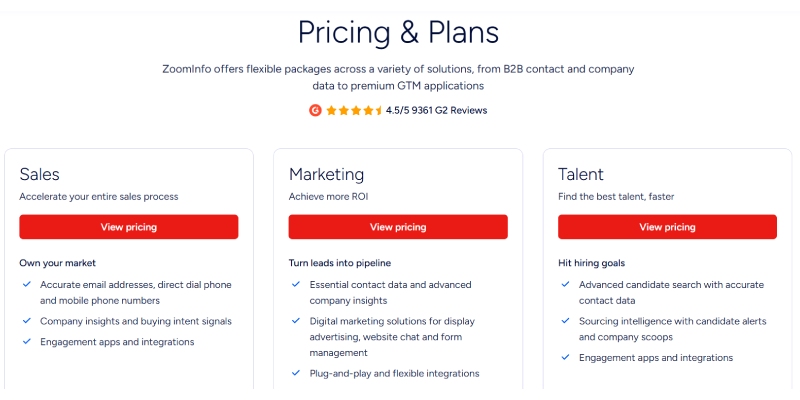
Based on widely reported market estimates and third-party sources, ZoomInfo’s plans typically fall in these ranges:
- Professional: Around $14,995/year for up to 3 users with approximately 5,000 annual credits. Additional users cost roughly $1,500 each.
- Advanced: Around $24,995/year for up to 5 users with approximately 10,000 annual credits plus monthly user credits. Additional users cost around $2,500 each.
- Elite: Around $39,995/year with the most features, highest credit allocations, and full access to add-ons like Streaming Intent and advanced analytics.
These are market estimates, not published prices. The actual quote you receive depends on your specific requirements and negotiation. Multi-year contracts and discounts for larger user groups are common. Renewal increases have been reported by users as a recurring pain point.
Credit System: How Each Platform Works
Both platforms use credits to control how many contacts you can export or reveal. The mechanics are different enough to affect real purchasing decisions.
Apollo uses a shared credit pool at the account level. Credits roll over within the plan year on some tiers, and you can top up with credit add-ons if you need more. The credit system is transparent: you can see exactly how many credits remain and what each action costs before you take it.
ZoomInfo credits are typically allocated per user on an annual reset cycle. Unused credits at year end generally don’t roll over, which means teams that don’t hit their full credit usage still pay the full contract amount. Credit usage is also less transparent during the sales process, with some users reporting confusion over what counts as a credit draw versus a standard data view.
For smaller teams watching credit usage carefully, Apollo’s shared pool model is more flexible. For enterprise teams with high-volume prospecting needs, ZoomInfo’s credit allocations are typically larger in absolute terms.
CRM Integration and Compatibility
Both platforms integrate with the major CRM systems and marketing automation tools. The depth of those integrations differs based on their target markets, and that’s where other factors like custom field mapping and native enrichment triggers start to matter.
Apollo.io Integrations
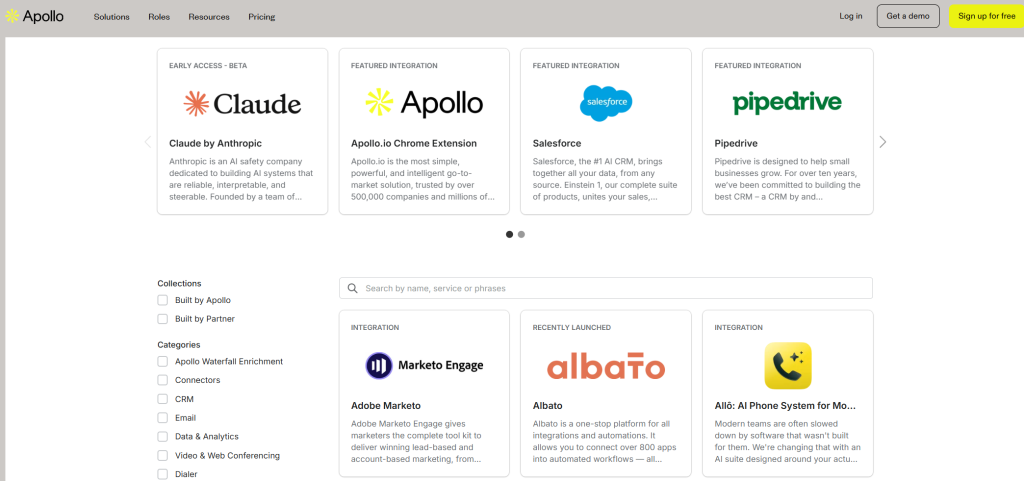
Apollo lists 50+ integrations, with the most commonly used being Salesforce, HubSpot, Gmail and Outlook. Its Chrome extension lets reps pull Apollo data directly from LinkedIn profiles to speed up list building. The Salesforce and HubSpot syncs are bi-directional, meaning contact updates in Apollo reflect in your CRM and vice versa. Zapier connections extend Apollo’s reach to hundreds of additional tools without custom development.
ZoomInfo Integrations
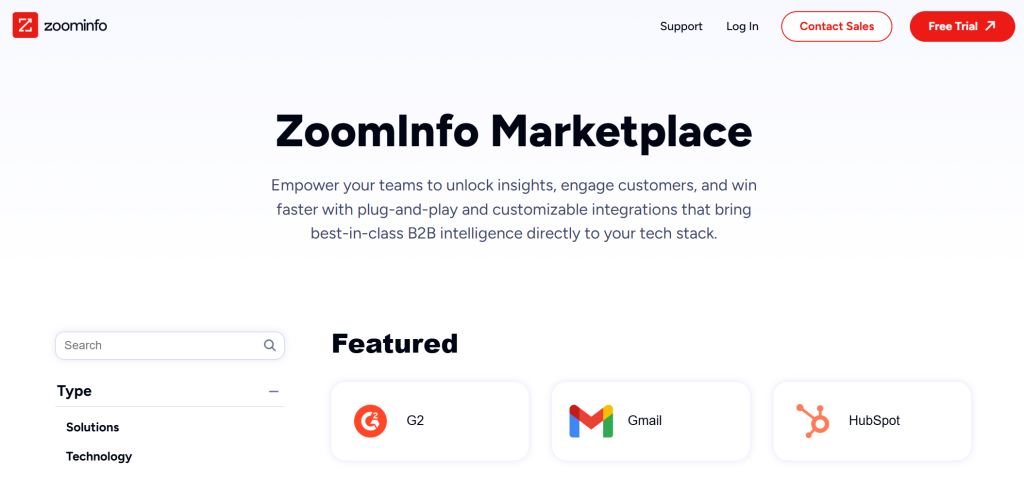
ZoomInfo integrates with Salesforce, Microsoft Dynamics 365, HubSpot, Marketo and other major enterprise platforms through its Marketplace. Its native Salesforce integration is particularly deep, with support for custom field mapping, lead routing rules, and automated enrichment triggers that keep CRM records current without manual intervention. ZoomInfo also connects with Slack for real-time buying signal alerts, so account executives can act on intent signals quickly.
For organizations running Microsoft Dynamics or Marketo alongside Salesforce, ZoomInfo’s native connectors are more mature than Apollo’s equivalent options.
Ease of Use
Apollo has a steeper learning curve than its clean interface suggests. Because it consolidates prospecting, sequences, dialing and analytics in one place, new users often need a few weeks to navigate the full feature set comfortably. Built-in onboarding tips help, and the platform’s workflow logic is consistent once you’ve mapped it out. Reps who primarily need prospecting and basic outreach typically get productive within a day or two.
ZoomInfo’s search interface is intuitive for data lookup. Finding a company, pulling contacts, and exporting to your CRM is fast. The complexity kicks in with advanced features like intent data setup, Engage sequences and automated lead routing, which require real configuration time and often dedicated admin support. ZoomInfo offers 24/7 customer support and structured onboarding for enterprise accounts, which helps teams get up to speed faster than they would solo.
For smaller teams without a dedicated RevOps function, Apollo’s self-serve model is easier to manage. For enterprise teams with IT and operations support, ZoomInfo’s complexity is manageable and its configuration options are more powerful. If neither platform fits, our list of ZoomInfo competitors compares 12 more options side by side.
Who Should Choose Apollo vs ZoomInfo?
The right platform depends on your team size, budget and the role data plays in your sales operations. Your target audience and prospecting volume are the other factors that tip the decision most reliably.
Choose Apollo.io If:
- You’re an SMB or startup that needs an all-in-one platform without a six-figure annual commitment
- Your team wants built-in email sequences, a dialer, and contact data in one tool rather than a separate outreach stack
- Transparent pricing and a free plan matter for budget control and internal approval
- Your prospecting is primarily focused on North American SMB and mid-market contacts
- You want a credit system you can actually predict and manage month to month
Choose ZoomInfo If:
- You’re running enterprise sales or account-based marketing where data depth and direct dial accuracy are non-negotiable
- Intent data is central to your prospecting strategy and you need real-time buying signals, not basic web crawl signals
- You need deep integrations with Microsoft Dynamics, Marketo, or other enterprise platforms with custom field mapping
- Your team is large enough and your pipeline is complex enough to justify a $15,000+ annual contract
- You need org charts, technographic data, and comprehensive firmographic coverage for enterprise account planning
Pros and Cons
Both Apollo and ZoomInfo have genuine strengths. Which ones matter most depends on your target audience, team size and budget.
Apollo Pros
- ✅ Transparent pricing from $49/user/month with a free forever tier — no custom quote, no sales call required
- ✅ All-in-one sales intelligence platform covering prospecting, email outreach, dialing and workflow automation in one place
- ✅ 275M+ contact database with 65+ advanced search filters for precise lead generation
- ✅ Shared credit pool with rollover on select tiers, making credit usage predictable for smaller businesses
- ✅ Solid deliverability in independent testing: 1.8% campaign bounce rate and 5.1% reply rate across actual users
Apollo Cons
- ❌ Intent data is basic — relies on third-party Bombora data rather than a proprietary streaming signal
- ❌ Mobile number and direct dial accuracy trail ZoomInfo for senior enterprise contacts
- ❌ EU and international data coverage is limited compared to its US data
- ❌ Less suited to sales operations teams that need advanced analytics or enterprise-scale automation
ZoomInfo Pros
- ✅ Vast database of 300M+ professional profiles with the strongest US direct dial and mobile accuracy on the market
- ✅ Advanced Streaming Intent delivers real-time data on buying signals from website visitors and content consumption
- ✅ Deep integrations with CRM systems including Salesforce, Dynamics 365, Marketo and HubSpot with custom field mapping
- ✅ Rich company insights: org charts, technographics and comprehensive firmographic data for enterprise account planning
ZoomInfo Cons
- ❌ High costs with no transparent pricing — contracts typically start around $15,000/year with hidden costs in add-ons and renewals
- ❌ More advanced features like Streaming Intent are locked behind higher tier plans, pushing the total cost up further
- ❌ Unused credits reset annually, so teams that under-use their allocation still pay full contract value
- ❌ EU and international data coverage is noticeably weaker than its US data
- ❌ Actual users frequently report surprise renewal price increases at contract end
Neither a Good Fit? UpLead Is the Alternative
If neither Apollo nor ZoomInfo fits your needs, UpLead is one of the most practical ZoomInfo alternatives on the market. UpLead offers verified B2B contact data at transparent, predictable pricing without the credit opacity or enterprise contract requirements that make ZoomInfo’s database hard to justify for smaller teams.
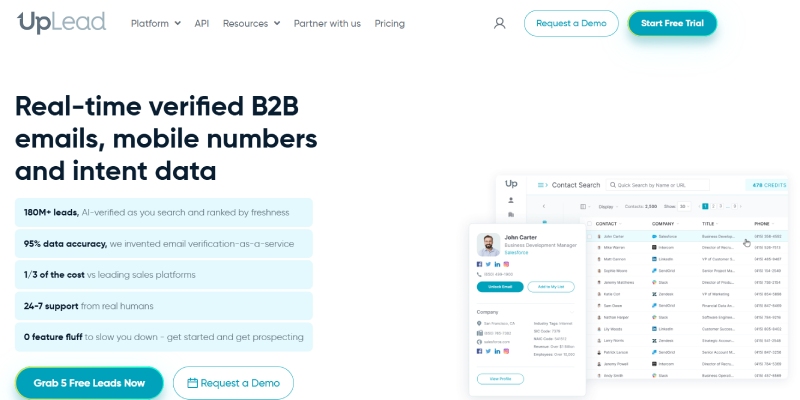
- 95% data accuracy guarantee: UpLead verifies emails in real time at the point of export, not in bulk beforehand. If a contact bounces, you get the credit back.
- 50+ advanced search filters: Build targeted lead lists by job title, company size, industry, technology stack, revenue, and more.
- Transparent pricing: Plans are publicly listed with no custom quote required. Credits are clear and credits roll over monthly.
- Free trial: New users get full platform access on a trial to test data quality before committing to a paid plan.
- Technology filters: Find prospects based on what tools they’re already using, a useful signal for relevance-based outreach.
UpLead is a strong fit for teams that need clean, verified contact data without locking into an annual enterprise contract. It doesn’t include Apollo-style sales engagement tools or ZoomInfo-level intent data, but for teams that already have an outreach tool and just need reliable data to feed it, UpLead fills that gap at a fraction of the cost. Sign up for a free trial to see the data quality for yourself.
FAQs About Apollo vs ZoomInfo
It depends on what you need. Apollo is better for SMBs and teams that want an all-in-one platform at a transparent price point. ZoomInfo is better for enterprise organizations that need deeper data, advanced intent signals, and direct dial accuracy for senior decision-makers. Neither is better overall — they’re built for different buyers.
ZoomInfo’s pricing is the most common reason teams look elsewhere. Annual contracts typically start around $15,000 with no self-serve option, no free trial, and renewal increases reported by many users. It’s also overkill for teams that don’t need enterprise-grade intent data or deep CRM automation. Smaller teams rarely extract enough value from ZoomInfo to justify the cost.
Apollo is worth it for most SMB and mid-market sales teams. The free plan lets you test data quality before committing. Paid plans start at $49/user/month and include built-in outreach tools that would otherwise require a separate tool. The value is strong relative to the cost, particularly for teams doing high-volume outbound.
Apollo publishes its prices openly, with self-serve plans from $49 to $99/user/month and a free forever tier. ZoomInfo doesn’t publish pricing — all plans require a custom quote, with annual commitments typically starting around $14,995/year. The credit systems also differ: Apollo uses a shared account-level pool, while ZoomInfo allocates credits per user annually with no rollover.
ZoomInfo’s intent data is more advanced. Its Streaming Intent feature monitors website visitor activity and content consumption in near real-time across its publisher network, surfacing accounts actively researching your category. Apollo uses Bombora and LeadSift partnerships for intent signals, which works for basic prioritization but isn’t as granular or timely as ZoomInfo’s offering. For teams that run account-based marketing strategies, ZoomInfo is the stronger choice for intent data.
When comparing UpLead and ZoomInfo, the main factors are pricing, verification method, and use case. UpLead offers transparent plans, a real-time email verification guarantee, and no minimum contract requirement. ZoomInfo offers deeper data and more advanced intent tools but costs significantly more and requires custom pricing. UpLead is a better fit for teams that need clean verified data at a predictable cost. ZoomInfo fits teams with enterprise budgets and complex account-based workflows.
Apollo vs ZoomInfo: The Bottom Line
Apollo and ZoomInfo solve the same problem in very different ways. Apollo is the better choice for teams that want a full outreach platform at a price they can actually justify, with a free plan to test before committing. ZoomInfo is the stronger choice for enterprise organizations where data depth, direct dial accuracy, and real-time intent signals are worth the premium contract.
Neither platform is a universal winner. Apollo runs out of headroom for enterprise-level data needs. ZoomInfo prices out most SMBs before they can evaluate whether it’s the right fit.
If you’re not sure which end of that spectrum your team sits on, UpLead offers a middle path: verified contact data at transparent pricing with a real-time accuracy guarantee. It won’t replace ZoomInfo’s intent engine or Apollo’s built-in sequences, but for teams that just need clean, reliable data to feed their existing outreach stack, it’s worth testing first.