


Choosing the right sales intelligence platform feels like a high-stakes gamble. You’re caught in a frustrating dilemma: Do you commit to a specialized data provider like ListKit, hoping for unparalleled data purity, or do you opt for an all-in-one platform like Apollo.io that promises to do everything? Every sales leader knows this choice is critical, and the pressure to get it right is immense. Making the wrong call isn’t just an inconvenience—it’s a direct hit to your bottom line. Settle for a tool with questionable data accuracy, and your sales team wastes precious hours chasing dead-end leads and polluting your CRM with useless information. On the other hand, choosing a platform that can’t scale outreach or integrate with your workflow means you’re juggling multiple subscriptions, creating data silos, and leaving revenue on the table. This is where clarity becomes your competitive advantage. This in-depth comparison cuts through the noise to directly address the core conflict: ListKit’s focused data integrity versus Apollo.io’s comprehensive, AI-driven feature set.
ListKit vs. Apollo: At a Glance
Here’s a quick side-by-side comparison table so you can see how the two tools stack up:
| ListKit | Apollo | |
| Use Cases | Targeted lead generation, industry-specific contact lists | Comprehensive sales enablement, integrated marketing capabilities |
| Database Size & Reliability | Over 710 million contacts, triple verified contact lists | Over 275 million contacts, around 90% accuracy |
| Data Enrichment Features | Basic features include verifying emails and phone numbers to ensure data accuracy | Advanced tools enhance contact details with insights like job titles, company size, and more |
| Lead Management | Simplified approach, allowing users to quickly access and export lead lists | Comprehensive tools include lead scoring, pipeline tracking, and automated workflows |
| AI Features | Limited to basic sorting and filtering capabilities | Advanced AI supports predictive analytics and personalized recommendations for outreach |
| Integrations | Basic integrations with tools for exporting lead data, such as spreadsheets or CRMs | Extensive compatibility with data platforms like Salesforce, HubSpot, Pipedrive, and more |
| Ease of Use | Highly user-friendly with an intuitive interface that requires minimal onboarding | Moderate complexity; powerful features may require training for effective utilization |
| Compliance | High compliance standards, ensuring GDPR and CCPA adherence for secure data handling | Equally high compliance, with robust measures to meet global data protection regulations |
| Browser Extension | Not available | Yes, enabling users to gather contact details directly from LinkedIn and websites |
| Free Access? | No free plan is available; all services are paid and tailored to specific needs | Yes, a limited free plan offers basic access to its database and features |
Who is ListKit For vs. Who is Apollo For?
While ListKit targets sales teams prioritizing data quality over feature breadth, Apollo.io serves organizations needing comprehensive sales and marketing automation. ListKit excels for small to medium businesses focused on streamlined prospecting with industry-specific contact lists. The platform appeals to teams that value simplicity and want to avoid the complexity of managing multiple sales tools.
Apollo.io, conversely, is designed for advanced sales and marketing teams requiring end-to-end prospecting capabilities. Large enterprises and growing organizations benefit from Apollo’s extensive feature set, including automated email sequences, detailed analytics, and sophisticated integrations. However, some users find the platform overwhelming, particularly smaller teams just starting their lead generation journey.
ListKit Overview
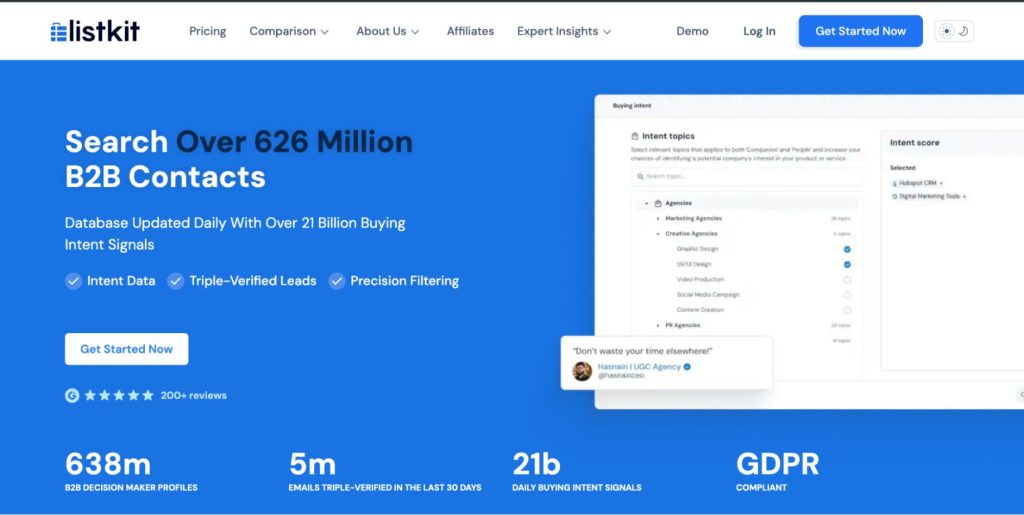
ListKit is a lead generation tool designed to provide high-quality, targeted B2B leads. ListKit’s curated list of contacts is accurate and relevant. The tool creates lists tailored to specific industries, meaning sales and outbound marketing teams spend less time prospecting. Like many competitors on the market, ListKit allows users to review verified contact details on a simple, easy-to-use platform. The tool is great for sales teams looking for hyper-focused contact lists.
However, if you’re a large, global sales enterprise, you may need a more robust, advanced platform like Apollo.
Apollo.io Overview
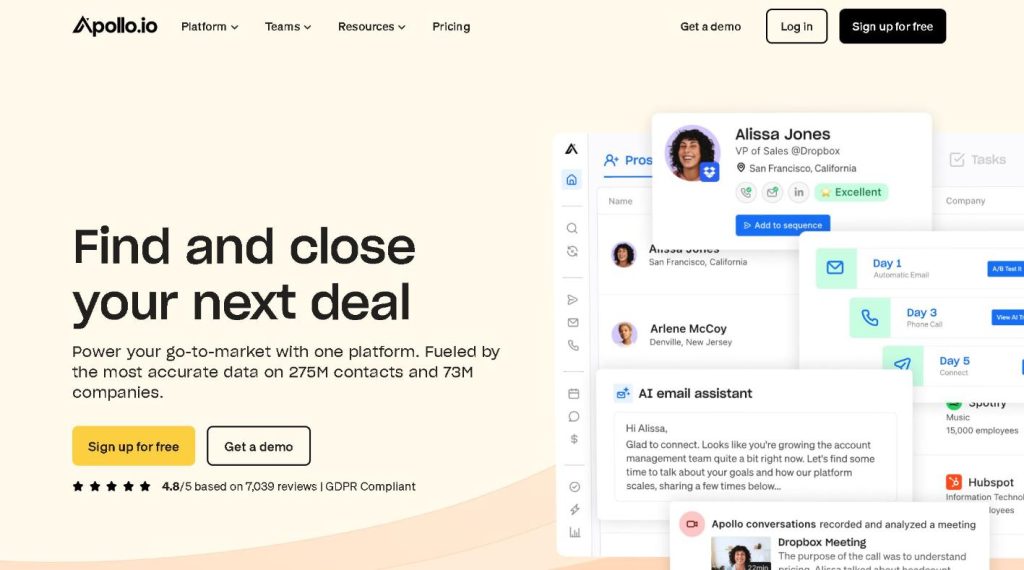
Another prominent lead generation tool, Apollo.io is an industry leader in terms of database completeness and sophisticated tooling. The platform allows for contact verification, sales, and marketing activities and has a vast global database. The platform allows businesses to filter on over 200 separate datapoints, meaning you can get exactly the list you’re looking for.
Designed for advanced sales and marketing teams, some users have noted that the platform can be a bit overwhelming. If you’re a small team or just starting out, ListKit may offer a better user experience.
ListKit vs. Apollo: Pricing & Plans
Choosing the right tool may come down to cost, especially for small to medium-sized businesses. Here’s a detailed look at pricing for both ListKit and Apollo and what you can expect at each price point.
ListKit Plans
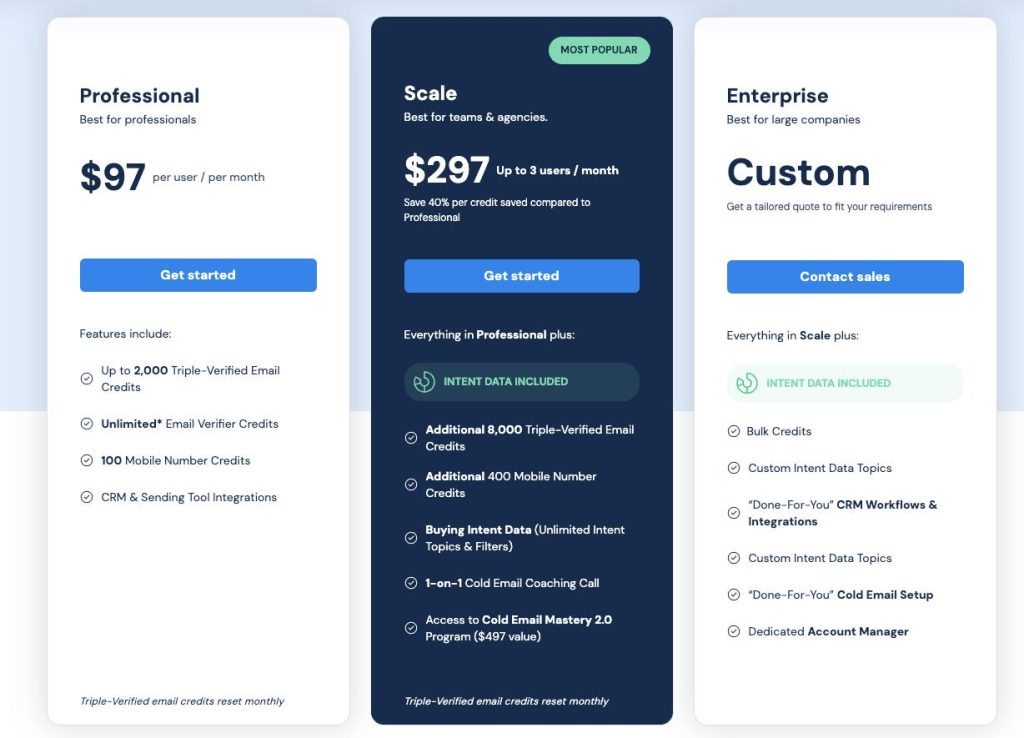
- Professional Plan ($97/month): ListKit’s professional plan is ideal for individuals looking to enhance their lead generation game. The plan provides the high-quality, curated contact lists that ListKit is known for. Each contact is triple verified. This plan includes 2,000 email credits per month, unlimited email verification credits, 100 mobile number credits, and CRM / Sending Tool integrations.
- Scale Plan ($297/month): Designed for teams and agencies, the Scale Plan allows for up to three users per month. You’ll get everything in the professional plan as well as 10,000 email credits, 500 mobile number credits, buying intent data, one on one coaching for cold emails, and access to the cold email mastery program valued at $497.
- Enterprise Plan: For businesses with unique needs, ListKit offers bespoke packages with custom pricing. These include hyper-specific targeting, such as focusing on niche industries or markets, and may also feature additional verification steps or custom formatting for exported data. The cost varies depending on the complexity and volume of the request.
Apollo.io Plans
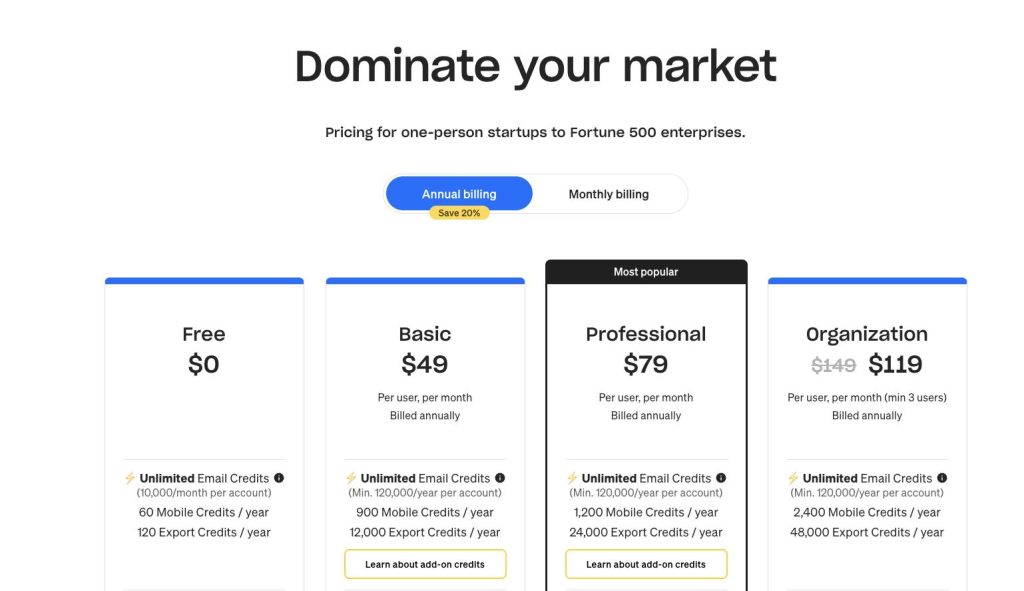
- Free Plan: Provides limited access to Apollo’s database and basic search filters. While useful for small sales teams or those exploring the platform, this plan lacks advanced features like automation and full data enrichment but is a great way to save money trying a new tool that may increase productivity. However, you will get up to 10,000 email credits per month, 60 mobile credits per year, and 120 export credits per year.
- Basic Plan ($59/month or $49/year per user): Offers access to Apollo’s extensive database, essential integrations and basic email outreach tools. This plan is ideal for startups or small businesses needing foundational sales tools. You’ll get unlimited email credits, 900 mobile credits per year, and 12,000 export credits per year.
- Professional Plan ($99/month or $79/year per user): Includes advanced features like automated email sequences, detailed analytics, and enhanced data enrichment. It also offers better integrations with CRMs, making it suitable for growing sales teams. You’ll get unlimited email credits, 1,200 mobile credits per year, and 24,000 export credits per year.
- Organization Plan ($149/month or $119/year per user, minimum 3 users): Designed for large organizations with complex needs. This plan includes full access to Apollo’s database, advanced AI tools for predictive analytics, unlimited automation, and dedicated customer support. You’ll get unlimited email credits, 2,400 mobile credits per year, and 48,000 export credits per year.
How Do the Credit Systems of ListKit and Apollo.io Compare?
The credit systems of ListKit and Apollo.io work fundamentally differently, which dramatically impacts your total cost of ownership. ListKit operates on a straightforward model where 1 credit equals 1 verified email contact, with credits rolling over month-to-month and allocated to your overall account rather than individual users. Additional credits cost between $39-$59 per 1,000 credits depending on your plan tier.
Apollo.io uses a dual-credit system that can be confusing. Email credits are generally unlimited for sending (subject to fair use policy of around 10,000 per month), while standard credits are consumed for revealing contact data. Revealing an email costs 1 credit, while mobile numbers cost 8 credits each. Credits are allocated per user per seat and expire at the end of each billing cycle with no rollover. Additional credits cost $0.20 per credit with a minimum purchase of 250 credits ($50) for monthly plans.
This means ListKit offers more predictable costs with credit rollover, while Apollo’s per-user, expiring credit model can lead to waste if credits aren’t used within the billing period.
ListKit vs. Apollo: Data Accuracy & Verification
Data accuracy and reliability is key when choosing a lead generation platform. Nobody wants high bounce rates or phone numbers that are no longer active. We’ll explore the differences in the size and quality of both ListKit and Apollo’s database to give you a better sense of how they stack up.
ListKit’s “Triple-Verification” Process Explained
ListKit’s triple-verification process is a three-stage validation system that sets it apart from competitors. The Primary Verification stage performs basic email syntax and domain validation to catch obvious errors. Secondary Verification conducts deep-level mailbox existence checks to confirm the email address is active and receiving mail. The Tertiary Verification stage uses proprietary validation for ‘catch-all’ servers that other tools typically flag as risky or unverifiable.
This comprehensive approach means ListKit can verify contacts that other platforms might reject, while maintaining significantly higher accuracy rates. With over 710 million contacts in their database, ListKit focuses on quality over quantity, ensuring bounce rates are significantly reduced and users consistently note the accuracy of contact data.
Apollo.io Data & Reliability
Apollo.io’s database contains over 275 million contacts and 60+ million companies, making it a substantial global database that meets most businesses’ needs. Apollo boasts 90% data accuracy and has been working to continually integrate AI into their data farming and validation processes to increase reliability.
However, there have been some customer reviews sharing concerns about data accuracy, with user experience being hit or miss. Apollo offers standard contact details, including name, email address, phone number, and general company details. While the platform provides extensive data coverage, the focus on database size sometimes comes at the expense of the rigorous verification processes that ListKit emphasizes.
ListKit vs. Apollo: Key Feature Breakdown
Both tools offer a lot to their target audiences. To help you decide which features would work best for you and your business, here’s a detailed breakdown of key features for ListKit and Apollo.io.
ListKit Features
Here are ListKit’s top features to keep in mind.
- Curated Lead Lists: Receive targeted lists customized for your industry and needs.
- High-Quality Data: Access verified contact information for precision in outreach.
- Straightforward Interface: Unlike Apollo, ListKit offers a simple navigation designed for ease of use.
- Compliance Assurance: Ensures GDPR and CCPA compliance for secure data handling.
Apollo.io Features
To help you compare the two tools, here’s a breakdown of Apollo.io’s top features.
- Advanced Search Filters: Pinpoint leads using detailed criteria.
- Automated Outreach Tools: Schedule and track email sequences.
- Data Enrichment: Similar to ListKit, Apollo offers fantastic data enrichment capabilities, allowing you to enhance contact details for deeper insights.
- Browser Extension: Unlike ListKit, Apollo offers a Chrome browser extension that allows you to access and add contacts via LinkedIn and other websites. This simple yet effective feature really sets Apollo apart.
- Extensive Integrations: Connect with CRMs and other sales tools seamlessly.
What are the AI Capabilities of ListKit vs. Apollo?
While both platforms leverage artificial intelligence, they apply AI in fundamentally different ways. Apollo.io provides comprehensive user-facing AI tools including an AI Research Agent for instant prospect insights, AI Outbound Copilot using advanced language models for personalized email generation, predictive lead scoring analyzing demographic and engagement data, AI filters for targeted list building, and call intelligence with transcriptions for sales call analysis.
ListKit’s AI works primarily on backend processes to power their “Triple-Verification” data process, AI-powered lead matching and curation for ICP targeting, and buying intent signal processing. The core difference is clear: Apollo’s AI assists with sales tasks like writing, scoring, and analyzing, while ListKit’s AI ensures data quality and verification behind the scenes.
For sales teams wanting AI assistance with outreach and lead qualification, Apollo offers more direct value. For teams prioritizing data accuracy over AI-powered sales assistance, ListKit’s backend AI approach delivers cleaner, more reliable contact data.
ListKit vs. Apollo: Integrations & API
Integrations are an important feature for virtually all lead generation tools, but you’ll see how different some data platforms can approach integrations with our comparison. Focusing on deep integration and API capabilities, Apollo focuses on becoming a truly integrated part of your workflow, while ListKit keeps integrations to a minimum to help streamline exports and data management.
ListKit Integrations
As we mentioned, ListKit focuses on simple integrations with popular tools, primarily focused on data export and data management. Here’s a quick breakdown of ListKit’s integration capabilities.
- Limited to essential tools for exporting leads.
- Custom APIs for specific requirements, enabling integration with in-house systems. Custom APIs allow sales teams with some tech skills to integrate with existing tools, but the configuration takes much longer than set integrations with other popular service providers.
Apollo.io Integrations
Unlike ListKit, Apollo.io focuses on a wide range of seamless integrations. Here’s what you need to know about Apollo.io’s integration and API capabilities.
- Extensive integrations with CRMs like Salesforce, HubSpot, and Pipedrive.
- APIs for enriching contact data and automating workflows, including integration with LinkedIn for seamless contact matching and outreach.
- Seamless connectivity with email marketing tools such as Gmail and other email/marketing tools.
ListKit vs Apollo: Ease of Use & Onboarding
Just as important as features and pricing is ease of use. Even the best features won’t make a platform a valuable tool if it isn’t easy to use. User experience is key, and as you’ll see here, one platform focuses on a simple, streamlined user experience while the other focuses on advanced features and capabilities that may not be simple to understand for most users.
ListKit Usability
ListKit’s usability sets it apart from Apollo – while the features may not be advanced, the interface is simple and straightforward, requiring little time to master the platform. It’s accessible for non-technical users, allowing sales teams to review curated contact lists immediately.
The platform is focused on curated contact lists and minimal integrations/API capabilities, meaning you simply log into the platform to get started. ListKit offers standard customer support, although Apollo’s customer support seems to be more robust.
Apollo.io Usability
Apollo’s platform is much more complex than ListKit’s and may require dedicated onboarding for sales teams to fully understand and master it. This means that implementation may be much longer when compared to ListKit, however, Apollo makes up for it with an excellent customer support team. You’ll find detailed documentation, tutorials, and on-demand live chat assistance available on their site.
How Does Customer Support & Onboarding Compare?
ListKit offers hands-on, coaching-focused support with free onboarding calls, 1-on-1 Cold Email Coaching Call on Scale plan ($297/month), access to Cold Email Mastery Program valued at $497, and G2 rating of 9.7/10 for support quality with under 2-hour response times. This personalized approach makes ListKit ideal for teams wanting direct guidance and training.
Apollo uses primarily a self-service model with extensive documentation, Apollo Odyssey learning platform, community forums, and live chat. Dedicated onboarding support is reserved for Organization plan ($119/user/month minimum 3 users) with G2 support rating of 8.8/10. While Apollo’s support is comprehensive, it’s less personal than ListKit’s coaching-focused approach.
How Do ListKit and Apollo Compare to Key Alternatives?
Understanding how ListKit and Apollo fit within the broader market landscape helps provide crucial context for your decision. Here’s how they compare against three major alternatives that sales teams frequently consider.
ZoomInfo
ZoomInfo is the enterprise-grade competitor with custom, annual contract pricing starting around $14,995-$19,000/year. Key features include advanced intent data with real-time streaming alerts, organizational charts mapping company hierarchies, database of 220+ million professional profiles, and AI-powered verification with 300-person research team. G2 named it No. 1 Enterprise solution for Buyer Intent Data in Spring 2024. ZoomInfo targets large enterprises while ListKit and Apollo serve small to medium businesses more effectively.
Cognism
Cognism is a premium sales intelligence platform focused on EMEA market and GDPR compliance. Key differentiator is Diamond Data® – phone-verified mobile numbers by human research team claiming 87% connection rates. Annual contract pricing with platform fee (~$15,000-$25,000) plus per-user licenses ($49-$99/month/user). No credit system – unrestricted data access. ISO 27001, SOC 2 Type 2 certified with DNC list scrubbing and data subject notifications. Cognism excels in European markets where ListKit and Apollo have less regional focus.
Lusha
Lusha offers user-friendly sales intelligence with credit-based pricing. Plans include Free ($0, 5 credits/month), Pro ($37.45/user/month, 500 credits/month), Premium ($59.95/user/month, 1,000 credits/month). Credit system: 1 credit for email, 5 credits for phone number. Credits roll over up to 12 months. Claims 81% accuracy rate for emails and phone numbers. Strong Chrome extension and simple interface but mixed reviews on data accuracy for niche markets. Lusha competes more directly with ListKit on simplicity while Apollo offers more comprehensive features.
ListKit vs. Apollo Reviews
Reviews of both ListKit and Apollo are solid, with great scores across the board. We reviewed user reviews on G2 and Reddit to get a sense of what customers say – here’s what you should know from fellow customers of ListKit and Apollo.
ListKit Reviews
It should be no surprise that users score ListKit highly for its simplicity and the quality of its contact lists. With contacts being triple verified and curated lists per industry, ListKit sets itself apart from other data platforms. However, some users feel limited by the lack of advanced features and integration capabilities.
Overall, we see ListKit getting 4 out of 5 stars and above in ratings, although the number of reviews is significantly smaller than Apollo, indicating a much smaller customer base.
Apollo.io Reviews
Like ListKit, Apollo receives 4 out of 5 stars and above in ratings across the board, with thousands of customer reviews. Customers highlight Apollo’s advanced features, capabilities, and built-in automation and outbound marketing tools. Some customers note that the tool can be difficult to use and note issues with data accuracy. The free plan is featured consistently in reviews, making it a great option for customers looking to try out a new platform.
The Verdict: Choose ListKit for Data Purity, Apollo for All-in-One Power
We’ve gone through a lot in comparing ListKit and Apollo, but which data platform is right for you? Here’s our final assessment!
Choose ListKit For Simplicity and Accuracy
Simplicity, accuracy, and ease of use – these are what set ListKit apart from Apollo. If you’re new to lead gen tools or your just looking for a simple, accurate tool, ListKit may be the right choice for your business. The curated, accurate lists of industry-specific contacts save your business time and money. You may also benefit from ListKit’s simplicity if you have a small team with focused needs.
Choose Apollo For Advanced Features and Scalability
If you’re a well-established organization looking for advanced features and scalability, Apollo.io may be your right choice. With powerful automation, extensive integration, and advanced platform features, the tool is designed to grow with your team. Offering versatility and seamless integration options, Apollo is ideal for larger sales teams and more complex campaigns.
Or, Try UpLead for Free Today
Looking for a balanced alternative? UpLead combines the best of both worlds, offering a vast database, powerful search filters, and compliance assurance. With a free trial available, it’s the perfect opportunity to explore a tool tailored for growing businesses.