

Not getting what you need from Leadfeeder? While it’s excellent for tracking website visitors, it might not have the data depth, filters, or pricing flexibility your team needs. Leadfeeder (which used the Dealfront name for a while) charges from €79/month billed annually for its Discover plan and offers a free Lite plan.
If you’re looking for a tool that fits your exact prospecting goals, here are 12 Leadfeeder alternatives, each with its strengths and limitations.
Top Leadfeeder Alternatives to Consider
1. UpLead
Best For: B2B teams that need accurate, real-time verified lead data with flexible prospecting options.
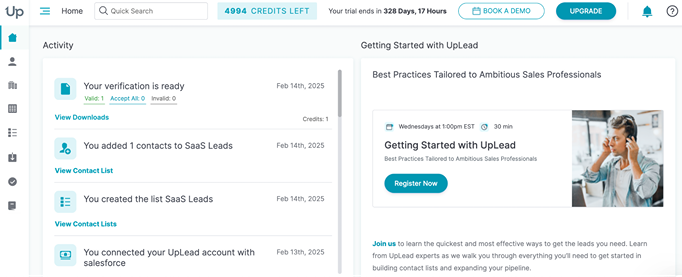
UpLead focuses on high-accuracy contact data, real-time email verification, and intent signals. While Leadfeeder identifies website visitors, UpLead gives you a broader approach: You can build targeted prospect lists and see who’s researching your sector.
It excels at filtering (e.g., industry, revenue, or software used) to quickly find qualified leads.
Pros
- Real-time verified data reduces bounces.
- Flexible filters by location, industry, and technology stack yield specific, relevant data.
- Intent data pinpoints high-intent leads for timely outreach.
Cons
- Trial credits offer a quick product overview but may not support large-scale testing.
UpLead Features
- Prospector Tool: Build targeted lists with multiple filters, including revenue range and tech usage.
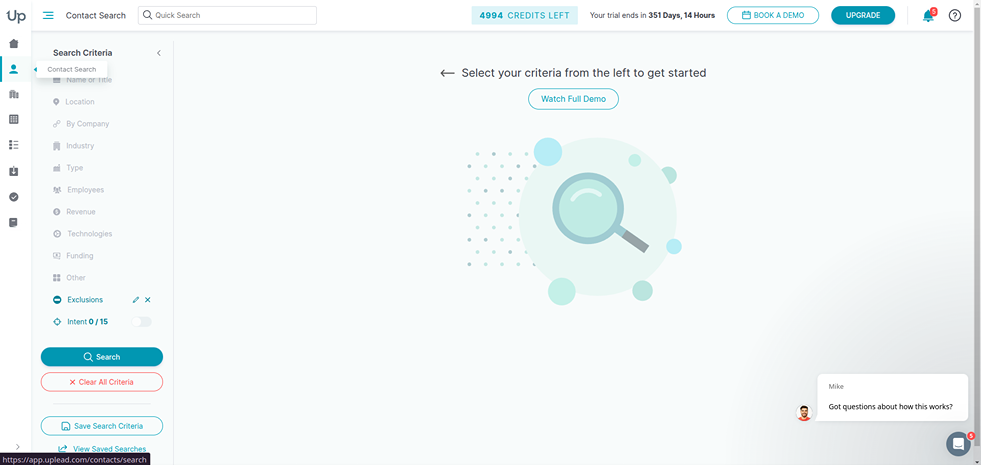
- Intent Data: Identify signals that indicate buying interest so you can reach out to prospects at the right time.
- Chrome Extension: Collect verified data on LinkedIn or company sites without switching tabs.
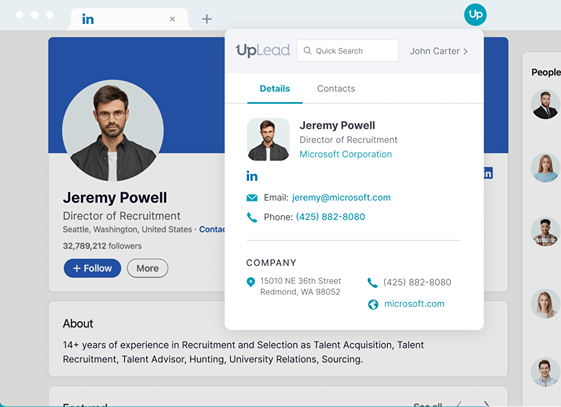
- Data Enrichment: Fill in missing fields (e.g., phone, email, or job title) and ensure existing data is correct.
- API Access: Connect UpLead data to your internal systems.
UpLead Plans & Pricing
Here are UpLead’s pricing plans, each personalized to different prospecting needs:
- Test Drive (Free Trial): $0 for 7 days (5 credits)
- Essentials (Monthly): $99/month (170 credits), or $74/month billed annually (2,040 credits/year)
- Plus (Monthly): $199/month (400 credits), or $149/month billed annually (4,800 credits/year)
- Professional (Annual): Custom pricing (for more info, contact sales)
What Customers Say
One G2 reviewer praises UpLead as a “game-changer,” highlighting its clean, accurate data and supportive team. They rely on it daily to connect with the right prospects and vendors, calling the outreach process effortless.
2. ZoomInfo
Best For: Large sales teams that need extensive global data, org charts, and advanced analytics.
ZoomInfo is a leading B2B intelligence platform that offers extensive contact coverage and direct dial information. Compared to Leadfeeder, ZoomInfo delivers deeper account insights, including company hierarchies, real-time funding alerts, and advanced enrichment. Its ability to quickly identify decision-makers across departments makes it a strong choice for enterprise-level sales teams.
Pros
- A database of hundreds of millions of business contacts, emails, and phone numbers, far exceeding Leadfeeder’s focus on website visitor tracking.
- Real-time email verification to ensure accurate contact data before outreach.
- Technographic filters to identify prospects based on their tech stack, intent signals, and firmographic details.
Integration with CRMS platforms like Salesforce, HubSpot, and others for enriched lead data.
- Advanced search filters and saved lists to speed up prospecting.
- Data enrichment tools to fill in missing details and create new sales opportunities.
Cons
- Higher price points can be challenging for smaller teams.
- Data accuracy can vary by region or industry.
ZoomInfo Features
- Org Charts: Visualize chains of command to identify multiple stakeholders.
- Scoops & Valuable Insights: Get alerts on recent funding rounds or leadership changes.
- Technographics: See which software tools a company uses for more tailored outreach.
- Data Enrichment: Bulk-update incomplete records with verified details.
ZoomInfo Plans & Pricing
ZoomInfo publishes no list prices. Here are the ZoomInfo plans with Tropic’s rate card figures. Vendr’s median contract is $33,500/year (range $7,200 to $156,000).
- Lite: Free (10 credits per month)
- Professional: $14,995/year (3 seats, 5,000 bulk credits)
- Copilot Advanced: $29,995/year
- Copilot Enterprise: $35,995/year
What Customers Say
One G2 reviewer calls ZoomInfo Sales an “improved product,” highlighting Copilot’s ability to provide timely account data to sales directors. They praise the thorough onboarding, note strong support from the account manager, and mention only minor Salesforce integration limitations.
3. HubSpot Breeze Intelligence (formerly Clearbit)
Best For: Marketing and SaaS teams that need real-time data enrichment and quick access to detailed prospect information.
Clearbit is no longer sold as a standalone product. Its enrichment and visitor identification now live inside HubSpot as Breeze Intelligence, and you need a HubSpot account to use them. It enriches inbound leads and sign-ups by appending firmographic and social data in seconds.
Breeze Intelligence improves captured leads with detailed insights, including industry, job titles, and social profiles. It provides rapid data updates through flexible APIs, making it ideal for businesses that need real-time personalization and advanced marketing automation.
Pros
- Offers visitor tracking (Reveal) to identify key accounts.
- Many customization options for different campaign needs.
Cons
- Credits-based pricing models, dependent on database size, may be confusing.
- Advanced features sometimes require extra technical setup.
Breeze Intelligence Features
- Enrichment API: Append firmographics and role data to form submissions in real time.
- Reveal: Identify otherwise anonymous visitors to tailor personalized marketing campaigns.
- Data Segmentation: Group leads by role or company size to improve targeting.
Breeze Intelligence Plans & Pricing
Breeze Intelligence runs on HubSpot Credits at $0.01 per credit ($10 per 1,000-credit pack); paid HubSpot seats include a monthly credit allowance. The old Breeze Intelligence Credits were retired in June 2025, and the archived standalone Clearbit plans are no longer sold.
What Customers Say
A Limo services provider notes that Clearbit “quickly gathers customer demographics, firmographics, and other key data. By aligning marketing and sales strategies with these insights, the team can run more focused outreach and close deals sooner.”
4. Cognism
Best For: Global teams seeking GDPR-compliant, phone-verified lead data.
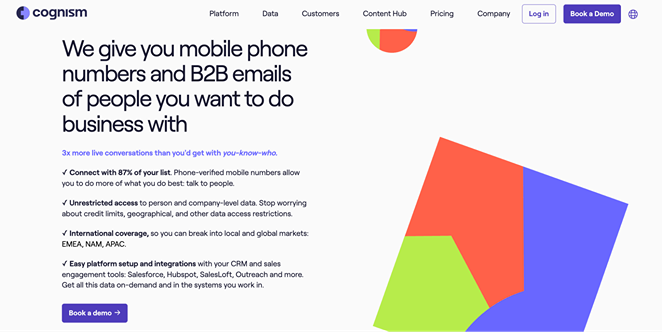
Cognism is a compliance-focused B2B platform offering real-time data verification across multiple regions. It focuses on phone-verified contacts and advanced compliance standards by delivering more reliable direct dials and specialized features for regions with strict privacy regulations.
Pros
- Provides high-quality contact data with verified emails and mobile numbers.
- Custom revenue range filters enable more precise targeting.
- Offers stronger B2B sales intelligence with direct prospect data.
Cons
- No transparent pricing.
- Pricing and trial access both require a sales call.
Cognism Features
- Intent Data: Detect when leads are actively researching your solution.
- Phone Verification: Reduce invalid numbers and improve call outreach.
- CRM Integrations: Sync data easily with Salesforce or HubSpot.
- Sales Intelligence: Gain insights into engagement patterns to refine targeting.
Cognism Plans & Pricing
Cognism does not disclose specific pricing on its website. Here are Cognism’s pricing details: Cognism sells Standard and Pro packages (5 seats included each), plus CRM Enrichment and Data-as-a-Service. Prices are quote-only. Vendr’s data from 109 purchases puts the median contract at $36,000/year (range $17,832 to $93,209).
What Customers Say
Multiple users cite Cognism’s high-quality data and intuitive interface, making lead generation and sales intelligence more efficient. The platform’s custom revenue range filters and contact data indicators help refine targeting, leading to more accurate and effective outreach via mobile and email.
5. Albacross
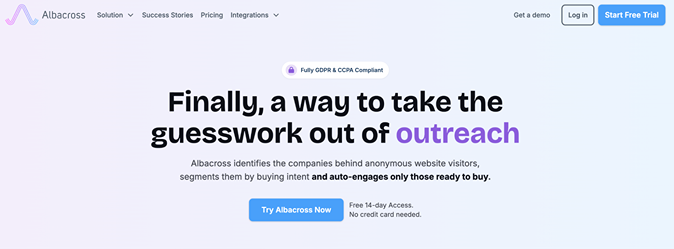
Best For: Companies that want to track anonymous website visitors and score potential leads.
Albacross tracks company visits and enriches them with firmographic details, helping businesses better understand their audience. Its automated lead scoring stands out by prioritizing high-value accounts, making it easier to focus on the most promising prospects.
Pros
- Strong website visitor tracking, similar to Leadfeeder, but with automated lead scoring to prioritize high-value prospects.
- Easy CRM integration.
- Real-time visitor insights help businesses act quickly on warm leads.
- User-friendly interface with simple setup compared to some competitors.
Cons
- Limited contact-level data compared to Leadfeeder’s more firmographic insights.
- Focuses mainly on website analytics and lacks direct prospecting tools like UpLead.
Albacross Features
- IP-to-Company Matching: Detect which organizations browse your site.
- Lead Scoring: Rate visitors based on how they engage with content.
- CRM Sync: Stream visitor data directly into your pipeline.
- Visitor Insights: Review page views and session durations to gauge interest.
Albacross Plans & Pricing
Here are the Albacross pricing plans. Pricing scales by identified companies, not per user, and there is a 14-day free trial:
- Starter: €59/month billed yearly (€84 monthly), up to 100 identified companies/month
- Professional: €149/month billed yearly (€213 monthly), up to 500 companies/month
- Organisation: Custom pricing, annual only
What Customers Say
Albacross is a powerful tool for identifying website visitors and running targeted outreach, but its pricing feels high for the features offered. Users praise its automated reports and ad-targeting capabilities but also cite the limited integrations for social media sites like LinkedIn and Facebook.
6. ListKit
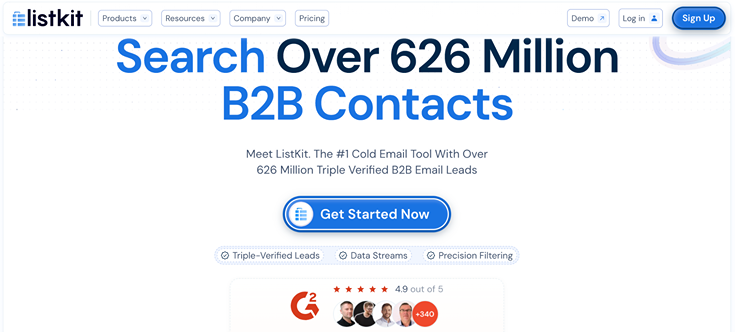
Best For: Teams that want B2B contact data and cold email sending in a single subscription.
ListKit bundles B2B contact data with cold email sending, managed inboxes and an AI script writer in a single subscription. Compared to Leadfeeder, which provides insights into engaged companies, ListKit gives you a 977M+ contact database for direct outreach without relying on website activity.
Pros
- Large contact database (977M+ contacts) that ListKit markets as triple-verified to reduce bounce rates.
- Cold email sending and managed inboxes are included, so you need fewer separate tools.
- One all-in-one plan keeps pricing simple.
Cons
- The single $597/month plan is expensive for teams that only need contact data.
- No free plan to test the data before you pay.
ListKit Features
- Contact Database: Search 977M+ contacts by location, industry, or job title.
- Email Verification: Contacts are triple-verified before export to lower bounce rates.
- Cold Email Sending: Run campaigns from managed inboxes inside the platform.
- AI Script Writer: Draft cold email copy with built-in AI.
ListKit Plans & Pricing
Here are the ListKit pricing plans:
- Full Cold Email Stack: $597/month (1,000 emails/day, higher volume tiers available; no free plan)
What Customers Say
A reviewer on Reddit discovered ListKit while exploring B2B email generation tools and was intrigued by its Intent Data feature, which allows users to pull data on people searching for specific keywords. However, they note that this feature is only available on the Pro plan, and other users echoed frustration at the pricing plans.
7. Apollo.io
Best For: Businesses want an all-in-one solution combining data sourcing with integrated outreach tools.
Apollo.io offers an extensive database of B2B contacts and built-in sequencing for emails and calls. It combines lead discovery with automated outreach, making it a better fit for teams looking to manage prospecting and follow-ups in one place.
Pros
- Larger database with extensive contact and company details compared to Leadfeeder.
- Built-in email outreach tools for direct prospecting.
- Automated workflows and sequences simplify sales efforts beyond Leadfeeder’s capabilities.
- Data enrichment and intent signals provide deeper insights into prospect activity.
Cons
- Less focus on website visitor tracking, which is Leadfeeder’s core use case.
- Limited real-time company identification, whereas Leadfeeder specializes in tracking anonymous visitors.
Apollo.io Features
- Contact Database: Millions of verified leads searchable by role, industry, or geography.
- Sequence Automation: Automate drip campaigns for email and calls.
- LinkedIn Extension: Export contact info directly from LinkedIn profiles.
- Metrics Dashboard: Track opens, replies, and call outcomes in one place.
Apollo.io Plans & Pricing
Here are Apollo.io’s pricing plans:
- Free: $0/month (75 credits per month)
- Basic: $49/user/month (annually) or $65/user/month (monthly)
- Professional: $79/user/month (annually) or $99/user/month (monthly)
- Organization: $119/user/month billed annually (minimum 3 users); larger custom plans via sales
What Customers Say
A G2 reviewer shares that Apollo.io makes outbound sales easier with its built-in email automation and a vast, high-quality contact database. However, they criticize the limitation of not being able to map multiple users under a single account.
8. Seamless AI
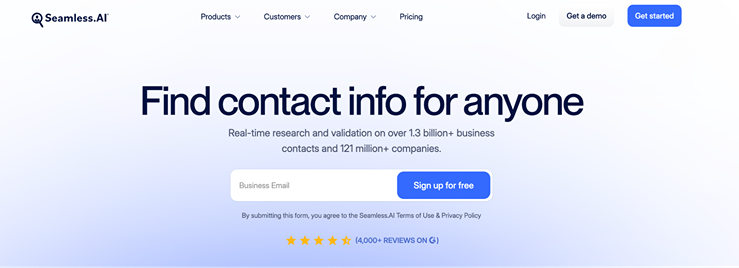
Best For: Sales teams seeking AI-driven lead discovery and quick verification across multiple online sources.
Seamless AI focuses on real-time contact data collection, offering verified emails and phone numbers sourced from multiple online channels. It’s more suited for teams that require direct access to decision-makers for outbound sales and cold outreach.
Pros
- Faster contact discovery with real-time web scraping.
- Browser extension makes LinkedIn and website prospecting easier.
- CRM and marketing automation integrations simplify outreach.
- Data enrichment and verification reduce bounce rates.
Cons
- No website visitor tracking.
- Data inconsistencies may require manual verification.
Seamless AI Features
- AI-Driven Searches: Collates data from social media, company pages, and other open web sources.
- Bulk Prospecting: Allows you to upload multiple names or domains to find leads in volume.
- Verification Checks: Flags invalid or risky emails to lower bounce rates.
- Browser Plugin: Capture leads as you navigate LinkedIn or official websites.
Seamless AI Plans & Pricing
Here are the pricing plans offered by Seamless AI. The platform does not disclose exact pricing, so you’ll need to contact sales for details. Buyers report $5,000 to $30,000 per year (Spendflo); Spendhound puts the average SMB contract at $7,991/year.
- Free: 1 user, 50 credits
- Pro: Per user, annual credit packages starting at 10,000 credits
- Enterprise: Custom pricing, unlimited users
What Customers Say
A LinkedIn user finds Seamless.AI a powerful tool for real-time contact discovery, helping sales teams access fresh, accurate data. They highlight its strong AI-driven search but note occasional inconsistencies and a higher price for larger teams.
9. LeadIQ
Best For: Sales teams that want quick LinkedIn data collection and straightforward lead handoff to their CRM.
LeadIQ gathers contact details directly from LinkedIn profiles, letting you transfer them into your CRM or email outreach tool. It excels at real-time LinkedIn scraping and quick contact creation, making it better suited for teams whose primary prospecting happens on LinkedIn.
Pros
- More accurate contact details (emails and phone numbers) than Leadfeeder, making it better for direct outreach.
- Free plan available with 50 credits per month, while Leadfeeder’s free Lite plan only shows the last 100 identified companies per month.
- Easier CRM integration with direct syncing to Salesforce, Outreach, and SalesLoft.
- AI-powered email generation helps automate outreach, which Leadfeeder lacks.
Cons
- Limited visitor tracking.
- The free plan is restrictive for larger teams.
- No deep website analytics like Leadfeeder, making it less useful for understanding visitor behavior.
LeadIQ Features
- LinkedIn Capture: One-click button to pull verified emails from LinkedIn.
- Email Outreach: Launch drip campaigns straight from the platform.
- CRM Sync: Automatically update Salesforce, HubSpot, or other CRMs.
- Collaboration: Tag colleagues and share leads within the same workspace.
Plans & Pricing
Here are the LeadIQ plans:
- Free: $0/month, 1 user, 50 credits (email = 1 credit, phone = 10 credits)
- Pro: From $200/month for up to 5 users (200 credits, more via a credit slider; 25% off annually)
- Enterprise: Custom users and credits
What Customers Say
A G2 reviewer shares that LeadIQ has an easy-to-use interface, CRM integration, and accurate data for prospecting. The free plan with 50 credits per month is a big plus, making it an excellent option for small teams.
10. Demandbase
Best For: B2B marketers looking to use account-based strategies and tailor content to specific businesses.
Demandbase zeroes in on account-based marketing (ABM), customizing website experiences and ads for identified companies. It also adds advanced personalization and predictive analytics to move leads through the funnel.
Pros
- Stronger ABM features than Leadfeeder, making it better for targeting high-value accounts.
- Demandbase offers intent data and account prioritization to focus on accounts showing buying activity. Leadfeeder also offers intent-signal filtering in its Activate plan, so intent data alone is not a unique Demandbase advantage.
- Deeper firmographic and technographic insights for B2B sales teams.
Cons
- Real-time website visitor tracking lacks detail.
- Heavily focused on enterprise users, while Leadfeeder is more accessible for SMBs.
- Requires more data input and strategy, whereas Leadfeeder works with minimal setup.
Demandbase Features
- Account Identification: Maps site visitors to specific organizations.
- Intent Signals: Identify and prioritize leads already at the buying stage.
- Ad Personalization: Serve tailored ads to your key accounts.
- Journey Analytics: Track each account’s activity across various channels.
Demandbase Plans & Pricing
Demandbase’s pricing structure is customized to each organization’s unique needs. Each plan includes a platform fee that covers essential software and services, complemented by a flat per-user fee for scalability. Vendr’s data from 185 purchases puts the median contract at $68,591/year (range $24,000 to $164,265). Demandbase One is listed on AWS Marketplace at $215,000 for 12 months.
What Customers Say
On Gartner Peer Insights, a user praises Demandbase for its balance of simplicity and depth, making it easy to use while offering advanced targeting. However, they note that essential add-ons like orchestration were not clearly highlighted upfront, leading to unexpected budget adjustments later.
11. RocketReach
Best For: Individuals and teams needing direct email lookups from names, domains, or LinkedIn profiles.
RocketReach provides verified contact details, including emails and phone numbers, making it optimal for direct outreach. This differentiates it from Leadfeeder’s account-level tracking, which is more suited for anonymous website traffic.
Pros
- Access to over 700 million contacts at 60 million companies.
- Advanced search filters for targeted prospecting.
- AI-powered recommendations for relevant leads.
- CRM and API integrations for a smooth workflow.
- Chrome extension for quick lookups on LinkedIn and other websites.
- Offers intent data to identify high-value prospects.
Cons
- No website visitor tracking like Leadfeeder.
- Free plan has limited searches before requiring payment.
- Some users report occasional data inaccuracies.
RocketReach Features
- Name/Domain Lookup: Enter a person’s name or a company domain to retrieve verified contact info.
- Bulk Searches: Process multiple names simultaneously for faster prospecting.
- Browser Extension: Grab contact details while browsing LinkedIn or corporate sites.
- Email Verification: Reduce bounce rates by screening out invalid addresses.
RocketReach Plans & Pricing
RocketReach offers a range of personalized pricing plans to individual users and teams. Here’s a breakdown of their offerings:
Individual Plans
- Essentials: $39/month or $19/month billed annually ($229/year), email only, 1,200 exports per year on annual plans
- Pro: $79/month or $52/month billed annually ($619/year), email and phone, 3,600 exports per year on annual plans
- Ultimate: $169/month or $115/month billed annually ($1,379/year), 20,000 exports per year on annual plans
Team Plans
- Custom team plans: From $6,000/year
What Customers Say
A Capterra user finds RocketReach easy to use with a high success rate in identifying leads, outperforming other tools tested. They note that the pricing is a bit confusing, but the overall experience has been positive.
12. 6sense
Best For: Enterprise-level teams seeking AI-driven account predictions and precise timing for outreach.
6sense processes multiple data sources to predict which accounts are most likely to convert in the near future. Unlike Leadfeeder, which focuses on a specific engagement metrics, 6sense uses intent data, buyer signals, and AI to anticipate where an account stands in the purchasing process.
Pros
- Predictive analytics for prioritizing sales outreach.
- Deeper insights into buying behavior and sales readiness.
- Multi-source data aggregation beyond website tracking.
- Advanced CRM and marketing automation integrations.
Cons
- No transparent pricing; it requires a demo and custom quote.
- Higher learning curve due to advanced AI-driven insights.
6sense Features
- Predictive Insights: AI forecasts which accounts show the strongest purchase intent.
- Intent Data Integration: Consolidates signals from web, email, and third-party sources.
- Process Orchestration: Aligns marketing and sales actions according to each account’s stage.
- Attribution: Track which campaigns or content drive real engagement.
6sense Plans & Pricing
6sense does not offer explicit pricing details on its website; users must contact sales for a customized quote based on their needs. 6sense replaced its Team, Growth and Enterprise plans with a credit-based license sold in three bundles (Sales Intelligence with data credits, Predictive AI, or both). A free Sales Intelligence signup still exists. Prices are quote-only: Vendr’s median is about $63,000/year (range $11,753 to $177,404).
What Customers Say
A G2 user appreciates how 6sense Revenue AI for Sales simplifies prospecting with powerful filtering tools and intent data for more targeted outreach. However, they also mention that setup can be time-consuming, and some data insights may not always be fully accurate.
Key Considerations for Choosing a Leadfeeder Alternative
Selecting a Leadfeeder alternative requires a clear focus on data accuracy, advanced features, budget constraints, and user-friendly implementation. Whether you’re a sales rep or part of a marketing team seeking B2B website visitor tracking, a capable B2B lead generation tool should be able to handle anonymous website visitors, verify email addresses, and offer visitor identification capabilities all at once.
Before you commit to a tool and its paid plan, consider these factors:
- Data Coverage & Quality
If you send emails to invalid addresses or outdated phone numbers, you’ll waste resources. Look for tools that verify contact information in real time or maintain frequent database updates. High-quality data translates into fewer bounces and more meaningful conversations. - Integrations
A platform that syncs smoothly with your CRM data, marketing automation system, or sales engagement software saves you hours of manual work. Many providers offer direct connectors or open APIs. Confirm that these integrations align with your current tech stack to avoid compatibility issues. - Budget
Different platforms bill by credits, seats, or usage tiers. Calculate the cost per lead or per month to see if it fits your growth strategy. Small teams might benefit from flexible pay-as-you-go plans, while larger organizations can use annual deals with higher lead volume. - Implementation
Some solutions can be installed and configured in minutes. Others require more specialized, technical skill. Evaluate your team’s bandwidth, especially if you’re juggling multiple new tools. - Customer Support & Training
Timely support can make or break your experience. Check if the provider has accessible documentation, live chat, or dedicated account managers. Responsive help reduces downtime and helps you adopt new features efficiently.
By comparing factors like data accuracy, integrations, budget flexibility, and training resources, you can choose a Leadfeeder alternative that truly boosts your outreach. The right choice helps you focus on warm leads, run efficient campaigns, and close deals faster.
Why Is UpLead the #1 Leadfeeder Alternative?
UpLead outperforms Leadfeeder across the board by combining real-time verified data, advanced filtering, and intent insights into one intuitive platform. Instead of only tracking B2B website visitors, UpLead provides deeper insights into each prospect’s ideal customer profile, including company size, technographics, and key decision-makers.
This lets you refine your outreach efforts with targeted emails, saving sales teams from manually sorting through anonymous website visitors and speeding up your sales funnel.
Its 95% data accuracy guarantee reduces bounced emails, while intent data signals show you exactly when leads are in buying mode.
Because UpLead works on a transparent credit-based pricing system, it’s easy to scale up or down depending on your prospecting volume. You also benefit from a user-friendly Chrome extension that sources contacts directly from LinkedIn or company websites.
Ready to see the difference accurate data can make? Sign up for a free trial to immediately benefit from verified contact lists, minimal data waste, and higher conversion rates. For B2B prospecting, UpLead sets a new standard for reliability and reach.
Frequently Asked Questions
Leadfeeder and Echobot merged under the Dealfront name. The company has since rebranded back to Leadfeeder, and dealfront.com now redirects to leadfeeder.com.
Yes, Leadfeeder is GDPR compliant because it processes user data in accordance with EU regulations. It also provides options for visitors to opt-out or anonymize their data.
The main difference between Leady and Leadfeeder lies in their feature sets. Leady focuses on identifying companies and delivering simplified analytics, while Leadfeeder integrates more deeply with Google Analytics and offers extra filtering to help qualify leads.