


| Target user | Pricing transparency | Free access | Database claims | Integrations (examples) | Standout strengths | Trade-offs |
|---|---|---|---|---|---|---|
| ABM teams with predictive needs | Quote-based; no public pricing | Free plan: 50 credits/month with Company & People Search, Sales Alerts, List Builder, Chrome extension | ~450M B2B profiles, 65M+ companies, 100M+ emails, 55M+ direct dials | Salesforce, Microsoft Dynamics, HubSpot, Marketo, Eloqua, Salesforce Marketing Cloud Account Engagement | Predictive account scoring, intent data, ABM automation | Paid tiers are quote-based and implementation takes time |
| Large enterprise sales & recruiting teams | Quote-based; no public pricing | No public free plan on site. Evaluation is sales-led. | Large global database; official accuracy rate and totals are not published on site | Major CRMs and engagement platforms | Deep customization, broad integrations, intent alerts | High cost, complex interface |
You must choose between account-based marketing with intent insight and contact-level list building. The wrong pick wastes months and budget. Choose 6sense for ABM with predictive account scoring and intent. Choose ZoomInfo for a large contact database with engagement add-ons and deep customization.
6sense vs. ZoomInfo Overview
Here’s a brief overview of what each tool has to offer. We’ll explore each in detail throughout the article, but it’s always good to start with a high-level review to get an overall sense of each platform and what they can offer.
6sense
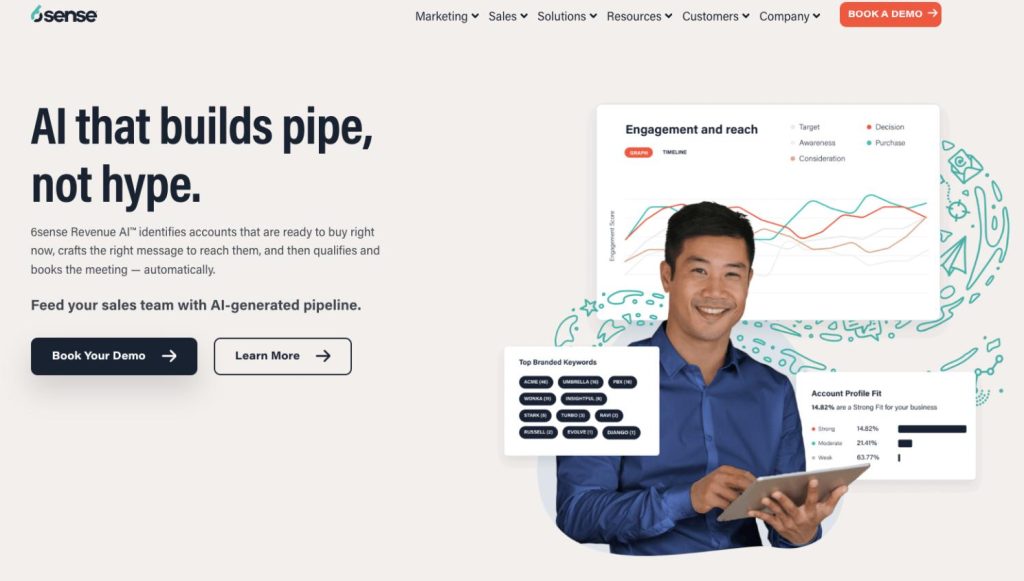
While the lesser known of the two, 6sense is a strong contender in the lead generation marketplace. The tool uses AI to remove manual work. 6sense focuses on automation and predictive analytics to provide curated lists of accounts by industry.
The platform enhances account engagement through personalized content and enhanced account-based marketing tools. If your sales and marketing team uses ABM practices, 6sense may be a great tool to use. Sales Intelligence highlights in-market accounts, reveals decision-makers, and guides outreach timing.
ZoomInfo
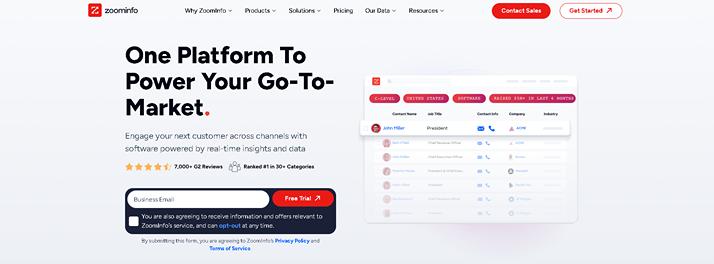
One of the leading B2B databases on the market, ZoomInfo is a global powerhouse. Designed to serve large, complex sales organizations, ZoomInfo has a host of tools and features to help teams grow and scale. The platform has powerful features, and while it can be complex to implement, it’s a flexible platform once it’s set up. Some top features include CRM integration, lead building, data management, and more.
ZoomInfo also provides tools, including Engage, Intent, and Chorus, which we’ll explore later in the article.
What is the Difference Between ZoomInfo and 6sense?
The main difference between ZoomInfo and 6sense is the approach to lead generation. ZoomInfo focuses on individual contact lead generation, while 6sense focuses on strategic account targeting. There are many other differences between the platforms, but it’s important to understand this key fundamental difference in approach.
Understanding and leaning into your marketing strategy (lead generation vs ABM) is the key to choosing which is right for you. Users will also find differences in the tools and features available, the usability of the platform, and pricing. Here’s a breakdown of their primary differences:
Primary Focus:
- ZoomInfo: Specializes in lead generation and contact discovery, offering a large global database of business contacts, direct emails, and company insights.
- 6sense: Focuses on predictive analytics and account-based marketing (ABM), using AI to identify intent and prioritize accounts. It also provides a database of individual and account-level contact details.
Core Features:
- ZoomInfo: Provides detailed contact profiles, sales triggers, and tools to research individual prospects.
- 6sense: Offers account scoring, buyer intent data, and multi-channel engagement tools for strategic targeting. Both tools offer in-platform features that help with outbound marketing efforts.
6sense vs. ZoomInfo Comparison
Here’s a comprehensive side-by-side view of how 6sense and ZoomInfo stack up.
| 6sense | ZoomInfo | |
| Use Cases | Account-based marketing, predictive analytics | Lead generation, contact discovery, sales prospecting, and data enrichment |
| Database Size & Reliability | ~450M individual B2B profiles, 65M+ companies, 100M+ emails, 55M+ direct dials | Large global database; official accuracy rate and totals are not published on site |
| Data Enrichment Features | Advanced tools enhance contact details with insights like job titles, company size, and company insights | Provides real-time updates on contact and company data |
| Lead Management | Account prioritization, intent data-driven scoring, and pipeline acceleration tools | Contact management, customizable workflows, and tracking engagement through the sales funnel |
| AI Features | Workflow founded on advanced AI capabilities | Intent data and lead scoring driven by AI |
| Integrations | Integrates with Salesforce, Microsoft Dynamics, HubSpot, Marketo, Eloqua, and Salesforce Marketing Cloud Account Engagement | Integrates with major CRMs and engagement platforms |
| Ease of Use | Simpler interface with advanced features, making it great for all team sizes | More complex interface designed for large, experienced teams |
| Compliance | Compliant with both GDPR and CCPA | Compliant with both GDPR and CCPA |
| Browser Extension | Yes | Yes (Chrome Web Store) |
| Free Access? | Free plan: 50 data credits/month with Company & People Search, Sales Alerts, List Builder, and a Chrome extension | No public free plan on site. Evaluation is sales-led. |
| Advantages | Predictive analytics and account prioritization, intent insights, strong ABM features | Global database updated in real-time, intuitive sales prospecting |
| Disadvantages | Paid tiers are quote-based and implementation takes time | Higher cost than most competitors, complex user interface |
Core Features of 6sense vs. ZoomInfo
Here’s how the core features of both 6sense and ZoomInfo compare.
6sense Features
6sense uses AI capabilities, leading to better automation and fewer manual processes. Here are some of 6sense’s key features to be aware of.
- Integration Capabilities: Connects with popular CRM platforms like Salesforce and HubSpot.
- Enhanced Account Engagement Insights: 6sense tracks buyer behaviors across multiple channels to help you target better accounts. There are a number of data points that 6sense uses to predict buyer behavior and where they may be in the sales funnel.
- Predictive Analytics: 6sense uses AI to identify high-value prospects at the onset, allowing you to focus on clients with a higher potential for conversion.
- Account-Based Marketing Tools: The platform allows you to personalize campaigns based on account-level data, making it an ideal option for teams that use account-based marketing strategies.
ZoomInfo Features
With larger enterprise customers in mind, here are some of ZoomInfo’s top features.
- Integration Capabilities: Similar to 6sense, ZoomInfo offers integration options.
- Proactive Intent Data and Alerts: The proactive alerts feature helps set ZoomInfo apart from 6sense and other similar B2B lead databases. ZoomInfo notifies you of customers within your target demographic that are more likely to be at the purchasing stage.
- Lead Builder: The lead-building tool lets you filter across data points, meaning you can build the exact list your team needs to succeed.
Database & Reliability
Database size and reliability are two key factors when choosing any lead generation service. Let’s take an in-depth look at both 6sense and ZoomInfo’s databases.
6sense Data
Both 6sense and ZoomInfo have large databases, with 6sense having ~450M individual B2B profiles, 65M+ companies, 100M+ emails, and 55M+ direct dials. Offering global coverage, the size of 6sense’s database is great for businesses of all sizes.
Beginning June 2025, 6sense refreshes Master Company Data monthly to improve accuracy, coverage, and matches. In terms of data points, you’ll see emails, phone numbers, name details, and general company information.
ZoomInfo Data
ZoomInfo has a large global database; official accuracy rate and totals are not published on site.
Data is sourced through submissions of data from third parties as well as internal algorithms to gather data across the web. The datasets provide the same information (name, email, company contact details, etc.), and both platforms have their data updated regularly.
Use Cases for 6sense vs. ZoomInfo
What is each tool used for? What’s the right customer type for both 6sense and ZoomInfo? Here are some quick use cases to help you understand the target customer for each platform.
6sense Customers
6sense uses account-based marketing, meaning teams that use ABM tactics today are a great fit for 6sense. ABM allows for account-level information rather than (or in addition to) individual contact details. With this approach, teams reach out to companies as a whole rather than targeting individuals within the business. With intent data, 6sense makes it easier to identify accounts or businesses that may be in a position to buy.
As an example, a B2B shared services company may specialize in outsourcing operations. They may target accounts rather than individual decision-makers because the solutions they provide are company-wide. 6sense would help create a curated list of accounts and personalized content development for those target accounts.
ZoomInfo Customers
ZoomInfo was designed with large enterprise customers in mind. Focusing on traditional lead generation methods, ZoomInfo has an individual contact database. ZoomInfo is beneficial for large companies focused on accelerated growth.
Plans & Pricing
Neither 6sense nor ZoomInfo are transparent about their pricing, but here’s what we could gather around pricing for each.
6sense Cost
6sense has no published pricing, so you’ll need to contact the sales team for a custom price quote. There is a free plan: 50 data credits/month with Company & People Search, Sales Alerts, List Builder, and a Chrome extension. In reading customer reviews, pricing may be high compared to competitors.
ZoomInfo Cost
Professional starts at $14,995/year and includes 5,000 bulk credits. Advanced and Elite increase the base and add 1,000 monthly user credits per seat. Per-user fees apply. Add-ons: Worldwide Data $9,995; FormComplete $7,500 (5,000 bulk credits); Enrich $15,000 (25,000 bulk credits); InboxAI Premium $480/user; Engage $15,000; NeverBounce 1M verifications $3,000; Attributes $8,000; Compliance API $5,000 for 50,000 calls plus $0.10 per extra call. Bulk credit tiers scale from $0.60/credit (5,000) to $0.20/credit (2,505,000+).
Contracts are annual. No true monthly subscription.
Integrations & API
If you don’t have a tool that can integrate with your existing software suite, even the most powerful tools can fall short. Here’s how 6sense and ZoomInfo stack up when it comes to integration and API capabilities.
6sense Integration Capabilities
6sense offers key integration capabilities with major CRM platforms and open API usage. Here’s what you need to know about 6sense’s integration features.
- Integrates with Salesforce, Microsoft Dynamics, HubSpot, Marketo, Eloqua, and Salesforce Marketing Cloud Account Engagement, making it simple to connect your B2B lead generation database with your central CRM.
- Open API allows you to integrate with in-house systems, further enriching your data and giving you the flexibility to integrate with your own platforms.
- Works well with other ABM platforms, allowing you to enhance your account-based marketing tactics.
ZoomInfo Integration Capabilities
ZoomInfo uses integration and API capabilities. It’s likely that ZoomInfo can integrate with your current suite of software. Here’s what you need to know about ZoomInfo’s integration features.
- ZoomInfo can integrate with Salesforce, Microsoft Dynamics, Slack, and more, allowing for automation and streamlining of sales processes.
- Integrates with major CRMs and engagement platforms.
- Multiple API options, giving you customization and control over your integrations.
Implementation & Interface
Once you’ve made the purchase, how easy is it to set up? Will you have ongoing support if things go wrong? Here’s what you need to know about 6sense and ZoomInfo’s implementation, interface, and ongoing support.
6sense Usability
Users say that 6sense is straightforward, and even though it offers a number of advanced features, the platform is simple to navigate. Ease of use goes a long way with end users, allowing teams to be productive with the tool faster.
Implementation and ongoing support are provided by a dedicated account manager, which is a major win for a company of this size. You’ll get dedicated implementation support, onboarding, and ongoing support and training. On-demand training resources are available to team members and a dedicated contact for more complex issues.
ZoomInfo Usability
ZoomInfo’s interface is search-driven, making it easy to navigate. However, some users say that ZoomInfo’s advanced features can be difficult to navigate and learn. ZoomInfo offers dedicated onboarding and training for new teams and 24/7 support.
The platform provides open customization, and while this may take more time to set up and implement, it’s worth it in the long run. Both 6sense and ZoomInfo offer the right implementation and onboarding support, although 6sense seems easier to navigate according to real users.
Compliance, Privacy & Security
Whether you’re building a list of 10 contacts or 1,000, the data needs to be compliant and secure. Here’s how each platform manages compliance, privacy, and security.
6sense
SOC 2 Type 2 and ISO/IEC 27001 certified, with GDPR/CCPA/CPRA and Data Privacy Framework commitments listed in the Trust Center.
ZoomInfo
ZoomInfo adheres to GDPR and CCPA requirements. The platform collates publicly available and third-party data but includes detailed individual profiles. There is an opt-out option for data subjects. The focus is on data protection protocols, including encryption and continuous monitoring to maintain secure environments.
Customer Reviews of 6sense vs. ZoomInfo
We reviewed third-party sites to get a sense of how customers are enjoying (or not enjoying) these two platforms. Here’s a snapshot of what customers say about each.
6sense Reviews
6sense customers give the platform high ratings, focusing on the AI features, enhanced account-based marketing capabilities, and predictive insights. However, as we mentioned earlier, pricing may be an issue. Customers note that the price may be a little higher compared to competitors, although it isn’t clear what each reviewer may have paid for the services.
ZoomInfo Reviews
ZoomInfo customers also give the platform high ratings, with many of them highlighting the advanced features, customization, and customer support.
6sense vs. ZoomInfo Pros & Cons
We’ve gone through a ton of information about both 6sense and ZoomInfo. To help you narrow down your choice, we’ve listed our top pros and cons for each.
6sense Pros & Cons
Here’s a quick breakdown of 6sense’s pros and cons.
Pros:
- Advanced AI capabilities
- Strong account-based marketing focus
- Comprehensive account insights and intent data
- Wide range of integrations and capabilities
Cons:
- Paid tiers are quote-based and implementation takes time
- Lack of transparency in pricing
ZoomInfo Pros & Cons
And here are the top pros and cons for ZoomInfo.
Pros:
- A streamlined platform that’s intuitive and easy to navigate
- Intent data and alerts identify prospects that are approaching the buying stage of the sales funnel
- Ability to integrate with business apps, meaning you can connect to your full tech suite
Cons
- Expensive compared to other similar platforms, limiting access to smaller companies
- Complex interface
Alternatives to 6sense and ZoomInfo
While both 6sense and ZoomInfo are good options depending on your need, there are several alternatives to both tools, and we’ve provided a quick breakdown of three you should watch out for.
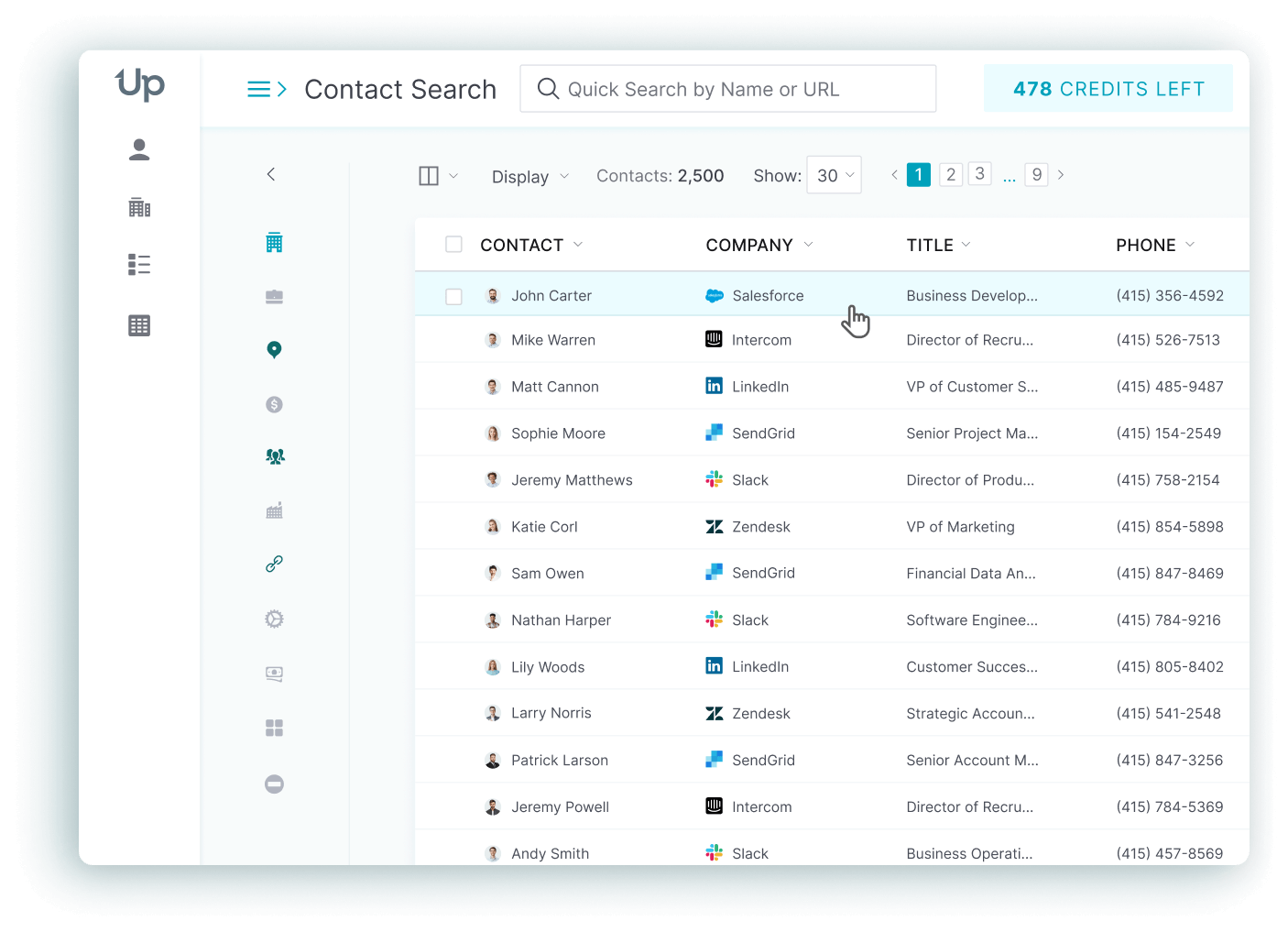
UpLead
UpLead is an industry-leading B2B lead generation platform focused on accurate, verified contact details. Users can access detailed profiles of prospects and obtain email addresses, phone numbers, and social media links. With a large global database that offers advanced filtering, real-time verification, and various integrations, you’re getting a powerful lead-generation tool at an affordable price. Whether you’re a small team or a global sales organization, UpLead is a must-have for any sales toolkit.
Demandbase
Similar to 6sense, Demandbase is an account-based marketing (ABM) platform designed to help B2B organizations target, engage, and convert high-value accounts. The platform combines data, AI-driven insights, and built-in advertising tools to enhance outbound marketing campaigns. Demandbase offers advanced analytics, intent signals, and CRMs and marketing tools integrations.
Apollo.io
Apollo.io is a sales intelligence platform that helps businesses identify prospects, manage outreach, and streamline workflows. Apollo.io includes features like automated email campaigns, task tracking, and integrations with CRM systems. Designed for larger enterprises, Apollo.io has affordable, scalable plans with some advanced features and filtering available.
Final Tips for Choosing a Sales Intelligence Tool
Selecting the right sales intelligence tool is important not only for the success of your team but also for the success of your business. Here are some top tips to keep in mind when choosing your next tool.
Understand Main Goals
Whether it’s generating leads, enhancing account-based marketing (ABM), or improving pipeline visibility before you make a purchase decision, you need to have clear goals in mind. 6sense excels in account-based marketing practices with its predictive insights and intent data, making it ideal for businesses prioritizing targeted account strategies. ZoomInfo is great for contact enrichment and lead generation, perfect for teams focused on building prospect lists.
Think About Your Current Tech Stack
We mentioned this earlier in the article, but integrations and API capabilities are key. Before you buy, make sure the tool integrates with your existing tech stack where needed. 6sense focuses on deep integration with popular CRMs in order to enhance ABM capabilities. ZoomInfo has broader integration capabilities, meaning it can adapt to any tech stack.
Weighing Budget Concerns
Weighing budget concerns can be difficult if you’re deciding between two tools that don’t publish pricing. You may want to look at a platform that has clear monthly or annual costs if budget is a primary concern. UpLead offers transparent pricing with flexible plans that fit teams of all sizes.
Consider Ease of Use & Timeline
If you need results quickly and can’t afford to wait for a long implementation and onboarding, you may want to consider a web-based alternative. While both 6sense and ZoomInfo offer dedicated onboarding and implementation, they may not be the quickest to set up. UpLead provides instant access with no implementation time required.
The Bottom Line on 6sense vs. ZoomInfo
Choose 6Sense For Account-Based Marketing and AI Capabilities
As we’ve mentioned through this comparison guide, 6sense was designed with account-based marketers in mind. It’s a great tool for teams focused on targeting accounts with intent data, custom outbound content, and automation. By putting AI at the forefront of the platform, teams can focus less on manual processes and more on closing deals.
Choose ZoomInfo for Large Enterprise Teams and Full Customization
ZoomInfo is the way to go for large sales, marketing, and recruiting teams with global reach. While pricing is much more than other competitors on the market, the tools, data, and integration options are likely worth it for large enterprise teams.
UpLead is the Ultimate Solution for B2B Sales & Marketing
If you want a tool that offers the best of both worlds, look no further than UpLead. With powerful features, industry-leading data accuracy, and a free trial, it’s a choice for businesses looking to accelerate growth and is a suggested software for global users. UpLead combines ease of use with verified contact data, transparent pricing, and instant access. No long implementation, no hidden costs, just results.
Start your free trial with UpLead today!
FAQs About 6sense vs. ZoomInfo
Here are some of the top questions we’ve seen about 6sense and ZoomInfo.
It depends on what you want in a B2B lead generation service. If you’re focused on account-based marketing strategies and like automation and AI, 6sense may be the better choice. If you’re a large enterprise team looking for full control and customization of the platform, ZoomInfo may be the way to go. For teams that need verified contact data, transparent pricing, and instant access, UpLead is a strong alternative to both.
The best alternative depends on your use case. For ABM with predictive account scoring and intent, choose 6sense. For a large contact database with deep customization, choose ZoomInfo. For verified contact-level prospecting with transparent pricing and instant access, choose UpLead. UpLead offers real-time email verification, advanced filtering, and a simple interface that requires no implementation time.
ZoomInfo is designed for large, global teams, and the pricing reflects that. Compared to other platforms that may offer a per-user price, ZoomInfo only offers enterprise pricing. If you’re a small team with limited budget, there are much more affordable options out there. UpLead provides transparent, flexible pricing with plans that fit teams of all sizes.