


As a sales development representative (SDR), your entire job boils down to one thing: booking qualified meetings. But you’re stuck staring at a silent phone and an empty calendar. Low response rates make hitting your quota feel impossible. Y
ou’re not alone.
57% of SDRs experience burnout. This constant pressure wears you down. You spend hours on outreach that goes nowhere. It makes you question your strategy and your abilities.
The grind is real and it’s exhausting. Stop the random acts of outreach. This guide provides a proven, 4-phase playbook used by top performers to consistently fill their pipeline.
We will show you exactly how to prepare, execute, build trust and optimize your workflow to not just book more meetings but book better ones.
How to Book More Meetings as an SDR: 15 Strategies That Get Results
Here 15 strategies that will help you book more meetings as an SDR:
Do Your Research on Prospects and Companies
It’s impossible to personalize outreach if you know nothing about prospects. Research target companies and specific decision-makers before reaching out. Identify their pain points so you can explain how your product or service alleviates those challenges.
For instance, if social media is weak, you could say: “Our platform’s intuitive video creation tools help teams make compelling social videos that grab attention. With eye-catching videos promoting your service, social media engagement could increase 30% in three months.”
Identify High-Intent, Relevant Prospects
Rather than blasting every lead, evaluate first. Focus on prospects experiencing the problems you solve or showing signs they may be shopping for a solution. These hot leads are more likely to take a meeting.
UpLead uses advanced analytics to detect when accounts are in research mode so you can capitalize at the perfect moment. Our B2B sales acceleration platform empowers SDRs to identify and engage hot prospects.
Align with Your Account Executive for Better Meetings
You can align with your Account Executive by establishing a formal SLA, structuring regular meetings, aligning compensation and defining team structure. Alignment with your Account Executive (AE) is critical for booking meetings that convert. Here are four best practices:
Establish a Formal Service Level Agreement (SLA): Create a written agreement defining mutual commitments, including a precise, mutually agreed-upon definition of a Sales Qualified Lead (SQL) using frameworks like BANT (Budget, Authority, Need, Timeline). The SLA should outline the handoff process with standardized CRM note-taking and facilitate “warm handoffs” where the SDR introduces the AE to the prospect.
Structure Regular, Productive Meetings and Feedback Loops: Hold weekly 1:1 sync-ups that are strategic working sessions covering passed leads and meeting outcomes, strategic account planning, messaging review and goal setting. Encourage AEs to listen to SDR call recordings and SDRs to attend at least 50% of the meetings they book.
Align Compensation and Incentives: Structure SDR compensation with a 60/40 or 70/30 split between base salary and variable compensation. The majority (70%) of variable compensation should be based on Sales Accepted Opportunities (SAOs) or qualified meetings set and completed, with a smaller portion (30%) tied to deals that close from their sourced opportunities.
Define the Team Structure and Ratios: Choose appropriate SDR:AE ratios – 1:1 for complex sales, 2:1 for large addressable markets with shorter cycles or 1:2 for higher-priced solutions with longer sales cycles.
Perfect Your Core Value Pitch
Nailing your core value proposition is crucial for booking more meetings. Whether you operate in inside or outside sales, it’s important to refine a concise elevator pitch that explains how you help prospects achieve goals in seconds. Save longer explanations for a scheduled call rather than a cold call.
For example, “Hi Joan, this is John from UpLead. We’re an AI sales acceleration platform that helps teams book 70% more meetings with less effort. Would next Tuesday at 2 pm work for a 15-minute intro call to see if we’re a potential fit for Acme’s needs?”
Practice your pitch so it sounds natural versus robotic. Time it to hit critical points fast while remaining conversational and casual.
Build Your Essential SDR Tech Stack
Sales acceleration software equips lead generation specialists to identify hot prospects and execute campaigns. The right tools handle tedious tasks so you can focus on relationship-building activities. Here are the essential categories:
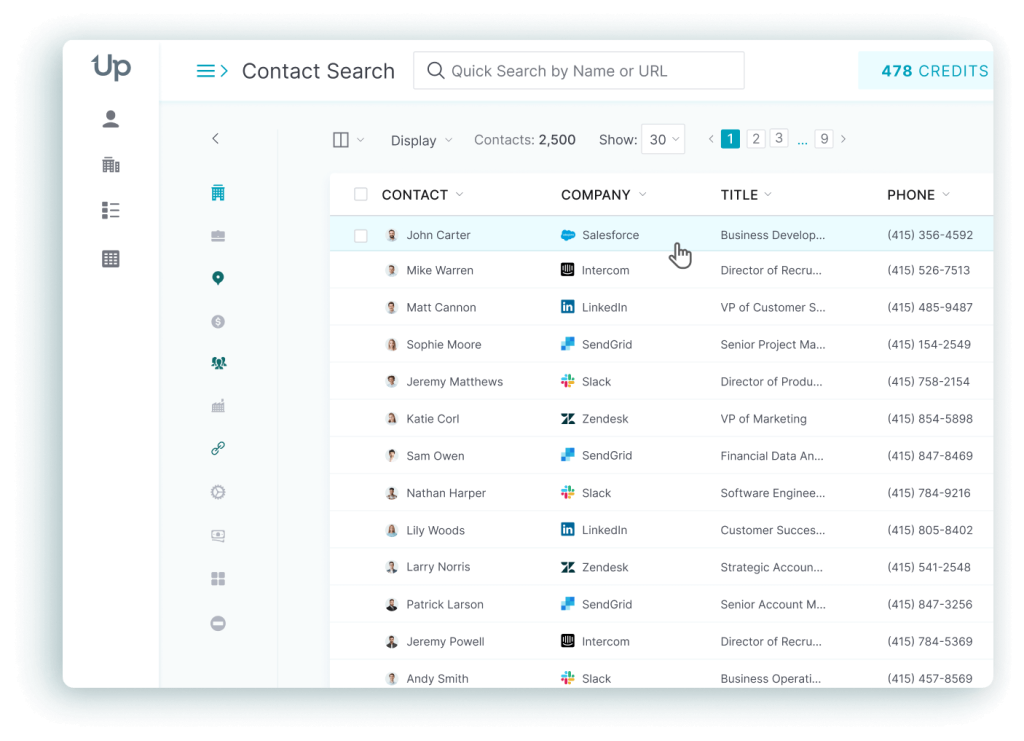
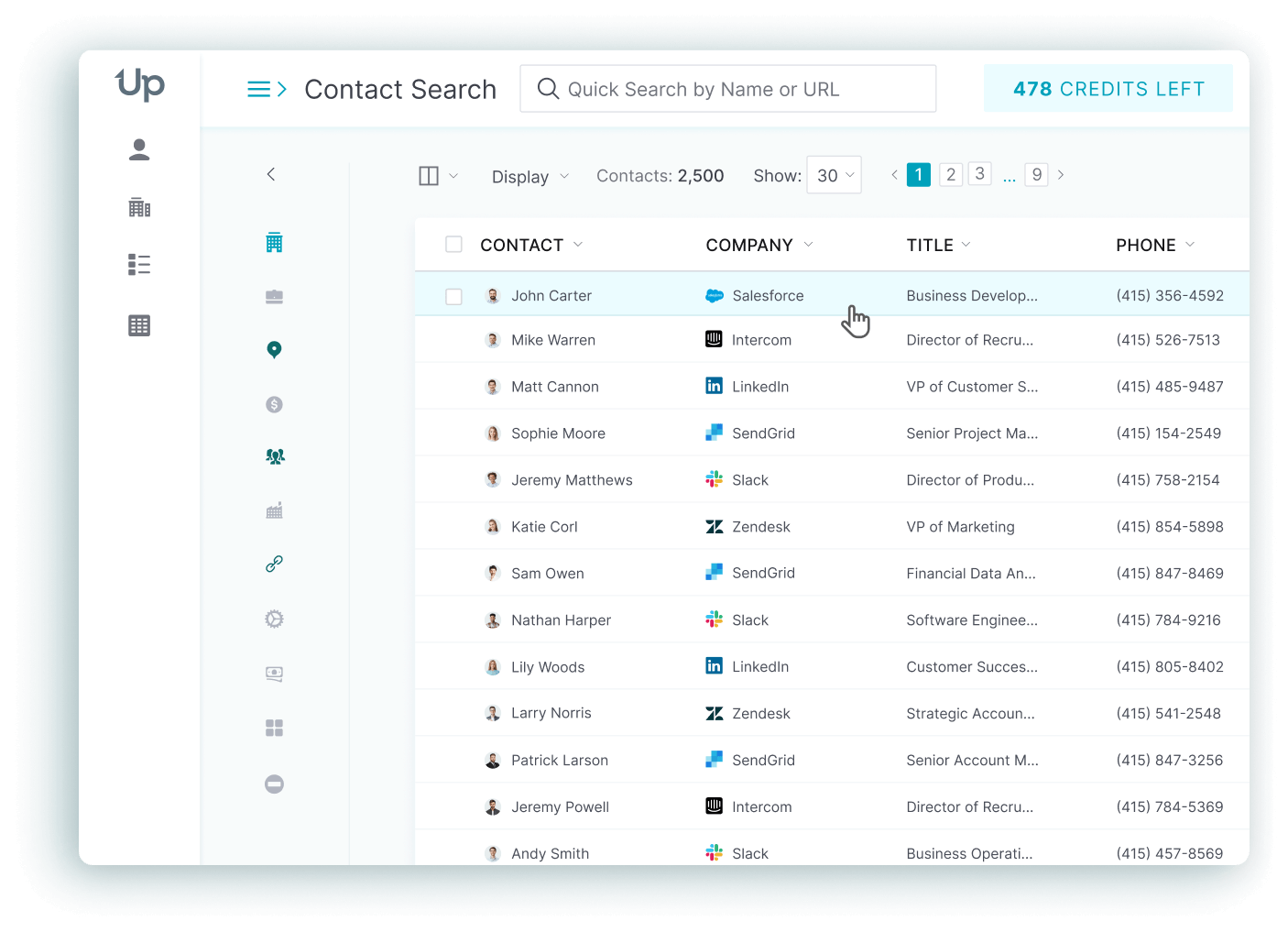
Prospecting and Data Enrichment: These tools provide access to accurate B2B contact and company data to build targeted lead lists. UpLead’s 160M-contact database with 95% accuracy enables SDRs to land more qualified meetings faster. Let’s connect to explore how we can accelerate your sales workflow and enhance customer retention. Other examples include ZoomInfo, Cognism and Apollo.io.
Sales Engagement: These platforms automate and manage multi-channel outreach sequences (email, phone, social) to engage prospects at scale. Examples include Salesloft, Outreach and HubSpot Sales Hub. HubSpot Sales Hub offers Contact and Lead Management, Deal Pipelines, Task Management and Automation, Email Integration and Tracking, Meeting Scheduler and Reporting/Analytics, with a free tier available and paid tiers starting with Starter, Professional and Enterprise plans.
CRM (Customer Relationship Management): The central hub for managing all prospect and customer data, tracking interactions and overseeing the sales pipeline. Examples include Salesforce Sales Cloud, HubSpot and Close.
AI Assistants and Conversation Intelligence: These tools use AI to analyze sales calls, optimize email copy and automate administrative tasks, providing data-driven insights. Examples include Gong, Regie.ai and Lavender.
Video Prospecting: These tools allow SDRs to create and share personalized video messages to stand out in a crowded inbox and build rapport. Examples include Vidyard, Loom and Sendspark.
Scheduling: These applications automate the process of booking meetings, eliminating back-and-forth emails and reducing no-shows. Examples include Calendly, Chili Piper and Doodle.
B2B software companies use UpLead to identify hot prospects by tracking companies seeking CRM solutions or those showing signs of needing an upgrade. UpLead’s list-building tools enable the company to compile a list of such businesses, including key contacts, their roles and recent activities indicative of their interest in CRM systems. Using this information, these companies’ sales team personalizes their outreach, addressing specific pain points each prospect might be experiencing with their current CRM system. This targeted approach, empowered by the right sales acceleration tools, leads to a higher rate of engagement and more scheduled meetings with potential clients.

Leverage AI for Hyper-Personalization and Efficiency
You can leverage AI by using tools to automate research, personalize outreach at scale and identify the best prospects. AI tools are transforming how SDRs work. They automate research, personalize outreach at scale and identify the best prospects. Use AI to summarize company news, generate personalized email openers and analyze call performance. Tools like Regie.ai and Lavender help you craft messages that resonate, while platforms like UpLead use AI to surface high-intent accounts. This allows you to spend less time on manual tasks and more time on meaningful conversations.
Make It Personal (At Scale)
Generic outreach efforts are easy to ignore. Stand out by personalizing every email and call. Research prospects beforehand to incorporate relevant details. Mention their role, company, industry concerns and interests.
For example, “I noticed on LinkedIn that you joined Acme Co last month. Making a transition to a new company can be challenging. That’s why I wanted to reach out. Our service could help you make an immediate impact in your new sales role by enabling you to connect with 50% more prospects.”
Personalization at Scale: The challenge is personalizing outreach when you need to reach dozens of prospects daily. Use a three-tier approach:
Tier 1: Basic (Company-Level) Personalization: Reference a shared industry or region to build common ground. Example: “I saw that [Company Name] is a major player in the Texas manufacturing space, and we’ve had experience helping clients in the industry and region streamline their supply chains.”
Tier 2: Mid-Level (Role-Specific) Personalization: Tailor the value proposition to their role. For a CEO, focus on ROI and business growth. For an HR leader, focus on employee retention or recruitment efficiency.
Tier 3: Advanced (Individual-Level) Personalization: Reference a specific, recent action or piece of content from the prospect. Example: “Hi [First Name], I read your recent LinkedIn article on the challenges of AI implementation and was impressed by your point on data integrity. It mirrors many of the conversations we’re having with other tech leaders.”
Use tools like Google Alerts or AI sales assistants to summarize company news and find these triggers.
Get to the Point in Your Messaging
Prospects are busy. Don’t make them read multiple paragraphs to understand why you reached out. State your purpose and proposed action upfront.
Bad email subject line: “Checking in on some ideas.”
Good subject line: “Request a Demo of [tool/platform] to increase sales.”
Email body:
“Hi Tim, I wanted to introduce myself. I’m John from UpLead. We make AI sales automation tools designed to help companies like yours book more qualified meetings.
I’d love to schedule a 15-minute intro call to explore if our platform could be a fit to help your sales team prospect more efficiently. Are you free this Thursday at 10 am or Friday at 2 pm?”
Master Cold Calling with a Proven Framework
You can master cold calling by using a 5-part framework: the opener, the value proposition, the pitch, objection handling and the close. Cold calling is a fundamental skill for SDRs. Use this 5-part framework to structure your calls for maximum effectiveness:
Part 1: The Opener (Pattern Interrupt): Break the prospect’s automatic rejection pattern with unexpected openers like “Hi [Name], this is a cold call. You can either hang up now or give me 30 seconds to tell you why I’m calling, and then you can decide. What do you want to do?”
Part 2: The Value Proposition / The Illuminating Question: Establish relevance by highlighting a potential problem using a statistic, then ask an open-ended question. Example: “I speak with other VPs of Sales, and they often find their reps spend about 15% of their day on admin work instead of selling. What steps are you taking to make sure your reps are focused on revenue-generating activities?”
Part 3: The Pitch (Brief and Problem-Focused): Based on their answer, explain in one or two sentences how your company helps solve that specific pain point.
Part 4: Objection Handling: Use a ‘Validate, Label, Ask’ framework to acknowledge concerns without ending the conversation.
Part 5: The Close (Low-Pressure): Use interest-based call-to-action like “Would you be opposed to setting aside 15 minutes next Tuesday to dive into how we could help your team?”
Voice tips: Use confident, calm tone, speak slowly with strategic pauses, avoid upward inflections.
Handle the Most Common Objections
You can handle common objections by using specific strategies for “send me an email,” “no budget” and “we use a competitor.” Objection handling is a critical sub-component of cold calling. Here are the top 3 common SDR objections and responses:
“Just send me an email”: Strategy: “I can do that. So I can send you the most relevant information instead of a generic brochure, could you tell me what’s your biggest priority right now when it comes to [area your product addresses]?”
“We don’t have the budget”: Reframe to ROI: “I understand. Many of our current customers had a similar concern. However, they found that our solution isn’t a cost but an investment. For example, we helped [Similar Company] achieve [X% increase in revenue]. Would it be worth 20 minutes to explore if we could generate a similar ROI for you?”
“We already use a competitor”: Acknowledge and differentiate: “That’s great to hear, [Competitor] is a solid company. We share a lot of mutual customers. They often use us for [Unique Feature] because [Competitor] doesn’t focus on that. How are you handling [Problem your unique feature solves]?”
Leverage Social Selling on LinkedIn
Social selling is about providing value, not promotion. Engage by liking and commenting on prospects’ updates. Share relevant articles. Transition conversations from social platforms into scheduled meetings.
Utilize Video Prospecting to Stand Out
Short, personalized videos stand out in crowded inboxes. Record yourself on camera addressing prospects by name. Explain that you noticed an upcoming anniversary and want to learn about their expansion plans and goals.
The human touch of video builds connection, so even prospects ignoring other outreach watch and respond. Getting creative with providing value via content, leveraging various sales techniques and embracing video enables SDRs to catch the attention of busy prospects and spur meetings.
Always Follow Up (Persistently, Not Aggressively)
One email or call is rarely enough. Be politely persistent in following up. While 8 touches was a traditional benchmark for getting a meeting, modern multi-channel outreach often requires more. Recent data indicates it takes 7-13 active touchpoints for most B2B sales cycles for an initial meeting. Cold prospects can require 20-50 touches and complex, high-value deals can involve hundreds of interactions across multiple channels. Multi-channel campaigns using 3+ channels see higher purchase rates than single-channel campaigns.
Use a varied sales sequence combining multiple email check-ins, cold calling and LinkedIn messages. Change up your approach and offer new value with each outreach.
The key is avoiding sounding like a mass, templated reach out. Make each connection feel like a thoughtful human reaching out to help. This personalized tenacity pays off by turning cold call contacts into warm leads booking meetings. Balancing persistence with respect takes finesse. Conduct follow ups and change approaches, but listen to uninterested prospects and politely move on. The key is avoiding hounding in your sales prospecting. Convey helpfulness versus pressure. Your genuine aim to add value shines through.
Offer Irresistible Value
Prospects love free, valuable resources. Offer them guides, free trials or consultations to entice engagement.
For example, tell them: “I’d love to share our latest guide on ‘How to Increase Lead Conversion Rates by 200%.’ Let me know where to send it.”
This content demonstrates your expertise while encouraging prospects to reply and build relationships.
Use Testimonials, Case Studies and Social Proof
Social proof builds trust, so prospects say yes to meetings. Gather positive reviews from current customers speaking to your product/service benefits. Feature them on your site and in outreach.
A prime example of this is Peloton, a company that revolutionized home fitness with its interactive exercise equipment and online workout classes. Peloton’s strategy of leveraging high-profile endorsements elevated their brand trust. They secured endorsements from respected names like Good Housekeeping, Forbes and Best Health, showcasing these on their platforms to create a buzz around their innovative products.
Emulating Peloton’s approach, gather positive reviews and testimonials from your current customers, those that speak to the benefits of your product or service. Display these testimonials on your website and in your outreach materials. As Peloton’s endorsements by well-known publications added a layer of credibility, your customer testimonials can serve a similar purpose.
Turn customer examples into case studies. Detail their challenges, how you solved problems and impressive outcome stats. For example, take inspiration from HubSpot, a leader in inbound marketing and sales software. HubSpot’s data shows compelling outcomes from using their integrated platforms:
- Marketing, Service and Sales Hub users closed 75% more deals than those using only the Sales Hub.
- Combining CMS and Marketing Hub led to an addition of an average of 122% more contacts than using the Marketing Hub alone.
Such statistics validate HubSpot’s effectiveness and serve as a powerful selling point. Sharing success stories in your outreach can influence prospects.
Leverage Your Network for Referrals
Happy current customers are some of your best salespeople and Dropbox’s phenomenal growth story is a testament to the power of customer referrals. Dropbox achieved a staggering 3900% user growth in 15 months, partly due to its legendary referral program. This program was a success because it offered:
- An extended version of the product as a reward.
- Integration as part of the onboarding process.
- Clear visibility of the benefits to users.
- An easy way for users to invite their friends.
- Constant updates on referral status.
Incorporate this approach into your sales strategy. When asking satisfied clients for referrals, remind them of the tangible benefits they could provide to their contacts, much like how Dropbox incentivized its users. Coming in with a referral gives you instant credibility and prospects are more likely to grant meetings as a favor to colleagues who have endorsed you. As Dropbox made it easy and rewarding for their users to refer others, ensure that your referral process is straightforward and beneficial for both the referrer and the referred.
Offer a Free Trial or Host a Demo
Offering a free trial is a powerful way to reduce the perceived risk for prospects, making them more likely to agree to meetings. It’s not about explaining the features of your product but allowing prospects to experience its value firsthand. For example, Groove HQ, a company in the support software industry, implemented a strategy to drive free trials through email onboarding of their blog subscribers. They reported that 10% of their blog subscribers started a free trial, demonstrating the effectiveness of this approach.
Incorporating this strategy into your sales approach, you might say, “We’d like to offer you a hands-on experience with our reporting dashboard. How about a free 14-day trial to see how our tools can benefit your sales workflow?”
Don’t wait for inbound demo requests. Reach out, offering personalized product walkthroughs showcasing solutions tailored to prospects’ needs. Eliminate back-and-forth friction by sending calendar booking links, so scheduling meetings is one click.
For example, “I’d love to show you how our integration with Salesforce could enhance your workflow. Below is a meeting link to choose a 30-minute demo time that works for you.”
Getting face time at live events, promoting customer wins and offering free access helps sales teams, including BDRs, provide value that motivates prospects to invest time in sales conversations.
Create an Effective SDR Schedule
You can create an effective SDR schedule by using time blocking, task batching and power hours. An effective SDR schedule is built on Time Blocking (dedicating specific blocks for specific tasks), Task Batching (grouping similar tasks together) and Power Hours (intense 60-120 minute blocks for high-value activities like cold calling).
Sample daily schedule:
8:30-9:00 AM: Daily Prep and Planning (review goals, organize prospect lists)
9:00-11:00 AM: Morning Power Hour (Calling Block 1) (focused cold calling to high-priority accounts)
11:00 AM-12:00 PM: Email and Social Media Batch (send personalized emails and LinkedIn engagement)
12:00-1:00 PM: Lunch and Mental Break
1:00-2:00 PM: Prospect Research and List Building (batch research for next day’s outreach)
2:00-3:00 PM: Follow-up and Admin Batch (CRM updates, follow-up emails)
3:00-4:30 PM: Afternoon Power Hour (Calling Block 2) (second focused calling block)
4:30-5:00 PM: End-of-Day Wrap-up and Planning (review performance, plan next day)
The biggest productivity killer is context switching between different types of tasks, which time blocking helps prevent.
Track the Key SDR Metrics
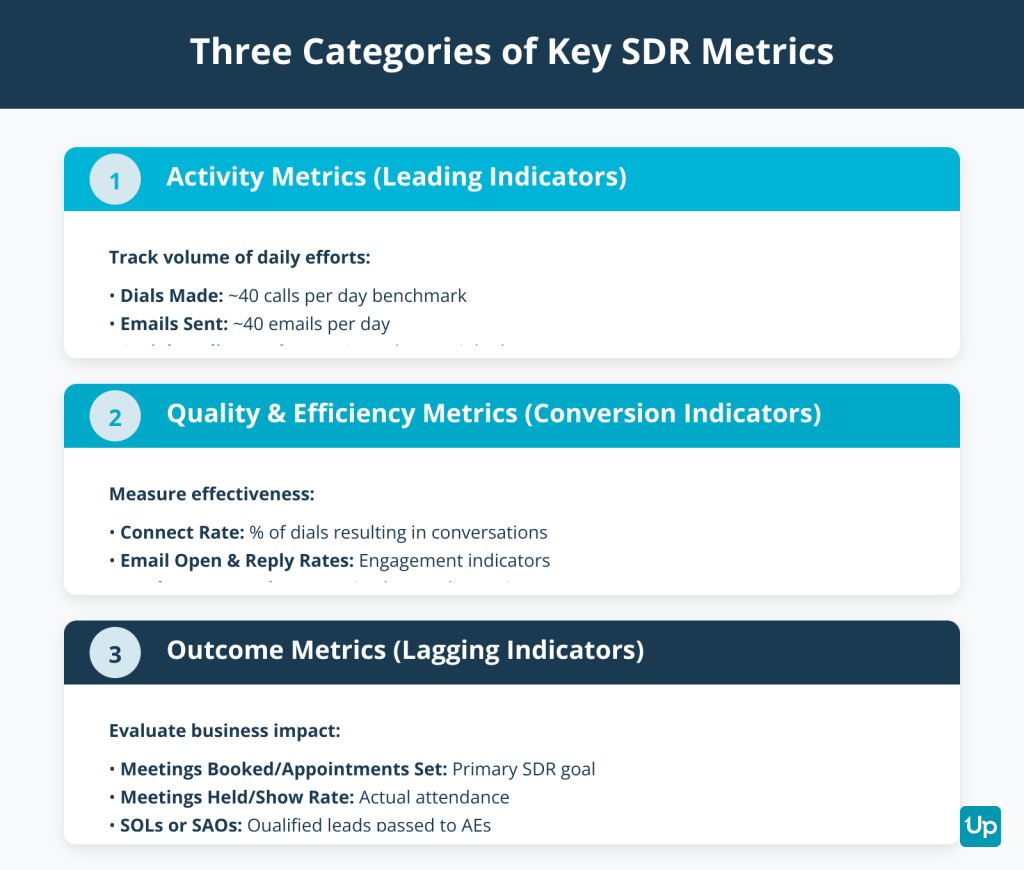
The key SDR metrics you should track are activity metrics, quality and efficiency metrics and outcome metrics. SDR success is measured using three main metric categories:
1. Activity Metrics (Leading Indicators): Track volume of daily efforts – Dials Made (benchmark: ~40 calls per day), Emails Sent (~40 emails per day), Social Media Touches (~16 per day on LinkedIn), Total Activities (60-80 quality touchpoints per day).
2. Quality and Efficiency Metrics (Conversion Indicators): Measure effectiveness – Connect Rate (percentage of dials resulting in conversations), Email Open Rate and Reply Rate, Lead Response Time (best-in-class: under 5 minutes), Meeting-to-Opportunity Conversion Rate (healthy rate: 60-70%).
3. Outcome Metrics (Lagging Indicators): Evaluate business impact – Meetings Booked/Appointments Set, Meetings Held/Show Rate, Sales Qualified Leads (SQLs) or Sales Accepted Opportunities (SAOs), Pipeline Contribution ($), Revenue Generated. Top SDR teams convert around 59% of SQLs to opportunities.
The distinction between activity metrics (effort) and outcome metrics (results) is important for balanced performance evaluation.
Reduce Meeting No-Shows
You can reduce meeting no-shows by using multi-channel reminders, providing value in advance, qualifying leads, optimizing scheduling and personalizing interactions. Meeting no-shows are a critical pain point. Here are actionable strategies to reduce them:
Multi-Channel Reminder Sequence: Use a combination of email, SMS and calendar invites. A common cadence is sending reminders 24 hours and 1 hour before the meeting. Text reminders can have open rates over 95%.
Provide Value in Advance: Send a clear meeting agenda with bullet points outlining what the prospect will gain from the meeting. You can send relevant content like case studies or short videos to build anticipation and reinforce the meeting’s value. Pre-meeting interactions can triple the show rate.
Qualify and Add Friction: Qualify leads before sending a calendar link to ensure only serious buyers book a slot. Adding a small amount of friction, like a confirmation step or asking them to state their goals, increases commitment.
Optimize Scheduling: Avoid scheduling meetings more than two weeks out, as interest can wane. Offer flexible time slots, with Tuesday and Wednesday afternoons often being the most productive.
Personalize and Humanize: Send the calendar invite after the call and follow up with a personal email to introduce yourself. Using personalized videos or connecting on LinkedIn can make the interaction feel more like a real relationship, increasing the likelihood of attendance.

What Is an SDR and What Is Their Primary Goal?
A Sales Development Representative (SDR) is a sales professional who specializes in the top-of-the-funnel activities of the sales cycle. Their primary responsibilities include outbound prospecting (identifying and researching potential customers), initial outreach (via cold calls, emails and social media) and lead qualification. SDRs are the first point of contact. They bridge the gap between marketing and sales. They nurture potential leads, educate them on the company’s offerings and identify their pain points. The main goal of an SDR is not to close deals but to book qualified meetings and appointments for Account Executives (AEs), who then take over to conduct demos and close the sale. This specialization makes the entire sales process more efficient. It allows AEs to focus on high-potential, qualified leads, which increases their productivity and the likelihood of conversion.
How Can You Build Resilience and Handle Rejection as an SDR?
You can build resilience and handle rejection by developing a growth mindset, depersonalizing rejection, practicing self-reflection and prioritizing well-being. Building resilience and handling rejection is critical for long-term success as an SDR. Here are four actionable strategies to develop the right mindset:
Develop a Growth Mindset: Adopt the belief that skills can be developed through effort and persistence. Reframe rejection and setbacks not as personal failures but as learning opportunities to refine your approach. This mindset fosters adaptability and encourages continuous improvement by seeking feedback and embracing challenges.
Depersonalize Rejection and Focus on Controllables: Understand that rejection is an inevitable part of the SDR role and rarely a personal attack. Prospects are declining the product or timing, not you as an individual. Focus on activities within your control, such as the volume of outreach, the quality of your research and the techniques you use, rather than fixating on the outcome of each call.
Practice Self-Reflection and Continuous Learning: Analyze your performance. Review call recordings or transcripts to identify what worked and what didn’t. This practice helps you learn from mistakes and celebrate small wins, which builds confidence. Ask for feedback from managers and peers to identify blind spots and accelerate your learning curve.
Prioritize Well-being and Know When to Take a Break: The high-pressure nature of the SDR role can lead to burnout. Recognize the signs of exhaustion and take proactive breaks to recharge. This can be a short walk after a difficult call block or using paid time off for a mental health day.
FAQs About Booking Meetings as an SDR
Booking sales meetings with qualified prospects is an SDR’s primary role. But how many is enough? Let’s explore common questions.
SDR meeting quotas depend on target market: SDRs targeting large enterprise accounts often have quotas of 6-8 meetings per month, while those focused on mid-market aim for 18-25+ meetings. One source cites an average of 15 meetings per month for outbound SDRs.
Daily call volume varies by strategy: 30-50 highly-researched calls for enterprise accounts to 80-100+ calls in a high-volume transactional model. Some analyses suggest a blended activity goal of 40-50 calls plus 10-40 personalized emails daily.
While not directly responsible for revenue, good SDRs pass abundant sales opportunities to closers, impacting revenue dramatically. SDR teams can be accountable for about 30-45% of new business revenue.
Key Takeaways to Start Booking More Meetings
The key takeaways around maximizing meetings booked as an SDR include:
- Build a resilient mindset to handle rejection
- Align closely with your AE for better lead quality
- Personalize outreach at scale while balancing persistence and respect
- Master cold calling with a proven framework
- Provide value via resources to build relationships
- Leverage multiple prospect contact channels
- Use tools like UpLead to accelerate the entire workflow
- Track the right metrics to optimize performance
- Reduce no-shows with strategic follow-up
Booking that first sales conversation is an art. However, mastering strategies like those above propels SDR and SDR managers to success.