


This guide provides everything you need to build a predictable, data-driven outbound prospecting engine that delivers results in 2025.
You’ll discover:
- Why outbound prospecting is a critical growth lever in 2025
- How to build a winning six-step outbound strategy from scratch
- How to leverage AI to scale personalization and prioritize high-value leads
- The essential KPIs to measure success and optimize your approach
- How to overcome the biggest challenges facing outbound teams today
By the end, you’ll have a complete roadmap to take control of your pipeline and drive consistent, scalable revenue.
Let’s get started.
What Is Outbound Prospecting?
Outbound prospecting is a proactive sales approach where your team initiates contact with potential customers who have not yet expressed interest in your solution. Outbound prospecting is fundamentally different from inbound sales, which relies on prospects initiating contact through digital channels like SEO, content marketing, or online advertising.
For most B2B companies, outbound prospecting starts with defining an ideal customer profile. Your team then generates a list of high-quality leads that match that profile. Outbound prospecting enables sales reps to create their own opportunities by proactively reaching out to these leads. Finally, sales reps contact those leads through cold calls, cold emails, LinkedIn messages or other direct channels to determine if they’re a good fit.
While outbound requires more initial effort than waiting for inbound leads, it delivers faster results and gives you direct control over your pipeline volume. The ultimate goal of outbound prospecting is to convert prospects into paying customers.
Why Is Outbound Prospecting a Critical Growth Lever in 2025?
Outbound prospecting is a critical growth lever in 2025 because it gives you direct control over your sales pipeline, independent of inbound marketing fluctuations. Predictable pipeline growth allows sales leaders to control the volume and pace of lead generation.
You dictate the volume of outreach, which leads to more consistent deal flow and accurate forecasting. This makes outbound non-negotiable for B2B companies that want predictable revenue.
Outbound is particularly powerful for targeting high-value enterprise accounts. Outbound sales teams are typically structured with specialized roles such as Sales Development Representatives (SDRs), Business Development Representatives (BDRs), and Account Executives (AEs) to maximize effectiveness. It’s the cornerstone of Account-Based Marketing (ABM), allowing you to surgically target ideal customer profiles based on industry, company size and technology stack. You reach decision-makers who rarely engage with inbound content.
In slow markets or when entering new verticals, outbound is often the fastest way to create demand where none exists.
The data backs this up. Outbound campaigns generate 50% larger deal sizes compared to inbound sources. Thirty percent of organizations are focusing on pipeline generation via outbound in their 2024 strategy. According to the Prospecting 2025 Report from Outreach.io, 80% of high-performing teams continue to rely on outbound as a key part of their revenue strategy.
Companies combining ABM with targeted outbound efforts achieved 60% higher win rates.
What Is the Difference Between Outbound and Inbound Prospecting?
The principal difference between inbound and outbound prospecting is who initiates the conversation.
With inbound marketing, the lead starts the sale. They read an article, attend a webinar, download an ebook and contact your company. Inbound sales rely on prospects initiating contact through digital channels such as search engine optimization, content marketing, and online advertising. Your team then follows up to see if a sale can be made.
In outbound prospecting, your company starts the sale. Through salespeople, your team contacts leads using cold calls, cold emails or other direct channels to introduce your brand and solutions.
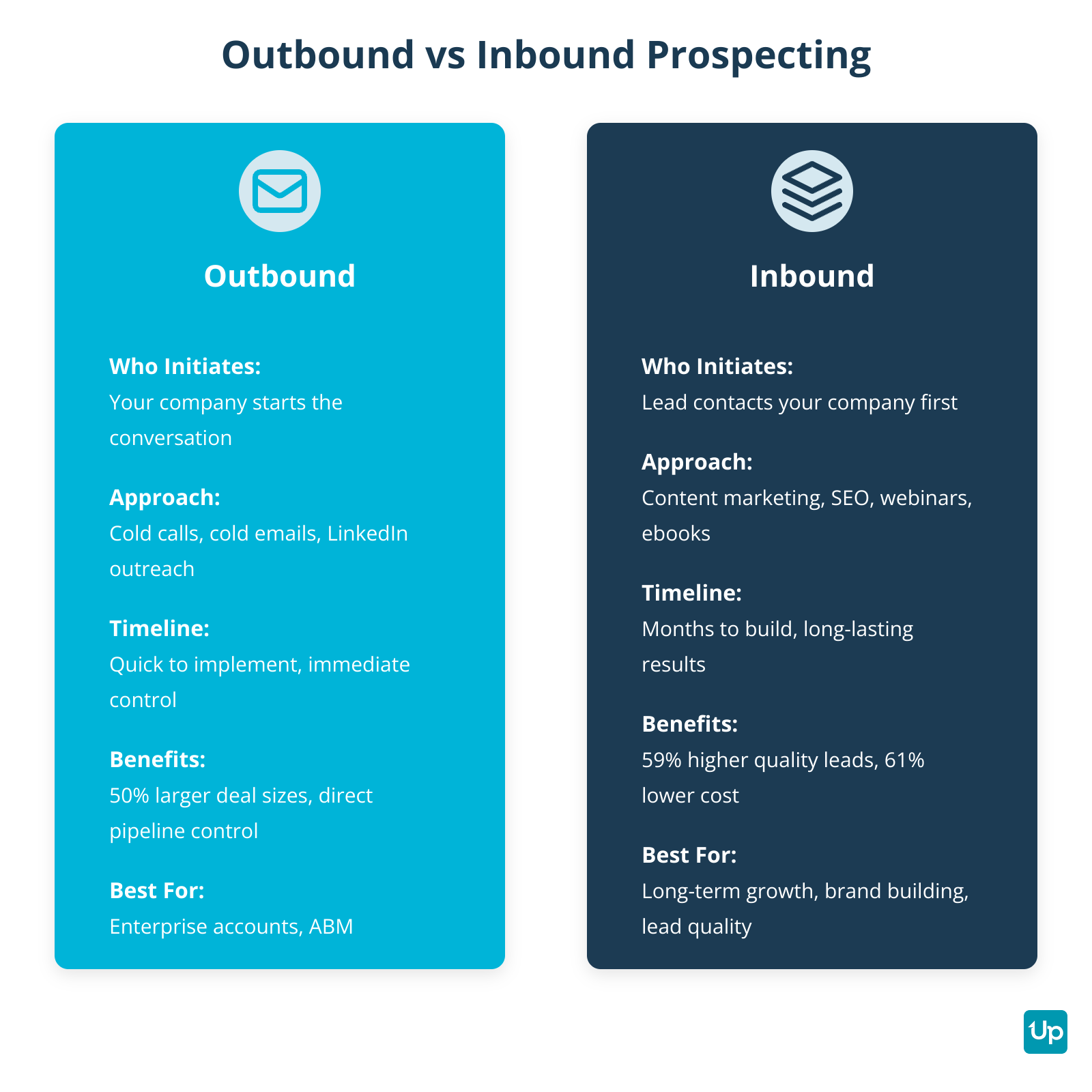
Outbound vs Inbound Prospecting Comparison
Inbound strategies typically take months or even years to build and maintain. However, their results are long-lasting. Inbound sales are designed to attract prospects over time through valuable content and digital presence. Fifty-nine percent of marketers state that inbound marketing provides the highest quality leads for the sales team, while only 16% say the same for outbound methods. Inbound leads are 61% less expensive to acquire than outbound leads. Inbound marketing can be up to 10 times more effective for lead conversion compared to outbound marketing.
Outbound strategies take much less time to build but are only effective while salespeople actively contact leads. They do, however, generate larger deal sizes and give you immediate control over pipeline volume.
When and How to Use a Hybrid Inbound/Outbound Strategy
A hybrid inbound/outbound strategy combines proactive outbound sales with inbound marketing to create a more effective, synergistic sales model.
This integrated approach allows teams to use insights from one strategy to fuel the other. For example, inbound engagement data—like who downloaded an ebook or visited a pricing page—creates a list of warm leads for the outbound team to contact.
Nearly half (43%) of teams now use a hybrid model, blending inbound and outbound sales efforts. Multi-channel marketing campaigns achieve a 31% lower average cost per lead than single-channel outreach, and 73% of B2B buyers purchase through digital channels.
A hybrid strategy is particularly effective for complex B2B sales with long cycles, high-value accounts that benefit from high-touch interactions or when entering new markets. Social selling can be used to engage and warm up target accounts by sharing valuable content and interacting with key decision-makers on platforms like LinkedIn before direct outbound outreach.
Concrete example workflow:
- Marketing team publishes gated high-value content
Note: Publishing valuable content not only attracts inbound leads but also supports social selling efforts by building credibility with target accounts. - Prospects download content providing contact information
- CRM flags leads from high-value target companies
- SDR initiates personalized outbound outreach referencing the downloaded asset
- SDR continues conversation to book meetings
Two-thirds of B2B buyers prefer remote human interactions or digital self-service over in-person interactions for many purchasing stages.
How to Build a Winning Outbound Prospecting Strategy in 6 Steps
Here’s how to build an effective outbound prospecting strategy from the ground up. Outbound sales strategies should be continuously refined and optimized based on performance metrics and feedback to maximize lead generation and revenue growth.
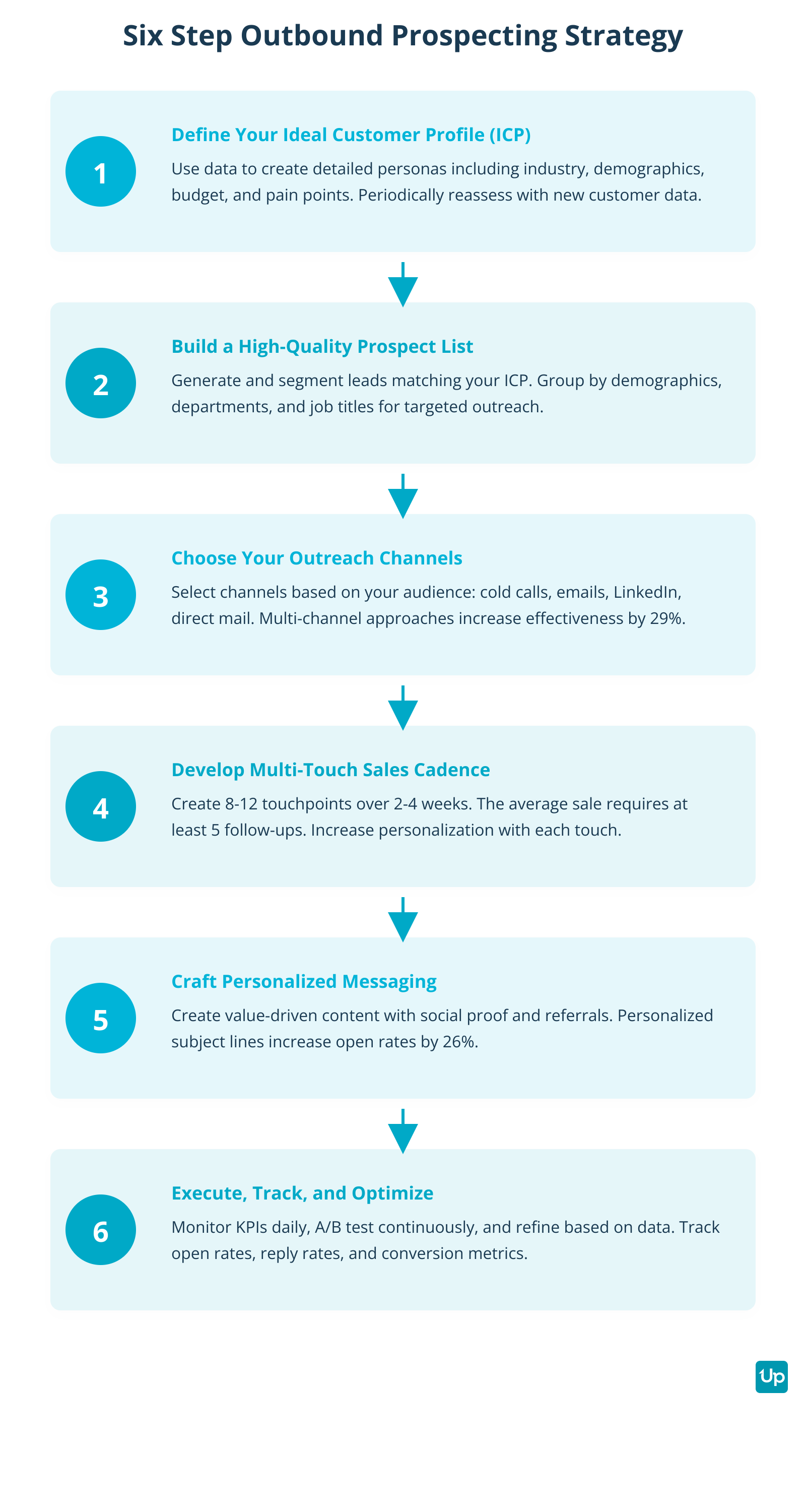
Six Step Outbound Prospecting Strategy
Step 1: Define Your Ideal Customer Profile (ICP) with Data
Your outbound prospecting efforts rely on the accuracy of your ideal customer profile. You need a perfectly-defined customer persona if you want to generate accurate, effective leads. Identifying the right prospects and high value targets is essential for maximizing outbound prospecting effectiveness, enabling you to focus your efforts on those most likely to convert and drive scalable growth.
By using buyer personas, you can increase your email’s clickthrough rate by 500%, and users will be 48% more likely to consider solution providers that personalize their services to them.
Take, for example, the following customer audience description by Hubspot:
You can easily see and organize multiple customer profiles, making them easy to understand and intuitively letting you know how to use them.
The best way to create your user personas is through data. Data-based refining allows you to discover trends and common ground with your customers, and it helps you avoid potential bias from altering the results.
Your ideal customer persona should be as detailed as possible and include data points like their industry, demographic, budget and pain points.
Once you’ve defined your ideal customer persona, you should periodically reassess it through data from new converting customers to refine it.
How to get started:
Use your existing customer base to identify your ideal customer profile and break down your current audience into customer personas.
One way to do this is through surveys and analytics. By creating engaging surveys that people want to fill out, you can better understand your audience. You can also use your analytics to get behavioral information, like the pages they visit in their customer journey, the pages that convert and those that don’t.
These data points can be used to get to know your audience better, identify trends among them and polish your funnel.
Step 2: Build a High-Quality, Targeted Prospect List
Once you have your ideal customer profile defined, you need to generate a list of high-quality leads that match that description. Outbound prospecting enables sales reps to create their own opportunities by proactively reaching out to potential buyers who have not yet expressed interest.
Getting a lead list and contacting them with the same script or template is insufficient. If you really want good results, you need to segment your list before any marketing efforts can happen.
There are multiple examples of how powerful lead segmentation is, with some people finding results like an 89% sales uplift and a substantial increase of value orders just from segmentation alone.
If you segment your list properly, you can improve at catering to the users’ main pain points.
How to get started:
Once you have your list of leads, start breaking it apart. Use information like user demographics, departments, job titles and any other relevant variables to group similar leads together.
Then, develop content that is both relevant to them and cost-effective to you. For example, you can spend the most time with highly valuable leads that are more likely to convert while automating your outbound strategy with colder leads.
By properly segmenting your list, you’ll not only sell the right solutions to the right people, but you can maximize your investment doing so.
Step 3: Choose and Integrate Your Outreach Channels
Source: Proposify
Once you’ve defined your audience, you can better choose which outbound channels will be best to target them.
There are many outbound channels:
- Telemarketing or cold calls
- Cold emails
- Direct mail
- Press releases
- Industry conventions
To maximize results, develop a cohesive outreach strategy that leverages the right tools and a well-integrated tech stack. This approach streamlines your outreach efforts, reduces tool fatigue, and ensures your team can efficiently engage prospects across multiple channels.
Email-only campaigns are diminishing in effectiveness, with lead rates falling by 29% year-over-year, making a multi-channel approach critical.
The trick to selecting the right ones is by using data-based decisions. These will help you define which channels are better to reach your leads and why. You should have a clear idea of which channels will be better to use and the kind of content you can use in those channels to cater to your audience perfectly.
Step 4: Develop a Multi-Touch Sales Cadence
A multi-touch sales cadence is a structured sequence of outreach activities across various channels (email, phone, social media) over a set period.
High-performing cadences typically involve 8-12 touchpoints spread over 2-4 weeks. The average sale takes at least five consecutive follow-ups before closure.
Concrete 10-day, 10-touchpoint B2B example:
- Day 1: Personalized Email/InMail
- Day 3: Email in the morning, phone call in the afternoon
- Day 5: Call in the morning, call with a voicemail in the afternoon
- Day 7: Email in the morning, call with voicemail in the afternoon
- Day 10: Final email and call in the morning
The more you follow up with someone, the more personalized your reach should be. This shows your prospect that you actually care about them and that you’re not trying to follow up to make a sale and leave.
Step 5: Craft Personalized, Value-Driven Messaging
Now it’s time to create the content you’ll be using to sell to your audience.
If you’re selling via phone, you may debate whether or not to use a cold call sales script. Scripts can be challenging to use, and you don’t want your sales reps to sound like robots reading lines. However, scripts also give you far more control over what your sales reps say, giving them a general idea of how to handle a conversation without needing to do a lot of memorizing. When using a script, it’s crucial to ensure your reps clearly communicate your value proposition and deliver a compelling sales pitch that resonates with the prospect.
If you’re going to use a script, make sure it gives your sales reps enough room for them to be themselves.
When it comes to emails, the content is quite different. You should ideally have both a marketing team and a design team working on each email. Crafting an effective subject line is essential, as it can significantly increase open rates and engagement in your outbound prospecting campaigns.
Personalized email subject lines can increase open rates by 26%. Personalized emails deliver six times more transactions than generic ones. Companies that invest in personalizing email outreach earn 40% more revenue than competitors who do not.
Have your marketing team create the strategy and the idea for each email one by one. Once you know what each email will be about, get your design team to work with you to represent each email better.
Test every email and make sure it works on multiple devices.
Hyper-personalization and relationship building are essential for standing out in outbound prospecting. Generic outreach gets ignored, so focus on creating dynamic, personalized sequences that adapt based on prospect engagement and foster genuine connections.
Use referrals:
Referrals are a powerful tool for your outbound prospecting efforts. No one likes feeling like they’re being sold to, even if they are. Referrals remove this component by letting someone else do the hardest part of the process: opening the door for your company to be introduced.
Source: ReferralCandy
Companies that use referrals report that, on average, they close the deal 69% faster, and their clients are 18% more loyal than those that have no referral.
Start by simply asking for introductions to your customers. After a positive interaction, phrase your request like you’re asking for help. For example, you can say, “I was wondering if you could help me with something. We’re trying to grow our business right now. Do you know of anyone like yourself that would be interested in these types of solutions?”
Finally, make sure you treat your referrals like VIPs, giving them excellent customer service and treating them like “friends of friends”, so they, in turn, have no hesitation when it comes to providing you with another referral.
Use social proof:
Establishing your credibility is important, especially when targeting users that may not be familiar with your solution. When outbound prospecting, you need to tell your leads who you are and why your solution works as quickly and effectively as possible. Building relationships and trust is key to successful outbound prospecting, as it helps differentiate you from generic, automated outreach.
The average consumer reads 10 reviews before purchasing something and trusts reviews as much as personal recommendations.
If this is the first time your prospect hears about your brand, or if they aren’t too familiar with it, they may be quick to dismiss your contact completely. After all, if you’re not providing social proof of your company, why should they go out of their way to look for it?
If you want to stand out, you need to give your prospects a reason to trust you and your brand.
Otherwise, you’ll be another person trying to sell them something.
Including social proof is crucial, but where you include it will depend on you, your company and your prospects.
If your prospects aren’t likely to have heard of your company, you may want to provide them with solid social proof in your first message. Instead of dropping names of brands who work with you, tailor the social proof to them. Choose a company they may have heard of or one similar to theirs, and tell them exactly how you helped them.
For example, you can say something like: “During 2024, we helped X company to improve their customer happiness levels by 31% through behavioral analytics and proper training. We can do the same for you.”
If your prospect is likely to click through or follow up, you may want to leave the social proof on your landing page so that you can focus on other things in your message.
Finally, it’s always a good idea to provide social proof on your home page, maybe even dedicating a page for case studies so anyone looking for more information can find it.
Step 6: Execute, Track, and Continuously Refine
Before planning for success, you need to define what success looks like. To do this, you’ll need to use the right metrics.
Some of these metrics may include:
- Click-through rate: How many clicks you get per email compared to the total sent emails
- Lead conversion rate: How many leads that go through the sales cycle end up converting
- Cost per conversion: How much it costs to convert a lead
- Time to close: On average, how long does it take to go from generating a lead to converting one?
- Call-to-close ratio: How many calls you generally have to make to get a sale
It’s also important to track conversion rates and the number of closed deals, as these metrics directly measure the effectiveness of your outbound prospecting efforts and overall sales success.
By defining what your metrics will look like, which ones should improve and how you’ll measure that improvement, you can be sure to start off on the right foot.
When you’re done developing and testing, it’s time to implement your strategy. When you start, you need to keep your marketing and sales teams on the same page by establishing a clear line of communication. This will make it easy for both teams to align themselves with a clear goal and path to achieve it.
Monitor your strategy closely, and check where and how things can be improved. Check your KPIs daily to see how close you are to reaching your goals. Measuring the success of outbound prospecting strategies involves tracking key performance indicators (KPIs) such as sales cycle time and cost per opportunity. Sales teams should continuously refine and optimize their outbound prospecting strategies based on data-driven insights to improve performance.
Avoid the ‘spray and pray’ approach of sending mass emails to lists of individual leads. Instead, reps should have a clear next-step strategy in place that includes updated messaging and a pre-planned follow-up cadence.
The 5-step process for A/B testing and weekly optimization:
- Establish a hypothesis: What do you think will improve your results?
- Isolate one variable: Test subject lines, CTA, email body or send times one at a time
- Segment and run the test: Use a statistically significant sample size (at least 1,000 subscribers)
- Measure key KPIs: Email Open Rate industry average is 23%, Reply/Response Rate industry average is 1-3%, Call-to-Connect Rate above 5% is good
- Analyze and optimize: Look for statistical significance (p< 0.05) before implementing changes
Keep your testing alive, allowing the feedback and learnings from the sales and marketing teams to permeate your strategy, changing and improving it as you go.
Whatever your channel may be, you should also pay close attention to your social media and inbound strategy so that all channels will provide the same cohesive message.
Never forget that your email is a reflection of you and your business. Ensure there are no factual errors or grammatical mistakes.
How Can AI Improve Outbound Prospecting?
AI can improve outbound prospecting by analyzing vast datasets, crafting personalized content at scale, scoring leads and optimizing sales cadences. Automating administrative tasks and other low-value activities with AI allows sales reps to focus on high-value conversations and outreach, ultimately moving deals forward more efficiently.
AI adoption among salespeople surged from 24% in 2023 to 43% in 2024, with 56% of sales professionals using AI in their daily workflow as of 2025. Eighty-three percent of sales teams using AI reported revenue growth in the past year, compared to only 66% of teams without AI. Seventy-three percent of salespeople using an AI-powered CRM state that these tools have significantly boosted their team’s productivity.
Here are specific, actionable use cases where AI transforms outbound prospecting:
- AI agents can automate account research, saving sales reps 15-20 minutes per account and freeing up more time for high-value outreach.
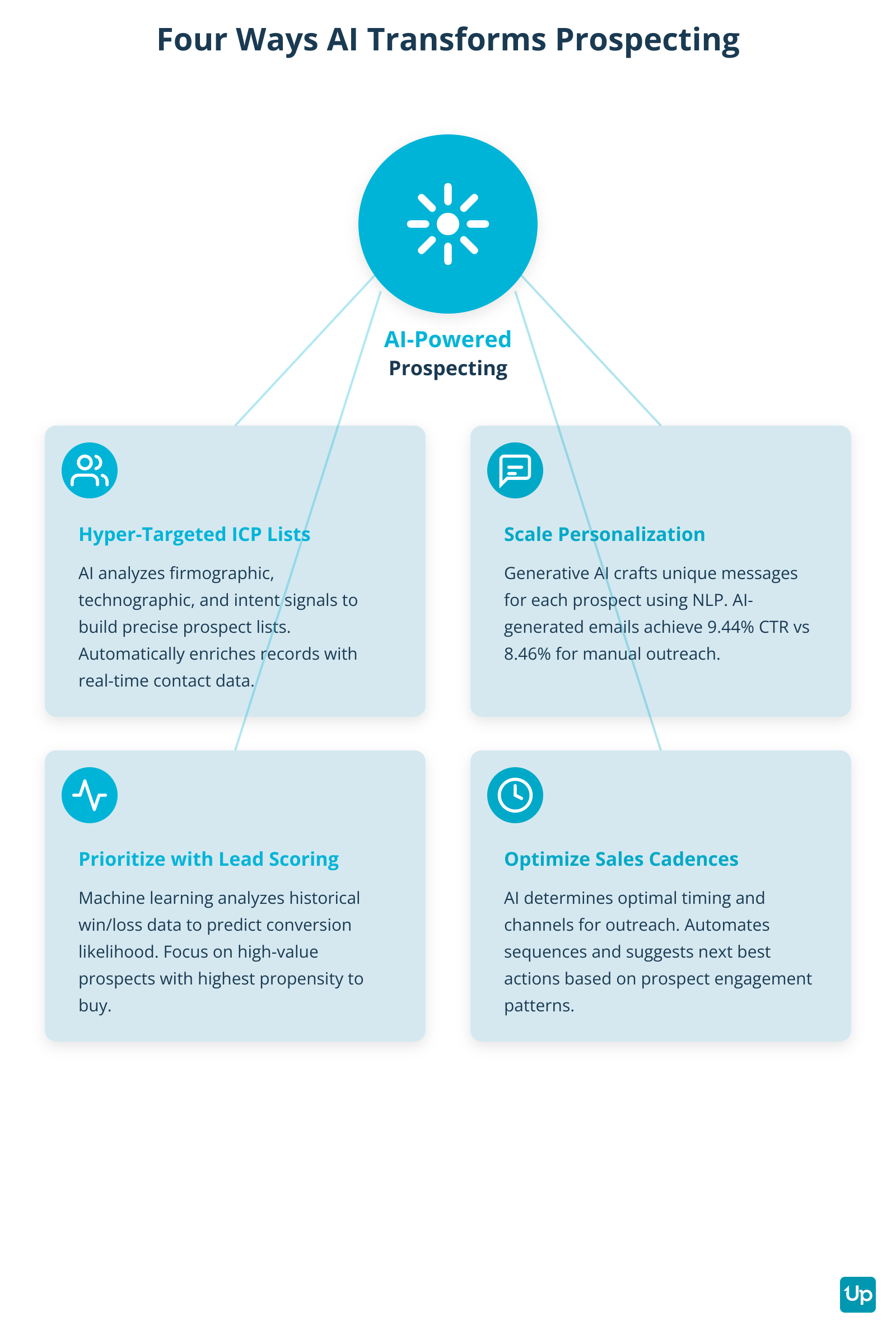
Four Ways AI Transforms Prospecting
Build Hyper-Targeted Lists with AI-Powered ICP Analysis
AI algorithms analyze vast datasets of firmographic, technographic and intent signals to identify ideal customer profiles (ICPs) and build highly targeted prospect lists.
AI scrapes data from websites, social media and CRM systems to build comprehensive lead profiles, reducing manual research time. It can enrich records with real-time company and contact details automatically.
Tool examples include Cognism (provides verified contact data and uses AI to identify intent signals), Seamless.ai (delivers verified contact data by searching live web sources) and Apollo.io (sales intelligence platform with lead-scoring capabilities).
Scale Hyper-Personalization in Your Outreach
Generative AI crafts personalized email content, subject lines and social media messages at scale. These tools analyze a prospect’s LinkedIn profile, company website and other data points to create relevant and authentic-feeling messages.
AI uses Natural Language Processing (NLP) to generate human-like messages tailored to the recipient’s role, industry and recent activities.
Reply.io‘s Jason AI generates human-like first-step emails, follow-ups based on thread context and can turn bullet points into complete emails using AI personalization that crafts unique messages for each contact by leveraging data like industry, job title and pain points.
Some AI tools report that AI-generated emails can achieve a higher click-through rate (9.44%) compared to manually written ones (8.46%).
Tool examples include Lavender (real-time email assistant that scores sales emails), Regie.ai (automates persona-based outreach campaigns) and ChatGPT/Gemini/Claude (LLMs for drafting and refining email copy).
Prioritize Leads with AI Scoring and Intent Data
AI lead scoring uses machine learning to analyze lead behavior, demographic data and engagement signals to assign a score indicating their likelihood to convert.
AI models analyze historical data of won and lost deals to identify patterns and attributes of successful conversions.
Tool examples include HubSpot Sales Hub (predictive lead scoring integrated into CRM), Salesforce Einstein (AI platform with predictive analytics), Clearbit (data enrichment and predictive scoring) and Leadspace (B2B data platform with advanced lead scoring).
Optimize and Automate Sales Cadences
AI helps automate and optimize the sequence of touchpoints in a sales cadence. It can determine the best times and channels for outreach and suggest the next best action based on prospect engagement.
AI analyzes past engagement data to identify the most effective sequences and timings for different prospect segments.
Tool examples include Salesloft (sales engagement platform with “Conductor” AI layer), Outreach (market-leading platform with “Kaia” AI assistant for conversation intelligence and deal management) and Copy.ai GTM AI Platform (generates compelling messaging for different sales stages).
What Are the Essential KPIs to Measure Outbound Prospecting Success?
The essential KPIs to measure outbound prospecting success are activity metrics (what your team is doing) and outcome metrics (what those activities produce). Understanding your target audience is crucial when evaluating KPIs such as cost per opportunity and sales cycle time, as it helps optimize marketing efficiency and sales performance. Measuring the success of outbound prospecting strategies involves tracking key performance indicators (KPIs) like sales cycle time and cost per opportunity.
A strategy without a measurement plan is incomplete. You need to track both categories for clarity.
Activity and Efficiency Metrics (Leading Indicators)
These metrics track the volume and efficiency of sales activities:
- Emails Sent/Calls Made: In high-volume scenarios, reps might make 80-150 calls daily, while complex sales may only require 20-50
- Deliverability Rate: Percentage of emails that successfully land in recipient’s inbox
- Bounce Rate: Percentage of emails that fail to be delivered (calculated as (Bounced Emails / Total Emails Sent) * 100)
- Lead Response Time: Responding within 5 minutes can be 21 times more effective at qualifying a lead compared to waiting 30 minutes
Effectiveness and Outcome Metrics (Lagging Indicators)
These metrics measure the impact and success of prospecting activities:
- Open Rate: Calculated as (Emails Opened / Emails Delivered) * 100
- Reply/Response Rate: Core engagement metric showing if message is compelling
- Click-Through Rate: Indicates interest in offer
- Meetings Booked/Appointment Rate: Critical bottom-of-funnel metric
- Lead-to-Opportunity Conversion Rate: Average MQL-to-SQL conversion around 13%, B2B SaaS lead-to-opportunity rate around 6.2%
- Win Rate/Opportunity-to-Close Rate: Average win rates decreased to 17-20% in 2023, with ‘good’ rates considered over 40%. Opportunities closed within 50 days have a 47% win rate
- Sales Cycle Length: Reportedly lengthened by 32% from 2021 to 2022
- Customer Acquisition Cost (CAC): Total cost to acquire a new customer
What Are the Key Outbound Prospecting Challenges in 2025?
The key outbound prospecting challenges in 2025 are rapid data decay, email deliverability requirements and buyer skepticism.
Here are the top problems sales teams face and how to solve them:
Rapid Data Decay
B2B contact data decays at rates ranging from 22.5% to 70.3% annually, with some sources stating up to 30% of contact data goes bad every year. A recent analysis from late 2024 noted an alarming monthly decay rate of 3.6% for business emails.
Solution: Implement continuous data hygiene using real-time enrichment and verification tools. Regularly clean lists to maintain a bounce rate below 2-3% and a spam complaint rate below 0.1%.
The Email Deliverability Gauntlet
Since February 2024, major providers like Gmail and Yahoo enforce strict sender requirements. For bulk senders (5,000+ emails/day), all three authentication protocols are mandatory: SPF, DKIM and DMARC with at least p=none policy.
The ‘From:’ header domain must align with either SPF or DKIM domain. One-click unsubscribe links in message body and List-Unsubscribe header are required, with unsubscribe processing within two days. Gmail spam rates must stay below 0.3%, with Google recommending below 0.1%.
Solution: Correctly configure technical authentication protocols and implement proper domain warming for new domains which face accelerated enforcement.
Overcoming Buyer Skepticism
Buyers are inundated with generic outreach, leading to skepticism and low engagement. Over-automation without a human touch backfires. Lead qualification is the number one seller challenge in 2025.
Solution: Adopt a hybrid approach. Use AI and automation for initial research, data analysis and scaling repetitive tasks, but ensure a human reviews and personalizes messages for high-value prospects. Focus on ‘hyper-personalization’ by referencing trigger events, buyer pain points and behavioral data to make outreach relevant. Companies using AI-powered personalization report a 10-20% increase in ROI. Incorporate a structured sales development process with specialized sales roles, such as sales development reps (SDRs), to efficiently qualify leads and address buyer skepticism. This specialization in sales development maximizes growth and ensures outbound prospecting efforts are both predictable and scalable.
What Are the Best Outbound Prospecting Software Tools for 2025?
The best outbound prospecting software tools for 2025 are UpLead, Apollo.io, ZoomInfo, Cognism, Outreach, Salesloft, Reply.io, Seamless.ai, Persana.ai, LinkedIn Sales Navigator, Vidyard, Aircall and Evaboot.
Outbound sales prospecting is a proactive approach to initiating contact with potential clients, focusing on identifying and engaging the right leads through targeted outreach. Outbound sales teams typically consist of specialized roles such as Sales Development Representatives (SDRs), Business Development Representatives (BDRs), and account executives (AEs), who manage different stages of the sales cycle.
Here are some of the best prospecting tools you can use:
UpLead for Lead Generation
UpLead is a Lead Generation Platform that was created to generate the right leads for your outbound strategy.
Unlike many other options, UpLead offers a 95% data accuracy guarantee . That way, you know you won’t waste time cold-calling broken numbers and sending emails to invalid addresses.
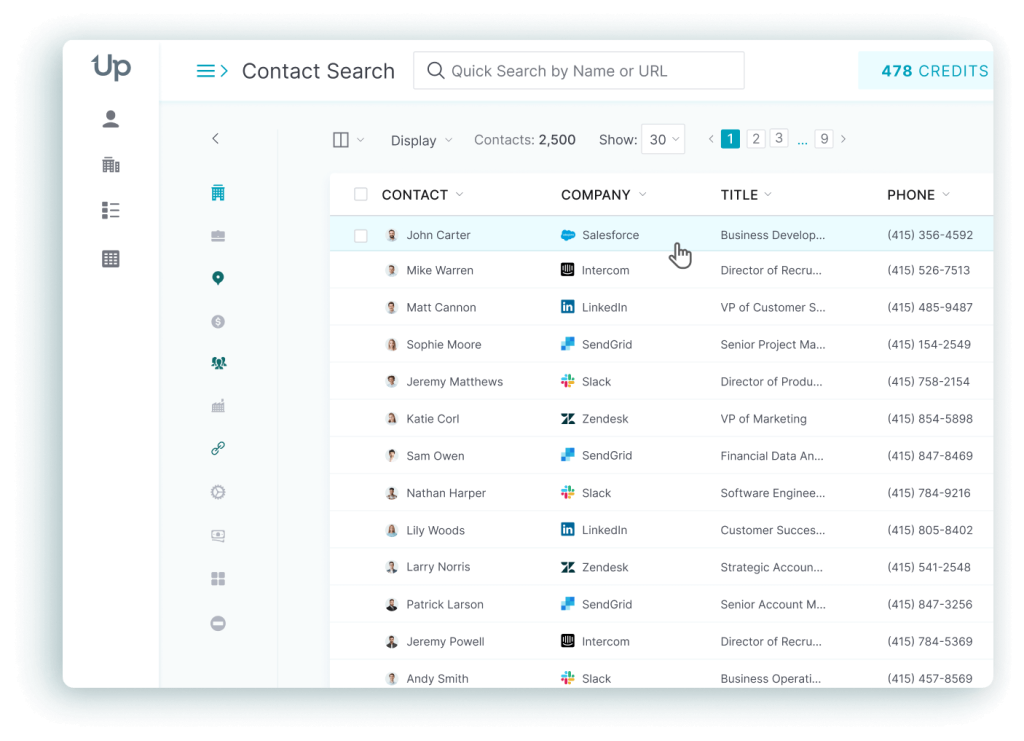
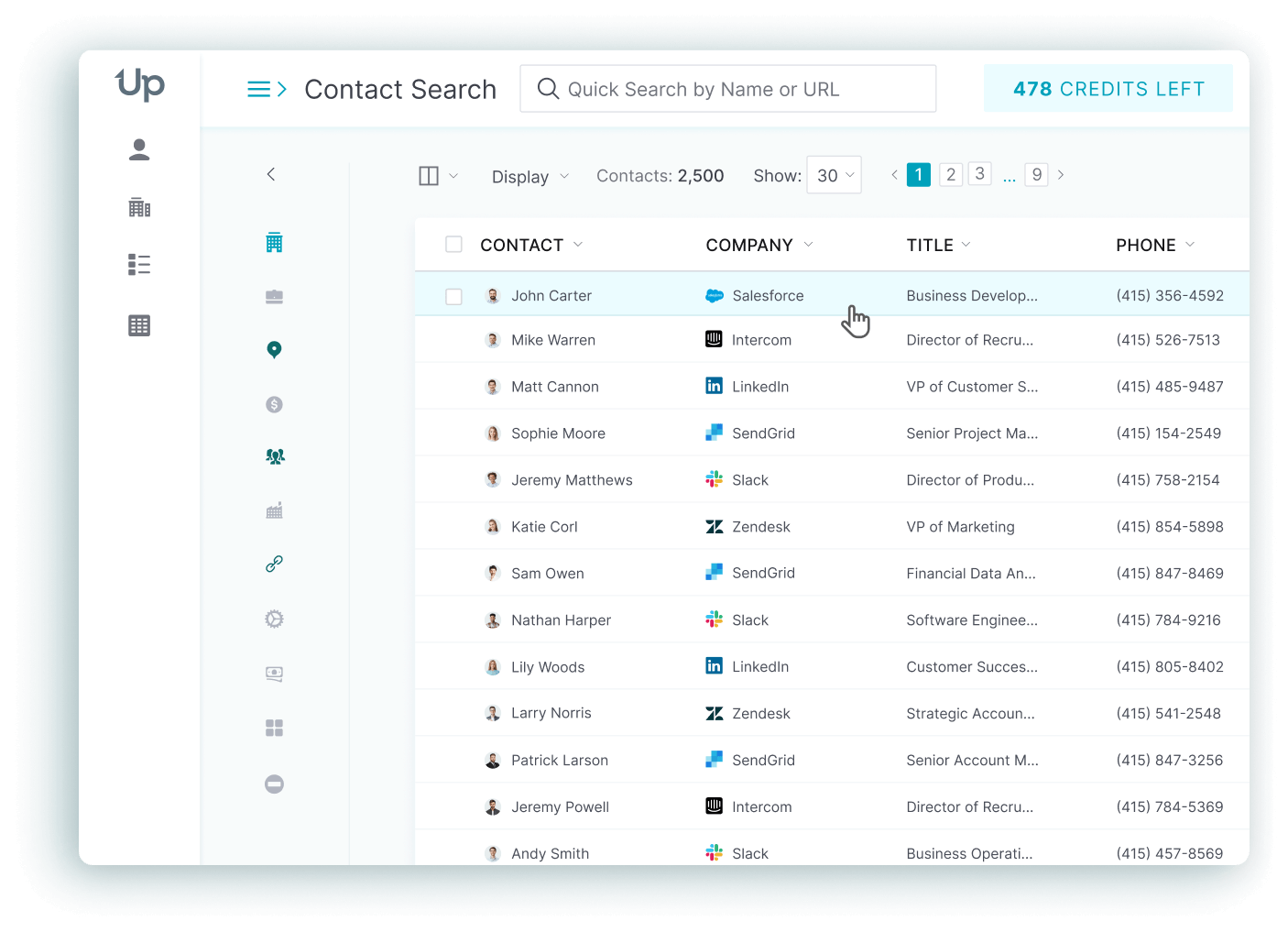
Generating leads with UpLead is very easy. To narrow your ideal leads, you can browse UpLead’s 200 million worldwide business contacts using over 50 criteria (such as job title, industry and location). All you need to do is to enter your customer profile, download the matching leads and start contacting them.
You can also look leads up through their information, such as name, company or phone number, to enrich your data.
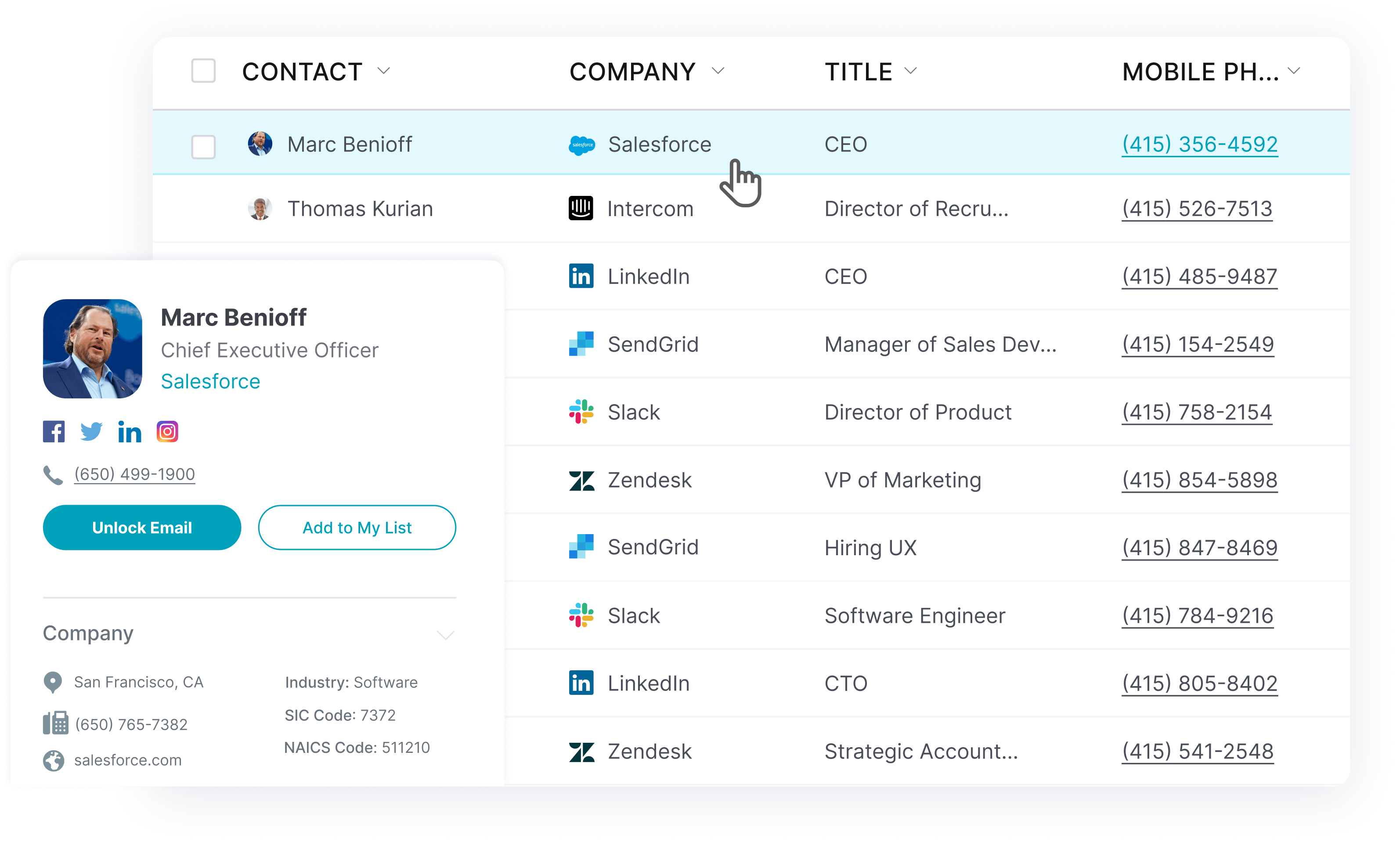
Rich Profiles
UpLead doesn’t just give accurate information; it shows it through vibrant profiles. These profiles flesh out your sales prospects so your salespeople can see who they’re contacting and personalize their approach to them.
UpLead offers credit-based pricing from $74/month (annual) for 170 credits to $149/month (annual) for 400 credits.
Start your free UpLead trial today.

Apollo.io
Apollo.io offers a comprehensive B2B database of 275+ million contacts with pricing tiers from Free ($0/month) to Organization ($119/month annually for 3+ users), featuring multi-channel sequencing and AI assistance.
ZoomInfo
ZoomInfo operates as a premium, enterprise-focused platform with quote-based pricing starting around $15,000 annually, providing extensive B2B data and advanced filtering capabilities.
Cognism
Cognism is a premium solution with custom pricing starting around $15,000 annual platform fee plus per-user costs, emphasizing GDPR/CCPA compliance and phone-verified mobile numbers.
Outreach
Outreach positions itself as an AI-powered ‘Sales Execution Platform’ with AI Revenue Agents, conversation intelligence (Kaia) and sales forecasting, with pricing estimated at around $100-$160/user/month.
Salesloft
Salesloft positions itself as a Revenue Orchestration Platform with custom pricing estimated at $125-$165/user/month, featuring Cadence automation and AI-driven insights.
Reply.io
Reply.io offers Jason AI for email generation and personalization, with plans starting from $49/month for Email Volume and $89/month for Multichannel. Fifty-five percent of sales professionals now use AI to craft or automate emails.
Seamless.ai
Seamless.ai operates on a credit-based system with a Free plan (50 lifetime credits), Pro (custom pricing with daily credit refresh) and Enterprise (custom pricing). The platform claims a database of over 1.3 billion contacts with real-time search capabilities and Chrome extension integration.
Persana.ai
Persana.ai is a Y Combinator-backed AI sales platform with credit-based annual pricing from Free (50 credits) to Unlimited ($600/month for 600k credits), focusing on AI research agents and real-time intent signals.
LinkedIn Sales Navigator
The LinkedIn Sales Navigator is a browser to find leads through LinkedIn’s database. With it, you can easily identify highly qualified leads, filtering them by their registered company, job position and the rest of their LinkedIn profile information.
LinkedIn Sales Navigator offers Core at $119.99/month and Advanced at $159.99/month, with Advanced Plus at custom pricing starting around $1,600/seat/year, featuring AI-powered Account IQ and Lead IQ capabilities.
While the obvious limitation of the Sales Navigator is the users’ LinkedIn presence, it’s a great tool for anyone already using LinkedIn.
Vidyard
Vidyard provides video prospecting capabilities with a Free plan ($0), Starter at $59/user/month and custom pricing for Teams and Enterprise plans, featuring AI script generation and direct CRM integrations.
Aircall
Aircall is a powerful and scalable cloud-based phone system. You can easily integrate it into your CRM to start adding and calling numbers from over 100 countries.
Scaling it up or down is very simple. This allows you to scale your teams according to seasonality and let your remote workers use the tool anywhere in the world.
Aircall offers Essentials at $30/user/month and Professional at $50/user/month (3-user minimum), featuring Power Dialer and deep CRM integrations.
With Aircall, you also get great analytics that will allow you to keep track of your KPIs in real time.
Evaboot
Evaboot is a specialized LinkedIn Sales Navigator scraper with credit-based pricing starting at $39/month for 500 credits, requiring a separate Sales Navigator subscription.
Outbound Prospecting Examples and Templates for 2025
Here are powerful outbound prospecting examples to inspire your campaigns:
AI-Personalized Cold Email Template:
Source: Nutshell
The company received this email after one of its employees attended a session at a large marketing conference.
As you would imagine, this email is worthy of praise for many reasons, mainly the CTA.
By breaking up the text, the CTA naturally gets a clear spot in one line, and the hyperlink makes it pop out of the email.
This is so effective that the company that received it uses it as an example of how to write clear CTAs.
Personalized Approach Using Events:
Source: SalesHacker
We all know people don’t want to be sold to. A great way to avoid this while selling is by using events as a bridge between a salesperson and a lead to get a pitch in organically.
This email, for example, is so good at generating rapport through events that culminated in the lead asking for a meeting with the salesperson.
Although it’s hard to scale up, personalizing your approach definitely pays off conversions.
Keeping It Simple:
Source: Yesware
No one wants to sit down and read a wall of text sent by some stranger. That’s why you should always simplify your approach wherever you can.
Remember: your priority is to get your lead interested. There will be time to talk in-depth about features and expertise.
When in doubt, shorter is always better than longer.
LinkedIn Message with Trigger Event:
Source: Tom Mallens
Knowing your audience’s pain points is half the battle. If your solution perfectly aligns with their pain points, all you need is to let them know.
In this example, you can clearly see how the sender uses social proof to show how he has fixed pain points before, which makes the message clear: “I’ve done it before, and I can do it again for you.”
Let your audience’s pain points take center stage and lead the conversation to the solution: your product.
Trigger-based outreach has been shown to achieve response rates up to 32%, significantly higher than traditional cold outreach.
Cold Call Script: Asking the Right Questions:
Source: G2
Phone calls remain a key component of the outbound sales process, especially for direct communication and quick conversions. Don’t just call people. Instead, fill them up with information and ask them to buy something. You need to tailor the information, letting them choose where they want you to expand.
This great template lets you do just that. With it, you can take the guessing out of the equation, asking your lead to choose between two options.
By slowly building up to your solution, you can ensure the solution is right for your lead, and your lead can organically learn the right information through the phone call.
Cold Call Script: Navigating Around Gatekeepers:
Source: Pipedrive
Navigating around gatekeepers can be very tricky when contacting someone by phone. You want to do it as quickly as possible, giving the gatekeeper the right amount of information to get through to the lead.
Sometimes, the simpler you can keep things, the better. This template shows you how you can quickly give enough information to the gatekeeper, establish rapport and ask to go through as quickly as possible.
Cold Call Script: Avoiding Objections:
Source: Salesmate
The most common objection you’ll get while on the phone is someone saying, “Can I call you back?” Writing scripts for this and the rest of your most common objections makes sense.
This script, while direct, lets your salespeople move around objections while being direct and honest with the person. It reassures the lead, letting them know this won’t take long and adds a bit of mystery to engage the user.
How Do You Stay Compliant With GDPR and CCPA in Outbound Prospecting?
You stay compliant with GDPR and CCPA in outbound prospecting by leveraging legitimate interest, being transparent, ensuring relevance, practicing data minimization, providing easy opt-outs and maintaining proper records.
Disclaimer: This information is for educational purposes and does not constitute legal advice. Always consult with a legal professional for compliance matters.
The General Data Protection Regulation (GDPR) applies to processing personal data of individuals in the EU, including business contact information.
B2B cold outreach is permissible under GDPR by leveraging the legal basis of ‘Legitimate Interest.’ Recital 47 states that ‘The processing of personal data for direct marketing purposes may be regarded as carried out for a legitimate interest.’ This means you can contact a prospect if your product or service is genuinely relevant to their professional role.
For GDPR compliance: be transparent in your first email about who you are and where you found their information, ensure relevance by only contacting prospects whose roles align with your offering, practice data minimization by collecting only essential data and provide an easy opt-out in every communication.
The California Consumer Privacy Act (CCPA) grants California residents rights over their personal information, including the right to know what information you’ve collected, the right to delete their information and the right to opt-out of sale or sharing of their data.
For CCPA compliance: provide at least two methods for consumers to submit requests, implement a clear opt-out link on your website, maintain records of all requests for at least 24 months and avoid purchased lists as it’s difficult to prove consent or legitimate interest.
Outbound Prospecting FAQ
What is the difference between outbound and inbound prospecting?
Outbound prospecting is when your company initiates contact with potential customers who have not yet expressed interest. Inbound prospecting is when leads contact your company first after engaging with your content or marketing.
How many touchpoints does it take to close an outbound deal?
The average sale takes at least five consecutive follow-ups before closure. High-performing cadences typically involve 8-12 touchpoints spread over 2-4 weeks.
What is a good reply rate for cold emails?
The industry average reply rate for cold emails is 1-3%. Anything above 5% is considered excellent. Personalized emails and trigger-based outreach can achieve response rates up to 32%.
How can AI improve outbound prospecting?
AI can analyze vast datasets to identify ideal customer profiles, craft personalized email content at scale, score leads based on conversion likelihood and optimize sales cadences. Eighty-three percent of sales teams using AI reported revenue growth in the past year.
What are the biggest outbound prospecting challenges in 2025?
The biggest challenges are rapid data decay (up to 30% annually), strict email deliverability requirements from Gmail and Yahoo and overcoming buyer skepticism due to generic outreach. Sales leaders play a crucial role in overcoming these challenges by driving innovation, streamlining outbound processes, and leveraging data-driven insights to improve prospecting performance and achieve higher productivity.
Conclusion: Take Control of Your Pipeline
Outbound prospecting is valuable if you want quick results in your sales strategy.
In 2025, the hybrid model (a mix of in-person, remote and e-commerce self-service) is the most dominant B2B sales strategy. Hybrid sales models can drive up to 50% more revenue than traditional, field-only sales approaches.
Do you already know your user persona? Plug their description on UpLead and start generating leads now.