


| TL;DR | Lusha | Apollo |
| Best for | Lead generation, list building, consistent contact validation | Lead generation, focusing on prospects closer to the purchasing stage |
| Database size | 280M+ contacts | 210M+ contacts; 35M+ companies |
| Companies covered | 15+ million full company profiles | 35M+ companies |
| Filters | Standard search filters | 200+ advanced filters / data attributes |
| Free plan highlight | Free plan with limited monthly credits; no card required | Free plan with unlimited email credits, limited exports, and basic sequences |
| Entry paid price (annual) | US$22.45/user/month (Pro, 3,000 credits/year, 3 seats) | US$49/user/month (Basic, 30,000 credits/user/year) |
| Entry paid price (monthly) | US$29.90/user/month (Pro, 250 credits/month, 3 seats) | US$59/user/month (Basic, 2,500 credits/user/month) |
| Credit allotment per tier | Pro: 3,000/yr or 250/mo; Premium: 7,200–88,800/yr (slider); Scale: custom | Free: 1,200/yr or 100/mo; Basic: 30,000/yr or 2,500/mo; Pro: 48,000/yr or 4,000/mo; Org: 72,000/yr or 6,000/mo |
| Integrations highlight | CRMs (HubSpot, Salesforce, Zoho), email platforms, Lusha API | Native Zapier integration and deep CRM/marketing hooks (Salesforce, HubSpot, Marketo) |
| Notable watch-outs | Smaller database vs Apollo; compliance concerns around personal contact details | Data accuracy concerns; credit refunds only for bounced emails sent within Apollo, not mobile numbers |
You need reliable direct dials and emails without blowing the budget. Lusha and Apollo meter access differently (seats + credits) and make different accuracy/database claims—easy to overpay or choose the wrong fit. This guide compares current plan names, monthly vs annual pricing, credit allowances, database scope, filters, and integrations so you can pick the right stack for your team size and credit usage.
What is Lusha?

Lusha was first released in 2016, and since then, it has become a well-known lead generation and sales intelligence tool. The tool was built and designed to make it easier for sales teams to find accurate contact details, meaning better closing and sales rates.
Lusha leans into AI, using its database to continuously update contact details. Getting contact details that are out of date can be frustrating – with Lusha, that doesn’t happen often. The size of Lusha’s database is substantial. The database has 280M+ contacts, and with AI and crowdsourced contact verification, you can be confident in the results you’re getting.
Lusha Pros & Cons
Pros
- Large database of business contacts when compared to other major players on the market.
- Generally user friendly design, including an easy to use browser extension.
- Improved contact validation through both manual and AI-driven validation, leading to improved accuracy.
Cons
- While their validation is definitely accurate, there have been concerns about providing personal information (such as personal phone numbers) to users without the contacts’ consent.
What is Apollo.io?

Apollo.io is another prominent lead generation platform that operates similarly to Lusha. The platform allows for contact verification, marketing, and sales activities and has a massive database of 210M+ contacts and 35M+ companies worldwide.
Apollo’s pricing is on-par with other similar offerings, but what sets Apollo apart is the sophisticated filtering allowed in its database. There are 200+ advanced filters/data attributes that you can filter on, meaning you can find the exact audience you’re looking for on the Apollo platform.
Apollo Pros & Cons
Pros:
- Strong integration with existing, popular CRM tools
- Access to buying intent data, allowing users to focus on customers ready to purchase
- A strong host of features including A/B testing
Cons:
- There may be issues with data accuracy on Apollo according to some users
- While there is robust filtering availability, some features can’t be customized like on other platforms
- Advanced features can be difficult to use
Lusha vs. Apollo Comparison Guide
Lusha and Apollo are both popular tools in the B2B lead generation space. With robust databases and additional features that enable streamlined lead generation, they operate similarly. Let’s break down a direct comparison of Lusha and Apollo.
Key Features
Both Lusha and Apollo offer tools and features that enhance their robust contact databases. With advanced search functionality, strong platform integration, and generous plans available at multiple tiers, it can be difficult to see the differences between the two. Here are the key features of both platforms, starting with Lusha.
Lusha
Lusha is well-established in the B2B prospecting space. With a range of tools and features, Lusha’s platform can help generate leads accurately. Here are some of Lusha’s top features.
- Prospecting Tools: At the heart of the Lusha feature lineup is the prospecting tool. As we mentioned earlier, the contact database boasts 280M+ contacts. With AI-driven validation, we’ve noticed an improvement in contact accuracy in recent months.
- New Engage Feature: The new Engage feature allows you to launch email outreach campaigns directly from the Lusha platform, including robust analytics, tracking, and testing.
- Integration Features: With Lusha API, quickly integrate Lusha with your favorite tools and applications.
- Dashboard Analytics: With a large focus on data, Lusha offers a powerful analytics dashboard that allows users to track performance and adjust their strategy all from one platform.
Apollo
With one of the largest B2B contact databases on the planet and a few key differentiating features, Apollo offers a good bit of value to its customers. Let’s take a look at some of Apollo’s top features.
- A/B Testing: By offering A/B testing, Apollo’s platform allows users to really dig into their outreach strategy. The intuitive platform prevents you from sending duplicate messages to the same contact and helps streamline the testing process.
- Automated Sequences: Apollo allows you to create automated outreach sequences for your outreach, meaning less manual intervention for your campaigns.
- Intent Data: One of the most valuable features that Apollo offers is access to its intent data / intent topics. Rather than guessing where prospects are in the purchasing cycle, intent data allows you to target prospects that are closer to the purchasing stage.
Database & Contact Reliability
Database reliability and contact accuracy are crucial for the platform to be successful. Let’s take a look at how Lusha and Apollo compare.
Lusha
As we’ve mentioned, Lusha has 280M+ contacts in its database, making it fairly robust. The data is primarily mined from public sources, so accuracy could be improved. There are some manual efforts and internal proprietary methods to update the data regularly.
Data will include standard information that many B2B databases provide, such as name, email addresses, titles, phone numbers, and general company information. Compared to Apollo, the database is much smaller. Still, the data is more accurate – if you’re looking at specific industries, Lusha may be a better option due to its data accuracy.
Apollo
Compared to Lusha, Apollo has a much larger global database. With 210M+ contacts and 35M+ companies, its database is larger than Lusha’s. However, there have been customer reviews stating issues with data accuracy. While accuracy may have been improving due to AI integrations, it’s important to take accuracy into consideration. Apollo offers standard contact details, including name, email address, phone number, and general company details.
Similar to Lusha, data is sourced from public sites with both manual and AI efforts to consistently update its data. One positive note on the data accuracy concerns – Apollo documents automatic handling of bounced addresses; credit refunds are only available for bounced emails sent within Apollo and not for mobile numbers.
Integrations & API
Standalone tools are good. Integrating into your existing platforms makes those tools great. Let’s dive into how well (or not well) each platform can integrate with your existing business software.
Lusha
Integration into your existing tools is essential to elevate your B2B prospecting. Nobody wants to have to learn and operate in a completely separate tool – it doesn’t add much value. Integration allows your team to supplement their existing core platforms. Here are our thoughts on Lusha’s integration and API capabilities.
- API: Lusha’s API is fairly straightforward and there haven’t been any noted issues with integration. The API allows you to directly integrate with a wide range of internal tools and platforms, making it a good option to add to your team’s prospecting toolkit.
- Email Marketing: Lusha can integrate directly with major email platforms such as Gmail, Mailchimp, Outlook, and more.
- CRM: If you use a popular CRM platform like Salesforce, HubSpot, or Pipedrive, you’re in luck – Lusha offers direct integration with major CRM providers. For smaller, bespoke CRM tools, the open API may be the way to go but can be a bit trickier than a direct integration.
Overall, Lusha offers what a customer would reasonably expect when it comes to Integrations and API.
Apollo
Apollo has very similar integration capabilities to Lusha, making it tough to choose between the two. Let’s take a quick look at what Apollo has to offer.
- Marketing Integrations: Apollo not only integrates with popular email providers, but also directly integrates with popular marketing tools such as Marketo.
- CRM: Similar to Lusha, Apollo will integrate nicely with popular CRM platforms like Salesforce and HubSpot.
- Automation: Where Apollo may be superior to Lusha is in its ability to integrate seamlessly with popular automation tools. Native Zapier integration and deep CRM/marketing hooks (e.g., Salesforce, HubSpot, Marketo) make Apollo a strong choice for automation-focused teams.
If you’re looking for more open-ended integration, Lusha may be the best option. If you use automation tools like Zapier, Apollo may be the right choice for you and your business.
Ease of Use
Ease of use is a key decision point for many teams – nobody wants a tool that’s difficult to use. Let’s take a look at how easy it is to implement and use both Lusha and Apollo to see what might be right for you and your team.
Lusha
Compared to Apollo, Lusha seems to have a more effortless user experience with simplified, easy-to-navigate platforms. You can easily locate the different tools and features available on the platform with just a few clicks.
Implementing Lusha is also relatively simple. Log in to your account and download/install additional tools, extensions, and even add-ins for your email and CRM platforms.
Apollo
Apollo has a more complicated interface than Lusha. However, if you’re an experienced user and need a high degree of platform customization, Apollo may be what you’re looking for. The customization tools allow you to set up the platform exactly how you need it, and you can even customize how Apollo interacts with your integrated platforms.
Chrome Extension
Both Lusha and Apollo offer easy-to-install Chrome extensions with a range of features. Even better? The Chrome extensions are free to install.
Lusha
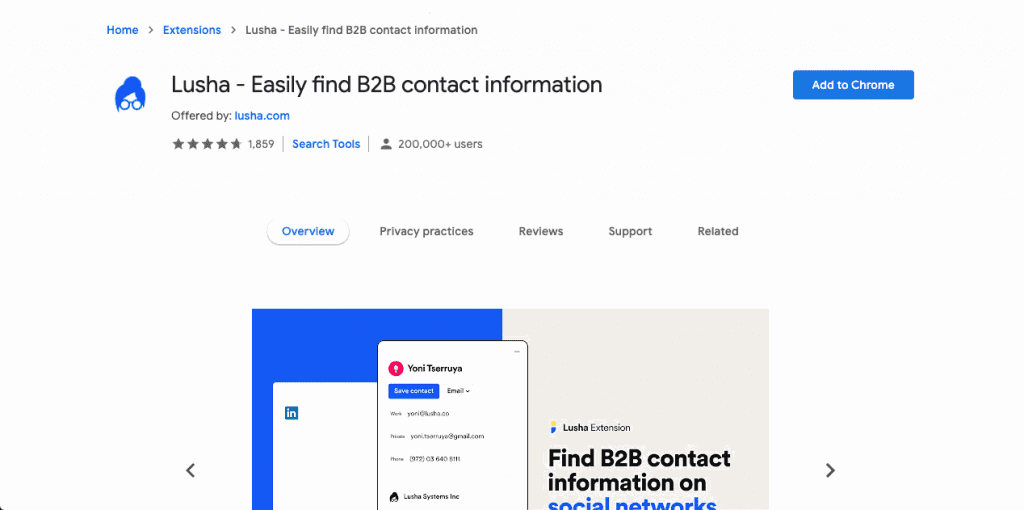
Lusha’s free Chrome extension is a powerful tool that allows you to instantly see verified emails on the site you’re currently searching. Whether you’re on a web page, LinkedIn profile, or even Gmail, Lusha’s extension will provide validated contact information. It also lets you seamlessly export contact data into your CRM platform.
What sets Lusha’s extension apart is the ability to track email opens and clicks from right within the extension. Most extensions only allow for contact validation, and not all of them even allow you to export or save your contact lists. The email tracking that Lusha offers is a nice added bonus that you won’t find in many other platform extensions.
Apollo
Apollo offers a Chrome extension that allows you to find, save, sequence, and enrich contacts across Gmail, LinkedIn, Salesforce/HubSpot, and websites. The extension allows you to validate a web page’s contact details or directly integrate with LinkedIn.
Plans & Pricing
Each platform offers a tiered approach to pricing approach, so you can select the level that’s right for your business needs. Here’s a breakdown of each platform’s pricing options.
Lusha
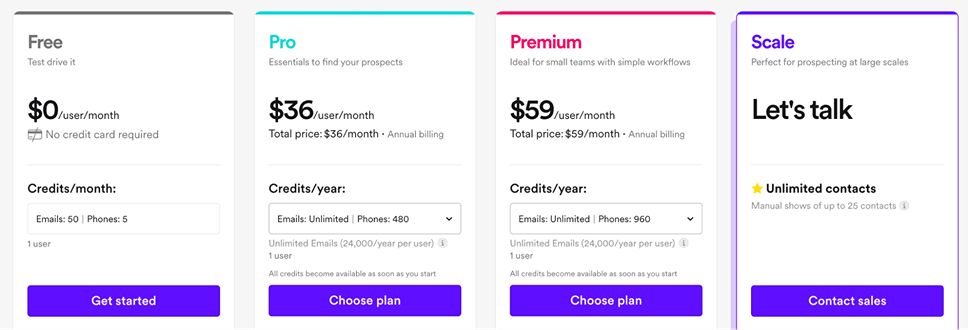
Similar to other platforms, Lusha offers a credit-based pricing system. Your monthly subscription gives you a certain number of credits to search depending on the contact type (all paid plans include unlimited email contact searches). Here are the different plan options for Lusha:
- Free Plan: US$0/month; limited monthly credits
- Pro Plan (annual): US$22.45/user/month; 3,000 credits/year; 3 seats included
- Pro Plan (monthly): US$29.90/user/month; 250 credits/month; 3 seats included
- Premium Plan (annual, credit slider): Selectable bundles (all prices per user per month, billed annually):
- 7,200 credits/yr (600/mo): US$52.45
- 18,000 credits/yr: US$123.55
- 22,800 credits/yr: US$155.10
- 32,400 credits/yr: US$194.60
- 34,800 credits/yr: US$228.05
- 52,800 credits/yr: US$335.85
- 76,800 credits/yr: US$403.00
- 88,800 credits/yr (≈7,400/mo): US$553.65
- Scale Plan: Custom seats & credits
Annual plans grant credits up-front; monthly credits roll over up to 2× the limit; cancel anytime in account settings.
Apollo
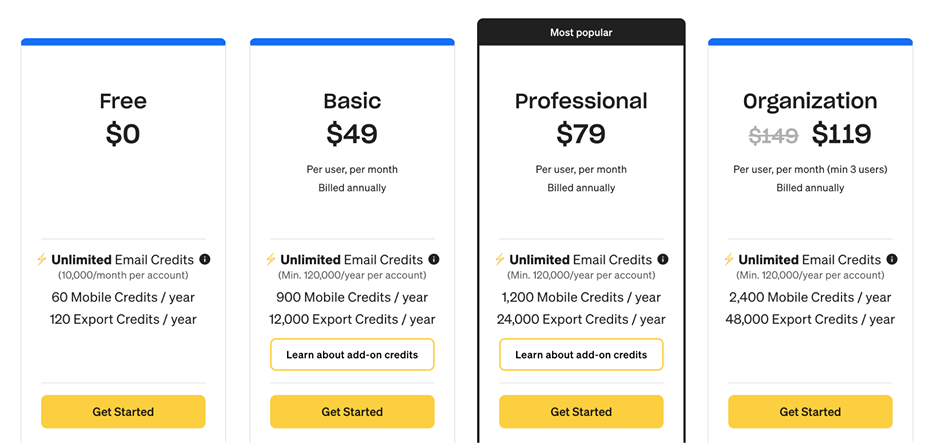
Compared to Lusha, Apollo’s plans are a bit more expensive but come with more credits to use. Here’s a breakdown of Apollo’s four plan options:
Annual billing (20% discount):
- Free (Starter): US$0; 1,200 credits/user/year
- Basic: US$49/user/month (annual); 30,000 credits/user/year
- Professional (most popular): US$79/user/month (annual); 48,000 credits/user/year
- Organization: US$119/user/month (annual); 72,000 credits/user/year; minimum 3 seats
Monthly billing:
- Free: US$0; 100 credits/user/month
- Basic: US$59/user/month; 2,500 credits/user/month
- Professional: US$99/user/month; 4,000 credits/user/month
- Organization: US$149/user/month (annual purchase only; shown for comparison); 6,000 credits/user/month; min 3 seats
Paid plans include a 14-day trial; if not purchased, downgrade to Free.
Main Differences Between Lusha vs. Apollo
We’ve talked a lot about both Lusha and Apollo, but let’s take a look at a direct comparison between the two in some key categories below.
Data Reliability
Both platforms boast accuracy and reliability, but there is a clear front-runner when it comes to data accuracy. Both Lusha and Apollo use similar data-crawling methods, primarily relying on public data and supplementing with manual and AI-driven data-capturing.
Insights & Intelligence
Lusha and Apollo both offer strong insights and intelligence features on their platforms. Lusha focuses on on-platform dashboards to seamlessly track performance and testing, while Apollo offers intent data / intent topics, allowing you to identify prospects that are closer to the purchasing stage. We’d give Apollo the edge when it comes to insights and intelligence.
User Experience
As we mentioned earlier, user experience is going to be a bit different across Lusha and Apollo. Lusha focused on a much more streamlined user experience, while Apollo offers far more customization options. While this makes the tool a bit more complicated, advanced users should be able to leverage the customization features to their advantage. Still, we’d lean toward Lusha when it comes to user experience since it is focused on being a beginner-friendly platform.
Integrations
It’s difficult to choose a winner in the integrations category as both platforms integrate with popular email platforms, CRM tools, and other business software. We recommend taking inventory of your existing suite of tools to determine which platform has the best integration capabilities for your business.
Compliance & Security
Both platforms adhere to major compliance regulations. Apollo publishes a Trust Center (SOC 2/ISO 27001, GDPR info). Lusha publishes its DPA and privacy resources. However, there have been complaints about Lusha consistently providing personal contact details on its platform. It’s important to distinguish between personal and business contact information prior to reaching out to prospects, as reaching out to their personal contact information may lead to a negative experience.
Support
Lusha and Apollo offer extensive customer support. From help articles and knowledge bases to live customer support, both platforms provide robust support options for teams of all sizes.
Overall Tool Value
Value depends on seats vs credits. Lusha bundles multiple seats on Pro/Premium and lets you scale credits via a slider. Apollo prices per seat with fixed annual/monthly credit grants per user. Choose based on team size and expected monthly/annual credit consumption.
Lusha vs. Apollo.io Comparison Table
Here’s a breakdown of how Lusha and Apollo compare side by side.
| Lusha | Apollo | |
| Database Size | 280M+ contacts | 210M+ contacts; 35M+ companies |
| Data Types | Includes contact info and business data points like annual revenue, business type, employee count, location. | Includes contact info and business data points like annual revenue, business type, employee count, location. |
| Unique Features | Buyer intelligence, Lusha API, dashboard analytics | Automated sequences, A/B testing, intent data / intent topics |
| Free Trial | Free plan with limited monthly credits; no card required | Free plan with unlimited email credits, limited exports, and basic sequences |
| Pricing | Four pricing tiers, including a free plan | Four pricing tiers, including a free plan |
| Chrome Extension | Available in both free and paid plans. | Available in both free and paid plans. |
| Integrations | Lusha integrates with CRMs like HubSpot, Salesforce, and Zoho, as well as marketing tools. | Integrates well with CRMs, email platforms, messaging platforms and automation tools. |
| Compliance | Adheres to major compliance regulations | Adheres to major compliance regulations |
| Target User | Businesses of all sizes and industries. | Businesses of all sizes and industries. |
| Best For | Lead generation, list building, consistent contact validation | Lead generation, focusing on prospects closer to the purchasing stage |
Which is Better, Lusha or Apollo.io?
Overall, Lusha seems to have a slight edge over Apollo for the everyday user. Both tools offer a host of good features and benefits, but Lusha’s ease of use and data accuracy make it a slightly better tool overall.
Choose Lusha For Better Data Accuracy
At the end of the day, having good data accuracy is the most important feature of any prospecting tool. Tools that offer inaccurate data don’t offer much value, which is why we think Lusha is the better tool here.
Choose Apollo For Advanced Features and Customization
If your team is well-versed in prospecting tools and you’re looking for advanced customization options, Apollo may be the right choice for you. With automation integration and a host of customization features, you can really make the tool your own.
UpLead is the Best Alternative to Both Tools
While both tools are solid options, UpLead beats them both. With an extensive database boasting 160M+ leads/contacts, UpLead provides reliable and accurate data with a 95% data accuracy guarantee (credits back if invalid). This makes it a viable Lusha alternative.
Its advanced search filter feature (50+ filters), real-time email verification, and technographic data tracking make it a powerful tool for finding and engaging with high-quality leads. UpLead’s transparent and affordable pricing structure makes it an attractive option for businesses of all sizes. Users also enjoy a 7-day free trial with 5 free leads and a Chrome extension.
FAQs About Lusha vs. Apollo.io
Here are some common questions about Lusha vs Apollo.io.
In our opinion, Lusha is a better tool overall than Apollo. Better data accuracy, ease of use, and a lower price point make Lusha a good tool for any-sized business.
Yes, Lusha is a legitimate company that was founded in 2016.
Apollo is primarily a prospecting tool used by sales teams to search for and validate contact data. Apollo can integrate with popular CRM platforms.
Apollo documents the automatic handling of bounces and the refunding of credits (emails sent within Apollo only).
What You Need to Remember About Lusha vs Apollo
At the end of the day, there are many good prospecting tools out there. When it comes to Lusha vs Apollo, Lusha wins out. However, the best alternative to both tools is UpLead. With industry-leading data accuracy, a host of easy-to-use features, and powerful integration options, UpLead can help take your business to the next level.