


TL;DR: 6sense vs. Cognism Quick Comparison
6sense is best for larger teams using account-based marketing who need AI-powered predictive analytics and intent data. You get ~450M B2B profiles, advanced lead scoring, and broad integrations. Plan for a steeper learning curve and higher overall cost.
Cognism is ideal for SMBs focused on straightforward lead generation with real-time verified contact data. It’s simpler to use with faster implementation, though it has fewer AI features and less transparent database size metrics.
Choose 6sense for sophisticated ABM and predictive insights.
Choose Cognism for simplicity and quick deployment. Both require custom pricing quotes.
No matter the size of your business, choosing the right sales intelligence tool is essential. From optimizing pipelines to enhancing lead gen efforts, these tools are a vital piece of a sales or marketing team’s strategy.
In this guide, we examine two well-known platforms. 6sense and Cognism. Both are popular tools, each with a different focus (and inherent pros and cons). We’ll also examine features, pricing, integrations, and so much more to help you decide which tool might be right for you.
What is 6sense?
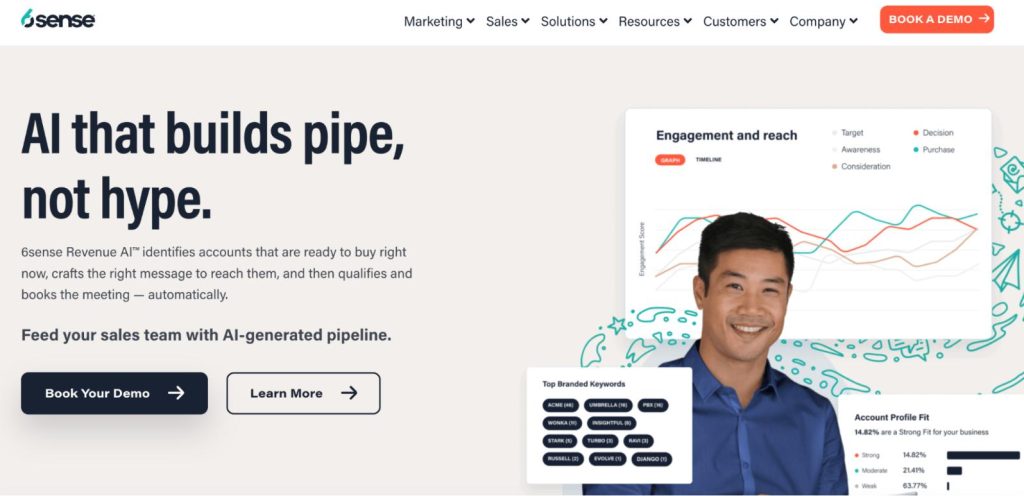
To get us started, let’s take a look at 6sense. 6sense is a powerful lead generation tool focusing on AI capabilities to enhance predictive analytics. The platform is tailored to teams that use account-based marketing strategies. Known for analyzing customer behaviors and tracking customer intent using numerous data points, 6sense does a good job of helping teams identify accounts that are more likely to convert.
6sense is a good choice for teams that like to lead with data in their sales and marketing strategies and, of course, those that already use account-based marketing tactics. The robust database has ~450 million individual B2B profiles and 65+ million companies.
What is Cognism?
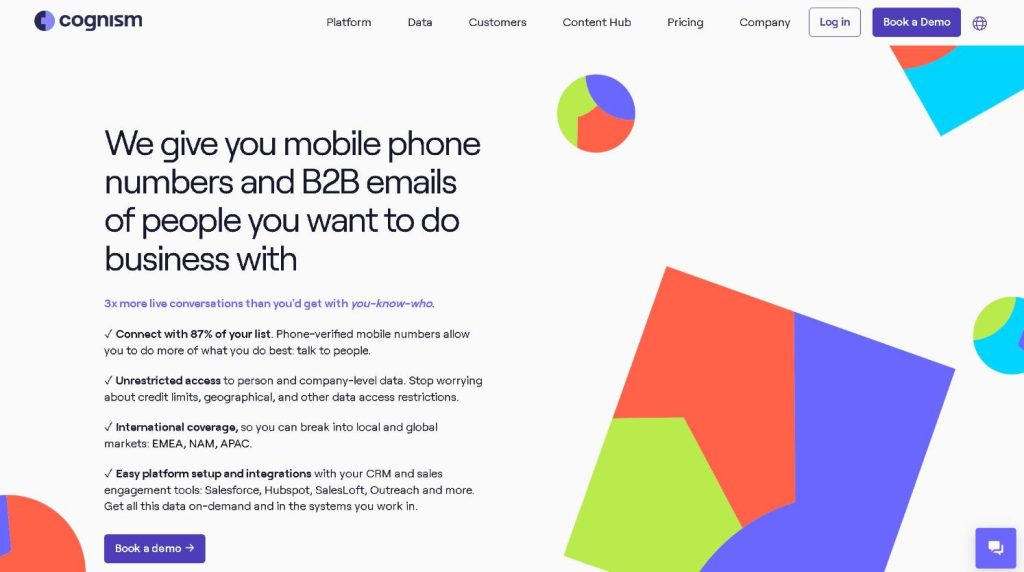
Comparatively, Cognism is a leading lead generation and data enrichment tool that focuses on providing high-quality lead data. Specializing in B2B data, Cognism offers users access to verified data and a streamlined user experience. Data is updated in real time to ensure accuracy.
If your team is solely focused on building lists of leads, Cognism may be a good choice. The platform and capabilities serve SMB through enterprise; packaging and price are tailored via sales.
Key Differences Between 6sense vs. Cognism
We see three key differences: data approach, ideal users, and integrations.
The main differences between 6sense and Cognism are data features, the target audience, and integration capabilities.
- Data Features: 6sense is focused on providing predictive analytics and buyer intent data, enhanced by AI. This helps businesses understand where businesses are in the sales funnel. Cognism is focused on accurate, real-time contact data for simple and streamlined list building.
- Target Audience: As we’ve mentioned, 6sense’s target audience is businesses that are already leveraging account-based marketing tactics. This is a more common approach with larger businesses with more complex sales needs. Cognism serves SMB through enterprise; packaging and price are tailored via sales.
- Integration Capabilities: Both tools integrate broadly. 6sense offers more advanced API options.
6sense vs. Cognism Comparison Table
Here’s a side-by-side view of how 6sense and Cognism stack up.
| 6sense | Cognism | |
| Use Cases | Account-based marketing, lead scoring | Lead generation, data enrichment |
| Database Size & Reliability | ~450 million individual B2B profiles and 65+ million companies | No public total |
| Data Enrichment Features | Predictive data and intent tracking | Real-time data verification |
| Lead Management | High-level lead scoring and segmentation | Robust contact data for outreach |
| AI Features | Strong AI-driven insights across the platform | Limited AI features |
| Integrations | CRM, marketing tools, open API capabilities | Primarily focused on CRM tools and email platforms |
| Ease of Use | Moderate learning curve compared to Cognism | Simple and intuitive |
| Compliance | Compliant with major global data standards | Compliant with major global data standards |
| Browser Extension | Yes | Yes |
| Free Access? | Free plan (50 data credits/month) | No publicly listed free plan; request a quote |
Cognism emphasizes phone-verified Diamond Data® rather than a public records count.
Comparing Key Features of 6sense vs. Cognism
We’ve highlighted the differences between the two tools and reviewed them in a side-by-side table. Let’s examine the key features of 6sense and Cognism.
6sense Core Features
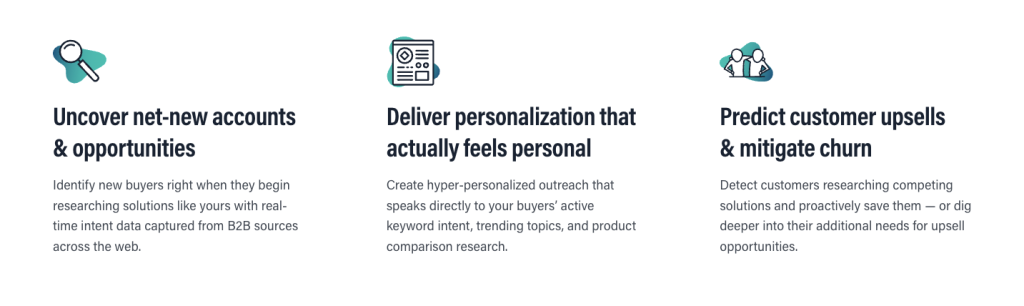
- Predictive Analytics: AI enriches records and scores accounts. It surfaces the ones that are likely ready. 6sense leans on numerous datapoints to generate a score for each lead, turning those datapoints into fairly accurate intent scores.
- Lead Scoring: Which brings us to the next key feature – lead scoring. Each lead is ranked based on the likelihood of conversion, giving teams a targeted list of accounts to focus on first. The data and scoring isn’t perfect, but gives a good guide for teams to get started.
- Account-Based Marketing Tools: If your team already uses account-based marketing tactics, 6sense may be the way to go. The platform focuses on serving up account details that are ready to convert.
Cognism Core Features
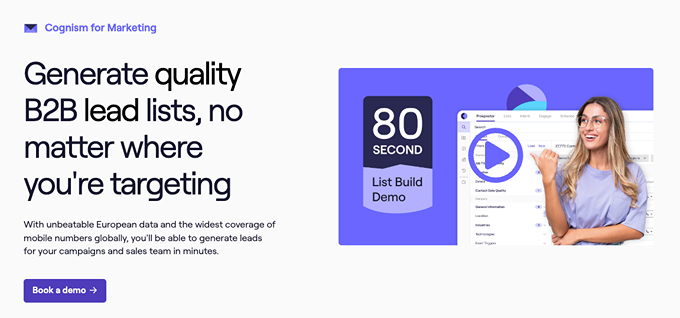
- Real-Time Data Verification: What helps set Cognism apart from 6sense and many other B2B databases is its real-time verification efforts. While it isn’t 100% accurate, the real-time verification and update is a crucial feature for any sales team – nobody wants outdated contact details.
- Lead Generation Focus: Cognism focuses on traditional lead generation, while 6sense leans into account-based marketing. If you’re looking for simple, intuitive list building, Cognism may be the way to go.
Both tools offer solid features—6sense has impressive AI and data features, while Cognism aims to provide accurate, real-time data for every contact.
Database Source, Size & Contact Quality
A tool is only as good as its database – here’s what you should know about both 6sense and Cognism’s databases.
6sense Data
6sense has ~450 million individual B2B profiles and 65+ million companies. Offering excellent global coverage, the size of 6sense’s database is great for businesses of all sizes.
6sense highlights high-quality B2B data; credits unlock/export verified emails and direct dials. No site-wide accuracy % is published. Similar to most major databases, in terms of data points, you’ll see emails, phone numbers, name details, and general company information.
Cognism Data
Cognism does not publish a total database number. It emphasizes phone-verified Diamond Data® and on-demand verification. Data is updated and verified real-time, but as we’ll see in the review section, it may not be as accurate as it states.
Cognism markets phone-verified Diamond Data® and ’Diamonds-on-Demand’; results are framed as connection-/match-rate improvements rather than a universal accuracy %. Cognism data is standard, meaning you’ll get names, emails, phone numbers, and general company information.
Pricing of 6sense vs. Cognism
Both vendors sell via sales with customized quotes. Use 6sense’s published Free tier details; for Cognism, keep our researched ranges and clarify they’re estimates.
We’ll keep this section short. Neither platform publishes pricing. Third-party numbers vary.
6sense Cost
When searching for 6sense pricing, it can vary widely – we’ve seen estimates between $50,000 and $120,000 annually, which can be impacted by a number of variables. Compared to platforms that use a credit-based or per-user pricing structure, this pricing isn’t attainable for most small businesses and a number of medium-sized businesses.
Cognism Cost
Cognism does not publish list pricing. Request a quote. Review sites put pricing around $20,000 to $100,000 annually. While a bit more affordable than 6sense, the platform is still pricey compared to other platforms.
Integration & API Comparison
Whether you have only a few other tools or an entire tech stack to consider, integration and API capabilities are an important factor when choosing your following sales intelligence tool.
Integrating with 6sense
6sense provides public People and Company APIs and major CRM integrations such as Salesforce. This open approach makes in-house integrations easier. It also allows you to integrate directly with many popular CRM platforms and other sales and marketing tools with just a few clicks.
Integrating with Cognism
Cognism integrates with Salesforce, HubSpot, Microsoft Dynamics, Pipedrive, Salesloft, Outreach, Bullhorn, and Zapier. It also offers documented API workflows.
6sense vs. Cognism Ease of Use
Ease of use is often just as important as pricing and data accuracy, so let’s see how easy each platform actually is to use.
6sense Implementation
While 6sense itself isn’t an inherently difficult tool to understand, when compared to Cognism, it’s materially more difficult. It has a wide range of powerful tools and features that users may need to spend time learning. Because of its complexity, implementation can take longer than Cognism.
On-demand training resources are available to team members and a dedicated contact for more complex issues.
Cognism Implementation
Cognism also requires dedicated implementation time. It is typically quicker to implement than 6sense. In terms of ongoing support, Cognism has a robust library of support and training, an AI chatbot, as well as live support. There is an option to submit a help request via a form on the site.
Overall, Cognism is the more straightforward platform to use.
What People Are Saying: Reviews of 6sense vs. Cognism
We’ve looked at review sites like G2 and Reddit to compile what customers say about both 6sense and Cognism.
6sense Reviews
6sense users note the extensive AI features positively. There are consistently high scores for features like ABM capabilities and its predictive insights. Users like the data enrichment and intent data to help predict accounts further along in the sales funnel.
Where 6sense falls short is in the longer implementation time, lack of transparent pricing, and learning curve for some of the more advanced features. As of Oct 30, 2025 (CET), users give 6sense a 4.2 out of 5 stars from 1,968 reviews.
Cognism Reviews
As of Oct 30, 2025 (CET), Cognism scores 4.6/5 from 1,155 G2 reviews. Reviewers like the clean UX and dependable integrations. Many users note that the platform is easy to use and appreciate the simple, intuitive platform. Users also note that the integrations work well, although they’re not as expansive as what 6sense has to offer.
Interestingly, a number of users state that the data is out of date and inaccurate.
6sense vs. Cognism: The Bottom Line
Choose 6Sense For Powerful AI Enhancements and Predictive Data
It’s clear that 6sense is a tool with robust data in mind. With predictive analytics, intent data, and lead scoring, teams can get ahead and reach out to accounts that are ready to buy. If you’re a larger sales team (likely with a larger budget for sales intelligence tools), 6sense may be a good option for you. AI is the way of the future, and 6sense is one of only a handful of tools leaning into this exciting technology.
Choose Cognism For Simplicity and Accuracy
If you’re a small to medium-sized business looking to get up and running with a sales intelligence tool quickly, Cognism may be a better fit for you. Cognism is typically faster to roll out. Teams like the straightforward workflows. Focusing on simplicity and data accuracy, Cognism offers core features that you’ll find with most lead generation tools, all in a streamlined interface.
Skip the Stress & Choose UpLead Instead
If you’re weighing both, try UpLead. It offers a faster path to reliable B2B data. With high-quality B2B contact details, a robust lineup of tools and features, and seriously affordable pricing, you can’t go wrong. With UpLead, you can start generating high-quality leads in just a few clicks. Sign up for your free trial today!
FAQs About 6sense vs. Cognism
Here are some common questions and answers about 6sense vs Cognism.
If you’re looking for a simple, affordable tool to help with lead generation, Cognism may be a good option for you. However, UpLead offers powerful tools, accurate data, and enhanced features at simple pricing.
Aside from Cognism, other major competitors include ZoomInfo and Demandbase. Both tools offer predictive analytics and account-based marketing features.
Cognism markets phone-verified Diamond Data® and ’Diamonds-on-Demand’; results are framed as connection-/match-rate improvements rather than a universal accuracy %.
Cognism is a privately owned company founded by James Isilay and Stjepan Buljat – it is not publicly traded.
What You Need to Remember About 6sense vs Cognism
6sense and Cognism are fairly different tools. While they both allow users to generate leads and verify contact details, they are targeting two separate customers. 6sense targets teams that use account-based marketing methods and want enhanced data and AI features. Cognism targets smaller teams that want quick, accurate lead results. Remember – UpLead is an ideal alternative to both 6sense and Cognism!