

MEDDIC is a B2B sales qualification framework built around six criteria: Metrics, Economic Buyer, Decision Criteria, Decision Process, Identify Pain, Champion. Sales teams use it to test whether a complex, multi-stakeholder deal is actually winnable before investing more time in it, rather than qualifying only on budget and timeline.
What is MEDDIC?
MEDDIC is a qualification methodology for B2B sales teams, most useful in long, multi-stakeholder deal cycles where a simple budget-and-timeline check misses too much risk. Instead of asking “can they pay and when,” MEDDIC asks whether the deal has a quantifiable outcome and a real decision-maker. It also checks for a known evaluation process plus an internal advocate who can carry it across the finish line.
The payoff shows up in forecasting more than in any single call. A pipeline full of deals that pass a MEDDIC check is easier to trust than one qualified only on “they seem interested,” because each criterion forces the rep to produce evidence instead of an impression.
Each letter stands for one qualification criterion:
- Metrics – the measurable result the buyer expects
- Economic Buyer – the person who controls the budget
- Decision Criteria – how the buyer will evaluate and compare options
- Decision Process – the steps and stakeholders the deal has to pass through
- Identify Pain – the business or technical problem driving the purchase
- Champion – the internal advocate who supports the deal when you’re not in the room
A deal can look active on paper and still be MEDDIC-weak if, for example, the only contact is a mid-level manager with no budget authority and no mapped decision process. MEDDIC exists to surface exactly that kind of risk early, before it costs a full sales cycle.
Where MEDDIC came from
Parametric Technology Corporation (PTC) is where the framework was built, in the 1990s. According to meddicc.com, the company founded by the people behind the methodology, Dick Dunkel and Jack Napoli developed it while working under sales SVP John McMahon. They studied why PTC’s deals were won, why they were lost, or why they stalled. By the time PTC’s sales team reached roughly 300 reps, attrition had become a serious threat; meddicc.com credits the resulting discipline with taking the sales org from $0 to $1 billion in ten years.
It has since become one of the most widely taught qualification frameworks for enterprise and complex B2B sales. Variants like MEDDICC and MEDDPICC extend the original six criteria, covered later in this guide.
The 6 MEDDIC criteria explained
Metrics
Metrics are the specific, measurable outcomes the buyer expects from your solution, things like cost savings, hours saved per week, revenue lift, or error-rate reduction. A deal without a stated metric is hard to defend internally, because the buyer has nothing concrete to show their own leadership.
Questions to ask:
- What number is this supposed to move, and by how much?
- How does the buyer currently measure that number?
Economic Buyer
The Economic Buyer is the person with the authority to release budget for the deal, not necessarily the person you talk to most often. In larger organizations this is often a VP, CFO, COO, or other business-unit leader who may never join a product demo.
Questions to ask:
- Who signs off once the deal is ready to close?
- Has anyone on our side actually spoken with this person?
- What does this person personally care about in the outcome?
- What has to happen before they’ll say yes?
Decision Criteria
Decision Criteria are the standards the buyer uses to compare vendors: required features, integrations, firmographic fit, pricing structure, security requirements, or expected ROI. If the buyer hasn’t defined these yet, that’s a signal to help shape them, not a signal to skip the question.
Questions to ask:
- Has the buyer written down evaluation criteria, or are they still forming them?
- Which criteria favor us, and which favor a competitor?
Decision Process
Decision Process is the actual sequence the deal must move through before a contract is signed, often tracked across a sales tech stack of CRM and e-signature tools: every step, every approval, every stakeholder involved. That usually means legal review, security review, procurement, budget cycles, plus any required sign-offs.
Questions to ask:
- What are the remaining steps between today and a signed contract?
- Who has to approve at each step, and in what order?
- Is there a budget cycle or renewal date that sets a hard deadline?
- Which of those steps has never been confirmed, only assumed?
Identify Pain
Identify Pain means finding the specific business or technical problem that is costing the buyer money, time, or risk right now. It also means understanding that problem’s root cause well enough to connect your solution to it directly, rather than relying on generic benefits language.
Questions to ask:
- What happens if this problem goes unsolved for another year?
- Who inside the company feels this pain most directly?
Champion
A Champion is an internal advocate, someone inside the buyer’s organization who wants your solution to win and has enough credibility to influence the Economic Buyer and other stakeholders. A friendly contact who likes your product but has no internal influence is not a Champion; that distinction matters enough that it shows up again in the mistakes section below.
Questions to ask:
- Has this person personally benefited from pushing initiatives like this before?
- Will they advocate for us in a room where we’re not present?
- Do they have a personal or political reason to want this deal to succeed?
- Have they ever gone to bat for a vendor before, and what happened?
MEDDIC qualification checklist
Before a deal review or forecast call, run it through this six-item checklist. Each line should have a real answer, not a guess:
- Do we know the specific metric this deal is supposed to move, and by how much?
- Have we identified the actual Economic Buyer, and has anyone on our team spoken with them directly?
- Do we know the buyer’s Decision Criteria, and where we stand against them?
- Do we know every remaining step in the Decision Process, including who signs off at each one?
- Can we state the buyer’s core pain in their own words, including why it matters to them?
- Do we have a Champion who will advocate for us internally, not just someone who likes the product?
A “no” on any line isn’t necessarily a reason to walk away from the deal, but it’s a reason to treat the forecast for that deal as unreliable until it’s resolved.
How to build a MEDDIC scorecard
Turning the checklist above into something you can track deal over deal is what a MEDDIC scorecard is for. Many sales teams use a simple three-point scale per criterion, scoring how well-evidenced each one is rather than just whether it was discussed:
Score each of the six MEDDIC criteria on that 0-2 scale during every deal review. A deal sitting at mostly 0s and 1s late in the sales cycle is a forecasting risk regardless of how “engaged” the buyer seems on calls. Engagement and verified qualification aren’t the same thing.
Worked example: scoring a deal with MEDDIC
Take a hypothetical deal: a sales rep is three weeks in with a 200-person logistics company evaluating a new routing platform. Here’s how that deal might score using the scale above:
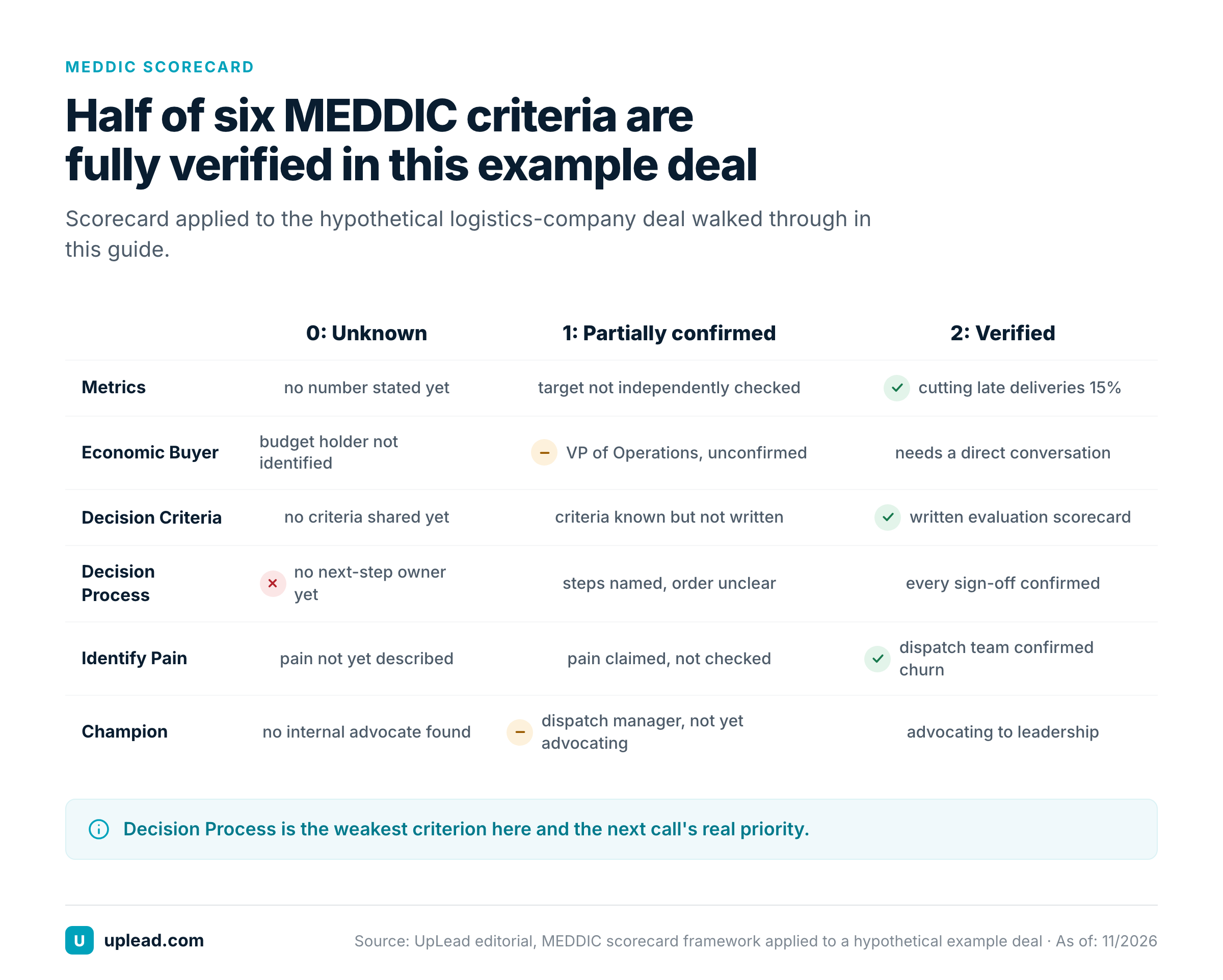
Read as a whole, this deal has strong evidence on Metrics, Decision Criteria, Pain. It’s exposed on Decision Process and only partially covered on Economic Buyer and Champion. The next call’s job isn’t more product demo time; it’s getting the Decision Process confirmed and turning the dispatch manager into someone who will actually advocate upward. That’s the kind of gap a plain “is this deal engaged?” read would miss entirely.
MEDDIC vs. BANT: what’s the difference?
BANT (Budget, Authority, Need, Timeline) and MEDDIC both qualify deals, but at different depths. BANT is a fast, four-question screen suited to simpler or shorter sales cycles; MEDDIC is a deeper framework built for deals with multiple stakeholders and a longer evaluation process where budget and timeline alone don’t tell you whether the deal can actually close.
| BANT | MEDDIC | |
|---|---|---|
| Criteria | Budget, Authority, Need, Timeline | Metrics, Economic Buyer, Decision Criteria, Decision Process, Identify Pain, Champion |
| Best for | Fast, transactional deals with one or two stakeholders | Complex, multi-stakeholder B2B deals |
| What it checks | Can they pay, who signs, do they need it, when | Can they pay, who signs, do they need it, when, how they’ll decide, and who will advocate internally |
| Main blind spot | Doesn’t check decision process or internal advocacy | Takes longer to complete; overkill for simple deals |
MEDDIC vs. MEDDICC vs. MEDDPICC
Two common extended versions build on the original six letters. MEDDICC adds Competition, understanding which other vendors or internal alternatives (including “do nothing”) the buyer is weighing. MEDDPICC goes further and adds Paper Process: the contracting, legal, security, procurement steps that happen after a verbal “yes,” which can stall a deal for weeks if they’re not mapped in advance.
The core six criteria stay the same across all three versions; MEDDICC and MEDDPICC only extend the meddicc sales process with extra qualification checkpoints for deals where competitive pressure or contract complexity is high enough to justify them. Teams running simpler deals can stick with the original six letters without losing anything material.
SPIN selling is another framework MEDDIC often gets paired with: a discovery questioning method Neil Rackham built from research on more than 35,000 sales calls. SPIN’s four question types, Situation, Problem, Implication, and Need-payoff, are how a rep gathers the detail that MEDDIC’s Metrics and Identify Pain criteria actually need; the two are typically combined rather than treated as rival frameworks.
Common mistakes when applying MEDDIC
- A one-time checklist run is not enough. MEDDIC criteria change as a deal moves; a Champion identified in week one can lose influence, and Decision Criteria can shift after a new stakeholder joins.
- Hope is not evidence, and a score should not be based on it. A criterion should only score a 2 when someone other than the rep has confirmed it; optimism isn’t verification.
- An eager buyer does not remove the need to map Decision Process. Enthusiasm from one stakeholder doesn’t remove procurement, legal, or security steps elsewhere in the organization.
- Inconsistent use of MEDDIC across the team breaks forecasting. If reps score deals differently, forecasts built from those scores aren’t comparable, which defeats the purpose of scoring at all.
- One enthusiastic stakeholder should not override the scorecard. A buyer who sounds ready on a call can still sit behind an unconfirmed Economic Buyer or an unmapped Decision Process; excitement on one line doesn’t raise the score on the others.
How UpLead supports MEDDIC qualification
Economic Buyer and Champion, two of the six MEDDIC criteria, depend entirely on knowing who actually works inside the account and how to reach them. A guess at a title from a signature block isn’t the same as confirming authority, and a scorecard built on guesses scores worse than one left honestly blank. UpLead’s B2B contact database is built for exactly that part of qualification:
Frequently asked questions
No. MEDDIC was created in the 1990s, but the underlying problem it solves hasn’t gone away: confirming budget authority, decision process, internal advocacy before forecasting a deal. Most criticism of MEDDIC targets rigid, checklist-only use, not the framework’s core logic.
Yes. Several sales-enablement vendors offer paid certification courses, including the company behind the MEDDICC name. Those programs cover MEDDIC and its extended versions, though certification isn’t required to use the framework internally.
BANT is a faster, four-question screen (Budget, Authority, Need, Timeline) suited to simple deals. MEDDIC adds Decision Criteria, Decision Process, Champion – the three that matter most in longer, multi-stakeholder B2B sales cycles.
MEDDPICC is MEDDIC plus two additional criteria: Competition (who else the buyer is considering) and Paper Process (the contracting and procurement steps after a verbal commitment).
MEDDIC was created at Parametric Technology Corporation (PTC) in the 1990s. Meddicc.com credits Dick Dunkel and Jack Napoli with developing it while they worked under sales SVP John McMahon.