

Crunchbase is a company and funding intelligence database used for market research and fundraising. Its Pro plan is priced at $49 a month on an annual, first-year discount, or $99 a month if you pay monthly. Business starts at $199 a month but needs a sales call to confirm. Custom Data Solutions covers the API and bulk data licensing, with no public price at all. This guide covers what each plan actually includes, what Crunchbase doesn’t tell you up front, and how the cost compares with three real alternatives: PitchBook, Owler, plus UpLead.
How much does Crunchbase cost right now
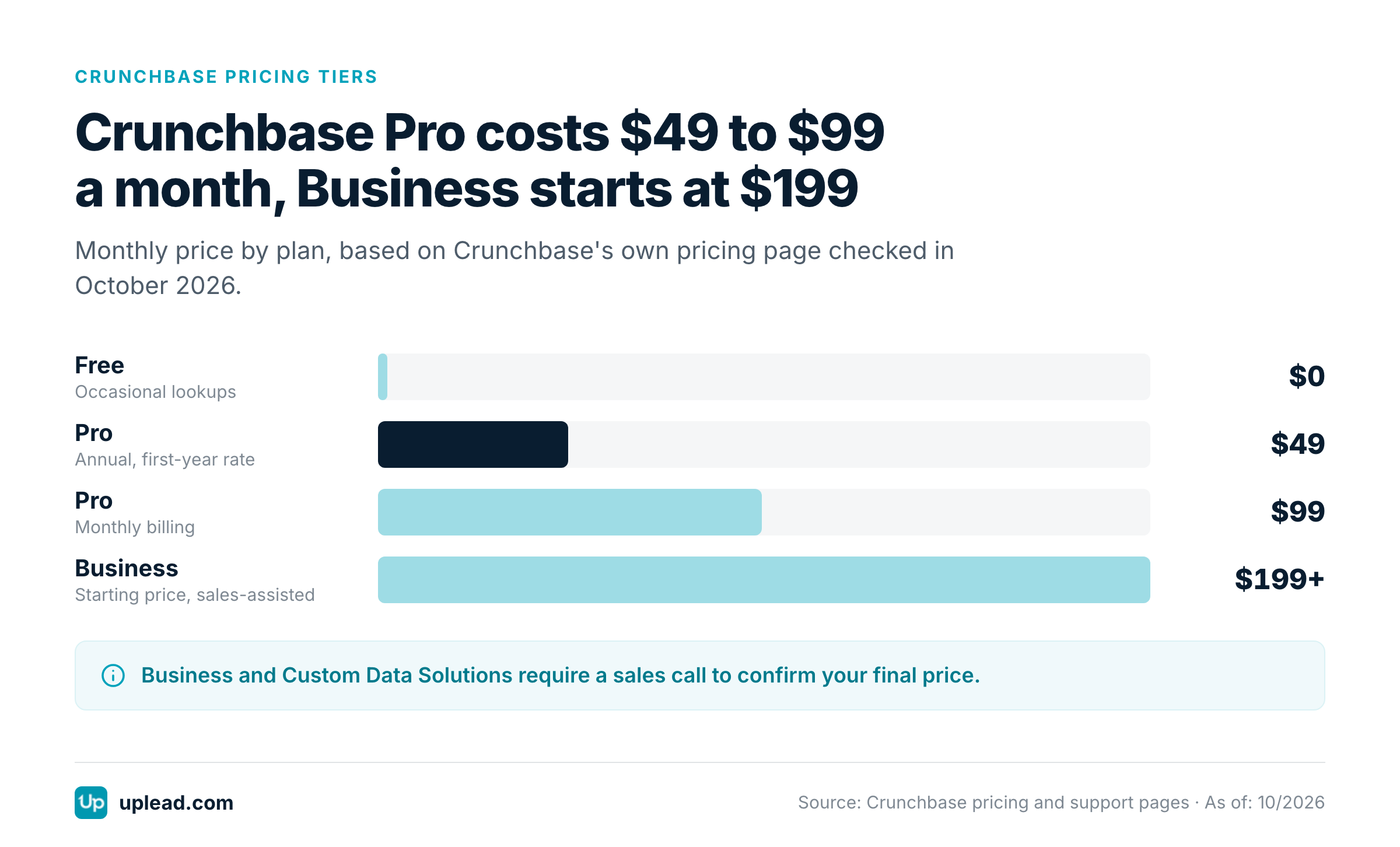
Pro runs $49 a month when you pay annually during the current new-user promotion, or $99 a month on a flexible month-to-month plan. Business starts at $199 a month, though you need to talk to sales to get a confirmed quote for your team size. The API and Custom Data Solutions tier has no published price at all. It’s quote-only.
| Plan | Price (USD) | Billing | Who it’s for |
|---|---|---|---|
| Free | $0 | n/a | Quick, occasional company lookups |
| Pro | $49/mo (annual, first year) or $99/mo (monthly) | Monthly or annual | Individual researchers, founders, solo GTM reps |
| Business | Starting at $199/mo | Annual, sales-assisted | Teams that need CRM sync, SSO, and shared access |
| Custom Data Solutions | Custom pricing | Sales-assisted | Companies building products on top of Crunchbase’s data |
Crunchbase’s $49 figure is a first-year introductory rate. Crunchbase’s own pricing page lists the standard annual rate at $79 a month and discounts it by 38% for new users in year one. G2’s pricing panel, which pulls numbers straight from Crunchbase, shows the same $49 a month but labels it a 50% saving instead. Both numbers are correct; they just use different baselines. Crunchbase’s 38% compares the discounted rate against its own $79 list price. G2’s 50% compares the $588 annual total against what you’d pay if you ran the $99 monthly plan for a full year ($1,188). Either way, you land on the same $49-a-month, $588-a-year charge for the first year.
Crunchbase Free
There is a free Crunchbase account, and it’s genuinely free forever, not a trial. It’s built for someone who wants to look up a single company every so often, not for anyone doing regular research.
The free plan caps you at five results per search, a hard limit that makes broad prospecting or market scans impractical. Your homepage feed and AI agent access are both limited rather than switched off entirely. Growth insights and most of Crunchbase’s prediction features sit behind Pro or Business. If you only need to confirm a company’s basic details once in a while, Free covers that. Anything beyond occasional lookups will hit the five-result wall fast.
Crunchbase Pro pricing
Crunchbase Pro costs $49 a month on the current annual, first-year promotion, or $99 a month with no annual commitment. Both options come with a 7-day free trial, so you can test the platform before you’re charged either way.
What Crunchbase Pro includes
Usage is capped too. You get up to 1,000 results per search and up to 2,000 data export rows a month. One seat is included. There’s no team management or single sign-on on this tier, and CRM integrations are reserved for Business.
Crunchbase Pro’s free trial and cancellation terms
Pro includes a 7-day free trial on both the monthly and annual billing options. Canceling during that window takes a few clicks in account settings and skips the retention offer entirely, since that offer only appears once you’re already a paying subscriber trying to cancel an annual plan.
After the trial, cancellation has two catches worth knowing before you subscribe. First, Crunchbase doesn’t prorate refunds: if you cancel partway through a billing period, you keep access until the period ends, but you don’t get money back for the unused time. Second, if you try to cancel an annual Pro subscription, Crunchbase offers a retention option to switch to the $99-a-month plan instead of a full cancellation. You can still cancel outright if you want to.
Crunchbase Business pricing
Business starts at $199 a month, but that’s a floor, not a fixed rate. A sales conversation confirms your actual price, which typically scales with seat count and usage.
Business includes everything in Pro. It adds the features teams actually ask for: Salesforce and HubSpot CRM integrations; single sign-on; team and seat management. Usage limits rise across the board too, including up to 5,000 export rows a month, more than double Pro’s cap. CRM data enrichment is available, but only once you’re buying 10 or more seats. Business is the tier built for shared access and admin controls. A single researcher is usually better served by Pro, which covers the same core data at a fraction of the cost.
There’s no published figure for what Business actually costs once a sales team quotes you, but third-party software deal-tracking platforms that log real negotiated contracts report annual totals commonly landing between roughly $4,000 and $51,000, with a reported median near $20,000, scaling mostly with seat count and contract length. Crunchbase hasn’t confirmed those figures, so treat them as a rough budgeting range, not a quote. The same deal-tracking data points to annual renewal increases in the 5 to 10 percent range on multi-year Business contracts, which is worth asking your sales rep to cap before you sign.
Crunchbase API and Custom Data Solutions pricing
There’s no published price for this tier. You have to talk to sales to get a number, and Crunchbase doesn’t disclose a starting rate the way it does for Business.
What you do get clarity on is how the data is packaged.
If your use case is checking a handful of companies by hand, you don’t need this tier. If it’s piping Crunchbase data into your own systems at scale, this is the only tier that fits. Budget for a sales cycle before you get a number.
Hidden costs and limits to know before you buy
Crunchbase’s sticker prices aren’t the whole story. A few terms only show up once you’ve already signed up or tried to leave.
The $49-a-month rate is a first-year introductory offer, not a locked-in rate. Expect the renewal price to move toward the $79 list rate once the promotional period ends, so budget for that before you commit to a full year. Cancellations aren’t prorated; your access runs out the billing period, but you won’t get a partial refund for the days you don’t use. Export limits are tighter than they look at first glance: Pro caps you at 2,000 rows a month and Business at 5,000, which can run out fast if you’re building large target lists rather than looking up companies one at a time. And Business pricing itself is opaque by design; the “$199” figure is a floor Crunchbase advertises to get you into a sales conversation, not a number you can budget against until that call happens.
Why Crunchbase’s pricing structure changed in 2026
Crunchbase’s current pricing page looks different from older third-party guides to the platform, and that’s not an error on either side; the product changed. Several comparison articles published earlier in 2026 describe Crunchbase as selling a fixed number of contact credit reveals per month, with extra credits sold as a separate add-on pack.
That credit system doesn’t appear anywhere on Crunchbase’s live pricing page or in its current support documentation. The plans have moved toward a usage model built around search results, export rows, plus AI agent access (Scout queries and MCP calls) instead of metering individual contact reveals. An older guide that talks about buying extra Crunchbase contact credits is describing a system that’s gone. It’s also a real point of difference worth knowing if you’re comparing Crunchbase to a contact-data tool like UpLead, which still prices by the contact: Crunchbase’s current plans don’t work that way anymore.
Crunchbase pricing vs. 3 real alternatives
Crunchbase isn’t the only option, but the three most common alternatives solve different problems at different price points. None of them is a drop-in replacement for all of Crunchbase’s use cases. For a longer list of options beyond these three, see UpLead’s full roundup of Crunchbase alternatives.
| Platform | Entry price (USD) | Self-serve checkout | Best for |
|---|---|---|---|
| Crunchbase Pro | $49 to $99/mo | Yes | Company and funding research for individuals |
| PitchBook | No public price (enterprise quote) | No | Institutional deal and fund data for PE, VC, and IB teams |
| Owler | Free tier, or $468/yr for Pro (about $39/mo) | Yes | Lightweight company news and competitor alerts |
| UpLead | $99 to $199/mo | Yes | Verified contact data: emails and direct-dial phone numbers |
PitchBook (institutional alternative)
PitchBook doesn’t publish a price. It sells an enterprise subscription that scales with team size and the data modules you need, and getting a number requires a sales conversation, the same as Crunchbase Business. The difference is depth and audience. PitchBook tracks more than 12 million private companies against Crunchbase’s roughly 4.7 million. It also adds fund performance data, limited-partner profiles plus dedicated analyst access, none of which Crunchbase offers at any tier. That depth is built for investment committees making multi-million-dollar calls, not for a sales rep building a prospect list. A workflow that ends in an IC memo needs data Crunchbase simply doesn’t have, whatever PitchBook turns out to cost for your team. A workflow that ends in an outreach list is paying for more than it needs.
Owler (budget alternative)
Owler is the cheapest named alternative here, and it now operates as part of Meltwater. Its free Community tier costs nothing but only gives you one company profile view and five followed companies a month, thinner than Crunchbase’s own free plan. Owler Pro costs $468 a year, billed annually, which works out to about $39 a month, undercutting even Crunchbase’s discounted Pro rate. See UpLead’s dedicated Owler pricing breakdown for the full plan details. For that price you get unlimited company follows, daily news snapshots, a competitor graph plus a Chrome extension. What you don’t get is Crunchbase’s funding-round depth, growth forecasting or AI search. Owler fits a reader who wants cheap, ongoing news alerts on competitors, not deep financial or funding research.
UpLead (a different job: verified contact data)
UpLead isn’t a Crunchbase substitute, and it shouldn’t be marketed as one. Crunchbase sells company and funding intelligence across private markets; UpLead sells verified contact data instead: validated emails and mobile direct-dial numbers tied to real people at real companies. UpLead’s Essentials plan runs $99 a month for 170 credits, and Plus runs $199 a month for 400 credits, with each credit releasing one contact’s verified email and mobile number. Extra credits cost $0.60 or $0.50 each depending on plan.
Several of Crunchbase’s own G2 reviewers specifically flag the lack of native verified phone and email data as a gap, since Crunchbase’s paid tiers surface company and people records without guaranteeing a working direct-dial number the way a credit-based reveal does. That gap is exactly what UpLead fills: a validated email and mobile number for one named decision-maker, on demand, rather than a broader company or funding profile. Pair the two instead of picking one. Use Crunchbase to find and qualify the company, then use UpLead to get the one contact detail Crunchbase’s current plans don’t guarantee.
Which Crunchbase plan should you buy
One rule holds across every tier. Don’t buy based on the discounted first-year rate alone. Check what the plan renews at. Check your real export volume against the row caps. Then confirm whether your actual workflow needs company and funding intelligence (Crunchbase’s job) or verified contact data (a tool like UpLead’s job); those are two different purchases even though they often get compared on the same page.
Frequently asked questions about Crunchbase pricing
Yes, Crunchbase offers a permanently free account rather than just a trial. It never expires or asks for a credit card. The catch is a hard five-result cap per search and a reduced homepage and AI agent experience, which rules it out for anything beyond occasional lookups.
Pro includes a 7-day free trial on both the monthly and annual billing options. Canceling during that window takes a few clicks in account settings and skips the retention offer entirely, since that offer only appears once you’re already a paying subscriber trying to cancel an annual plan.
The Pro plan costs $49 a month if you pay annually under the current first-year promotion, or $99 a month if you pay monthly with no annual commitment. The monthly option costs more overall, but it suits anyone who isn’t sure yet whether they’ll keep using Crunchbase past the first few months.
No separate charge applies for contact credits under Crunchbase’s current plan structure. Older reviews describe a per-contact credit system with paid add-on packs, but Crunchbase’s live pricing page and support documentation describe usage limits by search results and export rows instead, not by individual contact reveals.
Crunchbase is the cheaper, self-serve option for individual research, starting at $49 a month with a published price. PitchBook has no public price and requires a sales quote, but it also tracks more than double the number of private companies and adds fund-performance and limited-partner data that Crunchbase doesn’t offer at any tier, so the better fit depends on whether you need institutional-grade deal data or lighter company research.
Owler’s Community tier is free and covers basic company news and alerts, though it’s more limited than Crunchbase’s own free plan, capping you at one company profile view and five followed companies a month. For deeper free research, Crunchbase’s own free account still allows broader company lookups, just capped at five search results at a time.
Yes, you can cancel Crunchbase Pro at any time from your account settings, but Crunchbase doesn’t issue prorated refunds, so you keep access through the end of your current billing period without getting money back for unused time. If you try to cancel an annual plan, Crunchbase will also offer you a $99-a-month, month-to-month option before completing the cancellation.
No, there’s no public price for Crunchbase’s API or Custom Data Solutions tier. This tier targets engineering and data teams building Crunchbase data into their own product, not individual researchers, so expect a longer sales cycle than Pro or Business before you see a number.