

Choose UpLead if you need verified B2B contacts exported today. Choose Clay if you want to build a multi-provider enrichment workflow and have someone to run it. Plenty of teams use both, at different stages of the same pipeline.
UpLead vs Clay: The Quick Answer
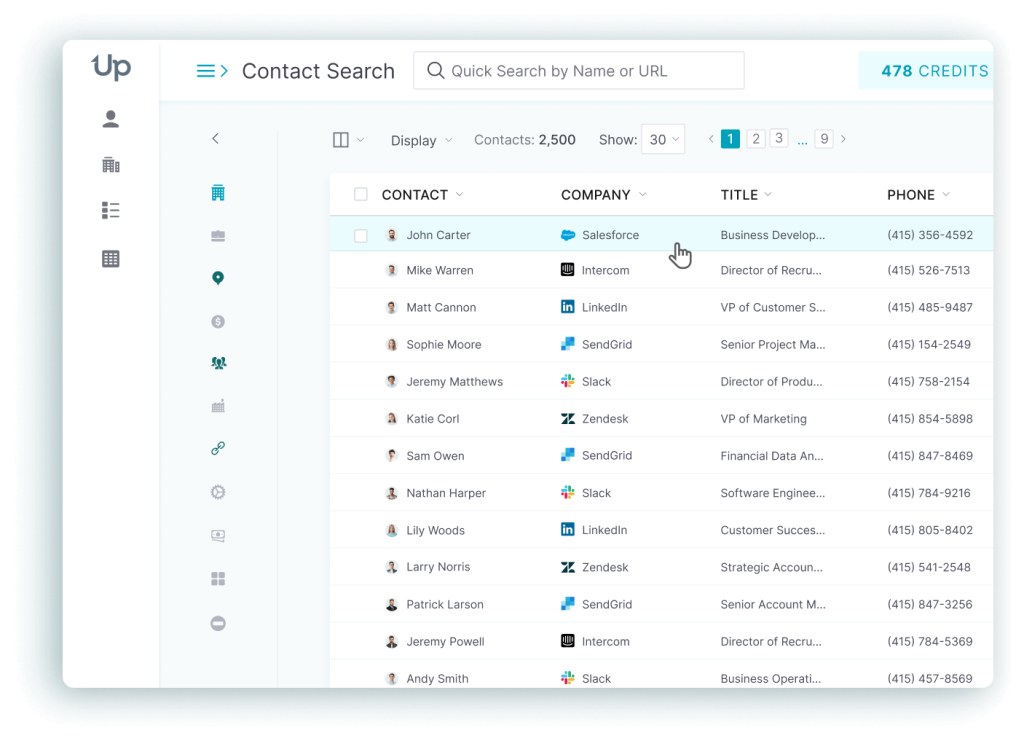
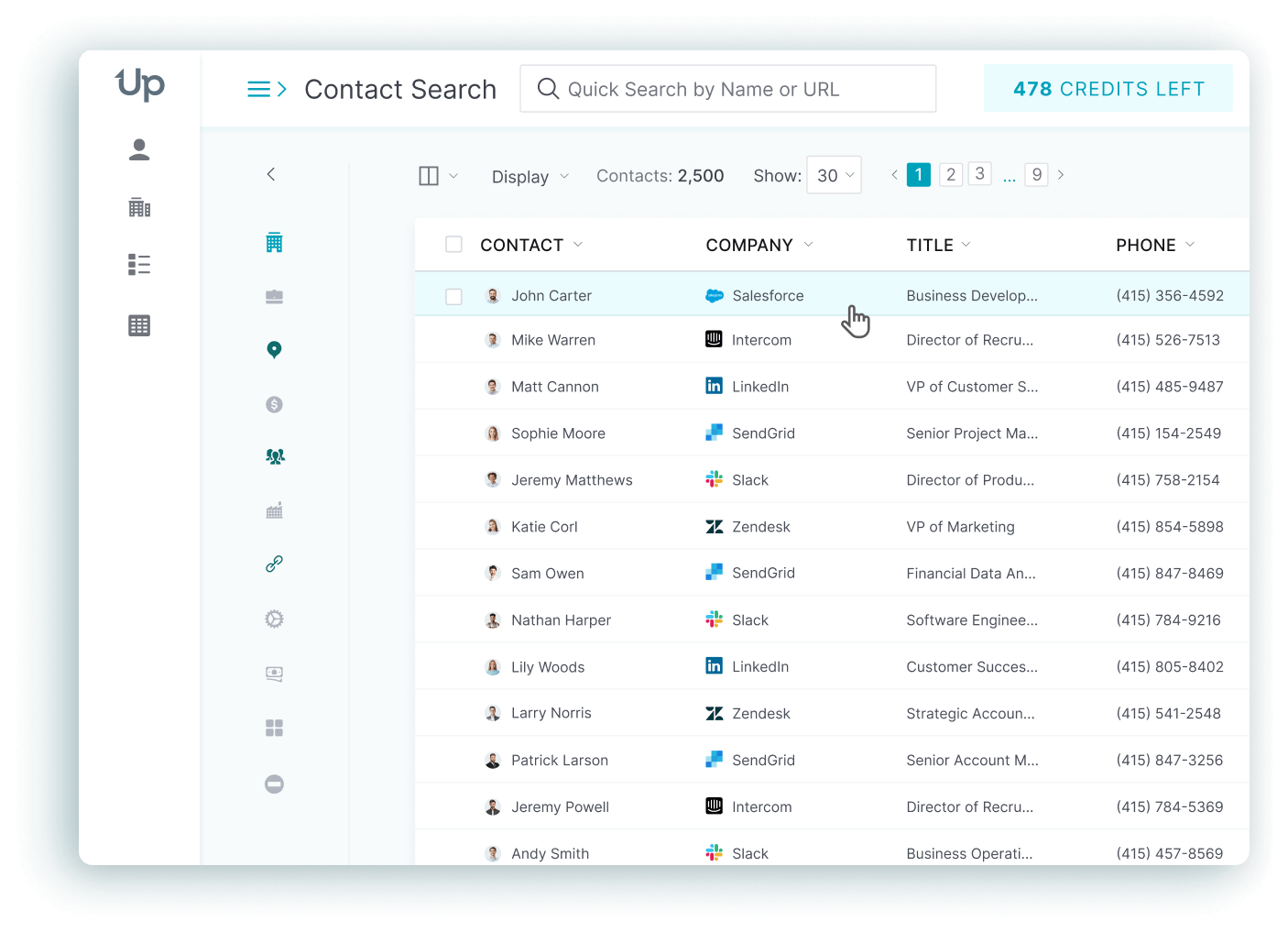
UpLead is a B2B contact database. Its homepage describes 200M+ leads that are verified as you search, backed by a 95%+ accuracy guarantee. You filter by industry, job title, company size or location, then export the contacts you pick.
Clay takes a different approach. It doesn’t own a contact database. Instead, it is an orchestration layer that pulls data from more than 150 connected providers. It lets you build multi-step enrichment and scoring workflows, and it hands you an AI research agent called Claygent to fill gaps a static database cannot answer.
Need a verified list to start outbound today? UpLead gets you there faster. Need to enrich existing leads with custom logic across many data sources? Clay gives you more control.
UpLead vs Clay at a glance
The table below answers the choice row by row. Read the last two rows first if you only have a minute.
| Category | UpLead | Clay |
|---|---|---|
| What it is | Proprietary B2B contact database | Data orchestration and workflow automation platform |
| Database | 200M+ contacts | No proprietary database; aggregates 150+ providers |
| Data accuracy | 95%+ accuracy guarantee, real-time email verification | Depends on the providers connected to each workflow |
| Pricing model | Per-credit subscription | Data Credits plus Actions |
| Starting price | $74/month billed annually, $99/month billed monthly | $0 free plan, then $167/month billed annually, $185/month billed monthly |
| Free option | 7-day trial, 5 credits | 100 data credits and 500 actions per month |
| CRM sync | CRM integration on every paid plan; bi-directional sync on Professional | Auto-sync and enrich for CRMs from the Growth plan |
| Choose it if | You need verified contacts exported today | You want to build custom enrichment across many sources |
| Skip it if | You need ongoing multi-source enrichment logic | You have no one to build and maintain workflows |
What Is Clay?
Clay is a workflow automation platform built around a spreadsheet-style interface, fed by more than 150 connected data providers. You import a list of companies or contacts, then build columns that pull from Clay’s provider marketplace. Columns can run AI research through Claygent. They can apply scoring logic. They can route qualified records into a CRM or outreach tool.
What Is UpLead?
UpLead is a B2B prospecting database. You can search by industry, job title, company size, revenue or location, and by the technology a company uses. Export as a CSV or push contacts into your CRM when you are ready. Emails go through real-time verification, so you are not working from a static list that could already be stale. Speed is the point: you can go from signup to a working prospect list in one session, because there is no workflow to build first.
Data Accuracy: How Each Tool Verifies Contacts
Verification is the core of how UpLead handles accuracy. UpLead’s homepage describes real-time email verification and backs it with a 95%+ accuracy guarantee, which gives you a concrete number to hold the vendor to.
Data quality works differently on the Clay side, since the platform has no data of its own to verify. Its waterfall enrichment queries multiple connected providers in sequence for each field, falling back to the next provider if the first returns nothing. Fill rates go up across a workflow as a result. Accuracy of any single result still depends on which provider filled that field. Clay doesn’t publish one accuracy number, for a simple reason: the number would only ever reflect whichever provider happened to answer.
UpLead vs Clay Pricing: What You Actually Pay
UpLead charges a flat monthly rate for a set number of credits, detailed on the UpLead pricing page. Clay charges separately for the data pulled in (Data Credits) and the workflow steps run (Actions), which makes the two models hard to compare on a single number. A concrete scenario helps.
| Plan tier | UpLead | Clay |
|---|---|---|
| Entry paid plan | Essentials: $74/mo annual, $99/mo monthly | Launch: $167/mo annual, $185/mo monthly |
| Mid paid plan | Plus: $149/mo annual, $199/mo monthly | Growth: $446/mo annual, $495/mo monthly |
| Top tier | Professional: annual billing only, custom pricing | Enterprise: custom pricing, annual commitment |
| Free option | 7-day trial, 5 credits | $0/mo, 100 data credits, 500 actions |
Scenario: the cost of reaching 1,000 verified contacts
Take a team that needs 1,000 contacts in one month. Using only the prices on each vendor’s pricing page:
- UpLead Essentials, billed monthly: $99 includes 170 credits. The other 830 credits at $0.60 each add $498, for $597 in total.
- UpLead Plus, billed monthly: $199 includes 400 credits. The other 600 credits at $0.50 each add $300, for $499 in total.
- UpLead Plus, billed annually: $149 a month for 400 credits, plus the same 600 extra credits at $0.50 for $300, so $449 in that month.
- Clay Launch: $167 a month billed annually, or $185 billed monthly. Launch lists 2,500 or more data credits a month, so 1,000 contacts fit inside the plan if each one uses up to 2.5 credits. Clay doesn’t publish a fixed credit cost per contact, but it varies by data provider. Extra credits start at $0.05 each.
The comparison is not like for like. The UpLead figures buy 1,000 contacts that come from its own database. Clay’s figure assumes you already have the companies or people to enrich, since Clay has no database to search, so the final credit cost depends on the providers in your workflow. If you need the list itself, UpLead’s price is the complete price. If you already hold the list and need it enriched in several ways, Clay’s flat plan can cost less.
UpLead Pricing
Essentials costs $74 a month billed annually, or $99 a month billed monthly, and includes 170 credits a month (2,040 a year). That works out to roughly $0.44 per credit on the annual rate if every credit gets used. Plus costs $149 a month billed annually, or $199 billed monthly, for 400 credits a month (4,800 a year), which brings the per-credit cost down to about $0.37. Professional is offered on annual billing only. It adds buyer intent data and full API access, as well as bi-directional CRM sync. New accounts get a 7-day free trial with 5 credits. Both Essentials and Plus can be bought month to month, but the lower $74 and $149 rates require annual billing.
Clay Pricing
Clay’s free plan includes 100 data credits and 500 actions a month. The Launch plan costs $167 a month billed annually, or $185 a month billed monthly. Growth costs $446 a month billed annually or $495 a month billed monthly, and is the first plan that includes CRM auto-sync. Enterprise pricing is custom with an annual commitment. Data Credits and Actions are metered separately, and Clay’s pricing page notes that an enrichment that returns no result isn’t charged. Actual monthly spend often runs higher than the sticker price once a workflow is fully built out and you add providers.
Clay replaced its earlier Starter, Explorer and Pro tiers with the current Free, Launch and Growth structure in March 2026, as described in Clay’s announcement. Confirm the live plan page before budgeting, since both vendors adjust pricing from time to time.
Usability: Ease of Use and Setup Time
Speed is UpLead’s advantage in this category. Sign up, set your filters, and you’ll start exporting a verified list within the same session. No workflow needs to be built first.
A steeper learning curve comes with Clay, because the product is a blank canvas rather than a finished list. You build tables, columns and formulas from scratch. Each workflow also needs its own provider connections. Many teams rely on a dedicated RevOps operator or a Clay specialist to build the first few workflows.
CRM Integrations and Data Sync
UpLead lists CRM integration on every paid plan, with a push moving contacts from an export into your CRM. Bi-directional CRM sync and full API access come with the Professional plan.
Clay’s pricing page lists CRM auto-sync and enrichment from the Growth plan. Enrichment data can get written back into existing CRM records on an ongoing basis, not just at the moment of import, which matters for teams trying to keep records fresh as companies and contacts change over time.
Where Each Tool Falls Short
Neither tool is a complete solution on its own.
UpLead is a database you search and export from, so it doesn’t run custom multi-source enrichment logic for you. Filtering centers on firmographic and technology criteria, and buyer intent data is reserved for the Professional plan.
Setup investment is Clay’s biggest limitation. Non-technical teams often struggle to get real value without a dedicated builder on staff. Total monthly spend can climb past the advertised plan price once multiple data providers get stacked into a workflow. Since Clay has no data of its own, a workflow is only as good as the providers connected to it, and every added provider becomes another cost line.
Verdict: UpLead vs Clay, Which Should You Choose?
No universal winner exists, because the two tools are not built for the same job. UpLead is the faster, simpler starting point when you need a verified contact list now. Clay is the better fit when custom enrichment across many sources matters more than speed, and you have the time and technical help to maintain workflows.
A common setup runs UpLead for fast outbound list building, then routes higher-value accounts through Clay for deeper, multi-source enrichment before outreach. For a look at how Clay stacks up against a different all-in-one platform, see our Clay vs Apollo comparison.
Frequently asked questions
Is UpLead better than Clay?
It depends on the job. UpLead is better for fast, verified contact list building at a predictable monthly price. Clay is better for multi-provider enrichment workflows and ongoing CRM sync.
How much does Clay cost compared to UpLead?
UpLead starts at $74 a month billed annually for 170 credits a month. Clay starts free, then moves to $167 a month billed annually. A direct comparison is tricky, since UpLead charges per contact credit while Clay charges separately for data and workflow actions.
Does Clay have better data than UpLead?
Clay has no proprietary database, so its data quality depends on which of its 150-plus connected providers fill a given field. UpLead maintains its own database instead, with real-time email verification. It also offers a 95%+ accuracy guarantee.
What integrations does UpLead support compared to Clay?
UpLead lists CRM integration on its paid plans. Full API access and bi-directional CRM sync come with Professional. Clay lists CRM auto-sync and enrichment starting on its Growth plan.
Can you use UpLead and Clay together?
Yes, and many teams do. A common pattern uses UpLead for fast, verified outbound list building, then feeds higher-priority accounts into Clay for deeper multi-source enrichment before a campaign goes out.
Is Clay or UpLead easier to learn?
UpLead is easier: it is a search-and-export tool with no workflow to build. Clay has a real learning curve instead, since every workflow gets built from scratch.