


UpLead Quick Take
Clay vs Apollo: The Short Answer
- Clay is a data enrichment and workflow automation platform. It pulls from 100+ external providers using waterfall enrichment and lets you build custom outbound pipelines. It doesn’t send emails or hold its own contact database.
- Apollo is an all-in-one GTM platform with its own database of 240M+ contacts. It bundles built-in email sequences, a dialer, plus analytics, all from one login.
- Choose Clay for custom enrichment workflows and multi-provider data quality, plus flexible automation. Choose Apollo for fast, integrated prospecting. It handles outreach too, without stitching tools together.
Most sales teams pick a tool based on the feature list and regret it two months later when the data bounces or the workflow breaks. That’s not a small mistake. Wasted credits and bad sender reputation are the price, on top of a pipeline full of stale contacts.
Apollo gets you moving in days. Teams that hit data quality walls or need custom enrichment logic hit a ceiling fast. Clay gives you precision and real control over your data stack, but it needs external tools to execute outreach and takes a few weeks to ramp properly.
Read through the comparison below. By the end, you’ll know which tool to use or whether you need both.
What Is Clay?
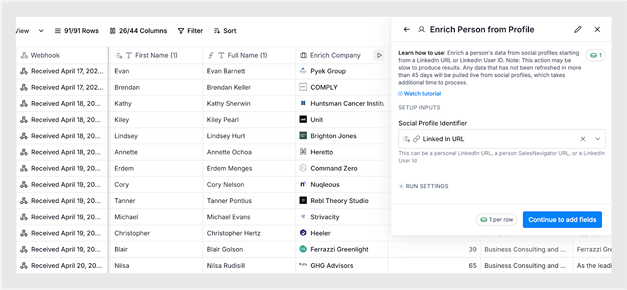
Built around a spreadsheet-style interface, Clay is a data orchestration and enrichment platform with no proprietary contact database. It connects to 100+ external data providers and lets you build enrichment pipelines that pull from multiple sources in sequence.
Bring a list. Clay enriches each row using your chosen providers, applies conditional logic, runs AI research through its Claygent agent and passes the results to your outreach tool or CRM. Sales teams use it to build high-precision outbound lists without switching between tools or chasing stale data.
Clay’s valuation has climbed fast on repeated funding rounds: a $100 million Series C in 2025 valued the company at $3.1 billion, and a $115 million Series D in September 2026, led by Wellington Management, pushed that to $7.1 billion. All paid plans still include unlimited users with no per-seat charge, which keeps it flat-out cheaper to run for larger teams and agencies than any per-seat competitor.
What Is Apollo?
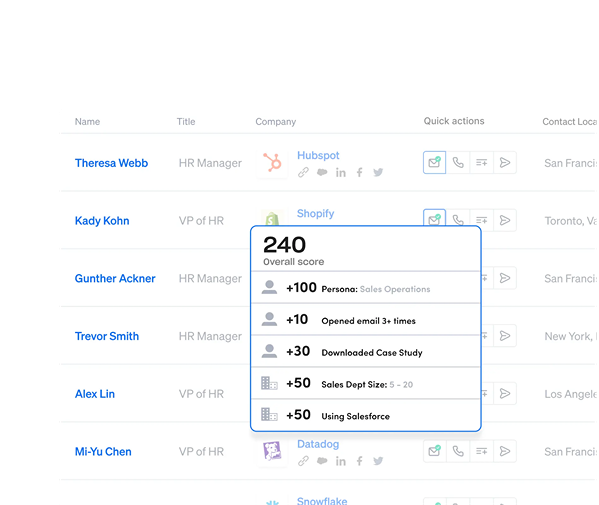
Apollo.io is an all-in-one sales engagement and lead generation platform with a proprietary database Apollo itself now puts at roughly 240M contacts and 30M companies, down from the 275M+ figure the company quoted in past years. Built-in email sequencing and a dialer run from the same dashboard, alongside intent data signals and analytics. No external tools needed for the outreach layer.
Search the database using filters for job titles, tech stack or intent signals. Build a list, then launch an email or call sequence without touching another tool. Prospecting and outreach execution happen in one place.
Founded in 2015, the company raised $100 million in a Series D in August 2023, led by Bain Capital Ventures, and carries a $1.6 billion valuation. Apollo’s G2 profile shows more than 9,500 reviews, making it one of the most-reviewed sales platforms in its category.
Clay vs Apollo: Side-by-Side Comparison
The table below maps both platforms across the dimensions that matter most for a typical outbound sales motion.
| Category | Clay | Apollo |
|---|---|---|
| Database | No proprietary database; uses external providers | ~240M+ contacts, 30M+ companies |
| Data enrichment | Waterfall enrichment across 100+ providers | Enrichment from its own database; limited external sources |
| AI features | Claygent AI agent; custom GPT-4 columns | AI email generation, lead scoring, AI recommendations |
| Outreach | No native sending; integrates with Instantly, Smartlead, HubSpot, etc. | Built-in email sequences, inbox rotation, dialer, LinkedIn touches |
| Pricing model | Usage-based; unlimited seats | Per-seat pricing |
| CRM integrations | Available on Growth and Enterprise plans | Available on all paid plans |
| Advanced filters | Build custom filters via logic columns | 100+ native filters (job title, tech stack, intent, location, etc.) |
| Intent data | Via third-party integrations | Built-in buying intent signals on Organization plan |
| Learning curve | Steep (3-4 weeks to proficiency for most teams) | Moderate (most users productive within days) |
| Free plan | 500 actions/month, 100 data credits/month | Limited exports and email credits |
| Compliance | SOC 2 Type II, GDPR, CCPA | ISO 27001, SOC 2, GDPR |
| Chrome extension | Yes | Yes |
Data Enrichment and Data Quality
Data handling is where the two platforms split cleanest. Get this wrong and the rest of the stack doesn’t matter.
How Clay’s Waterfall Enrichment Works
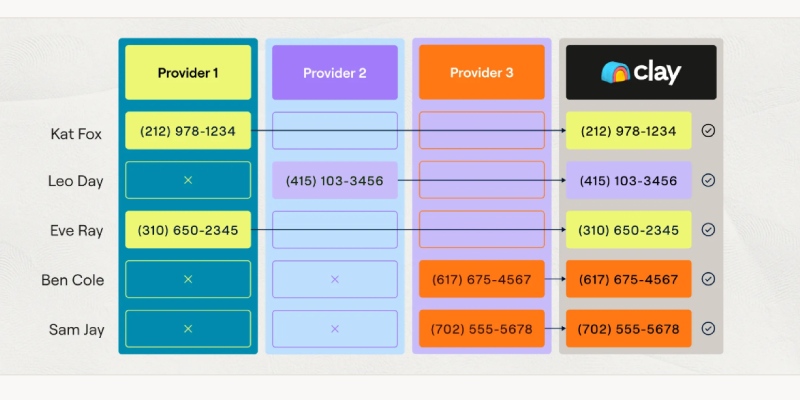
Clay holds no contact data of its own. Enrich a row and it runs a waterfall sequence: Provider A runs first, and if it returns nothing, Clay moves to Provider B, then C, until the field is filled. You control the provider order and the data source priority.
Coverage beats what any single provider can deliver. Stack People Data Labs for email and Clearbit for company data, plus Dropcontact for European contacts. Clay handles the logic. Cost optimization is built in too: cheaper providers run first and the expensive ones only fire when needed. Checking multiple sources this way produces 10-20% higher match rates compared to relying on one provider, which makes automated enrichment across a diverse ICP significantly more reliable.
Multi-source teams and those covering diverse ICPs or geographies get real value from this model. The tradeoff is credit consumption. Each enrichment step uses credits and complex workflows across many providers add up fast.
How Apollo Handles Data
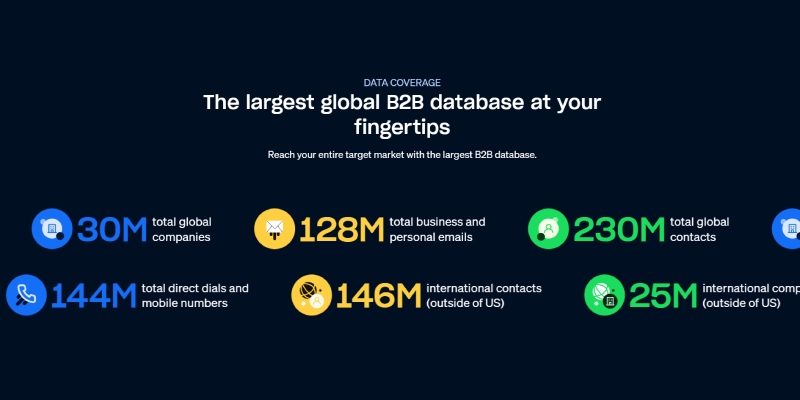
Apollo relies on its internal database as its main selling point. At roughly 240M+ contacts and 30M+ companies on Apollo’s own current count, it gives teams immediate access to a large contact pool without connecting external sources. Apollo’s own comparison page now claims 98% email accuracy, though independent tests and user reports on review sites (G2, Capterra) put the real-world figure closer to 65-80% depending on ICP.
Mainstream SaaS companies and North American prospects are where it performs best. Niche industries and smaller markets show more gaps, as do international contacts outside major English-speaking regions.
Enrichment works well when your ICP fits Apollo’s database. When it doesn’t, you’re stuck with what’s there. No provider swap, no fallback.
AI Features and Personalization
Both platforms have AI. The gap between what they can do with it is substantial.
Claygent: Clay’s AI Research Agent
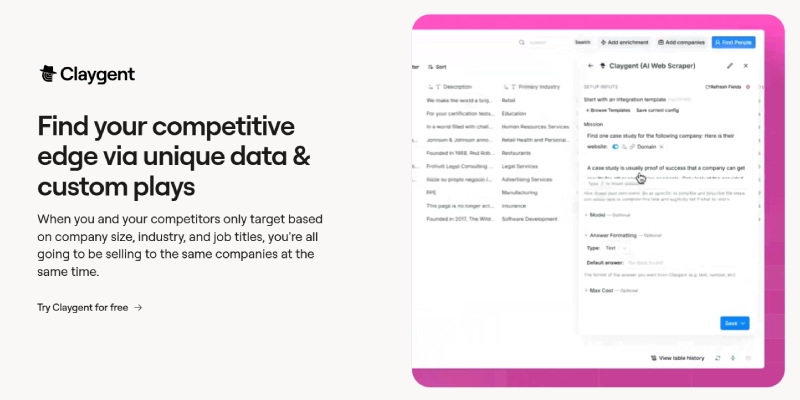
Claygent is Clay’s built-in AI research agent, powered by GPT-4. Point it at a company website and it identifies tech stack, extracts recent funding news, summarizes a LinkedIn post or pulls competitive mentions from live data on the web. Each result lands in your table as a custom AI column or enrichment block.
The payoff is personalized outreach that goes past first-name merge tags. Claygent writes a custom intro based on a prospect’s latest LinkedIn post, or flags companies that just posted a VP of Sales role as a buying signal. Users consistently report higher response rates when Claygent-written openers replace generic templates. Teams running outbound for multiple clients use this to differentiate at the individual line, not just the segment.
Apollo’s AI Capabilities
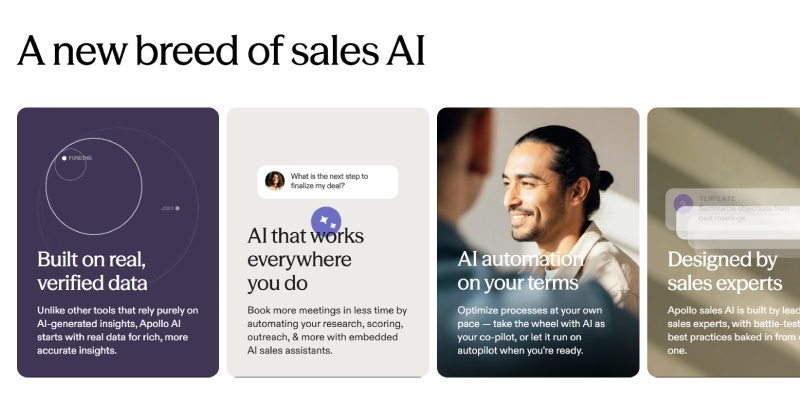
Apollo includes AI email generation and lead scoring, plus recommendation features. Unlike Claygent, it’s drawing from merge tags and templates rather than live prospect research. Basic personalization, not contextual personalization. That’s the honest distinction.
Lead scoring based on fit and engagement signals is useful for SDR teams working high-volume lists. For campaigns where the opening line needs to feel researched rather than generated, Apollo’s AI falls short. That’s not what it was built for.
Outreach and Engagement Tools
On outreach, the split is clean. Apollo has built-in engagement tools. Clay has none.
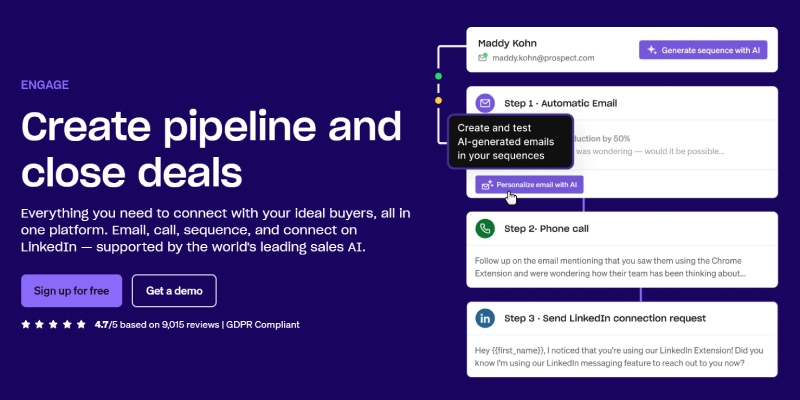
Apollo’s engagement layer covers multi-step email sequences and inbox rotation, a built-in dialer for calls and voicemail drops, plus LinkedIn touches and behavior-triggered follow-ups. Build a full outbound campaign from prospect list to closed reply without leaving the platform. For teams that don’t want to manage multiple tools, it’s without question Apollo’s strongest argument.
Clay doesn’t handle actual outreach. It enriches data and passes it downstream to Instantly, Smartlead, Lemlist, HubSpot or whichever sequencing tool you already use. Switching tools between enrichment and sending adds a step and an extra cost. The upside: you’re not locked into Apollo’s outreach layer and can use existing tools your team already knows.
A Clay plus outreach-tool stack usually beats Apollo on data quality and personalization depth. Apollo works better as a one tool solution where the goal is to launch automated outbound campaigns without managing separate platforms.
Workflow Automation and Integrations
Workflow automation is Clay’s core function. The spreadsheet interface supports conditional logic and fallback enrichment, GPT-powered custom columns, webhook triggers, plus branching actions. Build a rule like: if the company uses HubSpot and raised a Series A in the last six months, enrich the CTO’s contact from Dropcontact, run a Claygent research block and push to Slack. These scalable workflows are where Clay excels over any all in one platform with fixed automation capabilities. Apollo has nothing comparable on the data logic side.
Integrations include Notion, Airtable, Google Sheets, Slack, Zapier and Make, on top of HubSpot plus 100+ enrichment APIs. CRM auto-sync needs the Growth plan or higher.
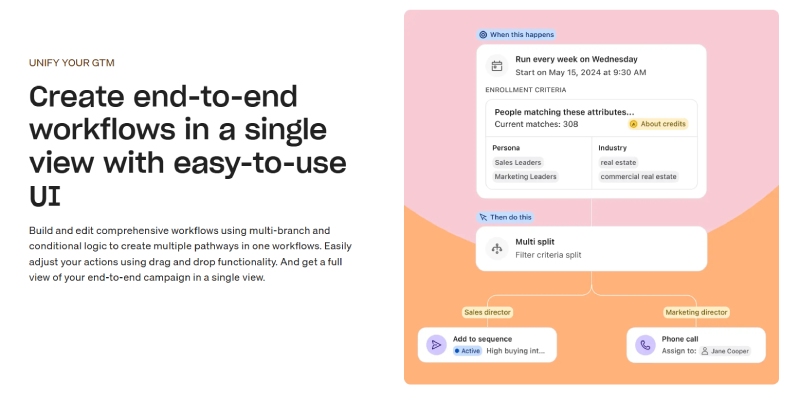
Apollo’s automation stays focused on outreach execution: timed steps and behavior-triggered follow-ups, plus sequence management. Native connections cover Salesforce, HubSpot and Gmail on paid plans, on top of Outreach plus SalesLoft. Wide integration surface, although the automation stays inside the platform’s fixed data model. There’s no conditional enrichment logic.
Teams needing custom workflows, multi-source enrichment or agency setups with multiple client accounts hit Apollo’s ceiling fast. Teams that want clean outreach automation without building pipelines from scratch hit Clay’s floor just as fast.
Plans and Pricing
Pricing models differ at the structural level. Clay’s credit-based model charges by usage (actions and data credits) with unlimited seats, whereas Apollo charges per user seat with additional credits on top for specific data exports. For high-volume teams, the credit-based model tends to get cheaper the more you use it, since headcount doesn’t drive the bill.
Clay Pricing
Clay uses two credit types: actions (workflow runs) and data credits (enrichment lookups). Unused data credits roll over up to 2x the monthly allocation on paid plans.
| Plan | Monthly billing | Annual billing | Actions / month | Data credits / month |
|---|---|---|---|---|
| Free | $0 | $0 | 500 | 100 |
| Launch | $185 | $167 (~$2,004/year) | 15,000 | 2,500 |
| Growth | $495 | $446 (~$5,352/year) | 40,000 | 6,000 |
| Enterprise | Custom | Custom | Custom (200,000+) | Custom (100,000+) |
(Source: Clay.com, verified 2026-10-12)
- Free: $0/month. 500 actions/month, 100 data credits/month. Unlimited seats. Supports waterfall enrichment and Claygent AI enrichment. Rows per table capped at 200.
- Launch: $185/month billed monthly ($167/month billed annually, about $2,004/year, saving ~10%). 15,000 actions/month, 2,500 data credits/month. Unlimited seats. Adds phone number enrichment and job change signal tracking, plus email campaign integrations. Rows per table up to 50,000.
- Growth: $495/month billed monthly ($446/month billed annually, about $5,352/year). 40,000 actions/month, 6,000 data credits/month. Unlimited seats. Adds CRM auto-sync and HTTP API integrations, plus web intent signal monitoring and priority support.
- Enterprise: Custom pricing. Unlimited rows, SSO and RBAC, on top of data warehouse syncing plus a dedicated growth strategist.
Apollo Pricing
Apollo’s pricing is per seat. For larger teams running high-volume outbound, headcount-based costs add up fast.
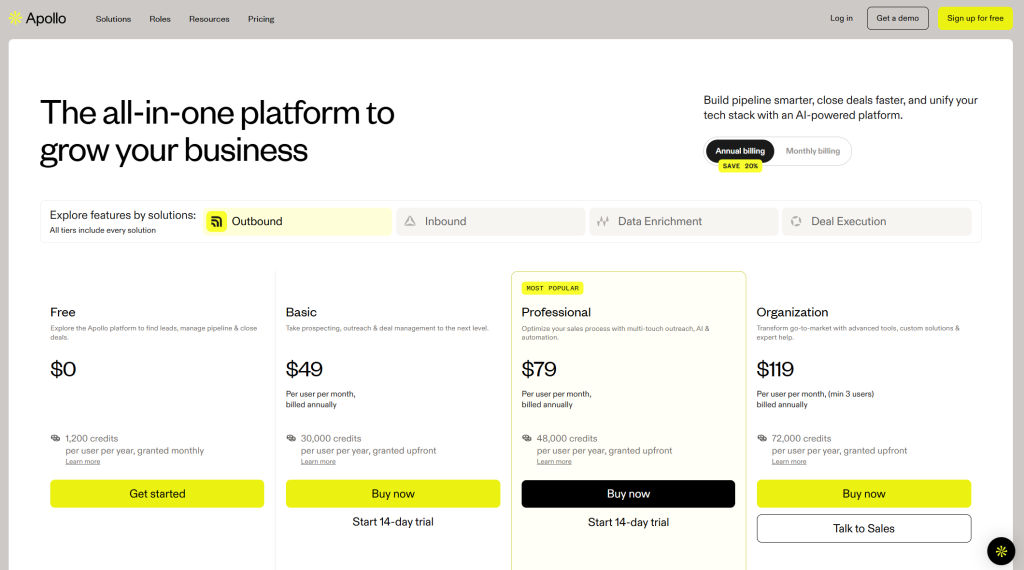
(Source: Apollo.io)
Hidden Costs to Know
Both tools have costs that don’t show up in the headline price.
On Clay, phone number enrichment burns 3-5x more credits than email enrichment. CRM sync is only available on Growth or Enterprise, so Launch-tier teams either pay up or manage exports by hand. Run complex waterfall workflows across five or more providers and credits disappear fast if you don’t watch usage.
On Apollo, mobile numbers cost credits even on paid plans. Bulk data exports to CRMs pull from export credits. The “unlimited” email credit policy has a fair-use cap: heavy users on paid accounts hit a throttle ceiling before year-end. Data enrichment and API access sit behind the Organization plan, which has a minimum annual spend for three users.
If you’re running Clay and need a dedicated outreach tool, budget for that separately. A combined Clay (Launch) plus a mid-tier outreach platform typically runs $250-350/month, comparable to Apollo Professional for a single user but much more cost-effective for teams of three or more.
Learning Curve and Support
Clay has a steeper learning curve than Apollo. When comparing Clay to most other tools in this space, the setup overhead is noticeable: connecting providers and building enrichment waterfalls takes time, as does configuring Claygent enrichment blocks. Users consistently report needing 3-4 weeks to fully understand the platform’s capabilities before the workflow feels natural. Live chat and email support are available, with dedicated support on paid plans.
Apollo is faster to start with. While Clay takes 3-4 weeks to ramp, most Apollo users are running sequences within a day or two. The platform’s breadth (database, sequences, dialer, analytics) means there’s more to learn overall, though you can start with just the prospecting layer and add features as needed. Support tiers up with plan level: 24/7 live chat and phone support are available at the highest tier.
For non-technical users or teams without a dedicated RevOps person, Apollo’s lower barrier to entry is a real advantage. Clay’s power, however, requires someone comfortable building logic-driven workflows.
Clay vs Apollo Reviews: What Users Are Saying
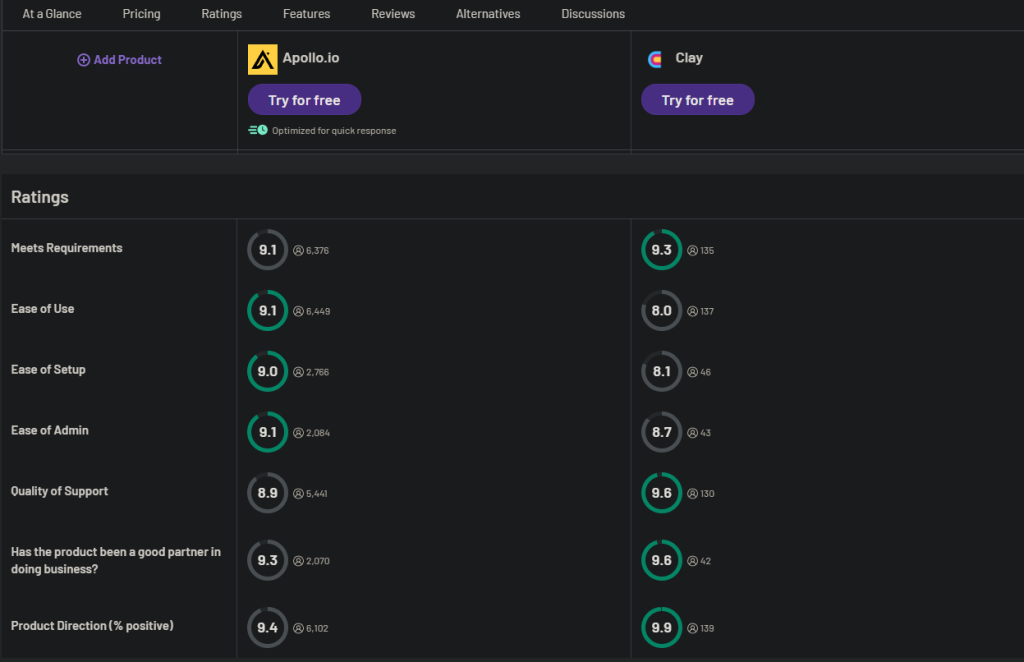
User reviews on G2 and Reddit, plus Capterra, paint a consistent picture of how each platform performs in practice.
Clay Reviews
Clay users highlight waterfall enrichment and custom workflow flexibility as standout strengths, plus Claygent’s AI personalization. Technical marketers and growth teams appreciate how much control the platform gives over data and sales processes, with many describing it as having a data engineer on their team without the headcount cost. Growth hackers and RevOps teams value the unlimited seat model, which makes it practical for agencies managing multiple client accounts. The most common complaints are the learning curve and clay credits anxiety: complex workflows across many providers can eat through credits faster than expected.
Apollo Reviews
Apollo’s large database and integrated outreach tools draw consistent praise. G2 users flag the ability to build a list and launch a sequence from the same dashboard without juggling separate tools. Advanced filters and intent signals stand out for SDR teams running high-volume outbound campaigns, as does the built-in dialer.
The most reported pain points are data accuracy (most often with mobile numbers and contacts outside North America), per-seat pricing that escalates with team size and the fact that key features like data enrichment and API access are locked behind the highest pricing tier. A recurring theme in negative reviews is customer support: users cite long response times and unresolved issues, particularly during bugs or reliability problems mid-campaign. Apollo’s G2 profile now lists more than 9,500 reviews, making it the more widely deployed of the two platforms.
Who Should Choose Clay?
Clay excels for data-obsessed revenue teams that need precision over speed and are willing to build workflows rather than use a ready-made all in one platform. It’s the right call when data quality, multi-source enrichment or custom logic is central to your outbound motion. Technical marketers and agencies managing multi-ICP campaigns get the most from it.
Who Should Choose Apollo?
Apollo works well for teams that want integrated prospecting and outreach without managing multiple tools. As a lead generation and engagement platform, it’s the right call when speed to launch matters more than maximum data precision and when your ICP fits well within Apollo’s database.
Can’t Decide? Try UpLead Instead
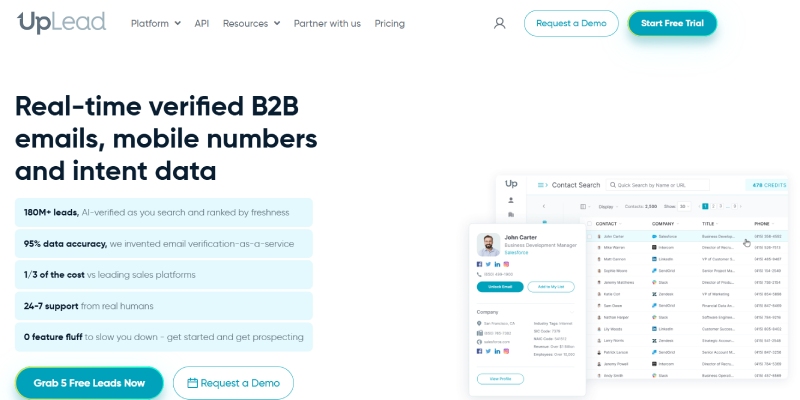
If neither tool is the right fit, UpLead is worth considering. It’s a B2B sales intelligence platform that combines a verified contact database with real-time email verification, plus advanced search filters and straightforward pricing. It sits between Clay’s complexity and Apollo’s seat-based cost model.
UpLead works well for teams that need reliable, verified B2B contact data without the overhead of building enrichment stacks or managing per-seat costs at scale.
Frequently Asked Questions
Can Clay send emails like Apollo?
Clay doesn’t send emails. It’s a data enrichment and workflow automation platform. To execute outreach, you connect Clay to a separate tool like Instantly, Smartlead, Lemlist or HubSpot. Apollo includes built-in email sequences and a dialer, so no external tool is needed.
Does Apollo have better data than Clay?
Apollo has a larger proprietary database (roughly 240M+ contacts on its own current count), but Clay produces higher accuracy by pulling from multiple providers in sequence and taking the best available result. Apollo’s self-reported 98% email accuracy claim often tracks lower in practice, most often with niche ICPs or non-North American contacts.
Which is more expensive, Clay or Apollo?
It depends on team size. Clay’s unlimited-seat model means costs don’t scale with headcount. A team of ten pays the same Clay subscription as a team of two. Apollo’s per-seat pricing, however, scales directly with users: a 10-person team on Apollo Professional runs $790/month (annual billing). A comparable Clay Growth plan with a separate outreach tool is roughly $500-600/month total. For larger teams, Clay tends to come out cheaper. For solo founders or very small teams, Apollo’s integrated platform can be the more economical option.
Can you use Clay and Apollo together?
Many teams do. A common setup uses Apollo for broad database prospecting and initial outreach, then routes high-value accounts through Clay for deeper enrichment and Claygent research, plus hyper-personalized follow-up. Apollo is one of Clay’s supported data providers, so you can pull Apollo data directly into Clay workflows.
What is waterfall enrichment in Clay?
Waterfall enrichment is Clay’s method of querying multiple data providers in sequence for each field. If Provider A doesn’t return an email address for a contact, Clay automatically tries Provider B, then Provider C. You control the order. The result is higher fill rates than any single provider delivers, with cost optimization built in (cheaper providers run first).
Is Clay better for agencies than Apollo?
Clay’s unlimited-seat model is a better fit for agencies managing multiple client accounts. There’s no per-user cost penalty for adding team members or client collaborators. Apollo charges per seat, so agencies with large teams or multiple client users face escalating costs. The workflow flexibility also makes it easier to build repeatable enrichment pipelines across different ICPs and accounts.
Does Apollo have intent data?
Apollo includes buying intent signals on the Organization plan, which tracks site visits and topic engagement. These behavioral signals suggest a company is actively researching a category. Clay doesn’t have native intent data but connects to third-party intent providers through its enrichment framework.
What to Remember About Clay vs Apollo
Clay and Apollo aren’t competing for the same use case. Clay is a data orchestration platform for teams that need custom enrichment workflows and multi-provider data quality, plus AI-powered personalization. Apollo is an all-in-one GTM platform for teams that want prospecting and outreach, plus calling, from a single dashboard.
Clay wins on data flexibility and waterfall enrichment, on top of custom automation plus cost efficiency for larger teams. Apollo wins on speed and integrated outreach, plus simplicity for teams that don’t want to build and maintain custom workflows.
Many high-performing outbound teams use both. Clay handles enrichment and personalization for high-value accounts, while Apollo handles volume prospecting and day-to-day sequences. If you need a third option with verified data and transparent pricing, plus no per-seat escalation, UpLead is worth testing for free.