

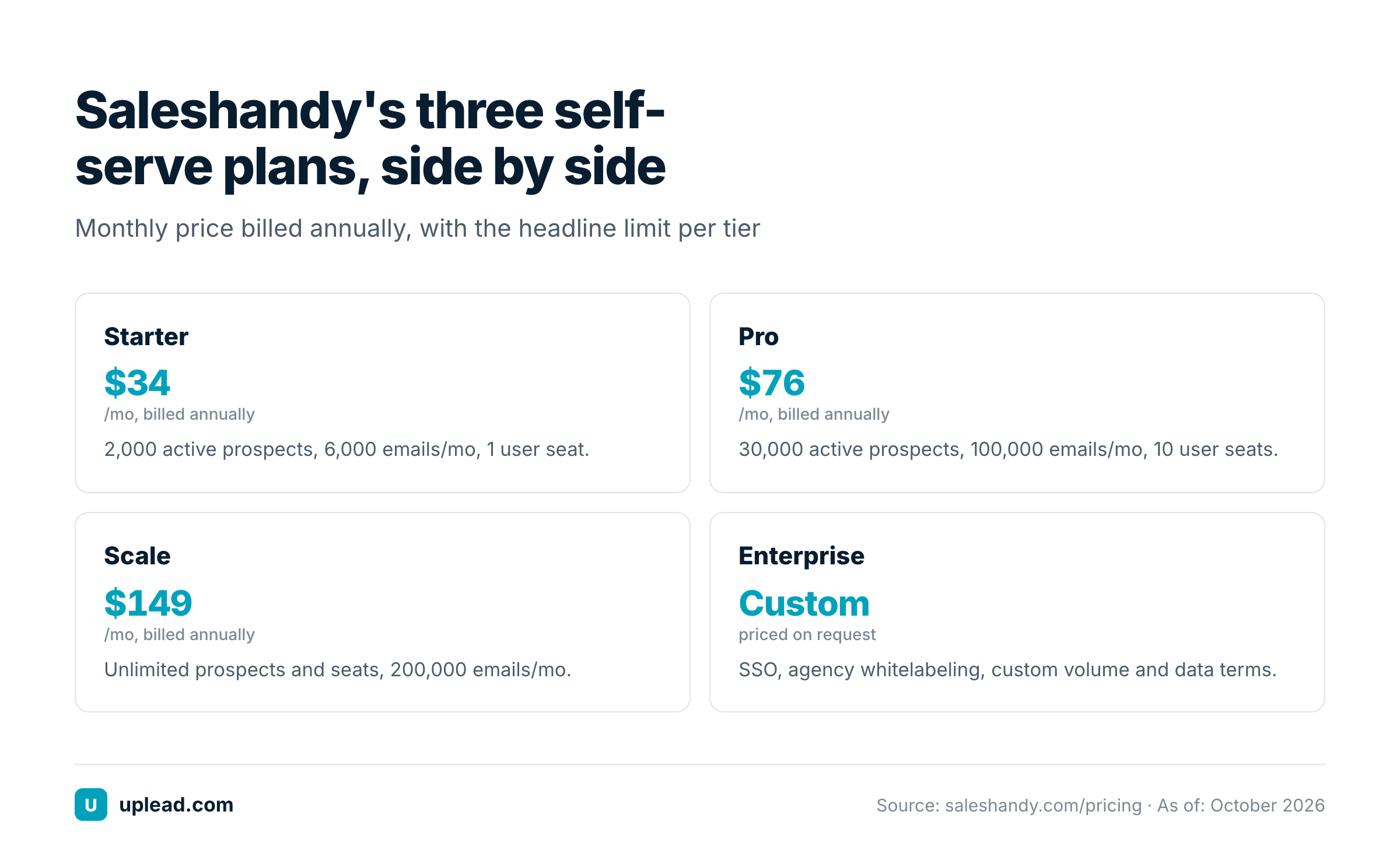
Saleshandy runs three self-serve plans today: Starter at $34 a month, Pro at $76 a month, and Scale at $149 a month, all billed annually, plus a custom Enterprise tier. Every plan carries a 7-day free trial with no credit card. The sticker price only tells part of the story. Email limits and lead-finder credits change by tier. Seat counts shift too, and mailbox deliverability is billed separately.
Saleshandy pricing at a glance
| Plan | Monthly (annual billing) | Monthly (month-to-month) | What it’s built for |
|---|---|---|---|
| Starter | $34 | $41 | Solo rep, 6,000 emails/mo, 2,000 active prospects |
| Pro | $76 | $99 | Small team, 100,000 emails/mo, 10 seats |
| Scale | $149 | $189 | Growing team, 200,000 emails/mo, unlimited seats |
| Enterprise | Custom | Custom | Volume and data terms sized to the account |
Source: Saleshandy pricing, checked October 2026.
Annual billing saves real money at every tier. Starter drops from $492 a year ($41 x 12) to $408. Pro drops from $1,188 to $912, a savings of $276. Scale drops from $2,268 to $1,788, a savings of $480. The jump from Starter to Pro is the steepest in the lineup, roughly triple the price for 16x the active prospects and 10x the users. It reads like a volume upgrade, but it’s really a seat upgrade in disguise.
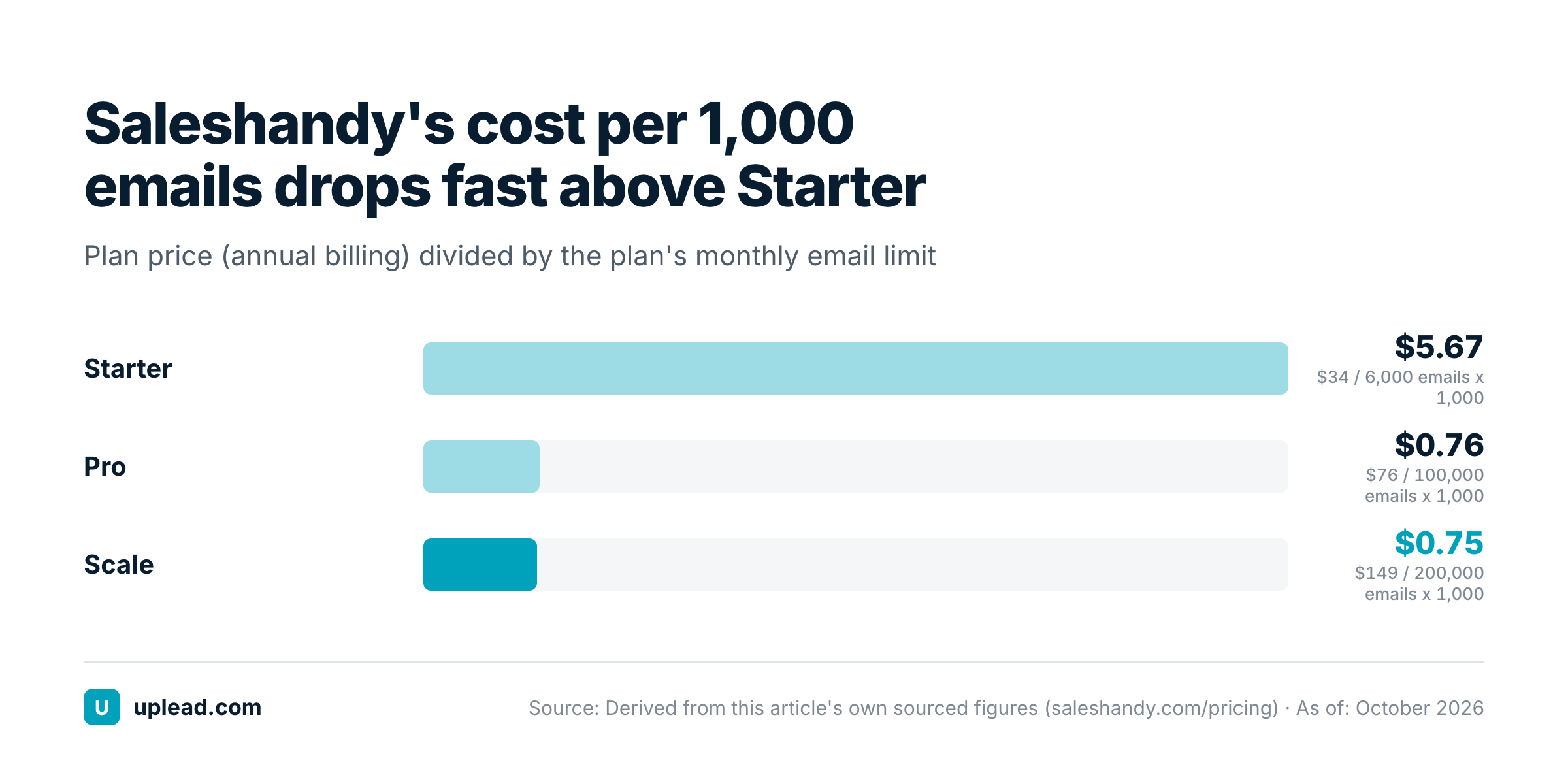
Cost per email sent drops fast once you move past Starter. Dividing each plan’s annual-billed price by its monthly email limit gives the real per-send rate.
What each Saleshandy plan includes
Starter caps out at 2,000 active prospects, 6,000 emails a month, and one user seat. You get 1,500 Lead Finder credits a month (18,000 upfront if you pay annually), 500 one-time email-verification credits, and 100 one-time AI credits. Support is an AI assistant plus email, and onboarding is self-guided. This tier fits a founder or a single SDR running one list at a time, not a team.
Pro raises the ceiling to 30,000 active prospects, 100,000 emails a month, and 10 user seats, the single biggest jump in the lineup. Lead Finder credits rise to 4,000 a month (48,000 upfront annually), verification credits to 1,000, and AI credits to 500. Live chat support is added on top of the Starter support options. The rest carries over unchanged from Starter: unlimited prospect storage, unlimited connected email accounts, plus unlimited warm-up accounts.
Scale removes the seat cap and the prospect cap outright: unlimited users, unlimited active prospects, and 200,000 emails a month. Lead Finder credits jump to 8,000 a month (96,000 upfront annually), verification credits to 5,000, and AI credits to 1,000. Scale also adds priority support with video calls and personalized one-on-one onboarding, a meaningful step up from Pro’s self-guided setup.
Enterprise sits above Scale with no published number. Saleshandy lists SSO and agency whitelabeling as the main differentiators. It also sizes volume and data terms to the account instead of publishing a flat number. That combination points this tier at agencies and larger revenue teams, not a single department.
One set of features doesn’t change by tier: integrations. Every plan, including Starter, connects to Salesforce, HubSpot, Pipedrive, Zoho CRM, and Zapier, plus API access, MCP/CLI, and webhooks. The API itself is also capped the same way everywhere, at 100 calls a minute and 50,000 calls a day, so upgrading plans buys more sending and lead-finder volume, not a bigger API allowance.
How Saleshandy’s credit system actually works
Credits only get spent on verified data. Saleshandy states plainly that unverified emails cost nothing. Catch-all address verification doesn’t cost extra credits either. A phone number reveal also includes its matching email, so a full contact with a direct dial runs 7 credits total, not 6. If your Lead Finder usage leans toward phone numbers, your monthly credit allotment will drain faster than the headline number suggests. Every phone pull quietly includes an email pull too.
The add-on most buyers miss: Email Infrastructure
Cold email at any real volume needs warmed-up mailboxes and spare domains so a flagged inbox doesn’t take your whole sequence down with it. Saleshandy sells this separately from the plan price.
Source: Saleshandy pricing, checked October 2026.
A connected domain costs $14 a year, and Saleshandy caps each domain at 5 mailboxes. Run the math before you commit to a plan: a team on Scale running 25 mailboxes on Annual Flexi adds roughly $87 a month on top of the $149 plan price, before counting the handful of domains needed to host those mailboxes. The plan tiers above don’t include this cost anywhere in their listed price.
Is Saleshandy’s pricing structure a good deal?
Saleshandy pricing vs. UpLead
Saleshandy and UpLead solve different parts of the same problem. Buyers often price both at once. Saleshandy bundles outbound email sending, sequences, plus a lead-finder credit allowance into one subscription that starts at $34 a month. UpLead prices verified contact data on its own, separate from any sending tool. Essentials runs $99 a month ($74 a month billed annually). Plus runs $199 a month ($149 a month billed annually). Every UpLead plan starts with 5 free credits and no card required.
If the budget line is “send more cold email,” Saleshandy’s per-tier bundle is built for that job. If the budget line is “find and verify accurate contacts before any outreach tool touches them,” that’s a UpLead problem instead. Saleshandy’s bundled Lead Finder credits stay a secondary feature there, not the core product.
The same question comes up against other categories too. Saleshandy’s sending engine competes with send-focused platforms like Instantly, while its bundled Lead Finder sits in the same general category as dedicated contact-finding tools like Lusha. Figure out which job the budget line is actually paying for before comparing sticker prices across categories.
What to remember about Saleshandy pricing
Three published self-serve tiers run from $34 to $149 a month. Each comes with a real trial, no card required, and a credit system that only charges for verified results. The part that catches teams off guard isn’t the plan price. It’s the Email Infrastructure add-on, billed per mailbox and sitting entirely outside the tier you pick. If you’re pricing this against a contact-data tool rather than a sending tool, UpLead’s credit-based plans are built for exactly that job.
Frequently asked questions
Starter costs $34 a month billed annually, or $41 a month billed monthly. Pro costs $76 a month annually, or $99 a month monthly. Scale costs $149 a month annually, or $189 a month monthly. Enterprise is priced on request.
No. Saleshandy offers a 7-day free trial with no credit card required, but there is no free-forever tier on the current pricing page.
Annual billing changes only the price, not the features. Starter saves $84 a year this way. Pro saves $276 a year. Scale saves $480 a year.
No. Email Infrastructure is billed separately per mailbox, from $2.99 to $3.99 a month depending on the billing option, plus $14 a year per connected domain.
One credit returns a verified work email. A phone number costs 6 credits, plus the 1 credit for the email it also reveals, for 7 total. Unverified results cost nothing. Catch-all verification doesn’t use extra credits either.
Saleshandy is a cold email and sales engagement platform built around outreach sequences, a built-in lead finder, and email verification, with a unified inbox and integrations into tools like Salesforce and HubSpot for managing the replies.
It depends on the tier. Dividing each plan’s annual-billed price by its monthly email limit works out to about $5.67 per 1,000 emails on Starter, $0.76 per 1,000 on Pro, and $0.75 per 1,000 on Scale.
Not in the sense of a static list for sale. Saleshandy’s Lead Finder spends monthly credits to surface and verify individual contacts on demand, which is a different model from purchasing a pre-built email list outright.