


Setting sales quotas has become one of the toughest balancing acts in modern sales leadership. Aim too high and you risk team burnout and attrition. Aim too low and you leave revenue on the table.
The data paints a stark picture: Ebsta’s 2024 B2B Sales Benchmark Report found that 69% of sales reps failed to meet their quota in 2024. RepVue’s platform data shows average quota attainment sits at just 43.14%. A QuotaPath survey revealed that 91% of organizations failed to achieve at least 80% of their team-wide quota targets in the first half of 2023.
This guide moves beyond simple definitions to provide a data-driven strategic framework. You’ll learn the methodologies, best practices and tools you need to set, track and achieve ambitious quotas that motivate your team and drive predictable growth.
What Is a Sales Quota?
A sales quota is the number of sales you expect from an agent or team during a determined time frame. Sales quotas are set for the sales team and sales representatives as part of the broader sales organization and sales force, ensuring alignment and coordination across the entire sales team. Sales analysts develop these quotas based on historical data, market conditions and company revenue goals.
Sales quotas can be measured during days, weeks, months, or years, such as a yearly quota or over a specified period. During that period, a quota can track different factors such as overall profit, units sold, customers acquired, and other relevant metrics. The right time frame and measurement tool depend on your company’s needs and business model.
Companies use sales quotas to establish what success looks like for their reps. They reward successful sales reps who achieve their sales quotas with bigger commissions or other prizes to keep them motivated, with a focus on achieving sales and hitting quota.
Organizations also use quotas to measure success and predict expected revenue and sales volume, including total sales, total sales generated, and sales activities completed.
Sales quotas are set to align with business objectives, broader business objectives, and the company’s financial goals. When developing quotas, organizations use sales data, relevant metrics, relevant sales performance data, and measure past performance to ensure targets are realistic and motivating. Quota based strategies rely on establishing the right sales quota for the entire sales team to drive performance and organizational success.
Why Are Sales Quotas Important?
Sales quotas are important because they serve as the link between individual effort and corporate objectives. For reps, quotas provide clear, measurable goals tied directly to compensation plans including bonuses and commissions. This clarity fosters accountability, keeps sales reps motivated, and helps increase sales.
Well-structured quotas can motivate both low-performing and high-performing reps by providing focus and a tangible metric for measuring progress. Achievable sales quotas, combined with monitoring rep activities, ensure that performance is tracked and goals remain attainable. They answer the question every salesperson asks: “What does success look like?”
For the business, quotas are foundational for sales forecasting, revenue predictability and strategic planning. They translate high-level company revenue goals into actionable targets, enable accurate resource allocation and provide consistent benchmarks for evaluating individual, team and regional performance. Sales team members are introduced to these targets, and sales ops plays a key role in aligning quotas across teams and supporting effective sales planning.
Quota analysis helps identify top performers, diagnose performance issues for targeted coaching and reveal opportunities in different sales territories. This data-driven approach to sales management replaces guesswork with measurable outcomes.
A fair and transparent quota strategy, built on realistic quotas, is also a tool for attracting and retaining sales talent. Unrealistic quotas drive significant attrition—43% of sales reps cite excessive pressure from unattainable quotas as their reason for leaving a job. Companies with effective sales compensation and quota programs can see up to 50% higher employee retention.
What Is the Difference Between Sales Quotas and Sales Goals?
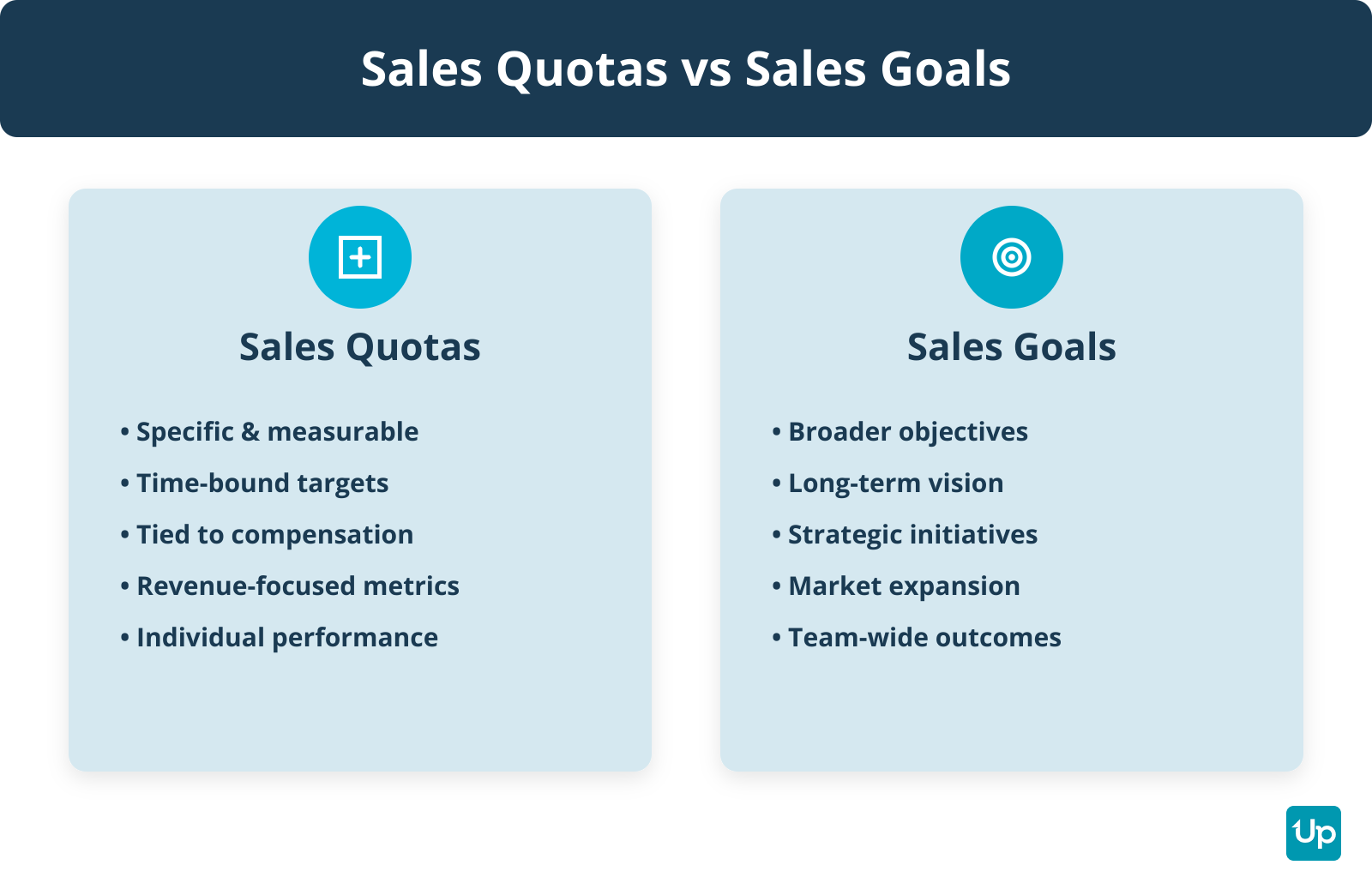
The difference between sales quotas and sales goals is that sales quotas are metrics focused on revenue, such as selling a specific amount of product by the end of the month. A sales quota is often a revenue target set for a specific period. Meanwhile, sales goals refer to a more holistic approach, such as expanding sales efforts to a new demographic or implementing new sales programs.
While sales quotas are the same as sales targets, they’re not the same as sales goals. Since both quotas and sales goals refer to a future sales-related objective, they can often be confused. The marketing department and business development representatives manage sales goals.
A sales quota is time-sensitive and measured by a specific metric. However, sales goals can be treated as overall objectives that will develop projects and strategies around sales. Sales teams use quotas as part of the sales objective. One example would be a quota of X customers that will complete the sales goal of new market penetration.
While a sales quota is a fixed number in a fixed time frame, a sales goal can be more of an overall objective of marketing and sales teams.
What Are the Main Types of Sales Quotas?
Not all sales quotas are created equal—the type of quota you choose can significantly impact your sales performance and overall strategy.
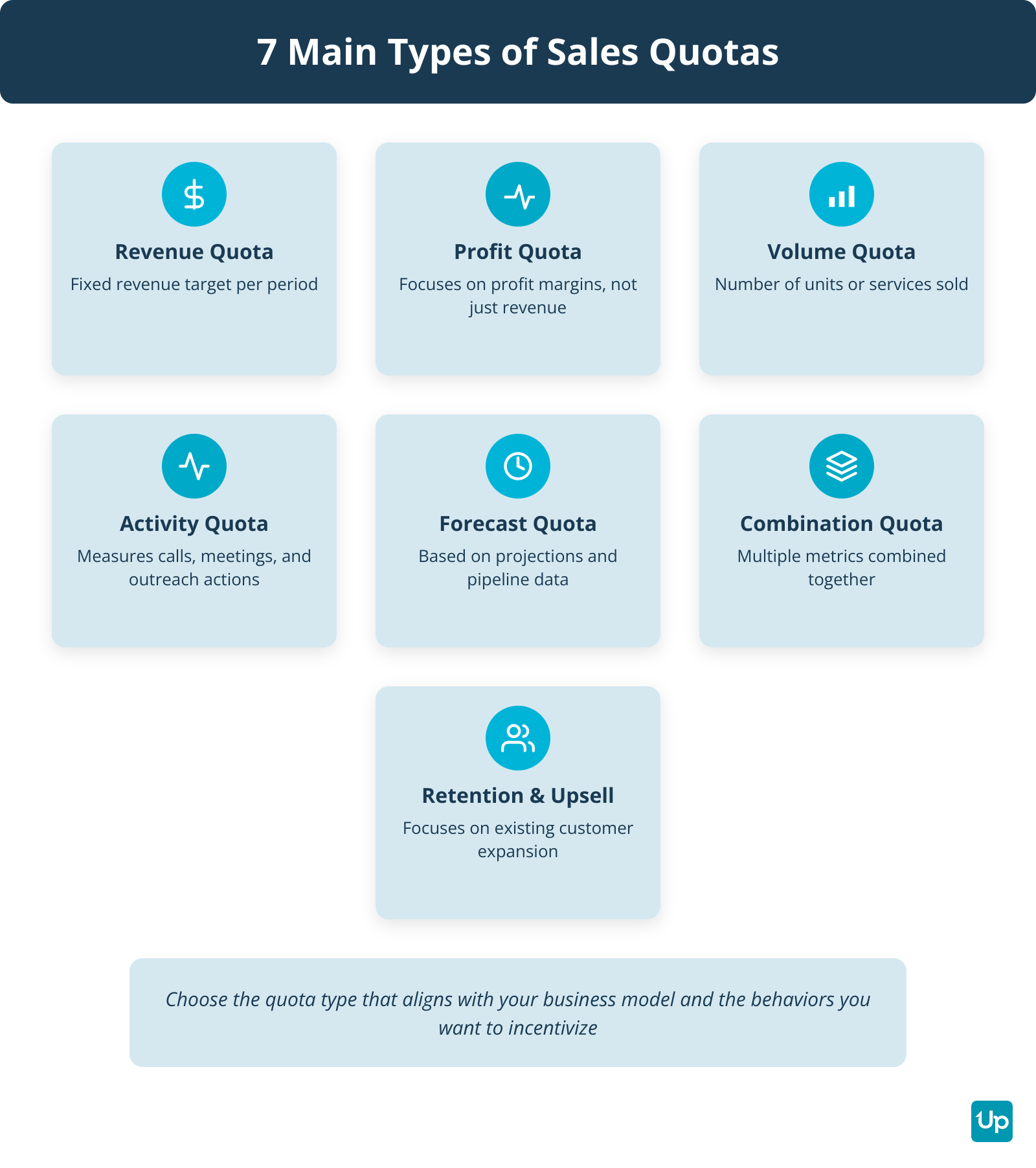
The main types of sales quotas are revenue quotas, profit quotas, volume quotas, activity quotas, forecast quotas, combination quotas, and customer retention and upsell quotas. Your ideal sales quota will differ depending on your business model and the product or service you offer.
Revenue Quota
This is the most common type of sales quota. With this quota, your sales reps are expected to sell enough products or services to reach a fixed amount of revenue.
This type of quota doesn’t reward the number of products sold. Instead, it rewards the amount of money made from them. This differentiation encourages sales reps and account executives to upsell their current customers to get the most revenue per transaction.
For example, perhaps Product X generates $10 of revenue and Product Y only generates $5 of revenue. A sales rep may try to focus on selling more of X and less of Y to achieve their profit quota.
Revenue quotas may prioritize profits over the number of units sold or newly acquired customers.
Profit Quota
Profit quotas focus on the actual profit margin generated from sales rather than gross revenue. This quota type accounts for the cost of goods sold, encouraging reps to prioritize high-margin products or negotiate better pricing.
For example, a rep might sell $100,000 in revenue but only generate $20,000 in profit. A profit quota ensures the focus stays on the bottom line, not just top-line revenue.
This approach works well for companies with varied product margins where strategic selling can impact profitability. Profit quotas are especially useful for companies serving several target markets with different price points, as they allow for tailored sales strategies and revenue targets for each target market.
Volume Quota
Revenue profit quotas measure how much sales reps make for the company, while volume quotas measure how much they sell overall. They’re measured according to the number of products or services the sales reps have sold.
For example, a subscription-based product may reward their sales reps for how many subscriptions they’ve sold during the month.
Volume quotas are often easier to calculate than profit ones. They’re also more transparent and easier to understand. These quotas help motivate sales reps to sell as much as possible regardless of each item’s individual profit.
Activity Quota
Another way to measure a sales rep’s effectiveness is with sales activity quotas. These quotas measure how many actions a sales rep has taken towards a sale, such as phone calls, sales calls, engagement with potential customers, number of leads reached, or number of new potential clients acquired.
While volume and profit quotas measure successful sales, activity quotas measure how often each sales rep works towards a sale and track their progress through the sales process, regardless of whether the sale is completed.
Sales activity quotas are great ways to measure how often each sales rep takes action and their engagement with the company. These quotas can be useful for identifying commitment to the job, not just the sales rep’s profitability.
Forecast Quota
Forecast quotas are sales goals based on projections developed by sales managers who analyze historical data, current pipeline, and market conditions such as supply chain issues. These quotas are used for realistic planning and resource allocation.
For example, if your team closed $500,000 in Q1 and your pipeline shows $750,000 in qualified opportunities for Q2, your forecast quota might be set at $600,000 to account for expected win rates and sales cycle length.
HubSpot’s Sales Hub provides a quota attainment feature to set and track sales quotas by rep and period, plus an integrated forecasting tool that uses real-time deal data to project revenue and categorize deals into forecast buckets like “Commit” and “Best Case.”
Combination Quota
Combination quotas often measure sales reps’ activity and profitability. A combination quota combines different sales objectives or metrics, such as profit goals with activity or customer satisfaction targets, to drive holistic performance. For example, a combination quota may consist of landing ten potential new customers and closing the sale with an average of two of the ten.
At first glance, combined quotas may seem more integral and holistic. However, they can become problematic if you measure too many metrics in the same quota. A sales rep may stress over their ratio of sales per client and lose focus on their main goal.
It’s often better to use a few metrics separately and combine them at the end. Then you can measure the sales rep’s effectiveness rather than trying to combine them all into one metric.
Customer Retention and Upsell Quota
In SaaS and subscription-based businesses, quotas focused on existing customers are critical. These include customer retention quotas, upsell quotas and cross-sell quotas.
A customer retention quota might require a Customer Success Manager to maintain 95% logo retention. An upsell quota focuses on upgrading customers to higher tiers, while a cross-sell quota measures success in selling additional products.
For example, a CSM might have a retention quota of 95% gross revenue retention and an expansion quota of $50,000 in annual recurring revenue through upsells and cross-sells.
This quota type recognizes that in many business models, especially SaaS, the real revenue growth comes from expanding existing customer relationships rather than just acquiring new logos.
What Are Common Challenges in Setting Sales Quotas?
Common challenges in setting sales quotas include unrealistic top-down goals, the “peanut butter” spread, the performance penalty, lack of transparency and ignoring market conditions. Setting effective sales quotas is one of the toughest challenges sales leaders face.
Unrealistic Top-Down Goals
Quotas set based on executive expectations without considering market realities or team capacity create immediate problems. A significant majority of sales leaders—76%—admit their quotas are unrealistic.
The solution is to implement a hybrid approach that blends top-down goals with bottom-up insights. Validate corporate goals against historical data, market potential and sales capacity. This creates quotas grounded in both strategic ambition and operational reality.
The “Peanut Butter” Spread
Many companies uniformly add a percentage to last year’s performance across all reps and territories. This “last year plus 10%” approach ignores territory potential and individual capabilities.
The fix is to base quotas on territory potential and market opportunity. Customize for each rep’s tenure, skill level and specific opportunities. A new SDR in a saturated territory needs a different quota than a veteran account executive in an emerging market.
The Performance Penalty
High performers are often “rewarded” with disproportionately higher quotas after exceptional years. This creates a success penalty that demotivates your top performers.
The solution is to separate one-time, anomalous deals from baseline performance when calculating future quotas. If a rep closed a once-in-a-decade enterprise deal, don’t assume they’ll repeat it next year.
Lack of Transparency
When reps don’t understand how quotas were calculated, it leads to distrust and the belief that the process is unfair or arbitrary.
Be transparent about your methodology. Communicate the reasoning behind the numbers and involve reps in the process. This fosters trust and increases buy-in, even when the targets are ambitious.
Ignoring Market Conditions
Static quotas that fail to adapt to economic downturns, new competitors or shifting customer behaviors set your team up for failure.
Review and adjust quotas based on market shifts. Incorporate external data on industry trends, competitive dynamics and economic indicators. Your quota strategy should be a living document, not a set-it-and-forget-it spreadsheet.
How Can You Set Motivating and Realistic Sales Quotas?
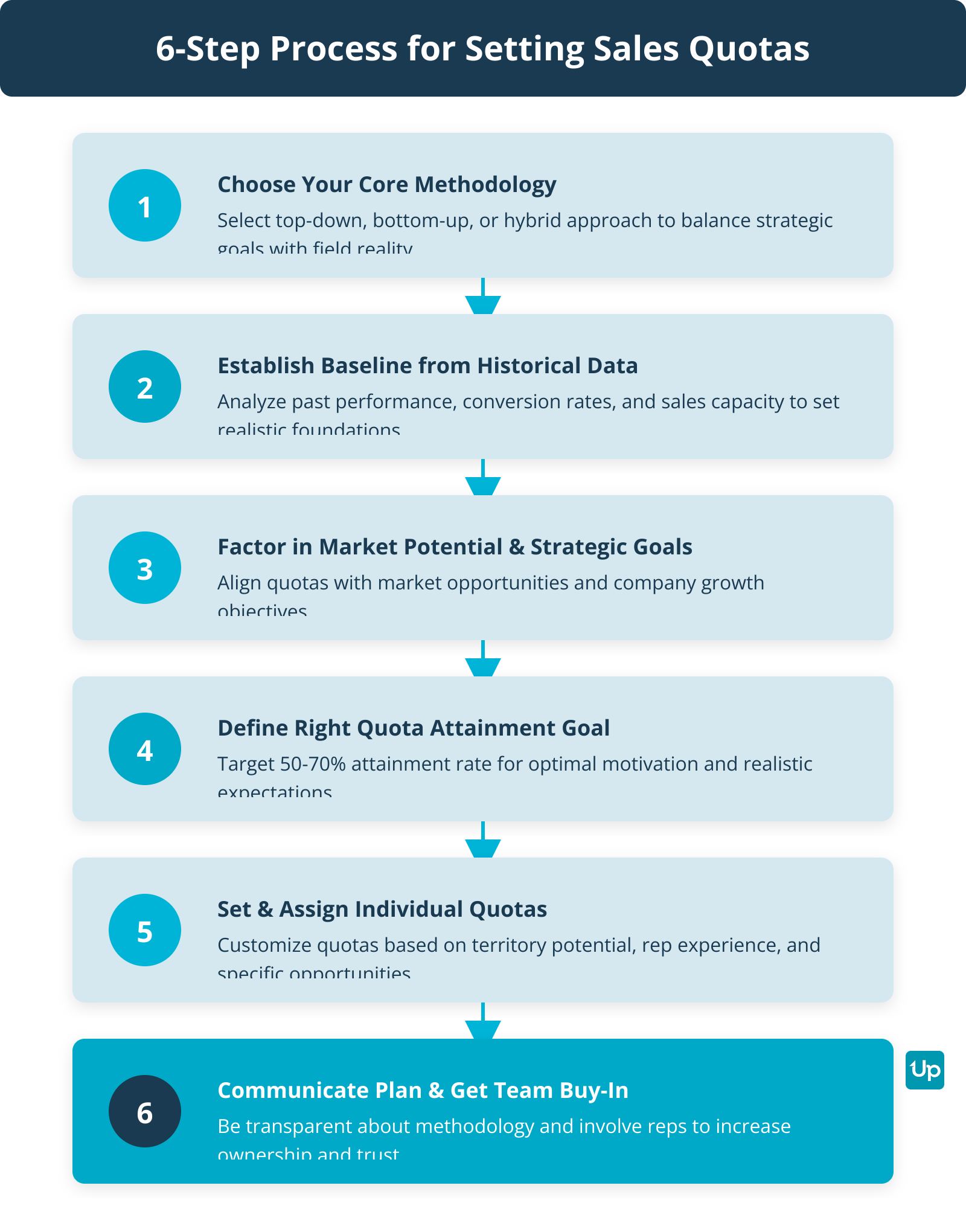
You can set motivating and realistic sales quotas by choosing your core methodology, measuring past performance, integrating relevant sales performance data, establishing a baseline from historical data and sales capacity, factoring in market potential and strategic goals, defining the right quota attainment goal, setting and assigning individual quotas, and communicating the plan to get team buy-in. Sales ops should be involved in supporting quota setting and management to ensure unified procedures and alignment across teams. A realistic quota is one that balances company growth needs with achievable targets.
Step 1: Choose Your Core Methodology
There are three foundational strategic methodologies for setting sales quotas.
The top-down approach starts with company leadership setting high-level revenue targets that cascade down to individual reps. This ensures alignment with corporate goals but can ignore ground-level realities.
The bottom-up approach starts at the field level with territory analysis and rolls up to company projections. This grounds quotas in market reality but may fall short of strategic growth ambitions.
The hybrid model blends both approaches to balance strategic goals with field reality. This is cited as the best practice, creating more realistic, sensible and motivating quotas while increasing buy-in from all levels.
Step 2: Establish a Baseline from Historical Data and Sales Capacity
You need to know where you’re standing to find out how you’ll reach your goals. Start by defining your baseline—your company’s minimum amount of sales based on historical performance. Analyze your sales data to measure past performance and identify trends that will inform your quota planning.
To establish a realistic baseline, look at your sales prospecting data and long-term metrics. Analyze seasonal fluctuations, conversion rates and average deal sizes. With this information, you can start drafting the right sales quotas for every period.
Calculate your sales capacity by determining how many reps you have, their average productivity and the time they have available for selling activities. This prevents setting quotas that exceed your team’s actual capacity to deliver.
Step 3: Factor in Market Potential and Strategic Goals
Your baseline tells you what you’ve done. Now factor in where you want to go and what the market will support.
Analyze your total addressable market, territory potential and competitive dynamics. If you’re entering a new market segment or launching a new product, adjust quotas to reflect the ramp-up period.
Align quotas with your company’s strategic growth goals, ensuring they support broader business objectives, business objectives, and the company’s financial goals. If the business needs to grow revenue by 30% this year, your quotas should reflect that ambition while remaining grounded in capacity and market reality.
Step 4: Define the Right Quota Attainment Goal
What percentage of your team should hit quota? The answer might surprise you.
RepVue’s platform data shows average quota attainment at 43.14% based on data from verified sales professionals at hundreds of companies. Forrester states that the average B2B sales organization’s quota attainment is around 47%, which isn’t necessarily negative as it can align with a properly structured incentive plan where the median seller is at 101% attainment.
The modern view suggests a healthy attainment rate is between 50-70%. In healthy SaaS organizations, 50-60% of fully ramped reps achieve their quotas. A 2022 Salesloft report noted about 65% of outside account executives meet their quotas.
The key insight is that a quota where 100% of reps succeed is too low, while a quota where only 20% succeed is demotivating and unsustainable. Aim for a target where roughly 60% of your team can hit quota with solid performance.
Step 5: Set and Assign Individual Quotas
Once you’ve established the overall framework, assign individual quotas based on territory potential, rep experience and specific opportunities. Introduce sales team members and sales representatives to their targets, ensuring they understand their specific quotas and how these align with company objectives.
Customize quotas for each sales rep’s situation. A new hire needs a ramp period with lower quotas in their first 90 days. A rep in a mature territory with a large existing book of business has different potential than one building from scratch.
Ensure your quotas reflect the right type or combination of types for your business model. An SDR might have an activity quota, while an account executive has a revenue quota and a customer success manager has a retention quota.
Step 6: Communicate the Plan and Get Team Buy-In
Setting the quota isn’t complete until it’s been communicated. A great quota plan fails without buy-in from the entire sales team and the broader sales organization.
Involve reps early through feedback sessions to increase ownership and ensure realistic targets. Hold formal roll-out meetings—not just emails—to explain the “why” behind quotas, connecting them to company strategy and market conditions. Make sure the entire sales team and sales organization understand the plan and how it impacts their roles.
Be transparent about your methodology, explaining the data and factors you considered. Provide clear written documentation each rep can reference. Offer tools and “what-if” calculators showing compensation scenarios at different attainment levels.
Schedule follow-up sessions for private questions and establish ongoing feedback loops for questions and adjustments throughout the quota period.
How Can You Track Sales Quota Attainment?
You can track sales quota attainment by monitoring relevant metrics such as quota attainment rate, pipeline coverage, win rate, sales cycle length, average deal size, relevant sales performance data, and sales activities completed. Setting quotas is only the first step. Tracking performance against those quotas is where the real management work happens.
The primary metric is quota attainment rate, calculated as actual sales divided by sales quota, multiplied by 100. A rep with a $100,000 quarterly quota who closes $80,000 has an 80% attainment rate.
Track pipeline coverage, which measures the ratio of pipeline value to quota. The optimal ratio is 3:1, meaning you need three dollars in pipeline for every dollar of quota. Lower coverage signals a problem early enough to correct.
Monitor win rate, sales cycle length and average deal size. These leading indicators help you diagnose why a rep might be falling short. A rep with a low win rate needs help with closing skills, while one with a long sales cycle might need help with qualification.
Sales activities completed—calls made, emails sent, meetings booked—are the earliest indicators. If activity drops, results will follow.
Use your CRM system and sales analytics platforms for real-time tracking and visualization. Modern platforms provide dashboards that show quota attainment, pipeline health, activity levels, monitoring rep activities, total revenue, and total sales generated at a glance, enabling proactive coaching rather than reactive firefighting.
What Is the Role of AI in Modern Quota Management?
AI transforms quota setting from a static, intuition-based process into a dynamic, data-driven one.
AI platforms analyze vast datasets including historical sales performance, seasonality, market trends, territory potential and individual rep skills to generate more accurate and equitable quotas. Machine learning algorithms like linear regression, ARIMA and neural networks power these forecasts.
Key applications include data analysis and forecasting, dynamic scenario modeling to assess the impact of price changes or market shifts and fair quota recommendations that move beyond simple “ratcheting” based on past performance.
According to a Gartner survey of 1,026 B2B sellers conducted from January through March 2024, sellers who partner with AI tools are 3.7 times more likely to meet quota than those who do not.
However, the same survey found that 72% of sellers feel overwhelmed by technology, and overwhelmed sellers are 45% less likely to attain quota. The lesson is clear: AI is a powerful tool for quota management, but it must be implemented thoughtfully with proper training and change management.
Platforms like Pigment offer AI-powered integrated business planning with specific sales quota planning modules, real-time scenario modeling and AI agents for autonomous forecast improvement. These tools are moving quota setting from an annual spreadsheet exercise to a continuous, adaptive process.
How Can Reps Hit Their Quota?
Reps can hit their quota by planning every sales call, calculating how many deals are needed to reach their sales quota, listening to their sales call recordings, conducting pre-call research, focusing on pipeline coverage and tracking their activity metrics. For sales reps facing ambitious quotas, these actionable tips increase your chances of success.
Plan Every Sales Call
Bestselling author and sales consultant Neil Rackham advises: “Before I go out on an important sales call, I still just carry around a little notepad and pencil. I’ll write down 3 or 4 good questions I want to ask, make a little plan, and then tear it up so that I’m not pulling it out in front of my prospect.”
The physical act of writing down questions and the desired course of the meeting helps you remember them. It leaves prospects with the impression that you’re well-prepared without appearing scripted.
Use mind maps to plan possible questions you would ask or answer. Plan the direction the sales call would take, along with possible obstacles and ways to overcome them.
Planning sales calls in this way also helps improve your team’s customer facing skills, such as active listening and understanding customer needs, which are essential for building stronger relationships and closing deals more effectively.
Listen to Your Sales Call Recordings
Neil Patel, cofounder at Crazy Egg, Kissmetrics and Quicksprout, shares this advice: “The best thing I’ve ever done when it comes to building my selling skills is listening to recorded calls. Listen to your sales calls and do roleplays. More importantly, don’t do this just once a week or once a month. We do this literally every single day with every salesperson on our team. That’s the reason our team closes so well.”
Record your calls, listen and identify where you made mistakes and why. Then do role-plays with corrections. Have your sales manager help you apply those corrections during future calls. Repetition is key.
Pre-Call Research Is Essential
Jill Konrath, author and B2B sales strategist, advises against scripted calls: “To get into big companies, you can’t make 100 cold calls saying the same thing to everyone. Several years ago, corporate decision-makers stopped answering their phones and rolled all calls to voicemail. They delete most messages within seconds because they sound like salespeople making their pitch.”
Instead, Konrath believes it is crucial to pre-research prospects and create personalized sales calls: “I discovered that the only way to capture the attention of these corporate decision-makers was to create a very personalized message based on in-depth research in their firm. Once I started doing this, I started setting up meetings.”
Research your prospect: their products, history, vision, needs and possible expectations. Personalize your sales call to grab their attention.
Focus on Pipeline Coverage
Don’t wait until the end of the quarter to realize you’re short. Maintain a 3:1 pipeline coverage ratio at all times. If your quarterly quota is $100,000, you should have at least $300,000 in qualified pipeline.
Review your pipeline weekly. Identify deals at risk and develop action plans to advance stalled opportunities. This proactive approach prevents end-of-quarter panic.
Track Your Activity Metrics
Know your numbers. How many calls do you need to make to book a meeting? How many meetings lead to a qualified opportunity? How many opportunities close?
If you know you need 100 calls to book 10 meetings, which lead to 3 opportunities, which close 1 deal worth $10,000, you can reverse-engineer exactly how much activity you need to hit your quota.
Track your daily and weekly activity against these benchmarks. If you fall behind on activity, you’ll fall behind on quota.
What Are the Best Sales Quota Templates and Calculators?
The best sales quota templates and calculators are Sales Quota Attainment by Klipfolio, Sales Plan Template by Smartsheet and Yesware Sales Quota Calculator. These templates can help you start measuring your sales quotas right away.
Sales Quota Attainment by Klipfolio
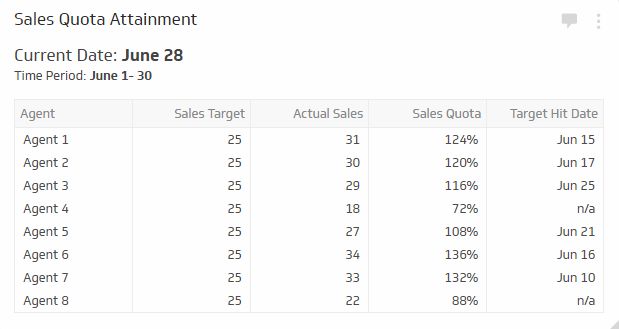
Klipfolio has a simple but effective template for measuring your sales quotas. In a spreadsheet, you fill in the names of your agents and their quotas to compare their actual sales. This allows you to have custom quotas with individual time frames for each sales rep to measure them individually.
This option is great if you’re looking for a template that’s simple to use and understand without any complex formulas or jargon.
Sales Plan Template by Smartsheet
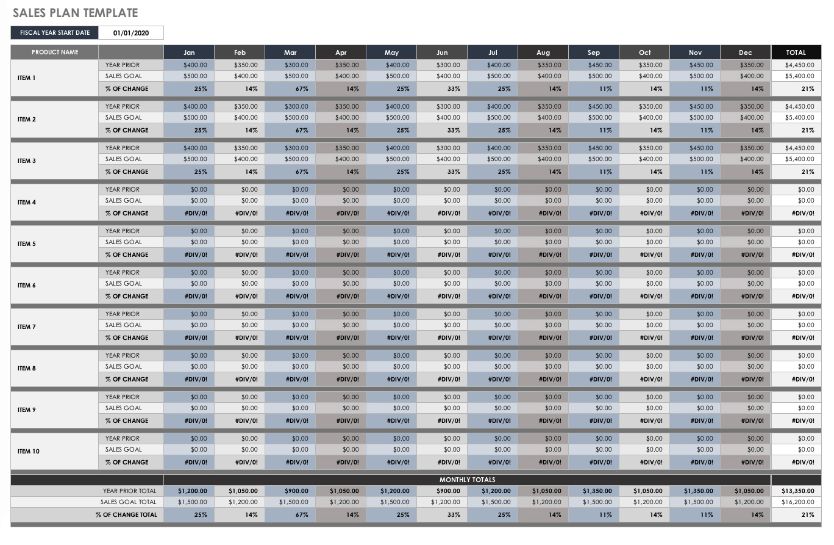
With this template from Smartsheet, you can plan your monthly quotas and see your yearly progress in one glance. Its focus on yearly progress allows you to compare your current year’s performance with how you did last year and add up your monthly progress.
Since it’s an Excel spreadsheet, you can edit any of it directly from your computer without depending on any internet connection.
This template is perfect for measuring sales reps with low turnover rates, identifying annual and seasonal trends and preparing predictive sales quotas.
Yesware Sales Quota Calculator
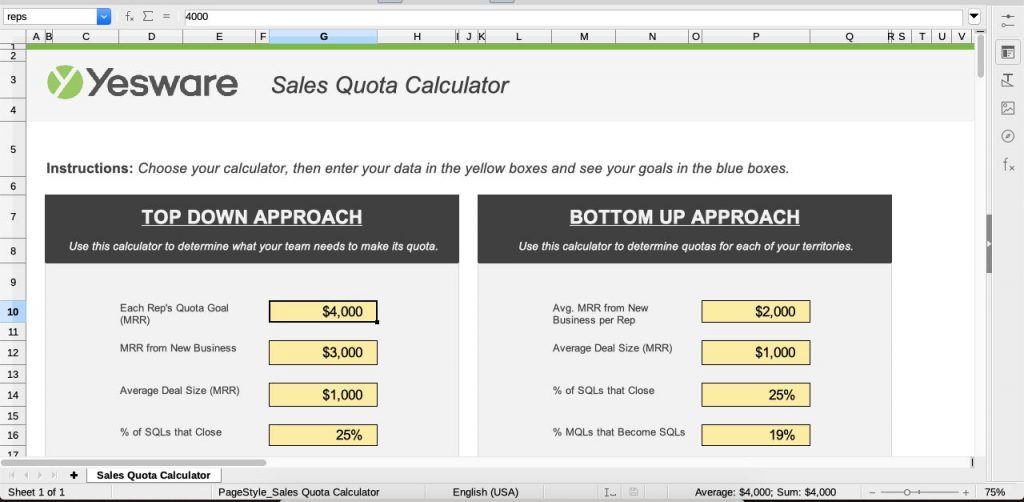
If you want to calculate your sales quota, Yesware has created a calculator to find the ideal one for you. With it, you can calculate the right quota using either a top-down approach or bottom-up approach. Just add your information such as your sales goals, number of sales reps and average sale size, and the calculator will tell you how many monthly sales, new customers and revenues your sales reps need to generate.
This calculator is perfect for anyone who wants to find the best way to reach their sales goals on time.
What Are Common Sales Quota Questions?
What Is the Difference Between a Sales Quota and a Sales Goal?
Quotas are specific, time-bound targets tied to compensation. Goals are broader, long-term objectives. A quota might be “$100,000 in revenue this quarter.” A goal might be “expand into the healthcare vertical.”
What Happens If You Don’t Meet Your Sales Quota?
Consequences vary by company but include loss of commission or bonuses. Consistent underperformance may lead to performance improvement plans or termination. However, in many organizations, 40-50% of reps miss quota in any given period.
How Often Should Sales Quotas Be Reviewed?
Review frequency depends on your sales cycle. For shorter cycles, monthly or quarterly reviews work well. For longer enterprise sales cycles, quarterly or bi-annual reviews are more appropriate. The key is to review often enough to make adjustments but not so often that reps lack stability.
Are All Quotas Based on Revenue?
No. Quotas can be based on volume, activity, profit or a combination. The right type depends on your business model and what behaviors you want to incentivize.
Conclusion
Sales quotas are vital ways to achieve predictable and sustainable growth. A well-crafted quota allows you to measure success, boost sales and adapt your goals as you go.
By analyzing your data, choosing the right methodology and communicating transparently with your team, you’ll master setting sales quotas that are both achievable and able to take your growth to the next level.
The difference between a quota that motivates and one that demoralizes often comes down to the process you use to set it. Invest the time to get it right and you’ll see the results in both team performance and company revenue.