

SPIN Selling is a methodology built on four question types, Situation, Problem, Implication, Need-payoff, that walk a buyer from describing their setup to stating out loud what fixing a problem is worth. Neil Rackham introduced it in 1988 after 12 years of research into more than 35,000 sales calls.
What Is SPIN Selling?
SPIN Selling is a sales methodology built on four types of questions: Situation, Problem, Implication, Need-payoff. Neil Rackham introduced the framework in his 1988 book of the same name, published by McGraw-Hill. The book grew out of roughly 12 years of research into more than 35,000 sales calls, run through Rackham’s consulting firm, Huthwaite.
Rackham’s central finding was simple but inconvenient for most sales training of the time: the tactics that close small, simple sales often hurt large, complex ones. A buyer making a six-figure decision has to talk themselves into it before a rep can close it. SPIN gives reps a repeatable question sequence that does exactly that. It walks a buyer from describing their current setup, to naming a problem with it, to feeling the real cost of that problem, to stating out loud what fixing it would be worth. Each letter in the acronym is a stage in that walk, not a separate technique to pick and choose from.
The theory behind SPIN selling is straightforward even where the practice takes work: a buyer trusts a conclusion they reached out loud more than one a rep hands them, so the questions do the persuading instead of the pitch.
How the SPIN Selling Process Works
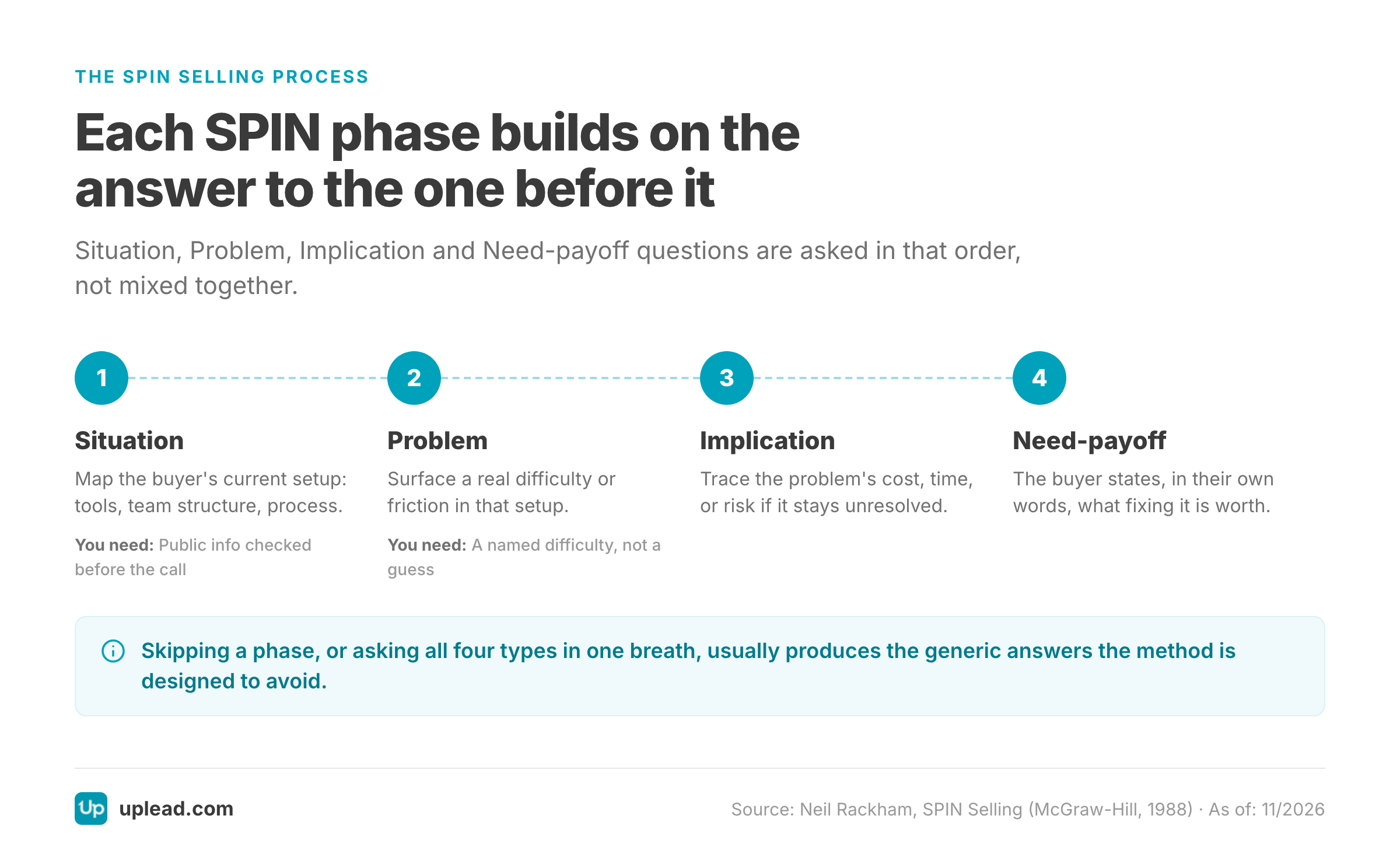
The four question types are asked in order, and each one builds on the answer before it. Skipping a stage, or asking all four types in one breath, usually produces the generic answers the method is designed to avoid.
Situation Questions
Situation questions map the buyer’s current setup: what tools they use, how their team is structured, what their process looks like today. They are necessary but low-value on their own. Rackham’s research found that top performers ask fewer of these than average reps, because a rep who shows up prepared does not need the buyer to re-explain public information. As a general rule, a call that is mostly Situation questions means the rep walked in without doing their homework.
Problem Questions
Problem questions probe for difficulties, dissatisfactions, or friction in that current setup. A generic conversation starts turning into a sales conversation right about here, because the buyer is naming something that is actually wrong.
Implication Questions
Implication questions take a named problem and trace its consequences: cost, time, risk, or knock-on effects on other parts of the business. This is the stage most reps skip, and Rackham’s research treats it as the one that separates average seller performance from strong seller performance in complex sales.
Need-Payoff Questions
Need-payoff questions ask the buyer to state the value of solving the problem, in their own words. Instead of the rep pitching a benefit, the buyer builds the case for the purchase out loud. That sentence becomes the strongest argument in the room, because the buyer, not the rep, said it.
The SPIN Selling Question Bank: Example Questions for Every Phase
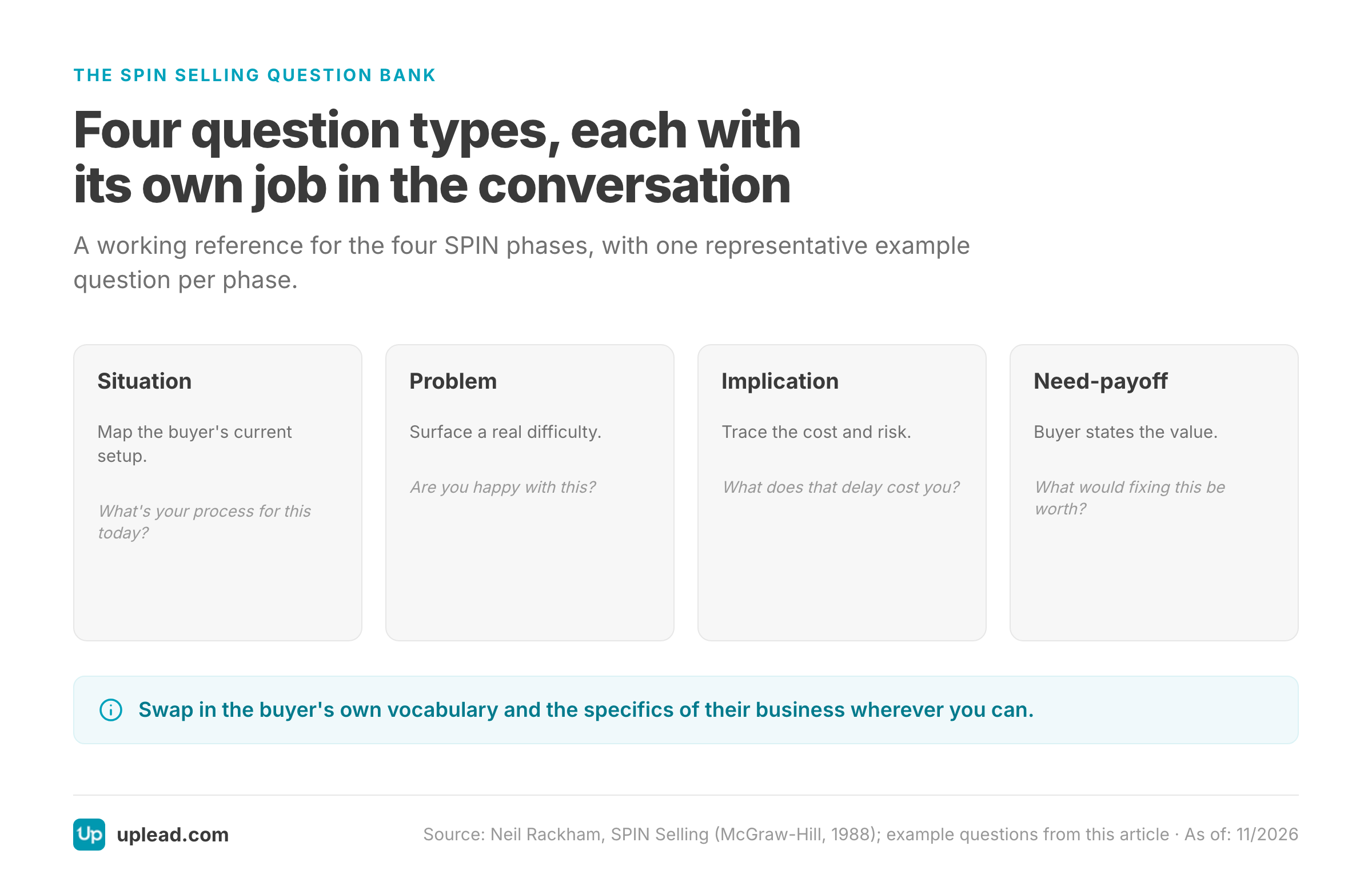
Use this as a working list, not a script to read verbatim. Swap in the buyer’s own vocabulary and the specifics of their business wherever you can.
Situation Questions (Examples)
- What’s your process for this today?
- If I sat in on how your team handles this right now, what would I actually see happen, step by step?
- What tools do you use for this?
- How long has your team been doing it this way, and has anyone questioned it recently?
- Who else weighs in on a decision like this?
- Walk me through how budget usually gets approved for something like this inside your company.
- How many people touch this process?
- What changed recently that made you start looking into this now instead of waiting?
- How do you measure success here today?
- Who actually owns this process end to end, and who just inherited pieces of it?
- What’s changed about your setup lately?
- How does this process connect to the other systems and teams your company relies on?
Problem Questions (Examples)
- Are you happy with this?
- Where specifically does your current approach fall short, and who notices it first?
- What’s the biggest friction point right now?
- Are there gaps between what this tool promised you and what it actually delivers day to day?
- Does this ever cause delays?
- What happens on the days when something in this process breaks down completely?
- Is your team spending too much time on this?
- How confident are you, honestly, in the accuracy of the data this process produces?
- What’s one thing you’d change about this?
- Does your current approach actually scale as the team grows, or does it start to crack?
- How much of this is still manual?
- Have you had to build workarounds for any limitations in your current setup?
Implication Questions (Examples)
- What does that delay cost you?
- How does that bottleneck ripple out and affect the rest of the team’s work?
- What happens next quarter if this keeps happening?
- Who else actually feels the impact when this process breaks down somewhere upstream?
- How much time does that waste each week?
- What’s the real risk if this problem isn’t addressed before the team doubles in size?
- Does this affect the numbers leadership sees?
- How does the team’s morale hold up when it hits this same friction over and over?
- Could this put a renewal at risk?
- How does your setup compare to what competitors in your space are already able to do?
- Where does this leave you in six months if nothing changes?
Need-Payoff Questions (Examples)
- What would fixing this be worth?
- If this stopped being a bottleneck tomorrow, what would your team focus on instead?
- Why fix this now instead of later?
- How would your team actually use the extra time this would free up?
- What would leadership say if this just went away?
- How would solving this change the way your team works on a normal day?
- Would this help you hit the goals you mentioned?
- What would it mean for the business if this ran twice as fast?
- How confident would you feel reporting on this?
- What difference would this actually make for the people who depend on it?
A Worked SPIN Selling Example
The exchange below is a hypothetical, built to show how the four question types connect, not a transcript of a real sale.
A rep is selling a data-enrichment tool to a VP of Sales Operations at a mid-size company.
Situation: “How is your team currently building and maintaining prospect lists?”
The VP explains that reps build their own lists by hand, pulling data from LinkedIn and a handful of free tools.
Problem: “Are you confident in the accuracy of the contact data your reps end up working with?”
The VP admits that bounce rates on cold outreach have been climbing, and nobody has had time to investigate why.
Implication: “What does that bounce rate end up costing you in rep time and in deliverability for the whole domain?”
The VP pauses, then estimates that reps lose several hours a week chasing dead contacts, and mentions a recent warning from their email provider about sender reputation.
Need-payoff: “If your reps had verified, current contact data from day one, what would that change about next quarter’s pipeline?”
The VP answers that reps could spend that time on calls instead of list-building, and that protecting sender reputation alone would be worth fixing this before it gets worse.
Notice that the rep never pitched a feature. The VP stated the cost of the problem and the value of fixing it, unprompted, in response to well-sequenced questions.
When SPIN Selling Works Best (and When It Doesn’t)
SPIN selling was built from research into large, complex sales, and it still performs best in that context.
The honest takeaway: SPIN is a questioning technique for sales that require genuine discovery, not a universal script for every kind of sale.
SPIN Selling vs. Other Sales Methodologies
SPIN is often mentioned alongside other named sales methodologies, but it solves a different problem than most of them. SPIN is a questioning technique used during discovery; frameworks like BANT and MEDDIC are qualification checklists used to decide whether a deal is worth pursuing at all. The table below lines up how each one is typically used.
| Methodology | What it actually is | Best-fit deal type |
|---|---|---|
| SPIN Selling | A structured sequence of discovery questions | Complex, multi-stakeholder B2B sales |
| BANT | A 4-point qualification checklist (Budget, Authority, Need, Timeline) | Shorter, more transactional B2B sales |
| MEDDIC | A 6-criteria qualification framework for forecasting deal health | Complex enterprise deals with multiple stakeholders |
| Consultative Selling | A broader, relationship-led selling posture | Relationship-driven B2B sales in general |
In practice, these are not mutually exclusive. A rep can use SPIN’s question sequence during discovery calls and still run the deal through a MEDDIC or BANT qualification pass afterward to decide whether it belongs on the forecast. SPIN’s four question types also sit comfortably inside a broader consultative, discovery-led sales cycle: the questioning technique and the overall sales process are different layers of the same deal, not competing systems. MEDDIC’s own namesake resource puts it plainly: SPIN guides the discovery conversation, while MEDDIC (sometimes extended to MEDDPICC, which adds Paper Process and Competition) qualifies the deal that comes out of it, and SPIN-style questions can supply the information that fills in MEDDIC’s qualification criteria.
Tips for Using SPIN Selling in Modern B2B Sales
Finding the right person to ask these questions matters as much as the questions themselves. A rep who reaches the actual decision-maker, instead of someone who has to relay answers secondhand, gets sharper situation and implication answers from the first call.
Frequently Asked Questions
Yes, for the type of sale it was built for. SPIN’s core insight, that complex sales close on the buyer’s own stated reasoning rather than a rep’s pitch, has not changed. What has changed is how reps prepare for the situation stage, since far more of that homework can now be done before the call instead of during it.
Situation, Problem, Implication, Need-payoff: that’s the order. Each stage builds on the answer to the one before it.
They answer two different questions at two different moments in the deal. SPIN helps a rep surface and build a problem while talking with the buyer; BANT’s four checkboxes (Budget, Authority, Need, Timeline) get filled in afterward, often in a CRM note rather than out loud on the call, to decide whether the opportunity deserves more time. A rep who runs a SPIN conversation well usually has everything needed to fill in BANT without a separate round of questioning.
BANT and MEDDIC are both qualification frameworks rather than questioning techniques. Consultative Selling is a broader relationship-led approach to the whole sales process. The Challenger Sale centers on teaching the buyer something they didn’t already know and then tailoring that insight to their role. The Sandler Selling System treats buyer and seller as equal participants and uses its own ‘Submarine’ sequence to move from a surface symptom down to the real root cause. Budget and decision process get qualified alongside pain before either side invests heavily. Each solves a different part of the sales process, and teams frequently combine more than one.
Think of the sales cycle as the map and SPIN as one leg of the route. SPIN questions do their work early, before a proposal exists and before anyone has committed to anything, which is also where most reps either earn or lose the right to a second meeting. Later stages of the cycle, like presenting a proposal or negotiating terms, lean on what the Need-Payoff questions already got the buyer to say out loud.