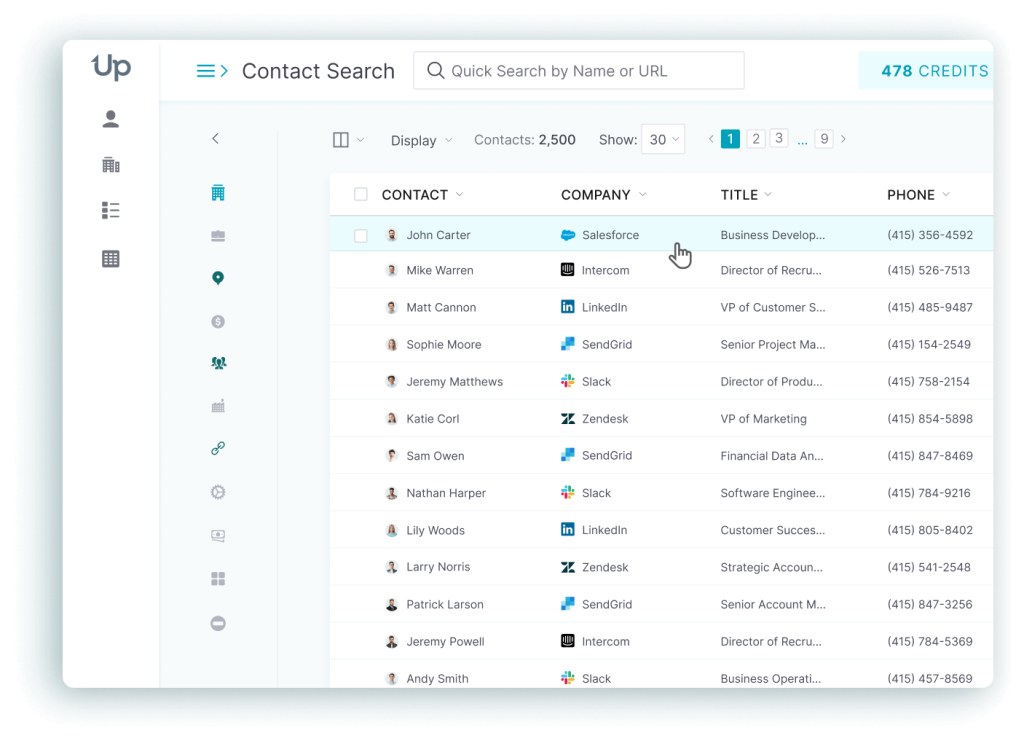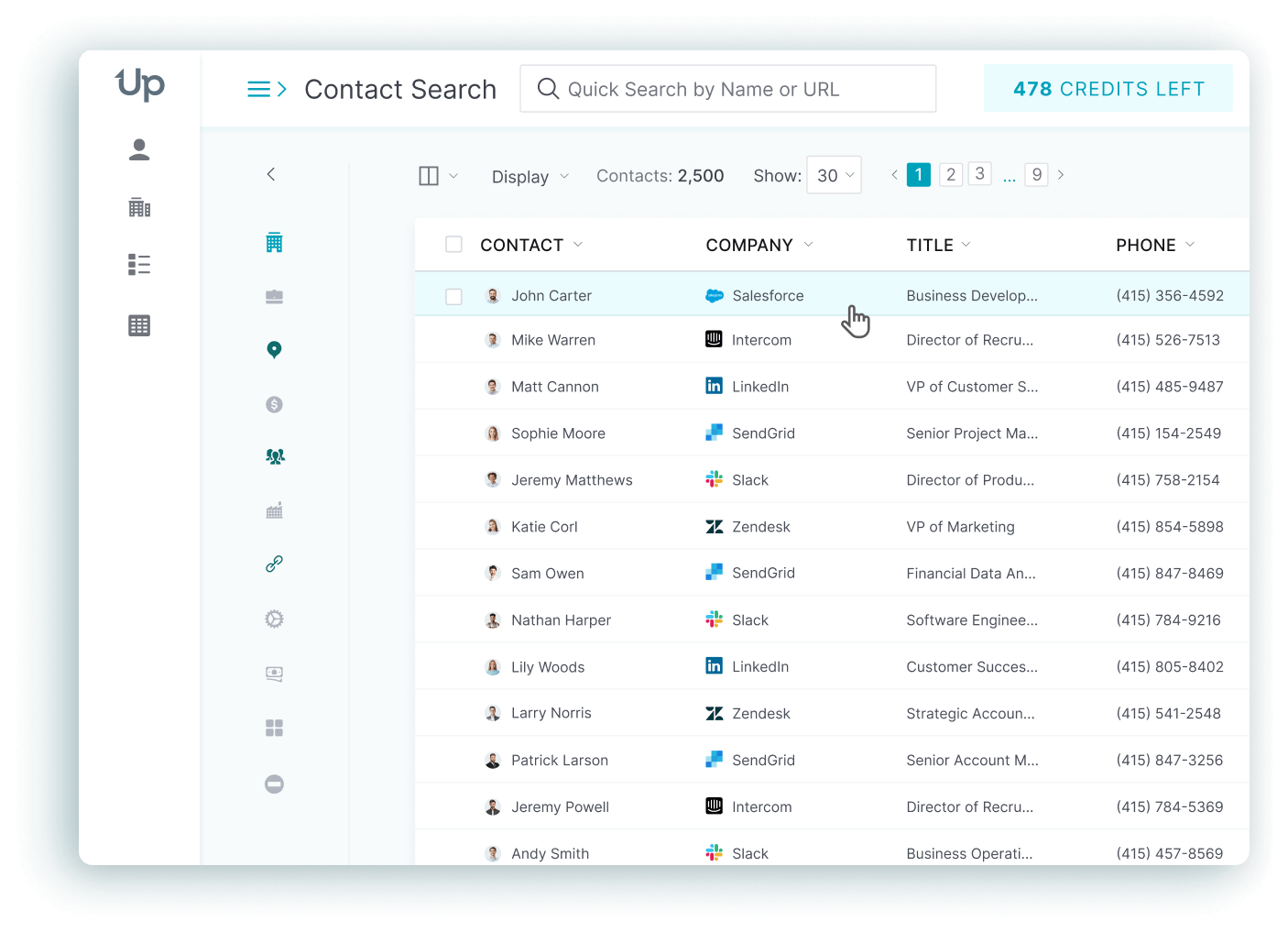


UpLead and Apollo.io both sell B2B contact data, but they charge for different things. UpLead is a contact database sold by the credit. It verifies each email in real time at export, one credit returns the email and the mobile number together, and it advertises a 95% data accuracy rate. Its plans include no sequencer or dialer, so teams do not pay twice for tools they already run. Apollo is a sales platform sold by the seat. It bundles a contact database with email sequences, and a dialer plus deal tools come in the same subscription. UpLead’s paid plans start at $99 a month ($74 a month billed annually) for 170 credits. Apollo’s Basic plan starts at $49 per seat a month billed annually ($65 billed monthly) for 30,000 credits a year, and a free plan exists.
UpLead vs Apollo at a glance
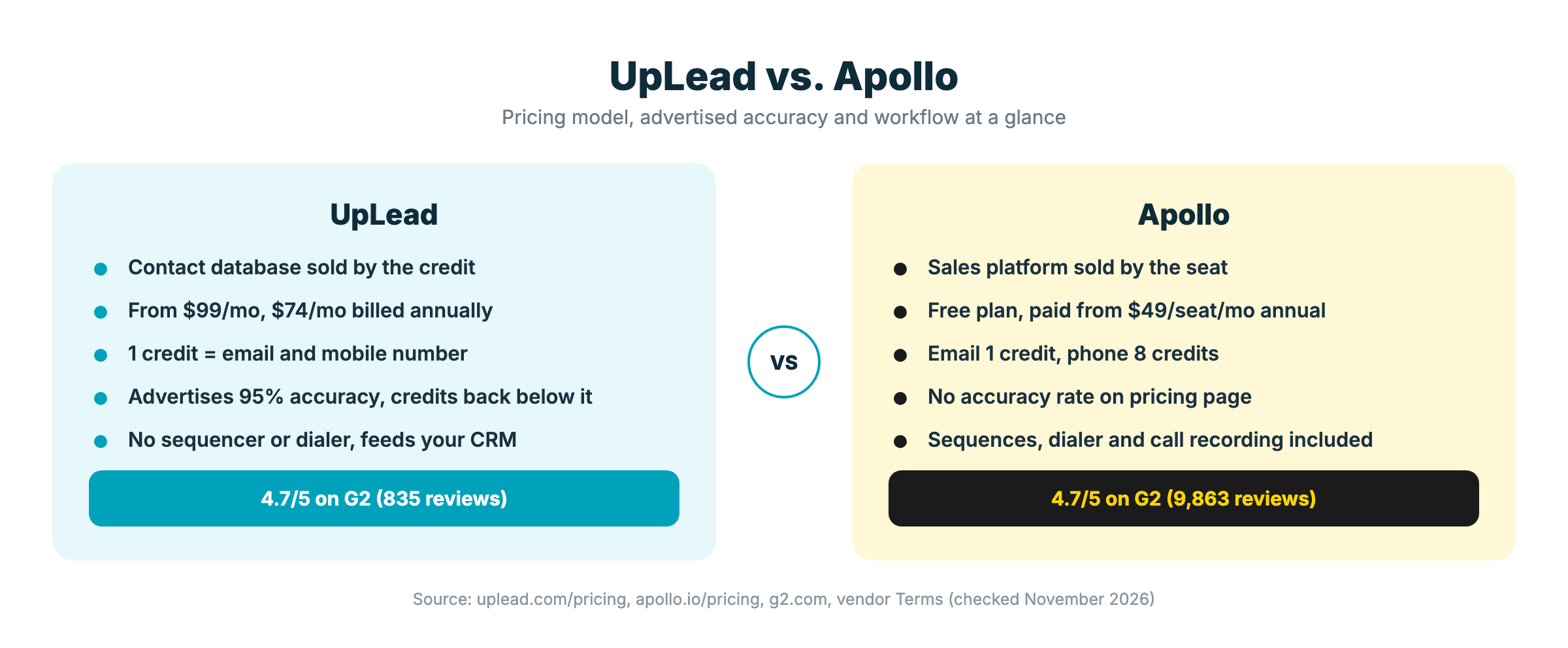
| UpLead | Apollo | |
|---|---|---|
| Pricing model | Credits per plan, 1 credit per contact | Per seat, credits pooled across the team |
| Starting paid price | $99/mo ($74/mo annual) | $65/mo ($49/mo annual) per seat |
| Free option | 7-day trial, 5 credits | Free plan, 900 credits per seat per year |
| Credit cost of a contact with email and mobile | 1 credit | 9 credits (1 email, 8 phone) |
| Advertised accuracy claim | 95% (UpLead about page) | None on the pricing page |
| Sequences and dialer | Not included | Included on paid plans |
| Renewal and cancellation | Auto-renews; cancel at least 60 days before renewal; fees non-refundable | Auto-renews; non-renewal notice at least 30 days before term end; fees non-refundable |
| G2 rating | 4.7/5 (835 reviews) | 4.7/5 (9,863 reviews) |
Source: UpLead pricing, Apollo pricing, UpLead on G2, Apollo on G2.
What UpLead and Apollo each do
UpLead is a searchable database of business contacts. You filter by industry, job title, company size, location or the technology a company uses, pick the contacts you want and export them. Each contact is checked with real-time email verification at the moment of export, and the company advertises a 95% accuracy rate for its data. The platform stops at the list: it has no email sequencer or dialer, and it pushes contacts into the CRM or sales engagement tool a team already runs.
Apollo.io covers more of the sales workflow. Its homepage describes 240M+ contacts and 30M+ accounts, and the same subscription includes unlimited email sequences, a dialer, call recording, an AI assistant, deliverability tools with email warmup, and intent topics. A rep can find a prospect and reveal the email, then enrich the CRM record and send the first sequence step without leaving Apollo. That breadth suits a small outbound team that wants prospecting and outreach in one tool. If you want a deeper look at the product itself, see what Apollo.io is and how it works.
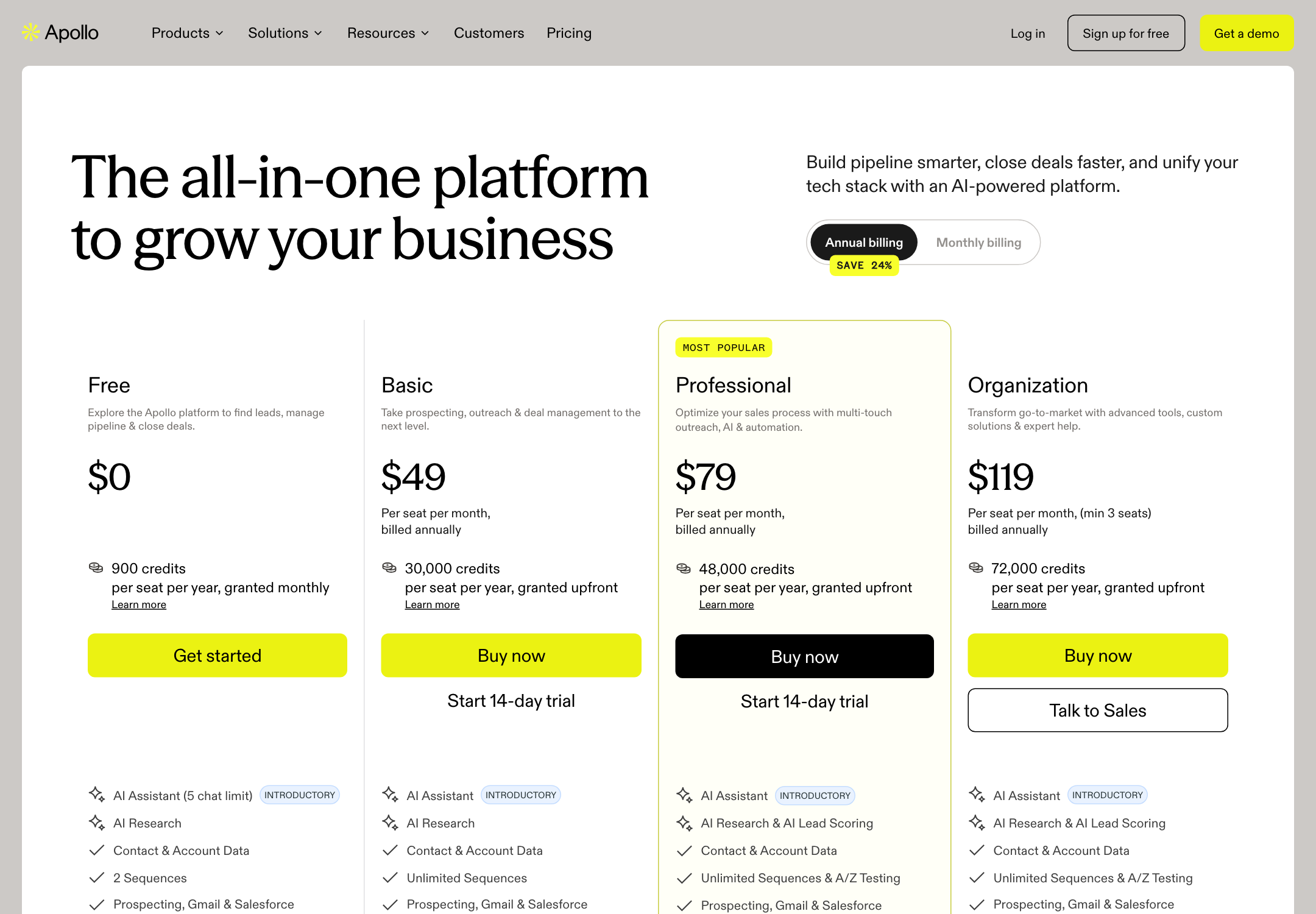
Apollo pricing (checked November 2026)
Source: Apollo pricing. Credits are pooled across the team, granted at the start of each billing cycle and do not roll over. A work email costs 1 credit, a phone number costs 8 credits and the US dialer costs 1 credit per 30 seconds. All seats on an account share one plan level, so a team cannot mix Basic and Professional seats. Apollo also sells add-ons: Advanced Dialer at $119 per team a month billed annually ($149 billed monthly), and Inbound from $119 per team a month billed annually ($149 billed monthly). Apollo’s free trial of paid plans runs 14 days with 75 credits.
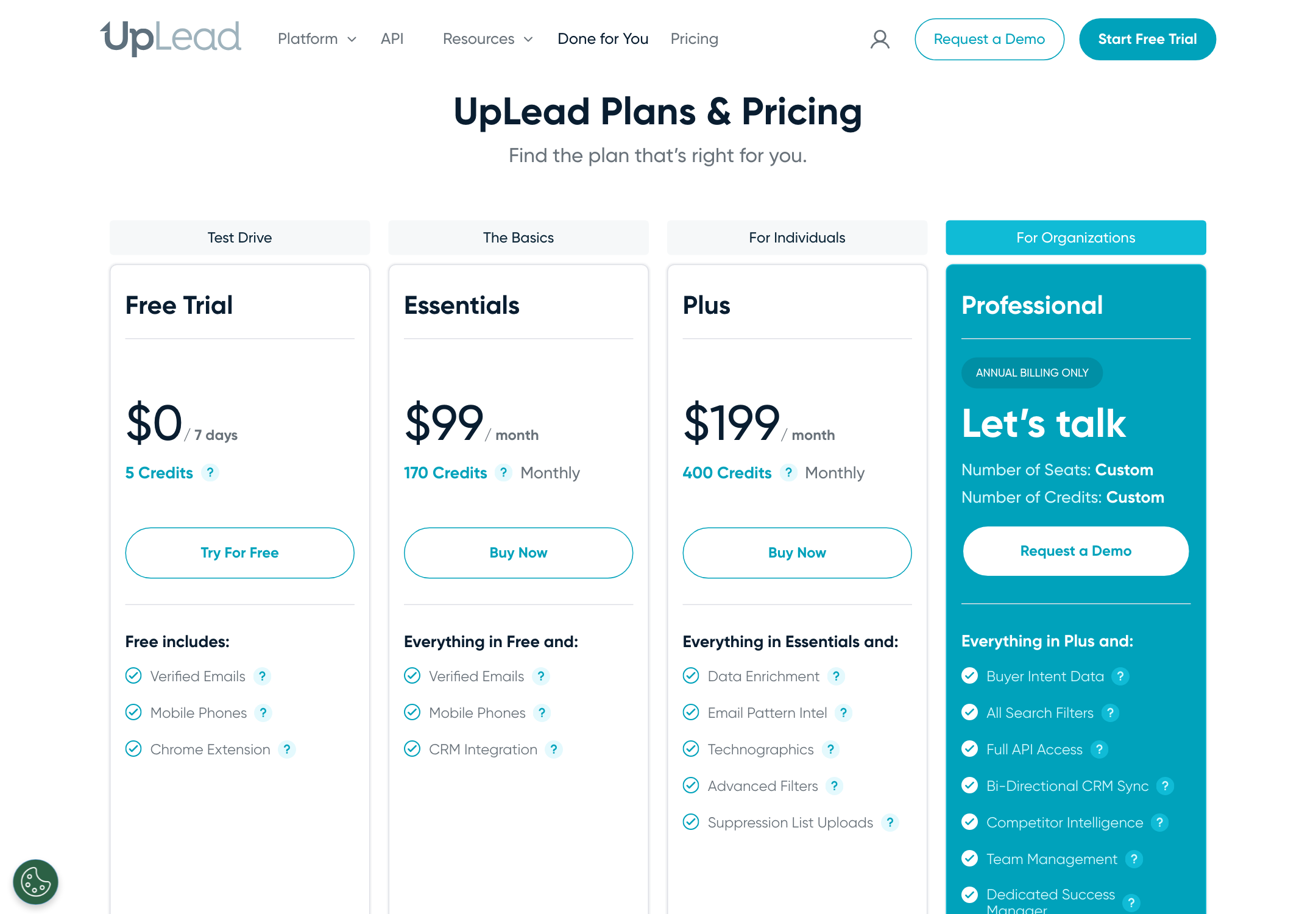
UpLead pricing (checked November 2026)
Source: UpLead pricing. One credit returns one contact with its email and mobile direct dial. Extra credits cost $0.60 each on Essentials and $0.50 each on Plus. Essentials and Plus are single-user plans. The custom-priced Professional plan adds team accounts as well as buyer intent data, while full API access and bi-directional CRM sync live there too. Plus adds technographics across 16,000 technologies and data enrichment. Email pattern intel and suppression list uploads come with it.
What one contact costs on each tool
A fully revealed contact costs less than half as much on Apollo as on UpLead, because a credit buys different things on each tool. On UpLead one credit returns the email and the mobile number together. On Apollo an email costs 1 credit and a phone number costs 8, so a contact with both costs 9 credits. The table divides each plan’s yearly price by its yearly credits to get the cost of a revealed contact, meaning one with both email and mobile number.
| Plan | Billing | Price (USD) | Credits | Cost per credit (USD) | Cost per revealed contact (USD) |
|---|---|---|---|---|---|
| UpLead Essentials | Monthly | $99/mo | 170/mo | $0.58 | $0.58 |
| UpLead Essentials | Annual | $74/mo | 2,040/year | $0.44 | $0.44 |
| UpLead Plus | Monthly | $199/mo | 400/mo | $0.50 | $0.50 |
| UpLead Plus | Annual | $149/mo | 4,800/year | $0.37 | $0.37 |
| Apollo Basic | Monthly | $65/mo | 2,500/mo | $0.026 | $0.23 |
| Apollo Basic | Annual | $49/mo | 30,000/year | $0.020 | $0.18 |
| Apollo Professional | Monthly | $99/mo | 4,000/mo | $0.025 | $0.22 |
| Apollo Professional | Annual | $79/mo | 48,000/year | $0.020 | $0.18 |
Each figure divides the price per year by the credits per year, then multiplies by 9 for an Apollo contact with email and phone. Apollo’s figures are per seat and assume every credit is used, since unused credits expire each cycle.
Apollo is cheaper per credit and, on paper, per contact: less than half the price for a contact with email and phone, and about $0.02 for a contact that needs only an email. The price of a contact is only part of the cost, though. A bounced email costs a rep time and puts sender reputation at risk, and a lower credit price does not recover either. UpLead verifies every email in real time at export, and one credit includes the mobile number, where Apollo charges 8 credits extra for the phone. For teams that weigh data quality alongside price, that is the trade UpLead is built around, and the next section covers it.
Data accuracy and verification
UpLead advertises a 95% data accuracy rate and says customers get their credits back if accuracy falls below it (UpLead about page); its pricing page also states a 95% rate. Emails are verified in real time when you export. UpLead lists 200M+ leads across its database on its homepage.
Apollo describes 240M+ contacts and 30M+ accounts on its own homepage. Records are refreshed regularly and filled out through waterfall enrichment, which queries more than one source to complete a record. Its pricing page publishes no accuracy percentage or refund terms for bad data.
Review sites show the trade-off in numbers. Both products hold a 4.7 out of 5 on G2: UpLead from 835 reviews and Apollo from 9,863. G2’s comparison page lists outdated contact records (225 mentions) as a top drawback for Apollo, next to praise for easy navigation (349 mentions) and time saved on sales (214 mentions). Treat these as signals of what reviewers notice, not as an audit of either database. A short pilot on your own target accounts settles it: export 100 contacts from each tool and send them through a verifier before any campaign.
Contract terms: renewal, cancellation and refunds
Both vendors’ Terms of Service are worth reading before you sign. The table summarizes the clauses that matter most for a purchase decision, as read on 20 November 2026.
| UpLead | Apollo | |
|---|---|---|
| Auto-renewal | Yes, the plan renews at the end of the term (section 3.2) | Yes, for a period equal to the expiring term (section 4(c)) |
| Cancellation | At least 60 days before the renewal date (section 3.2) | Written notice of non-renewal at least 30 days before term end (section 4(c)); Apollo’s help page says monthly plans can be cancelled at any time and annual plans are a 12-month commitment |
| Refunds | Fees are non-refundable (section 3.4) | Fees are non-cancelable and non-refundable, with no refund for partially used services (section 4(c)); Apollo may grant one at its discretion |
| Unused credits | Do not roll over to the renewal term (section 3.1) | Expire at the end of the billing cycle (section 4(d)) |
| Data accuracy | UpLead does not warrant the accuracy, completeness or usefulness of the data (section 6.1) | Apollo does not warrant the accuracy, completeness or quality of any data (section 6(d)) |
Source: UpLead Terms of Service, Apollo Terms of Service, Apollo pricing. Both vendors disclaim data accuracy in their terms, which is common in this category, so the practical safeguard is the same for either tool: test a sample before committing to a full term, and diary the cancellation date when you sign.
Features that matter
The split is simple. If your reps live in a sequencer and a dialer, Apollo covers those jobs inside the subscription. If your team already runs Outreach, SalesLoft, Lemlist or another engagement tool and needs clean contacts to feed it, UpLead’s export does that job through its integrations, so the team pays for no features it will not use. For Apollo’s data-only alternatives, see Apollo.io competitors; for programmatic access to Apollo’s data, read the guide to the Apollo.io API.
UpLead pros and cons
Apollo pros and cons
Which should you choose: UpLead or Apollo?
Some teams use both: Apollo for sequencing and calling, UpLead as the list source they import. Weighing Apollo against other tools raises the same pricing and data questions. See Cognism vs Apollo or Instantly vs Apollo, or read Apollo’s head-to-head with another prospecting database. For the full cost picture of Apollo’s plans, see Apollo.io pricing, and for how UpLead sits against a larger enterprise platform, read UpLead vs ZoomInfo.
Why teams choose UpLead over Apollo
- Verification at export. Each email is checked in real time when you export it (UpLead).
- One credit, email and mobile. A credit returns a contact with its email and mobile direct dial, where Apollo charges 1 credit for an email and 8 for a phone number (UpLead pricing, Apollo pricing).
- An advertised accuracy rate. UpLead advertises 95% accuracy and says it returns credits below it (UpLead about page); Apollo’s pricing page publishes no accuracy rate.
- Credits, not seats. You pay for contacts rather than per seat, and nothing for a sequencer or dialer you already run, because the export feeds Outreach, SalesLoft, Lemlist and other tools through integrations.
Frequently asked questions
For teams that focus on data quality, yes. UpLead verifies each email in real time at export, advertises a 95% accuracy rate with credits returned below it, and includes the mobile number in a single credit, with no seat pricing and no paid sequencer or dialer to carry. Apollo is the better fit if you want an all-in-one sales platform with sequences, a dialer and a free plan, and it is cheaper per credit.
Apollo is cheaper on paper. Its Basic plan costs $49 per seat a month billed annually, against $74 a month for UpLead Essentials, and a fully revealed contact costs about $0.18 on Apollo against $0.44 on UpLead Essentials billed annually. The two are not the same product: UpLead’s price buys a contact list with verified emails, Apollo’s buys a platform.
Yes. Apollo’s free plan costs $0 and includes 2 sequences and basic filters, with 900 credits per seat per year granted monthly. UpLead has no permanent free plan, only a 7-day trial with 5 credits.
No. UpLead is a data provider, so it has no sequencer or dialer. Teams send from a tool such as Outreach, SalesLoft or Lemlist, which UpLead connects to, or from Apollo itself.
Around 6 March 2025 Apollo’s LinkedIn company page was restricted, and MarTech reported no explanation from LinkedIn. Apollo said it was working with LinkedIn to resolve it, and its CEO said the restriction did not disrupt its services or core platform (MarTech).
Tools buyers most often compare with Apollo include ZoomInfo and Cognism, as well as Lusha, RocketReach, Clay or UpLead. Our guide to Apollo.io competitors lists ten alternatives with pricing.
Apollo’s pricing page publishes no accuracy percentage or refund terms for bad data. G2’s comparison page lists outdated contact records (225 mentions) as a top drawback for Apollo, so verify a sample of exported contacts before sending at scale.