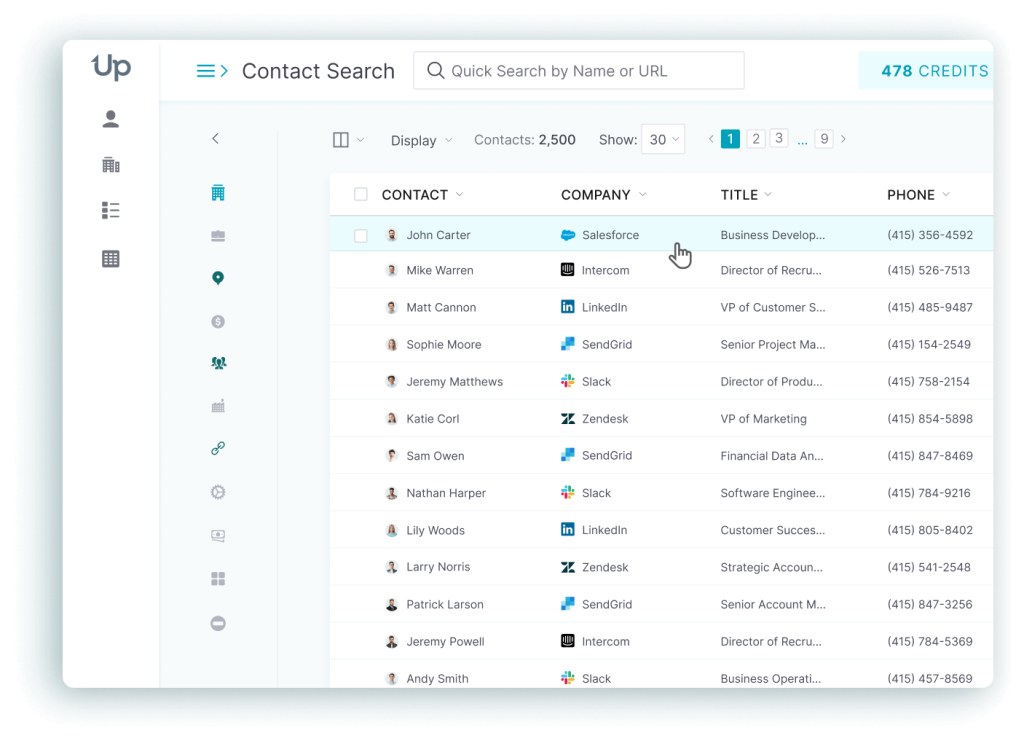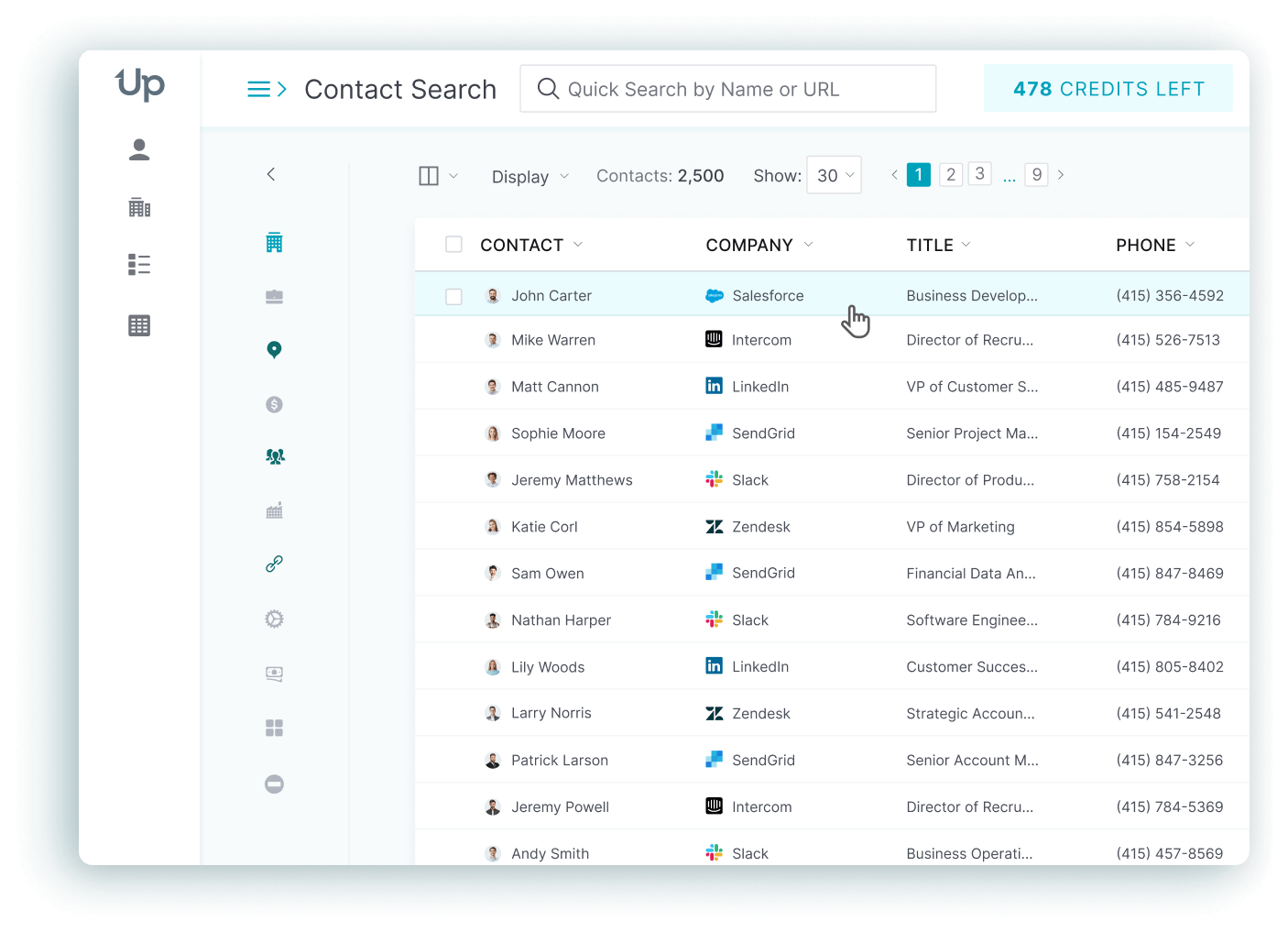


Instantly and Apollo solve different halves of the same problem. Apollo charges per seat and bundles a 240M+ contact database with a dialer and sequencing in one subscription. Instantly charges by sending volume and scales through unlimited mailboxes, with lead data sold as a separate Credits add-on. If your bottleneck is finding people to contact, Apollo’s built-in data wins. If your bottleneck is how much email you can safely send, Instantly’s mailbox model wins. Many teams end up using both.
This guide compares current 2026 pricing and data for both platforms, plus their AI features and user reviews, using figures checked directly against Instantly’s and Apollo’s own sites rather than recycled estimates.
What Is Instantly?
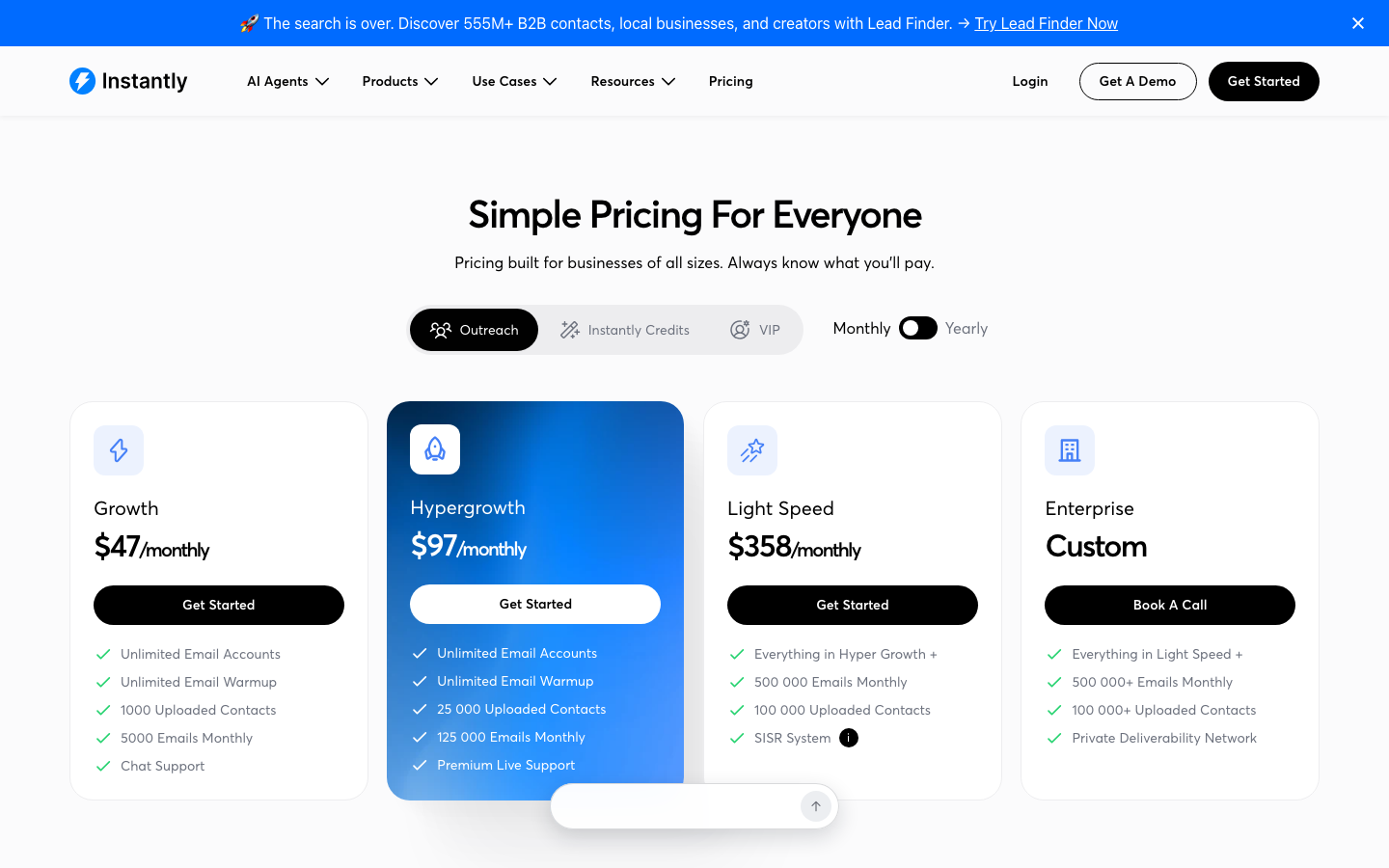
Instantly is a cold email sending and deliverability platform built around unlimited mailboxes rather than user seats. Instead of paying more per person on the team, a plan’s price is set by how many emails you send and how many contacts you upload each month. Every paid plan includes automated inbox warmup, and the top Light Speed tier adds a private deliverability network meant to keep high-volume sending out of spam folders. Instantly also offers a separate line of Credits plans that bundle a large B2B lead database with waterfall enrichment, for teams that want sourcing and sending from one vendor. Entry pricing starts at $37.60 per month on the Growth plan when billed annually.
What Is Apollo?
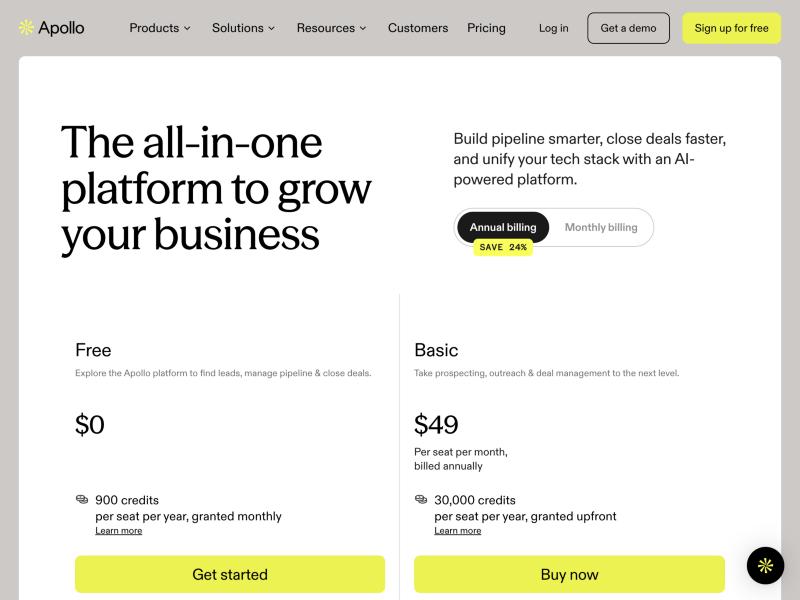
Apollo is a sales intelligence and engagement platform priced per seat. Every paid plan gives each user a pool of credits for revealing emails and phone numbers. Each seat also gets access to Apollo’s own contact database and built-in sequencing, and the Professional and Organization tiers add a native dialer with call recording on top. Apollo’s own site currently states its database holds more than 240 million contacts and more than 30 million company accounts, refreshed and enriched on an ongoing basis. Paid plans start at $49 per user per month billed annually, and the Organization tier requires a 3-seat minimum.
Where that pricing lands depends heavily on team size. A single Apollo seat looks cheap next to an Instantly plan with no per-seat cost at all, but the math flips once a team grows past a handful of reps, since every additional Apollo seat adds another full subscription while an Instantly plan’s price is set by sending volume, not headcount.
Instantly vs Apollo: Side-by-Side Comparison
The table below lines up the two platforms on the dimensions that actually change which one fits your team.
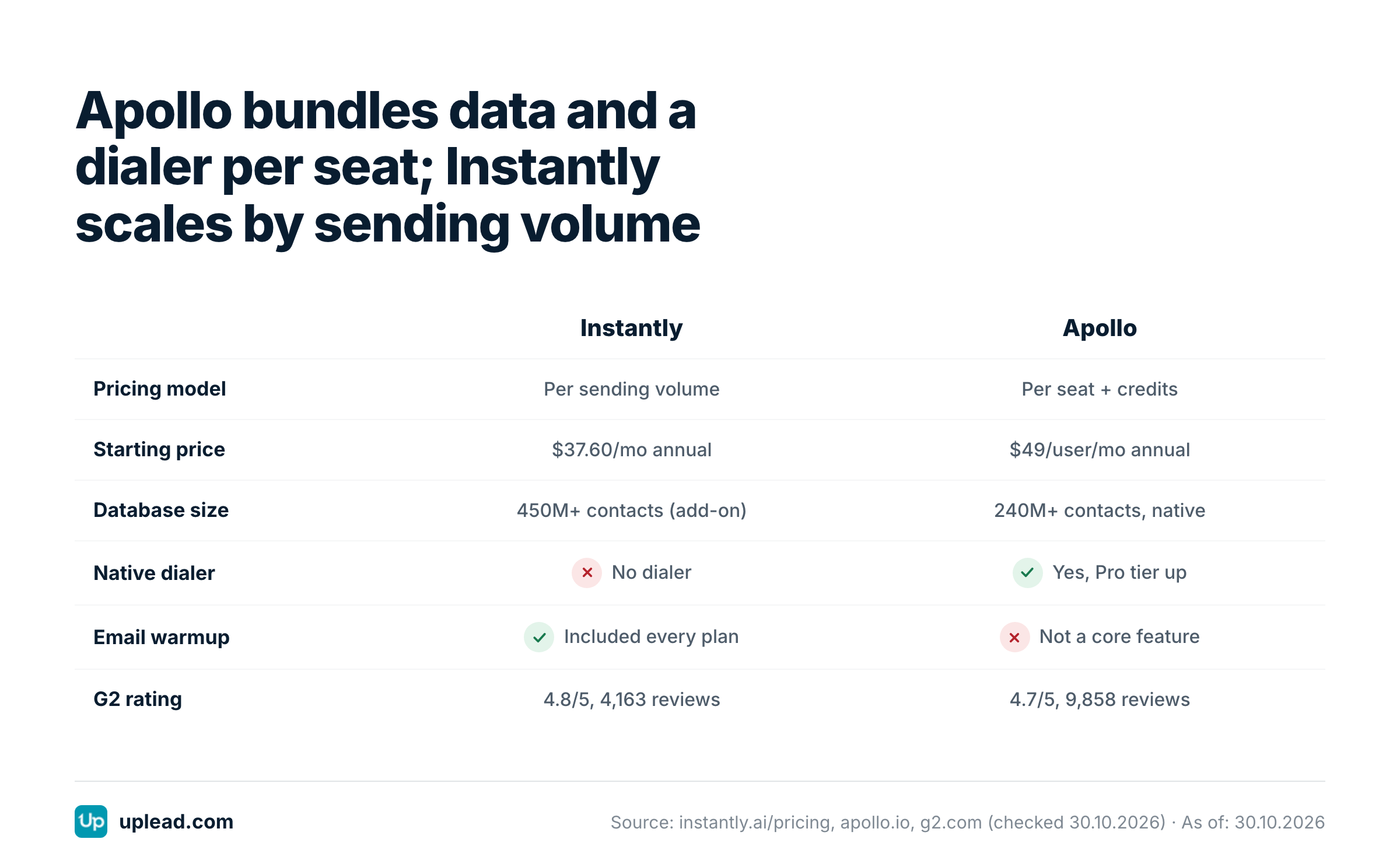
| Instantly | Apollo | |
|---|---|---|
| Pricing model | Per sending volume / credits | Per seat, plus pooled credits |
| Starting price (annual) | $37.60/mo (Growth) | $49/user/mo (Basic) |
| Free plan | No standalone free tier | Yes – $0, about 900 credits/year |
| Database size (vendor-stated) | 450M+ contacts (Credits plans only) | 240M+ contacts, 30M+ accounts (all paid plans) |
| Native dialer | No | Yes (Professional, Organization) |
| Email warmup | Included on every plan | Not a core feature |
| AI features | AI reply/intent-sorting agent | AI lead scoring, AI Research, AI Assistant (beta) |
| G2 rating | 4.8/5 (4,163 reviews) | 4.7/5 (9,858 reviews) |
Built-in data and a dialer in one subscription are where Apollo wins. Sending volume and mailbox scaling without adding seats are where Instantly wins. Neither tool is simply “better” – they’re built for different bottlenecks.
Sending Volume and Deliverability Infrastructure
Sending capacity in Instantly scales with mailboxes and plan tier, not with how many people are on your team – that’s the platform’s core design choice. The Growth plan covers 5,000 emails per month across unlimited connected mailboxes. Hypergrowth raises that ceiling to 125,000 emails per month. Light Speed goes further still, to 500,000+ emails per month, and adds a private deliverability network: a dedicated sending infrastructure meant to protect inbox placement at high volume. Automated warmup ships on every paid tier, gradually building sending reputation on new domains and mailboxes before a real campaign starts.
High-volume cold sending was never Apollo’s design target in the same way. Third-party testing referenced across review sites puts Apollo’s outbound sending cap at roughly 50 emails per mailbox per day. That ceiling ties to plan tier and the number of connected mailboxes per seat, which makes it a structural limit for teams whose main need is sheer email volume rather than data or calling – not a setting you can simply raise.
What this means in practice: an agency running six-figure monthly send volumes across many domains will outgrow Apollo’s per-seat sending caps extremely quickly. A five-person sales team sending moderate volumes alongside calls and sequences will rarely hit a ceiling that truly matters.
Data and Lead Sourcing
Every paid Apollo plan includes a native database: 240M+ contacts and 30M+ company accounts, searchable and filterable without buying a separate product. That database is folded straight into the seat price. Each seat also gets a monthly pool of credits for revealing emails and mobile numbers.
Instantly’s approach to data is newer and structured differently. Its core Outreach plans (Growth, Hypergrowth, Light Speed) skip a lead database entirely – they’re priced purely for sending. Teams that want sourcing from Instantly directly have to step over to its separate Credits plans (Growth Credits, Supersonic, Hyper Credits, Enterprise Credits), which add a 450M+ B2B lead database with 13 filters and waterfall enrichment, starting at $37.60 per month annually. That raw number is larger than Apollo’s own stated 240M+ contacts, though the two aren’t filtered the same way: Apollo splits out a separate 30M+ accounts count that Instantly doesn’t report at all.
Apollo bundles data and sending into one seat price – that’s the practical difference between the two. Instantly treats data as an optional, separately-priced layer on top of its sending infrastructure, which is useful if you want one vendor for both, but it does mean paying for two Instantly products instead of one if you need both sourcing and high-volume sending.
AI Features Compared
Instantly’s AI centers on the sending workflow itself. An AI reply agent reads incoming replies and sorts them by intent: interested, not interested, or out of office. It can also route or draft follow-ups automatically. Unibox rounds out the picture by managing replies across every connected mailbox in one inbox.
Apollo’s AI features sit closer to the research and prioritization side of the workflow. AI-driven lead scoring ranks which accounts and contacts are worth working first. An AI Research feature pulls public signals into account summaries. Apollo currently labels its AI Assistant as beta, and none of these AI features replace the dialer or sequencing tools – they layer on top to help a rep decide who to contact and in what order.
Put simply: Instantly’s AI optimizes what happens after you send. Apollo’s AI optimizes who you contact before you send.
Plans and Pricing
Pricing mechanics are the single biggest difference between these two tools, so it’s worth seeing both in full.
Instantly Pricing
| Plan | Monthly | Annual | Emails/mo | Uploaded contacts |
|---|---|---|---|---|
| Growth | $47 | $37.60 | 5,000 | 1,000 |
| Hypergrowth | $97 | $77.60 | 125,000 | 25,000 |
| Light Speed | $358 | $286.30 | 500,000+ | 100,000+ |
| Enterprise | Custom | Custom | 500,000+ | 100,000+ |
Separate Credits plans (lead database add-on) start at $37.60/month annually (Growth Credits) and scale up through Supersonic and Hyper Credits, all including the 450M+ B2B database, 13 filters, and waterfall enrichment. A managed VIP service with a dedicated account manager is available by custom quote.
Apollo Pricing
| Plan | Per user/mo (annual) | Per user/mo (monthly) | Seat minimum | Credits/user/year |
|---|---|---|---|---|
| Free | $0 | – | – | ~900 (2 sequences, 1 intent topic) |
| Basic | $49 | $65 | – | ~30,000 |
| Professional | $79 | $99 | – | ~48,000, unlimited email credits |
| Organization | $119 | Custom only | 3 users | ~72,000, custom mobile credits |
Professional is the first tier to add the native dialer and call recording; Organization adds call transcription and international/local dialing presence.
Instantly vs Apollo Reviews: What Users Are Saying
Both are strong scores, though Apollo’s rating rests on more than double the review volume, which matters for how much weight to put on either number – a larger sample tends to smooth out the effect of any single unhappy or unusually enthusiastic reviewer.
Reviewers commonly point to ease of setup and mailbox management as strengths for Instantly, since there’s no seat-based data entry curve to climb before a first campaign goes out. Apollo reviewers more often cite the breadth of its combined workflow – data and dialer plus sequencing, all in one place – as the reason they keep a single seat open. Credit limits show up repeatedly as the most common Apollo complaint once a team scales past a handful of users and starts competing for the same pooled allotment.
Neither rating distinguishes cleanly between a buyer evaluating the free or entry tier and one running an Enterprise or Organization deployment, so treat both scores as a starting signal rather than a final verdict – read a handful of recent reviews for the plan tier you’re actually considering before committing to an annual contract.
Who Should Choose Instantly?
Choose Instantly if your bottleneck is sending volume, not finding people to contact. It fits best when:
- You already have a list, or can build one through a separate enrichment tool or Instantly’s own Credits add-on.
- You run multiple domains or mailboxes and need warmup and deliverability handled automatically.
- You’re an agency managing outreach for several clients and need to scale sending without adding a seat for every client.
- You don’t need a dialer or in-platform CRM – just reliable, high-volume email sending.
Who Should Choose Apollo?
Choose Apollo if your bottleneck is finding the right contacts, not sending volume. It fits best when:
- You’re a small-to-mid-size sales team that wants data and sequencing, plus calling, in one seat-priced subscription.
- You want a native dialer with call recording and (on Organization) call transcription, rather than a separate calling tool.
- Your sending volume is moderate enough that Apollo’s per-mailbox caps won’t become a bottleneck.
- You’d rather pay per user than manage a separate sending-infrastructure product.
Can’t Decide? Try UpLead Instead
If the real question is “where do I get accurate contact data without committing to either platform’s full workflow,” UpLead is worth a look. UpLead focuses specifically on verified B2B contact and company data with real-time email verification, so you’re not paying for sequencing, dialing, or warmup you may not need yet. Credits are only spent on contacts that pass verification, which sidesteps the pooled-credit frustration several Apollo reviewers describe.
UpLead plugs into whichever sending tool you choose – including Instantly – once you’ve decided how you want to send. That makes it a reasonable middle path for a team that wants Apollo-grade data accuracy without an Apollo seat, or that wants to feed a verified list straight into Instantly’s sending infrastructure instead of paying for Instantly’s own Credits add-on.
What to Remember About Instantly vs Apollo
Even though they show up on the same shortlist, Apollo and Instantly aren’t solving the same problem. Apollo bundles data and sequencing with calling, all under a per-seat price, with a 240M+ contact database built straight in. Instantly scales sending through unlimited mailboxes at a flat, volume-based price, with a separate 450M+ database available as an add-on for teams that want sourcing from the same vendor. Match the tool to the bottleneck you actually have – contact sourcing or sending volume – and don’t rule out running both.
Frequently Asked Questions
The closest thing to a free alternative to Apollo is Apollo itself: its own Free plan, priced at $0, with roughly 900 credits per year (about 75 per month). That plan is capped at two sequences and one intent topic. Instantly does not offer a comparably-scoped free plan – its lowest tier, Growth, starts at $37.60 per month billed annually. Teams that specifically need free contact data rather than free sending are better served comparing dedicated data tools, including UpLead’s free trial, rather than treating either outreach platform’s free tier as a long-term fit.
Apollo is a widely used, long-standing platform. Its 4.7-out-of-5 rating across 9,858 reviews on G2 reflects a large, mature user base rather than a new or unproven product. As with any contact-data provider, accuracy varies by record. Apollo’s own credit-expiry and seat-minimum terms are also worth reading closely before committing to an annual plan.
Yes, and plenty of teams do. A common setup is sourcing and verifying contacts in Apollo (or a dedicated data tool), then sending and warming up campaigns through Instantly, which keeps each tool doing the job it’s structurally built for instead of forcing one platform to cover both halves of the workflow.
Yes. Apollo’s native dialer with call recording is included on the Professional plan, and the Organization plan adds call transcription plus international and local-presence dialing. Instantly has no dialer – it’s a sending and deliverability platform only.
It depends on what “cheaper” needs to include. Five Apollo Basic seats would run roughly $245/month billed annually ($49 x 5), with data and sequencing included for everyone. Instantly doesn’t charge per seat at all – a single Hypergrowth plan ($77.60/month annually) can support a five-person team’s sending needs, but it carries no built-in contact data, so the true cost comparison depends on whether that team already has a list or needs to add Instantly’s separate Credits plan on top.