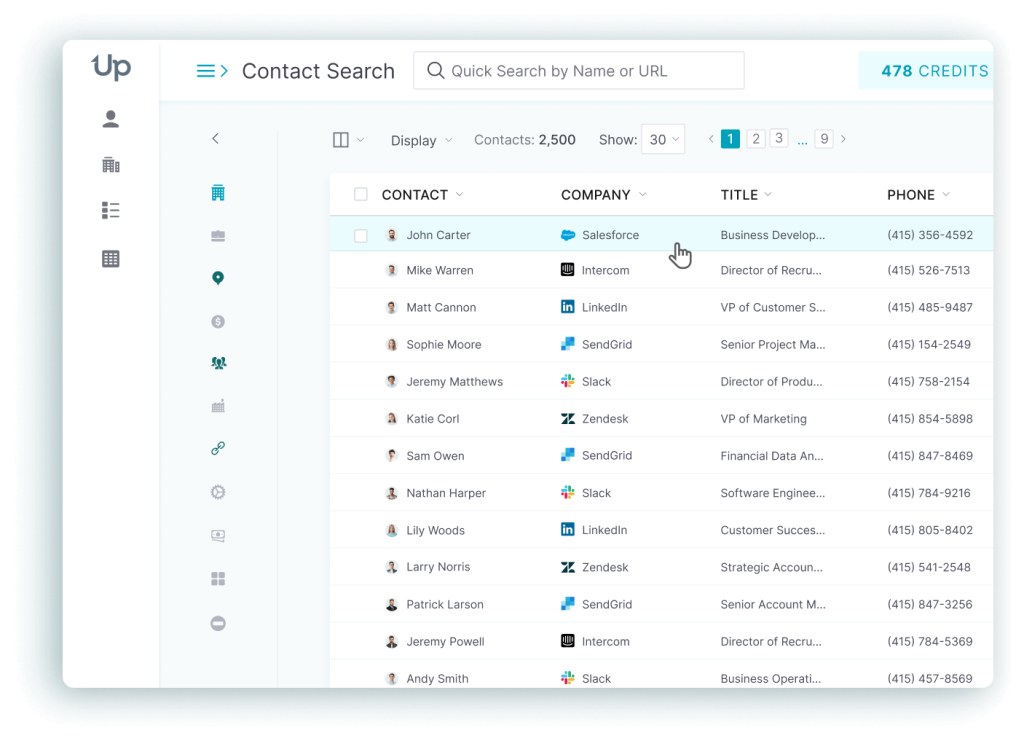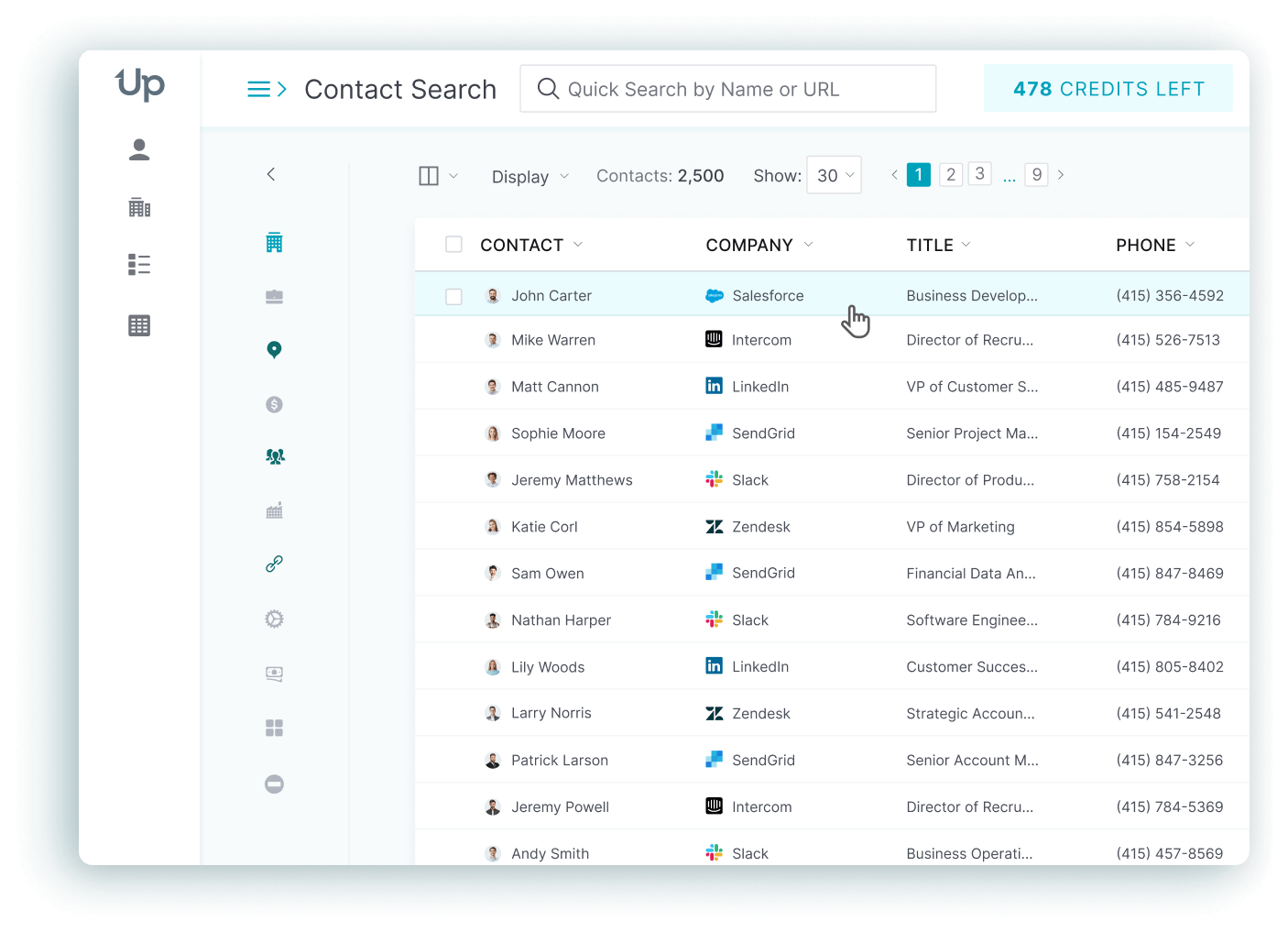


UpLead and Crunchbase get compared because they both show up in a sales or research stack, not because they do the same job. UpLead is a searchable B2B contact database built for finding and exporting verified emails and mobile numbers in bulk. Crunchbase is a company and funding intelligence platform built for researching private companies and, increasingly, predicting what they’ll do next. UpLead’s paid plans start at $99 a month ($74 a month billed annually); Crunchbase’s paid plans start at $49 to $99 a month for Pro, with a separate Business tier from $199 a month.
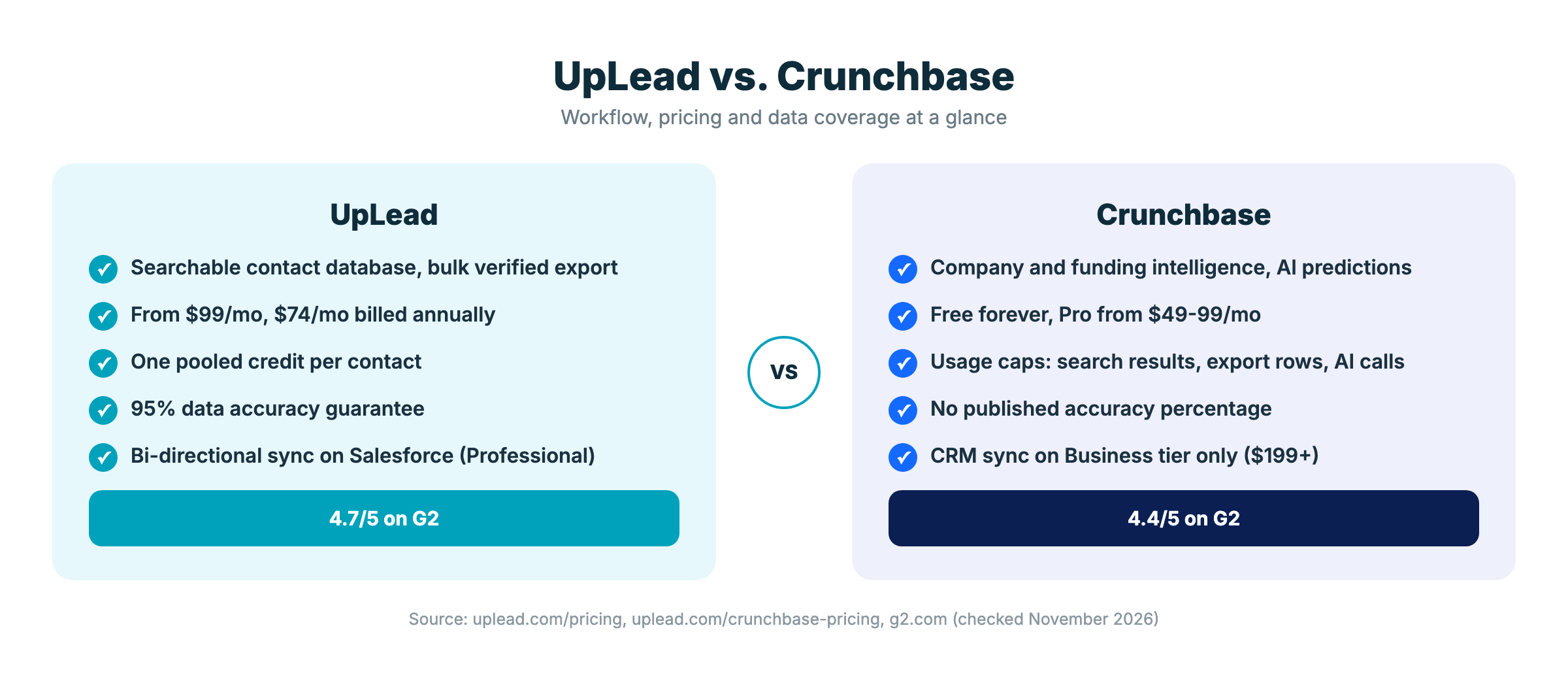
UpLead vs Crunchbase at a glance
| UpLead | Crunchbase | |
|---|---|---|
| Starting paid price | $99/mo ($74/mo annual) | $49-99/mo (Pro) |
| Free plan | 7-day trial, 5 credits | Free forever, capped at 5 results per search |
| Primary workflow | Filtered database search, bulk verified export | Company/funding research, AI-assisted predictions |
| Pricing model | One pooled credit per contact | Usage caps: search results, export rows, AI-agent calls |
| Data accuracy claim | 95% (stated on every tier) | Not published as a percentage |
| G2 rating | 4.7/5 (835 reviews) | 4.4/5 (415 reviews) |
Source: UpLead pricing, UpLead’s Crunchbase pricing guide, G2.
What UpLead and Crunchbase actually do
UpLead works like a search engine for verified contacts. You filter by industry, title, company size, location or technographics. The results populate as a list, and you export verified emails and mobile numbers in bulk. UpLead states 200M+ leads in its database and backs every tier with a 95% accuracy guarantee that refunds credits on confirmed bad data. The workflow is built for a sales or marketing team that needs a new target list before a campaign starts, not for researching a single company in depth.
Crunchbase works the other way. It positions itself today as “private company data & predictive intelligence,” and the product has moved well past a simple company directory. Its own homepage states 39 billion live private market signals, plus 30 million-plus verified updates a year, plus 15 million-plus predictions refreshed weekly. That data feeds an AI layer (Crunchbase Scout) that forecasts funding rounds, company growth, plus acquisition or IPO odds. Crunchbase claims 84% of real-world funding rounds are predicted by its models. What it doesn’t do is guarantee a working direct-dial phone number or verified email the way a credit-based contact tool does, which is exactly the gap UpLead fills.
Crunchbase pricing (checked, see disclosure above)
Source: UpLead’s Crunchbase pricing guide, G2. Pro’s $49-a-month rate is a first-year introductory price; Crunchbase’s own standard annual rate is $79 a month once that promotion ends, so budget for the renewal before committing a full year. CRM integration doesn’t appear at all on Pro: it’s reserved for Business, and CRM data enrichment specifically needs a minimum of 10 seats even on Business. Crunchbase also doesn’t meter by contact credit the way UpLead and most contact-data tools do. Its 2026 plans cap search results per search, export rows per month, plus AI-agent usage (Scout queries, MCP calls) instead. That’s a real mechanic change from the per-contact-credit system older reviews still describe.
Crunchbase Free
Free is a genuinely permanent account, not a time-limited trial, but it caps every search at 5 results, which rules it out for anything beyond the occasional single-company lookup. Growth Scores and competitor rankings sit entirely behind a paid plan, along with all of Crunchbase’s forecasting features.
Crunchbase Pro
Pro includes a 7-day free trial on either billing option. It covers core firmographic and funding data, plus an analysis layer (Growth and Heat Scores, competitor rankings, micro-industry groupings, valuation estimates). It also covers the forecasting categories (funding, growth, acquisition, IPO) and the AI tools (natural-language AI Search, the Scout assistant, Model Context Protocol access for Claude or ChatGPT agents, saved searches and lists up to 100 each). What it doesn’t include: team seats beyond one, single sign-on, or any CRM sync.
Crunchbase Business
Business starts at $199 a month, but that’s a floor a sales call confirms, not a fixed rate; third-party deal-tracking data reports real annual contracts commonly landing between roughly $4,000 and $51,000, with a reported median near $20,000, scaling with seat count. It adds what Pro leaves out: Salesforce and HubSpot CRM integration, single sign-on, team and seat management, plus a higher 5,000-row export cap. A G2 listing for Crunchbase separately shows connector availability for tools like Microsoft Dynamics 365 Sales or Insightly CRM, though those are broader integration-marketplace connections rather than the two CRM syncs Crunchbase documents as a named plan feature.
Crunchbase API and Custom Data Solutions
There’s no published price for this tier; it’s quote-only, aimed at engineering teams building Crunchbase data into their own product rather than browsing it in a dashboard. The API ships in four bundles: Firmographics, Core Financials, Advanced Financials, plus Insights and Predictions. Custom Data Solutions adds enterprise-scale MCP access and bulk API access, delivered through cloud storage or a data warehouse.
UpLead pricing (checked November 2026)
Source: UpLead pricing. UpLead states a 95% data accuracy rate on every tier, backed by a credit-refund policy for bounced emails. Additional credits cost $0.60 each on Essentials and $0.50 each on Plus. Bi-directional CRM sync is listed on the Professional tier and is Salesforce-specific; Essentials and Plus carry one-way “Advanced CRM Integrations” instead, covering Salesforce, HubSpot, Zoho, Pipedrive plus more. A team that needs two-way Salesforce sync on a smaller plan should confirm that limit before buying.
How the pricing models actually compare
A feature checklist misses this distinction entirely. UpLead still runs on the classic contact-data model: one pooled credit per contact, spent only when you export a verified email or mobile number, and refunded if the data bounces. Crunchbase dropped that model in 2026. Its current plans don’t sell contact-reveal credits at all; instead you’re capped by how many results a single search can return (1,000 on Pro), how many rows you can export in a month (2,000 on Pro, 5,000 on Business), plus how many AI-agent queries you run through Scout or its MCP connection. Older third-party reviews of Crunchbase that describe buying extra “contact credits” are describing a system Crunchbase has already moved on from. Practically, that means you can’t compare the two tools on a cost-per-contact basis the way you’d compare two contact-data vendors against each other; Crunchbase’s limits are about how much you can search and export, not how many people you can reveal.
Features that matter
Data accuracy and coverage: UpLead vs Crunchbase
UpLead states a 95% accuracy rate on every tier and backs that number with a credit-refund policy when a contact’s data turns out wrong, which gives it a concrete, checkable claim. Crunchbase doesn’t publish an equivalent percentage for its company and funding data; its pitch is breadth and freshness instead, with 39 billion live signals and 30 million-plus verified updates a year feeding its forecasting models. Crunchbase also reports tracking roughly 4.7 million private companies, a figure UpLead’s own Crunchbase pricing guide verified directly against Crunchbase’s pages in October 2026 (not independently reloadable on the day of this check, see the disclosure above). The two accuracy stories aren’t measuring the same thing: UpLead is claiming a verification rate on individual contact records, while Crunchbase is claiming coverage depth and update frequency across company and funding records.
Does Crunchbase verify emails and phone numbers like UpLead?
No. Crunchbase’s paid tiers surface company and people records, including some contact information, but it doesn’t guarantee a working, verified direct-dial phone number or email the way a credit-based reveal tool does, and multiple G2 reviewers call this out directly. UpLead’s whole product is built around that one guarantee: a 95%-accurate verified email and mobile number for a named decision-maker, refunded if it’s wrong. If a working phone number is the actual deliverable you need, Crunchbase’s own data model isn’t built to promise it.
Who should pick UpLead, and who should pick Crunchbase?
Most teams that genuinely need both aren’t choosing between them: they’re pairing them. A common real workflow uses Crunchbase to find and qualify a company through its funding signals, then uses UpLead to get the one verified contact detail Crunchbase’s current plans don’t guarantee. If you’re comparing Crunchbase’s pricing on its own, see UpLead’s full Crunchbase pricing guide; if you want the wider field of Crunchbase alternatives, see 11 Best Crunchbase Alternatives.
Frequently asked questions
Crunchbase Pro lists lower at $49 to $99 a month against UpLead’s Essentials at $99 a month ($74 a month billed annually), but they aren’t the same purchase. Crunchbase’s price buys company and funding research with AI-assisted forecasting; UpLead’s price buys a searchable contact database with verified emails and mobile numbers.
Yes, and it’s permanent rather than a trial, but it caps every search at 5 results, which limits it to occasional single-company lookups. UpLead doesn’t have an ongoing free tier; it offers a 7-day trial with 5 credits instead.
Not cleanly. UpLead searches a contact database by filter and exports verified emails and phone numbers in bulk; it has no funding history, investor data or predictive scoring. Crunchbase researches companies and forecasts their next moves; it doesn’t guarantee a verified, working contact detail the way UpLead does. Several real workflows use both rather than picking one.
No, not anymore. Crunchbase’s 2026 plans cap usage by search results per search, by export rows per month, plus by AI-agent queries (Scout, MCP), not by individual contact-reveal credits. UpLead still uses one pooled credit per verified contact exported, refunded if the data bounces.
Yes, and on a lower-priced tier. UpLead offers one-way “Advanced CRM Integrations” starting on Essentials ($99/mo), covering Salesforce, HubSpot, Zoho, Pipedrive plus more, with bi-directional Salesforce sync on the Professional tier. Crunchbase reserves any CRM integration, limited to Salesforce and HubSpot, for its $199-plus Business tier. CRM data enrichment specifically needs 10 or more seats.
Crunchbase doesn’t publish an accuracy percentage the way UpLead does. Its pitch is coverage and freshness instead: 39 billion live private-market signals and 30 million-plus verified updates a year by its own count. For contact-level accuracy specifically, UpLead’s 95% guarantee with a credit-refund policy is the more checkable claim, because Crunchbase doesn’t make an equivalent guarantee on individual phone or email records.