

ZoomInfo is a go-to-market data platform with one of the largest B2B databases on the market. It earns its price for mid-size and enterprise sales teams, and it is a hard sell for small teams that need verified contacts without a five-figure contract.
What Is ZoomInfo?
ZoomInfo is a go-to-market intelligence platform used by sales and marketing teams to find company and contact data. Teams also track buyer signals and run outbound campaigns from the same workspace. The company, ZoomInfo Technologies Inc., trades on Nasdaq under the ticker GTM. It announced the switch from its original ZI symbol on May 12, 2025, and trading under GTM started the next day. The announcement came with the launch of GTM Studio, a workspace for planning and launching campaigns with ZoomInfo’s data and AI tools (ZoomInfo’s announcement). The company name itself did not change. The ticker did, and the product positioning moved to “GTM”.
That shift matters if you are comparing tools. Older reviews still describe ZoomInfo as a bundle of separate products: SalesOS for sales teams and MarketingOS for marketers, with OperationsOS handling data hygiene and TalentOS recruiting. Most of that functionality now sits in a single GTM Workspace, with an AI assistant called Copilot that surfaces account insights and drafts outreach messages. If a comparison still leans on the old product names, treat it as dated.
ZoomInfo also grew out of a 2019 merger with DiscoverOrg, a rival data provider once known for org charts and human-verified contacts. DiscoverOrg no longer exists as a standalone product, so a buying decision should rest on what ZoomInfo offers today.
Key Features
ZoomInfo’s core pitch is depth of data plus the tools to act on it.
Database size and coverage. These are ZoomInfo’s own figures from its about page, and the same page lists 135M+ phone numbers, 120M+ of them direct dials. They are cumulative, vendor-reported counts, not a guarantee that every record is current. Reviewers on G2 and elsewhere consistently describe coverage as strongest for companies headquartered in the United States and Canada, with thinner accuracy across much of EMEA and APAC.
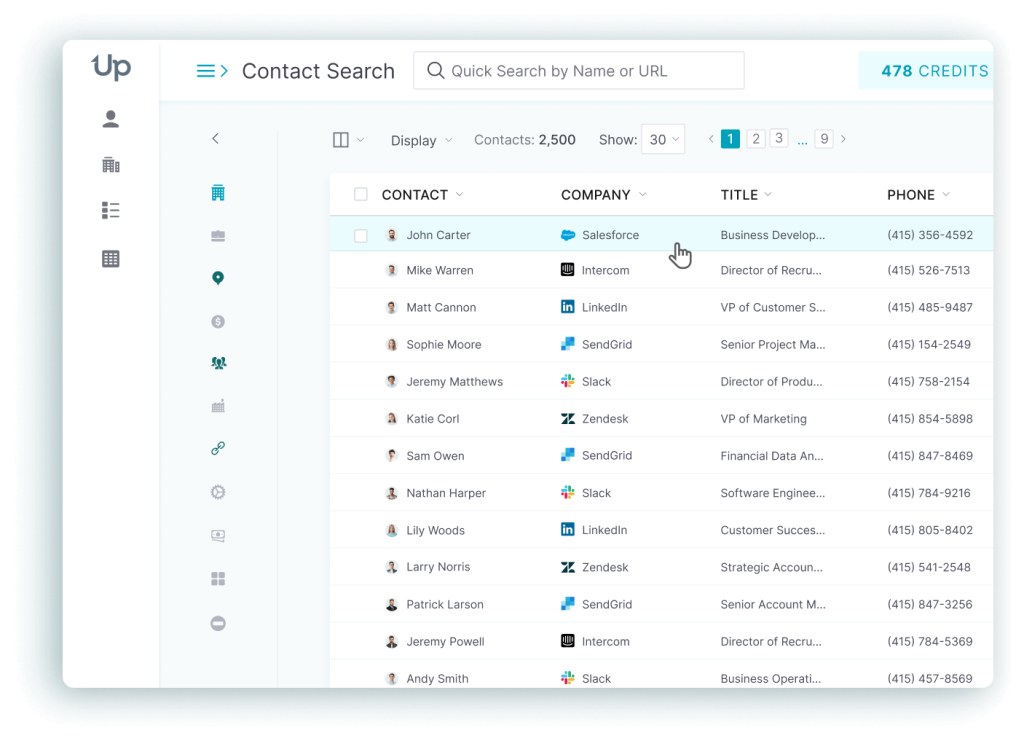
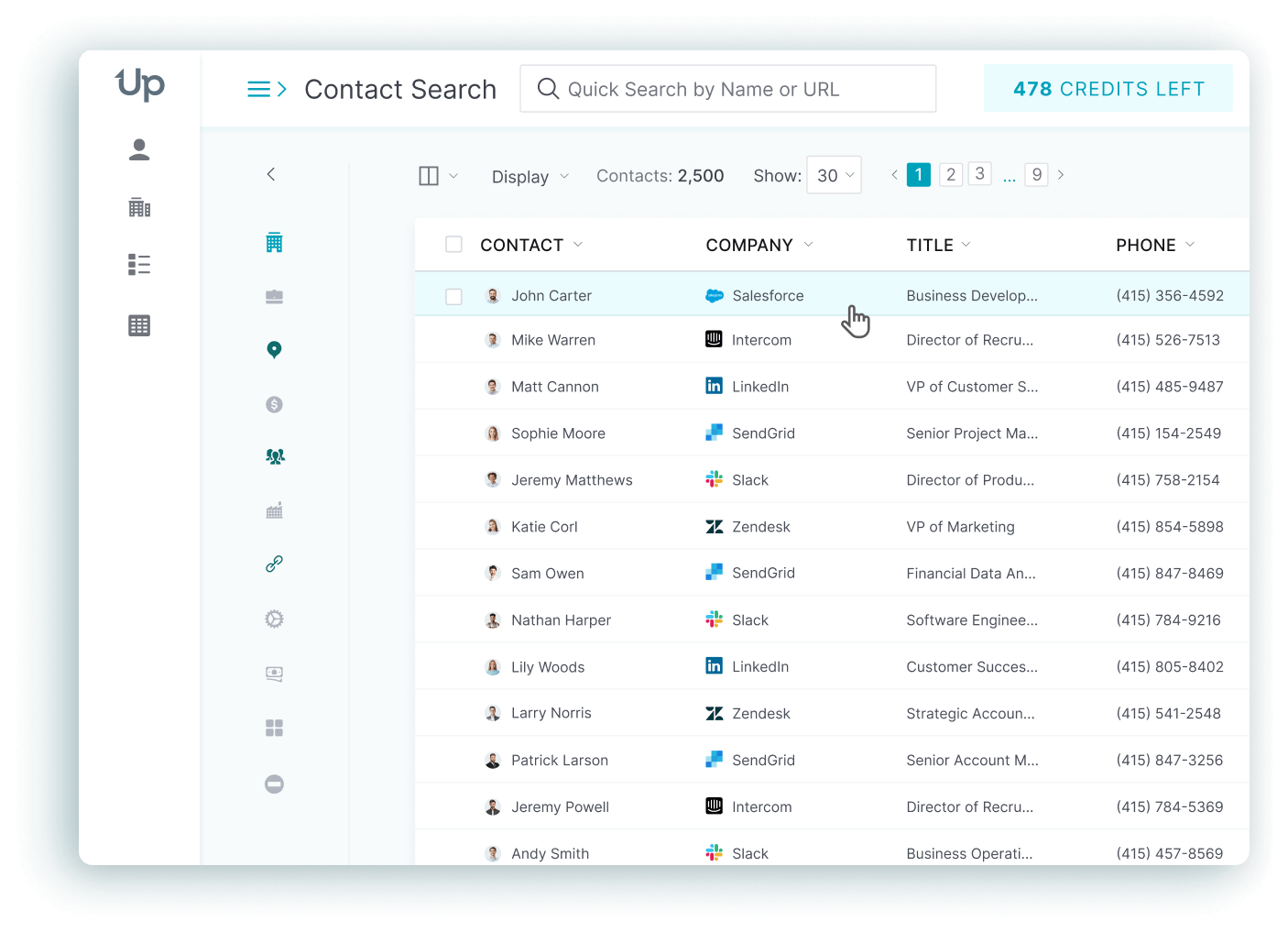
Search, filters, org charts. Users can filter prospect lists by firmographic data such as industry and revenue, plus headcount. A second filter layer covers technographic data, meaning the software a company already runs. From there, users can narrow by org-chart position to find decision-makers inside a specific department.
Chrome extension. The ZoomInfo Chrome extension pulls contact and company data onto any page you are viewing, such as LinkedIn profiles. One click pushes that data into a CRM or sales engagement tool.
Integrations. Native connections cover Salesforce, HubSpot, Outreach and Salesloft, plus Marketo and Microsoft Dynamics. Records sync in both directions, so a contact enriched in ZoomInfo flows into a sequencer’s cadence and the outcome lands back in the CRM once it converts.
Intent data and Copilot. ZoomInfo tracks buyer intent signals, meaning companies actively researching topics related to your product, and surfaces them inside GTM Workspace. Copilot analyzes account and contact signals to tell reps which accounts to prioritize, and drafts what to say when they reach out. It works as an AI layer over the raw data rather than a separate product to buy.
How Much Does ZoomInfo Cost?
ZoomInfo does not publish prices. Its pricing page says pricing depends on features, license count and credit usage. Every quote is custom. On that page, one credit is the export of one professional or company profile.
The pricing model is also changing. In its 10-Q for the quarter ended September 30, 2026, ZoomInfo states that beginning in the third quarter of 2026 it introduced a hybrid pricing model: an annual platform fee plus pre-purchased credits, with other flexible arrangements, in addition to its traditional seat-based packages. In practice, a quote today can combine a platform fee and a credit allotment, sometimes with seats on top, so two buyers with the same headcount can pay very different amounts.
Because ZoomInfo publishes no price list, the figures below are estimates from reported customer contracts and third-party pricing trackers, not ZoomInfo numbers. Smaller teams often report starting around $15,000 a year for a base package. Mid-size teams commonly report $25,000 to $30,000. Larger deployments with intent data, extra seats or additional modules are reported at $40,000 or more annually. Treat every one of these as directional.
| ZoomInfo | UpLead | |
|---|---|---|
| Published prices | No, custom quote | Yes |
| Entry price | Not published (third-party estimates start near $15,000 a year) | Essentials: $99 a month, or $74 a month billed yearly |
| What a credit buys | Export of one profile | One contact with verified email and, where available, mobile direct dial |
| Monthly credits at entry | Quote dependent | 170 (Essentials), 400 (Plus) |
| Free option | Free trial on request; a limited Lite tier has been described at 10 monthly credits | 7-day trial with 5 credits |
| Contract | Annual contracts typical | Monthly or yearly |
Source: ZoomInfo pricing and UpLead pricing. For a deeper look, see UpLead’s ZoomInfo pricing breakdown.
What tends to move the price:
- Number of seats, and how many people need direct database access versus enrichment-only access
- Whether you add intent data, typically priced as an add-on
- Multi-year commitments, which can lower the effective annual rate but lock in spend
- Renewal negotiations, where customers commonly report increases of 10 to 20 percent
How ZoomInfo Gets Your Data, and How to Opt Out
Many people first meet ZoomInfo after a sales email that mentions their job title, and ask how the company got their details. ZoomInfo’s privacy page points to its Personal Information Notice for sources, and the platform has historically built profiles from public web sources and business filings, plus data contributed by users of its tools. One contributor program is Community Edition, which shares contact data from users who install its email plugin. That program has drawn separate disputes, covered in the FAQ below.
If you want your profile removed:
- Open ZoomInfo’s removal request form and verify your identity.
- Submit the removal. Where it applies, ZoomInfo treats a removal request as an opt-out from sale or sharing of that profile.
- To see what ZoomInfo holds first, use the access request form.
Covered persons under New Jersey’s Daniel’s Law can email [email protected] for expedited processing. Removing a personal profile does not remove business or company information, and providers can re-collect public details later, so check back after a few months.
Pros of ZoomInfo
What Real Users Say
The clearest quantified result comes from a case study ZoomInfo published about Seismic, a sales enablement company that has used the platform for more than five years. In Seismic’s case study, based on user surveys, sellers credit ZoomInfo signals with identifying or influencing 39 percent of their active pipeline, report being 54 percent more productive and say they recover about 11.5 hours per week.
These are self-reported survey results published by the vendor, so read them as a best case. Elsewhere the picture is more mixed. Reddit’s r/sales community and Trustpilot reviewers describe a wider range of experiences. Some reps say the data improved their pipeline. Others found the sales process pushy and the ongoing cost hard to justify once the initial contract ended. ZoomInfo works well for teams that build a real workflow around its data and Copilot, and it does not pay for itself just by being installed.
ZoomInfo Review FAQ
Is ZoomInfo legit and trustworthy?
Yes, it is a legitimate, publicly traded company (Nasdaq: GTM) used by thousands of sales and marketing teams, but it has faced real privacy scrutiny. A court approved a $29.55 million class-action settlement. The suit claimed ZoomInfo used people’s names and professional details without consent to market its paid service, with statewide classes in California, Illinois, Indiana, plus Nevada (Top Class Actions). It was a private class action, not an FTC enforcement action, and not an admission of wrongdoing. You can ask for removal through ZoomInfo’s privacy request form, as described above.
What is the lawsuit against ZoomInfo?
The most significant recent legal matter is the privacy class action above, which concerned the use of personal data for marketing and settled for $29.55 million. Separate, smaller disputes have been filed over the Community Edition data-sourcing program, which collects contact data from users who install its email plugin.
Who is ZoomInfo’s biggest competitor?
The most frequently cited competitors are Apollo.io, Cognism, Lusha, RocketReach, LeadIQ, plus UpLead. Each targets a different part of the market. Apollo leans toward a broader sales engagement suite. UpLead focuses on real-time email verification at a lower, published price. See UpLead’s full breakdown of ZoomInfo’s competitors to compare them side by side.
Is ZoomInfo free?
Not in any meaningful way for regular prospecting. ZoomInfo’s pricing page offers a free trial rather than a free plan, and ZoomInfo’s own pricing guide has described a limited Lite tier of 10 monthly credits. That is enough to sample data quality but not to run an outbound program. Every paid plan requires a custom quote.
Final Verdict: Is ZoomInfo Worth It?
ZoomInfo is one of the largest and most detailed B2B data platforms on the market, and the Seismic case study shows what is possible once a team builds a workflow around its data and Copilot. Mid-size to enterprise sales organizations with budget for a five-figure annual contract, and a need for deep filtering across firmographic and technographic data, will likely find it a strong option.
It is a harder recommendation for a smaller team, for anyone who needs transparent self-serve pricing instead of a negotiated quote, or for a team that wants a lighter tool focused on verified email accuracy rather than the full go-to-market suite.
Consider UpLead instead if:
- You want published pricing instead of a custom quote: UpLead’s paid plans start at $99 a month with no annual commitment (UpLead pricing)
- You need real-time email verification on every contact you export, backed by UpLead’s 95% data accuracy guarantee
- Your team is small enough that a five-figure annual commitment does not make sense yet
- You would rather test a tool with a self-serve trial than sit through a sales cycle first
For a direct side-by-side, see UpLead’s ZoomInfo comparison, or browse the wider field of ZoomInfo competitors.