Will Cannon is the Founder & CEO of UpLead, the B2B sales intelligence platform rated #1 on G2 for Easiest to Use and Best ROI. Before UpLead, he led customer acquisition for Dropbox, Morgan Stanley, ADP, and dozens of Fortune 500 companies at BWG Marketing. He has sent over 100 million cold emails and built growth systems used by thousands of sales teams worldwide.
Table of Contents
Add a header to begin generating the table of contents
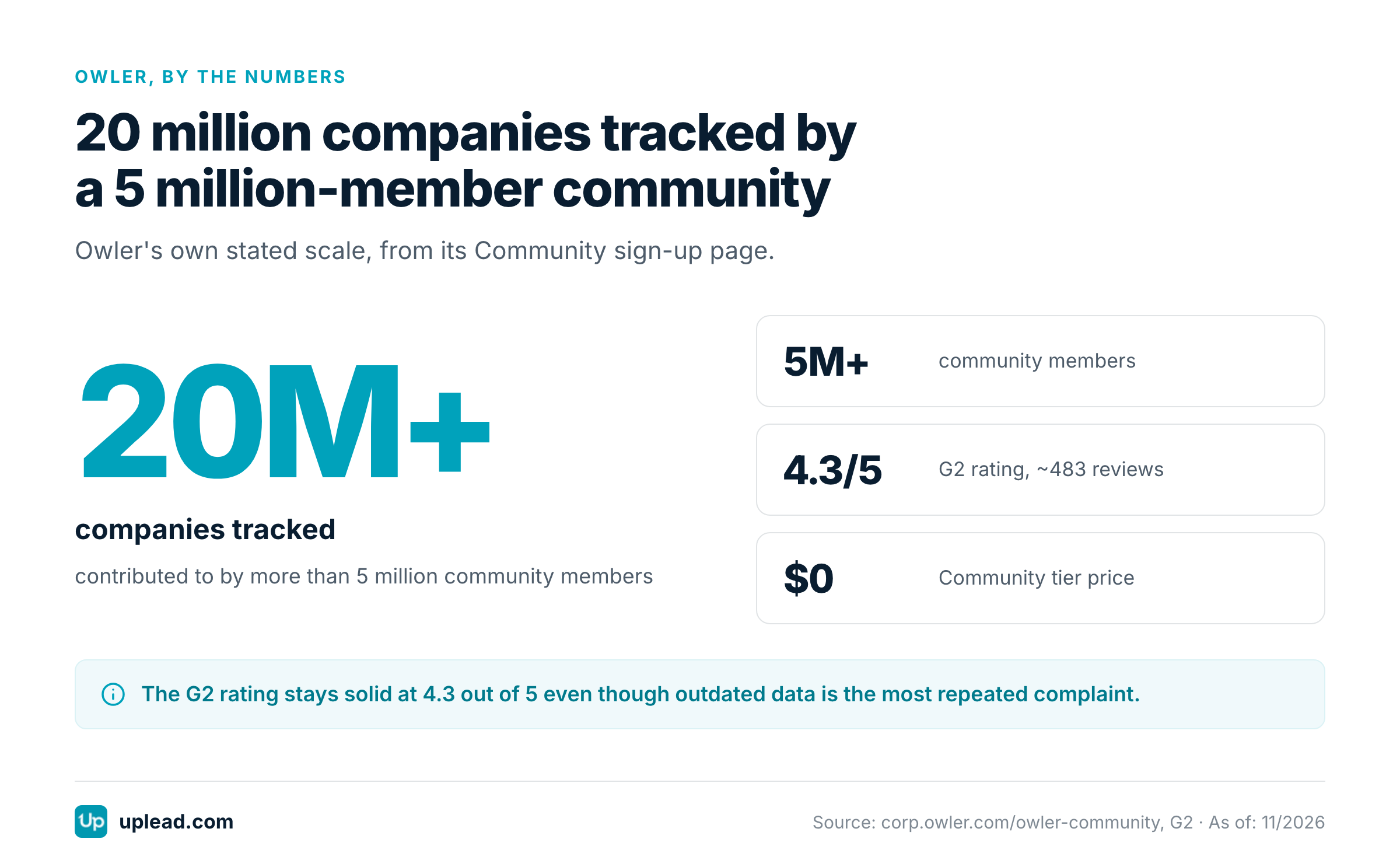
Owler tracks more than 20 million companies on a community of over 5 million business professionals who contribute news and competitor data. It is a company-intelligence and news-tracking tool first, not a contact database, so if your team’s real bottleneck is finding verified emails and direct-dial phone numbers, a different category of tool will serve you better. This guide covers eight real alternatives, UpLead, ZoomInfo, Crunchbase, Apollo.io, Lusha, RocketReach, LinkedIn Sales Navigator and HubSpot Breeze Intelligence (formerly Clearbit), plus the specific reasons teams start looking past Owler in the first place.
UpLead publishes this guide and is one of the eight tools compared below. Prices were checked directly against each vendor’s own pricing page in late October and early November 2026.
Owler earns its 4.3 rating on G2 honestly. Signing up is easy, the newsfeed is genuinely useful for watching named competitors, and the Community tier costs nothing. Four specific gaps still show up often enough in reviews, and inside the product itself, to name before you pick a replacement.
The data is crowdsourced, and crowdsourced data goes stale. Owler’s own marketing describes its community members as the source of “unique, fresh, and exclusive data.” That same model is why outdated or missing company details are the single most repeated complaint on G2, Capterra and Software Advice.
Owler was never built to hand you a verified email or phone number. Search Owler’s own site for anything resembling contact-reveal language and you will not find it. A team whose actual job is outbound prospecting is using a tool built for a different task.
Paid pricing is genuinely hard to pin down. Owler’s own pricing page redirects into a gated checkout flow rather than a public price list. Third-party trackers land on different numbers for the Pro tier, and nobody could confirm a published price for the team-level Max plan during this research.
It answers one question, not two. A real AI Overview capture for this exact search split the intent cleanly: are you tracking company news and competitors, or trying to reach a decision-maker directly? Owler only answers the first half.
None of this makes Owler a bad product. It makes Owler the wrong tool for roughly half the people who search for an alternative to it. For the other half, it is arguably the right tool already, and the fix is simply to add a contact-data tool alongside it.
Features to check for in an Owler alternative
Before committing budget to any of the eight tools below, run each one against this checklist.
Company intelligence versus contact data. Decide first which job you are hiring a tool to do. Crunchbase and LinkedIn Sales Navigator sit closer to Owler’s own job description. UpLead, Apollo, Lusha plus RocketReach sit on the other side of that line.
How contact data gets verified. Real-time verification at the moment of search behaves very differently from algorithmic pattern-matching against a static database. Ask the vendor directly.
The credit system’s actual mechanics. Phone reveals typically cost more credits than email reveals, and unused credits usually expire at the end of the billing cycle rather than rolling over.
CRM sync depth, not just the presence of an integration. A one-way push to your CRM is a different product than genuine bi-directional sync, and several vendors gate the deeper version behind a higher tier.
A stated accuracy figure, and what happens when it is wrong. UpLead publishes 95% with a credit-refund policy attached; several competitors publish a number without saying what recourse you get if it misses.
Free-tier or trial limits that match your evaluation needs. Five lookups tests formatting, not data quality across a real target list.
Regional coverage, especially outside North America. More than one vendor here shows weaker accuracy and coverage in EMEA and APAC than in the US, by its own reviewers’ account.
Seat minimums and annual-only tiers. Apollo’s top tier requires three seats minimum; UpLead’s Professional tier is annual-only, and both change the real first-year cost for a small team.
Whether pricing is published at all. ZoomInfo and Owler’s own paid tiers both require a sales conversation or a third-party estimate.
What the vendor’s own case studies actually measure. A named customer with a specific, dated result is worth more than a marketing adjective.
UpLead
Best for
Small and mid-market teams whose main job is finding verified emails and phone numbers fast
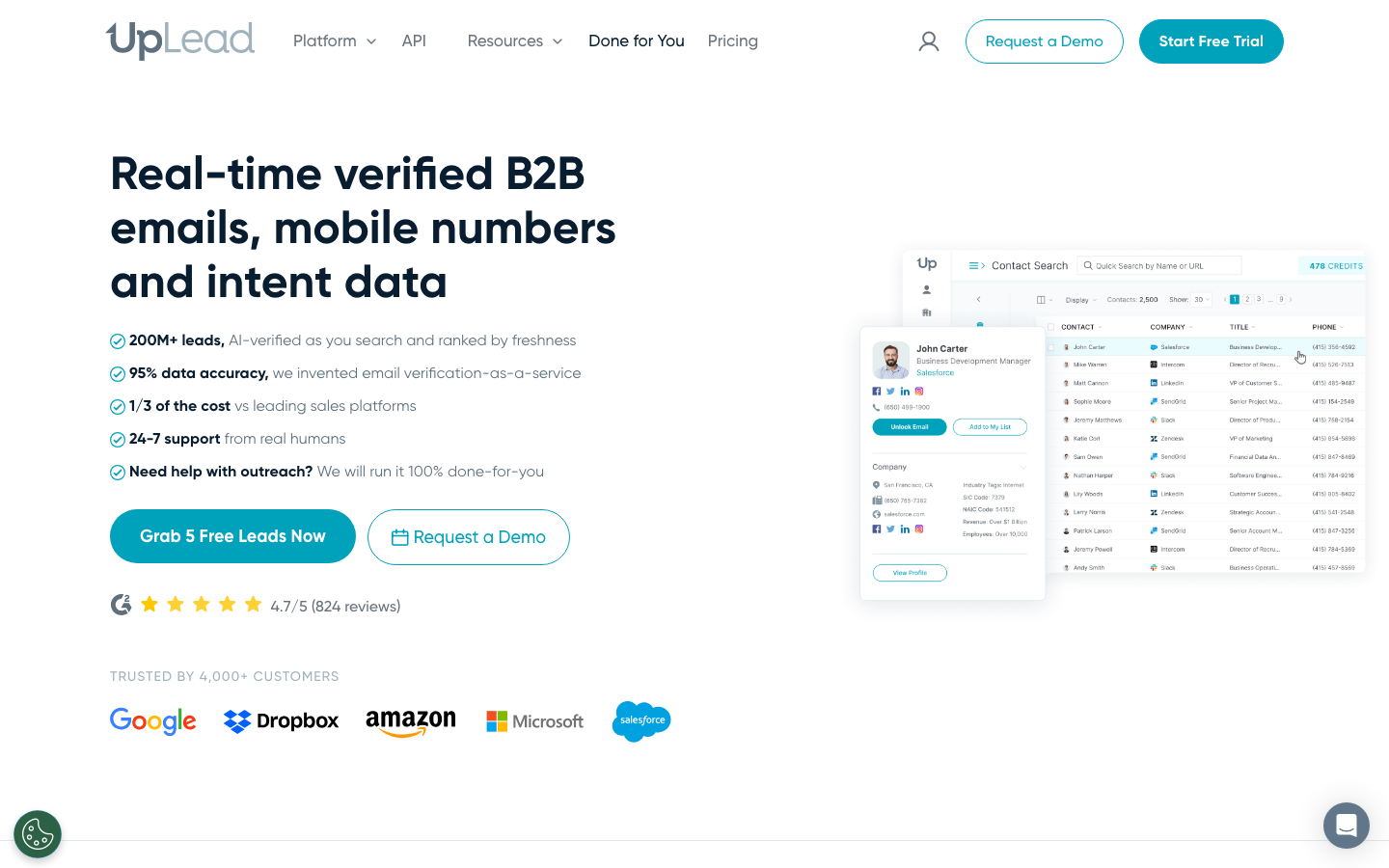
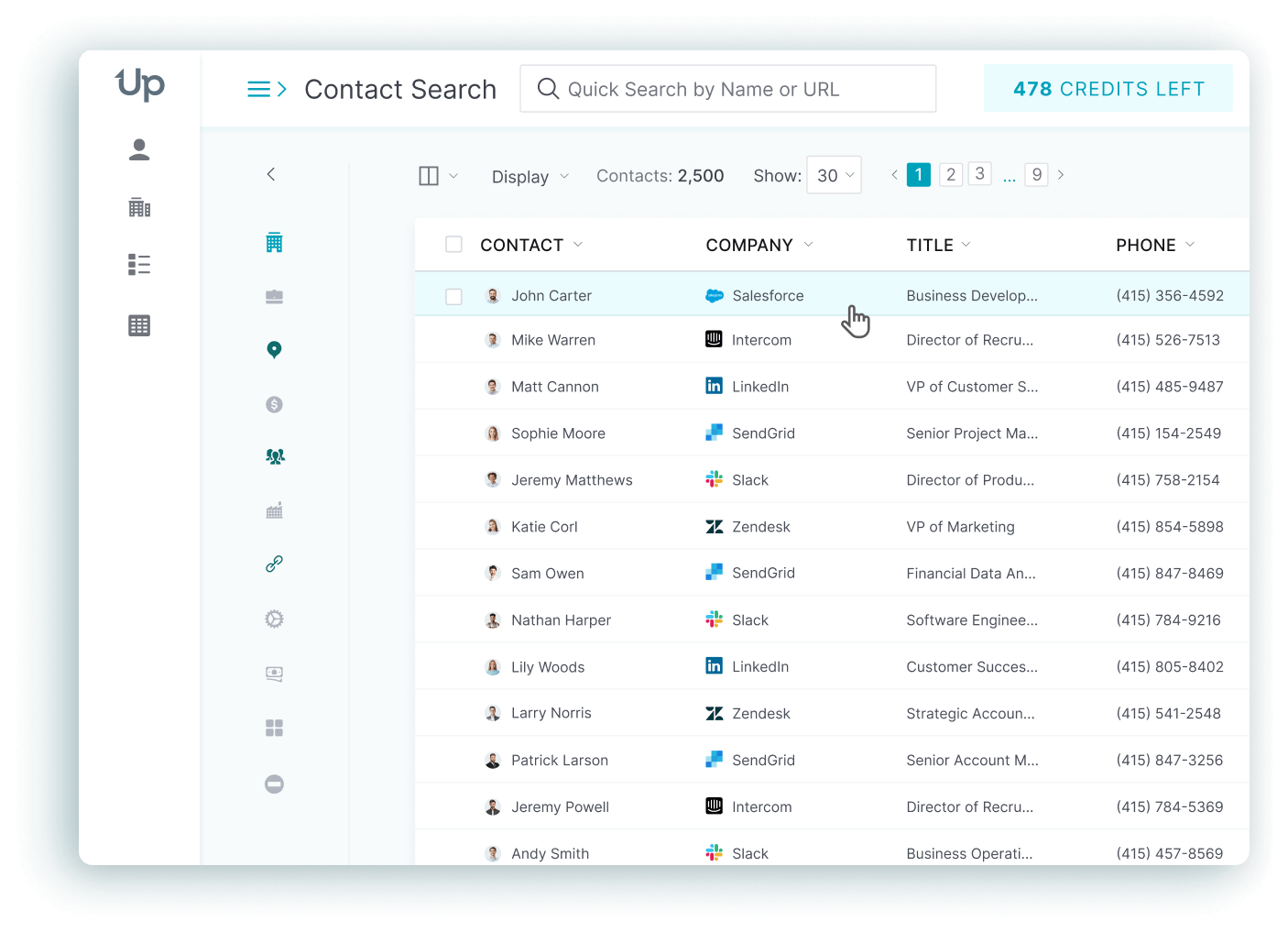
UpLead’s homepage, showing its live contact-search interface. (Source: UpLead)
UpLead’s database covers more than 200 million leads with 16,000-plus technologies tracked for technographic filtering, and every contact is verified in real time at the moment you search rather than pulled from a static cache. That real-time step is why UpLead backs every tier with a 95% data accuracy guarantee and a credit-refund policy when a contact turns out to be wrong.
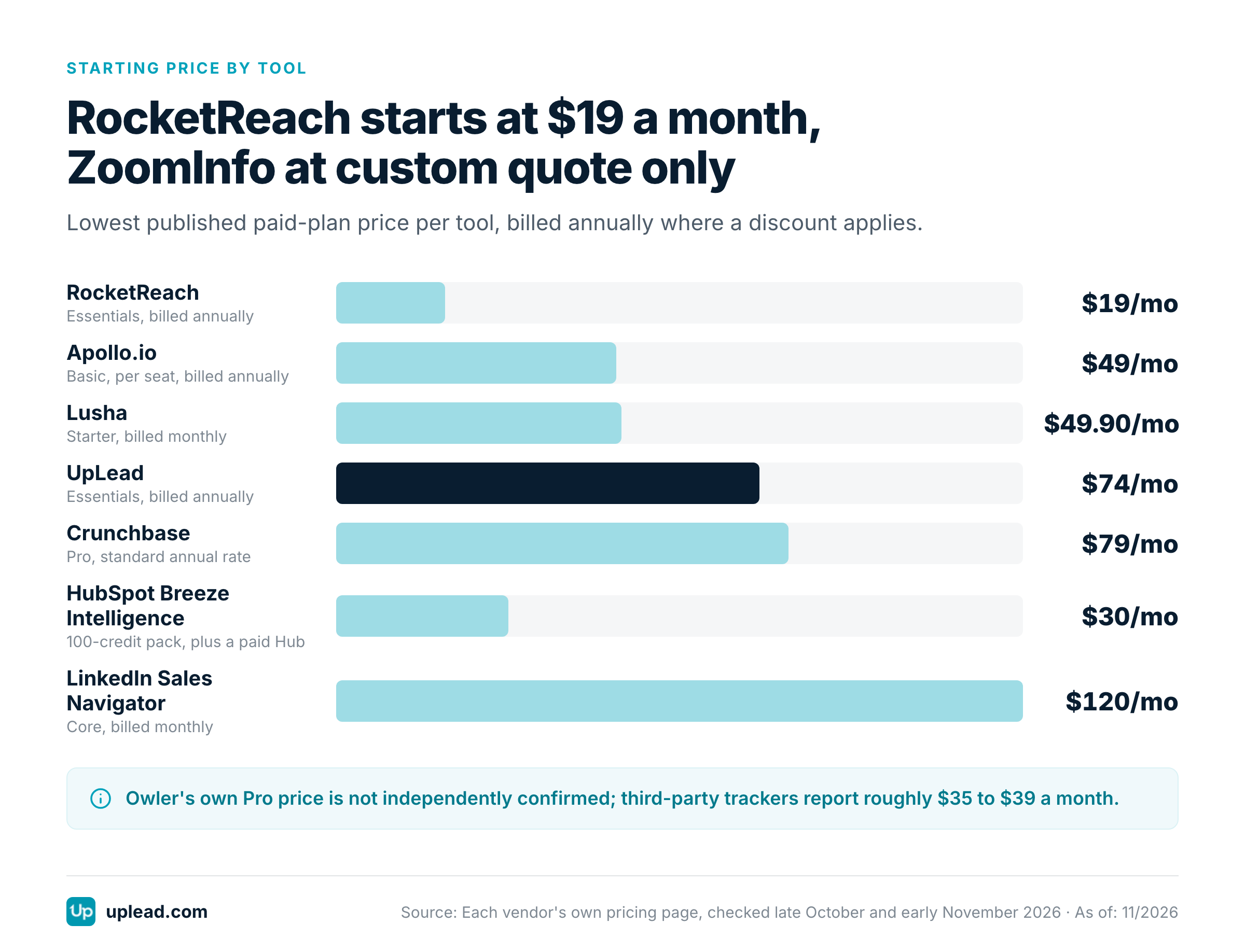
The tradeoff shows up in price. UpLead costs noticeably more per seat than RocketReach or Apollo’s entry tier, and the Professional plan is sold annual-only, so a small team testing the water has to commit for a full year to reach the top of the range.
Features that matter
✓Real-time email verification catches a dead address before you waste an outreach attempt on it, instead of after
✓95% accuracy guarantee with credit refunds gives real recourse, not just a marketing number
✓16,000-plus tracked technologies build a target list around a prospect’s exact tech stack, not just its industry code
✓Bi-directional CRM sync on the Professional tier keeps Salesforce records current both ways, where lower tiers only push one way
✓A Chrome extension with no feature gating ships verified emails and mobile numbers from the Free Trial tier up
Free Trial
Monthly$0
Yearlyn/a
7 days, 5 credits
Essentials
Monthly$99
Yearly$74 (billed annually)
170 credits/mo
Plus
Monthly$199
Yearly$149 (billed annually)
400 credits/mo
Professional
MonthlyCustom
YearlyAnnual only
Bi-directional CRM sync
Source: UpLead pricing. Extra credits cost $0.60 each on Essentials and $0.50 each on Plus.
✓ Pros
Data accuracy and accurate contact information are the most common praise, with ease of use close behind (G2)
UpLead’s contact-data accuracy score on G2’s own comparison pages runs around 8.4 to 8.5 out of 10, ahead of several named competitors (G2)
The real-time verification step means a bad number or dead email is the exception, not the rule, in reviewer feedback (G2)
✕ Cons
Missing contacts and outdated contacts are UpLead’s own most-cited complaints, even at a lower rate than most competitors here (G2)
Pricing clarity and filtering limitations show up as a smaller, recurring complaint (G2)
The Professional tier’s annual-only billing is real friction for a team that wants to test the top tier first
Customer proof
Kyber Security switched from ZoomInfo to UpLead, cut $14,000 a year from its data-tool spend, and built $400,000 in open pipeline off the switch (UpLead case study).
UpLead or Owler? Owler tells you a company raised funding; UpLead gives you the verified email of the person you would actually call about it. Keep both if company-news tracking and outbound prospecting are both part of your job.
ZoomInfo
Best for
Enterprise teams with the budget and negotiating room for a custom contract
Starting price
Custom quote only, no published self-serve price
Free plan
None published
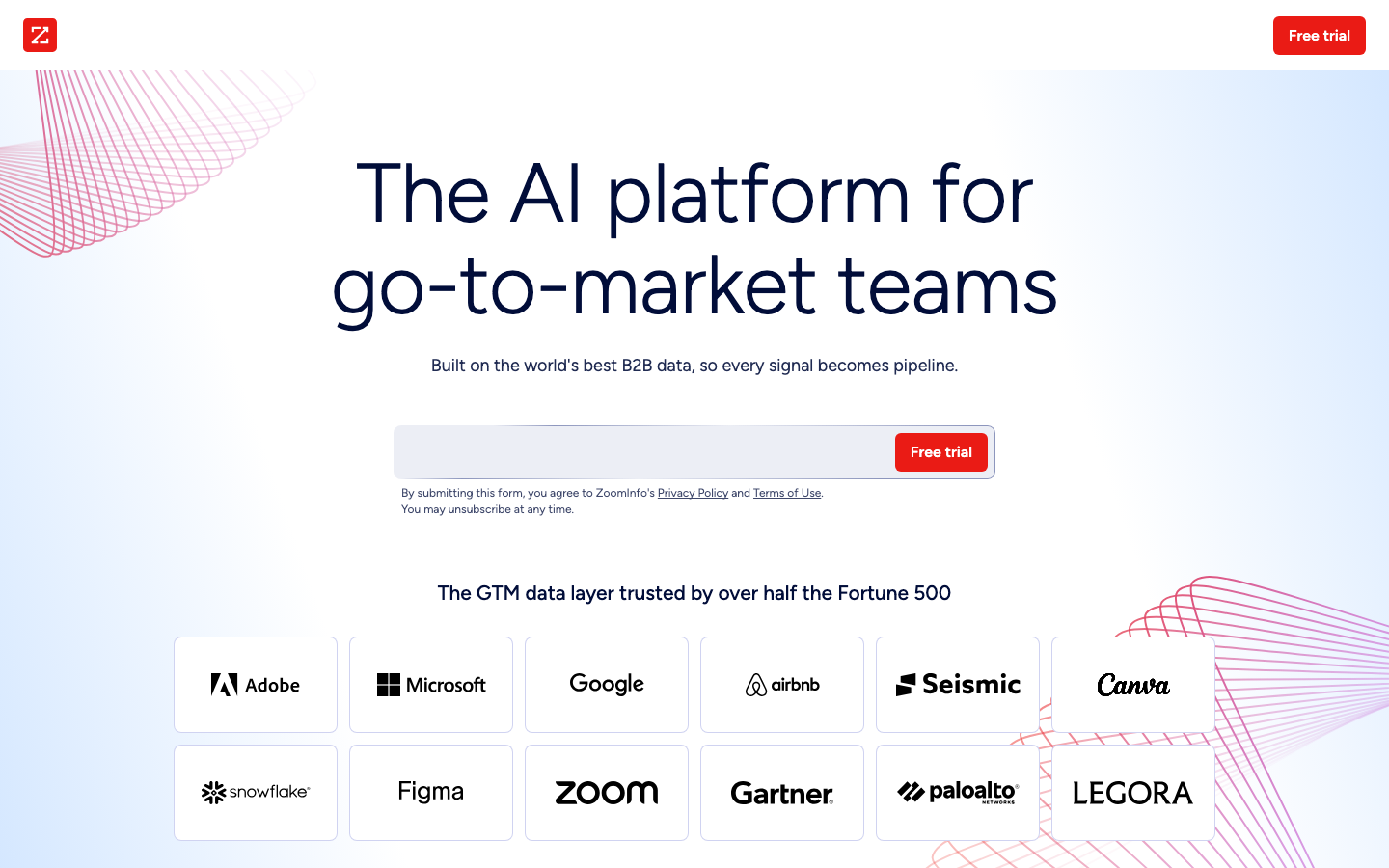
ZoomInfo’s homepage, promoting its AI platform. (Source: ZoomInfo)
ZoomInfo’s current database page states 203 million-plus company records and 410 million-plus contact profiles, searchable across more than 300 filters, though the company’s own marketing pages have shown different headline numbers at different times, so treat the exact figure as directional. ZoomInfo reported $1.25 billion in GAAP revenue for full-year 2025, and Vendr’s buyer-data marketplace puts the median real-world contract at $33,500 a year across 1,578 verified purchases, with buyers typically negotiating about 22% off the initial quote.
The tradeoff is transparency. There is no published self-serve price anywhere on zoominfo.com, and auto-renewal contract terms are a recurring complaint in both G2 discussions and Better Business Bureau filings.
Features that matter
✓300-plus searchable filters let large teams build highly specific target lists that smaller databases cannot replicate
✓Direct-dial phone accuracy is cited as a strength even by reviewers who complain about other parts of the product
✓Buyer-intent signals surface accounts actively researching a solution category, not just accounts that fit a firmographic profile
✓Technographic and org-chart data at enterprise scale support account-based marketing programs most smaller tools cannot run
✓A published Customer Impact Report citing an average 100% increase in win rates and 70% reduction in marketing spend gives buyers aggregate benchmarks, even though those are averages, not guarantees
Data depth and direct-dial phone accuracy are ZoomInfo’s most consistently praised strength (G2)
A 4.5 out of 5 rating across roughly 9,000 reviews is among the highest review volumes in this category (G2)
Buyer-intent and technographic layering give enterprise teams targeting options most competitors here cannot match
✕ Cons
Auto-renewal contract terms generate some of the most persistent complaints on G2 and in BBB filings (G2)
Price opacity means every buyer effectively negotiates blind with no published list price to anchor against
Data accuracy runs noticeably stronger in the US than in other regions, per reviewers (G2)
Customer proof
Snowflake built an account-propensity scoring model on ZoomInfo’s technographic and firmographic data; accounts with the highest propensity scores reached 25% higher engagement and twice the new-customer conversion rate of lower-scored accounts (ZoomInfo case study).
ZoomInfo or Owler? Owler’s free tier covers news on 20 million companies; ZoomInfo’s five-figure contracts cover verified contacts on a smaller, deeper set. The two barely compete on price and only partly compete on use case.
Crunchbase
Best for
Investors, analysts and business-development teams doing company and funding research
Starting price
$79/mo standard annual Pro rate
Free plan
Yes, permanent, capped at 5 results per search
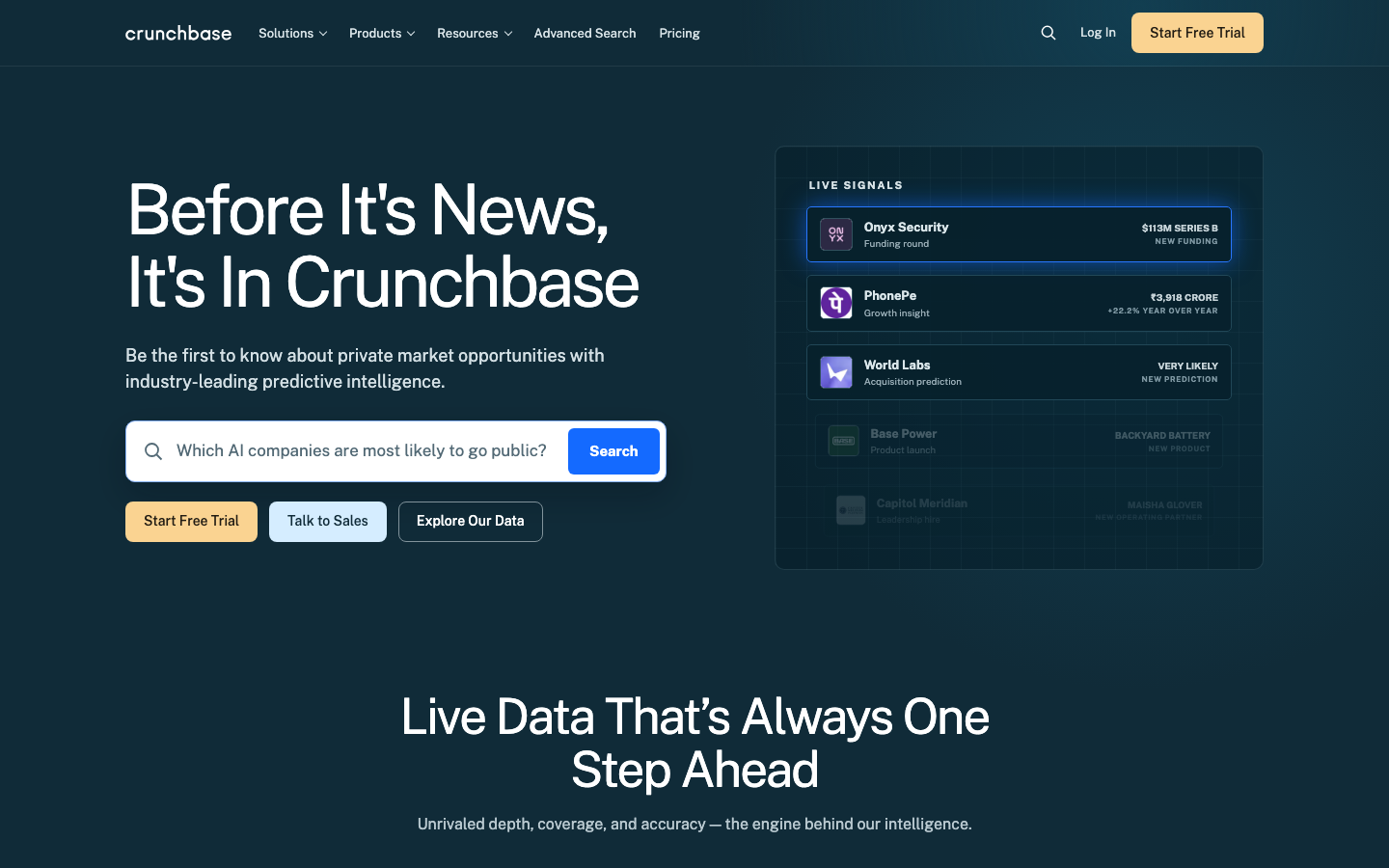
Crunchbase’s homepage, showing live funding and company signal cards. (Source: Crunchbase)
Crunchbase tracks roughly 4.7 million private companies and positions its 2026 product around 39 billion live private-market signals and more than 30 million verified updates a year, plus a new AI assistant called Crunchbase Scout and Model Context Protocol access for connecting its data to agents inside Claude or ChatGPT. The free tier is permanent, not a trial, though its 5-result search cap is useful for spot-checking one company and nearly useless for list-building.
Crunchbase’s 2026 plans moved away from the old per-contact-credit model entirely. Usage is now metered by search results per search and by export rows per month, with AI-agent calls tracked on top of that, so comparing its cost per contact against a credit-based tool like UpLead or Lusha is structurally inexact.
Features that matter
✓Crunchbase Scout answers natural-language questions about a company or market instead of forcing you through manual filters
✓39 billion live private-market signals give analysts and investors a scale of funding and market data smaller tools do not attempt
✓A permanent free tier lets a team evaluate the product indefinitely, not just during a trial window
✓Model Context Protocol access lets technical teams pull Crunchbase data directly into their own AI workflows
✓Salesforce and HubSpot sync on the Business tier moves company and funding signals straight into a CRM pipeline
Crunchbase holds a G2 Leader badge alongside its 4.4 out of 5 rating across 415 reviews (G2)
The permanent free tier is rated highly for letting smaller teams evaluate real data before any purchase (G2)
Predictive-intelligence features like Scout and funding-round prediction are called out as genuinely differentiated
✕ Cons
Crunchbase does not guarantee a verified, working phone number or email the way a credit-based reveal tool does (G2)
The free tier’s 5-result cap makes real list-building a paid-plan requirement almost immediately
The 2026 switch away from per-contact credits means older third-party cost comparisons are now out of date
Customer proof
RevTek Capital’s Crunchbase Business case study reports up to a 25% increase in closed-won revenue, up to 25% shorter deal cycles, a pipeline grown by millions of dollars, and up to 5 hours saved per rep every week (Crunchbase customer story).
Crunchbase or Owler? Both tools answer “what is this company doing.” Crunchbase answers it with deeper funding and market-signal data; Owler answers it with a free, simpler newsfeed built by its own user community.
Apollo.io
Best for
Small to mid-size teams that want prospecting, enrichment and sequencing in one subscription
Starting price
$49/seat/mo billed annually (Basic)
Free plan
Yes, 900 credits/year, Gmail-only sending
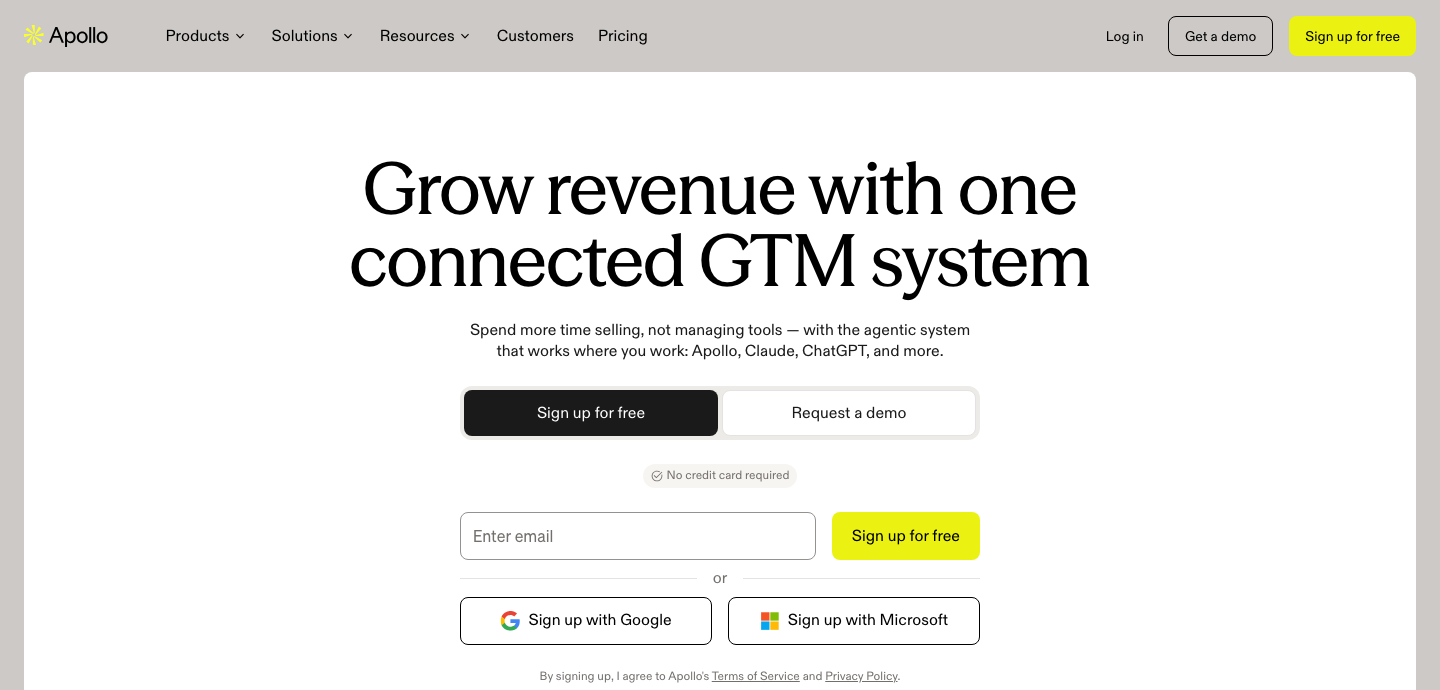
Apollo.io’s homepage, promoting its connected go-to-market system. (Source: Apollo.io)
On an annual billing cycle, Apollo’s Free plan grants 900 credits a year and restricts outbound sending to Gmail accounts. Basic runs $49 per seat per month for 30,000 credits a year, Professional runs $79 for 48,000 credits, and Organization runs $119 per seat per month with a minimum of three seats for 72,000 credits. People enrichment costs 1 credit for an email and demographic match, with 8 more credits added if a mobile number comes back with it.
The tradeoff is data consistency. G2’s own cons rollup flags inaccurate data in roughly 458 reviews and weak mobile-number accuracy outside the US in about 407 more, a noticeably higher complaint volume than smaller, more specialized tools in this list.
Features that matter
✓A genuinely usable free tier at 900 credits a year lets small teams prospect for real, not just test the interface
✓Built-in email sequencing removes the need for a separate outreach tool
✓CRM-sync endpoints that cost 0 credits mean syncing records to Salesforce or HubSpot never eats into your enrichment budget
✓AI-assisted call recording and insights on the Professional tier, 4,000 minutes included, add coaching data most competitors charge extra for
✓Record-selection limits up to 10,000 leads per export on lower tiers, removed entirely on higher ones
Ease of use and the lead-generation workflow are the most-cited strengths, with built-in automation close behind (G2)
The free tier itself earns praise for being usable, not just a crippled demo (G2)
A 4.7 out of 5 rating puts Apollo among the highest-rated tools in this comparison (G2)
✕ Cons
Inaccurate data is cited in roughly 458 reviews, one of the higher complaint counts here (G2)
Mobile-number accuracy outside the US, especially in EMEA, is a specific and repeated complaint (G2)
Support is Apollo’s lowest-rated G2 subcategory at around 4.2, with reviewers describing slow responses (G2)
Customer proof
Cyera’s own Apollo customer story reports cutting manual prospecting work by 50%, saving more than 4 hours a day, and booking 75% more meetings (Apollo customer story).
Apollo.io or Owler? Owler will tell you Cyera just closed a funding round; Apollo will hand you the email address of the VP of Sales you would reach out to about it, from the same screen you send the first message.
Lusha
Best for
SMB and recruitment teams focused on North America and the UK
Starting price
$49.90/mo billed monthly (Starter)
Free plan
Yes, 40 credits
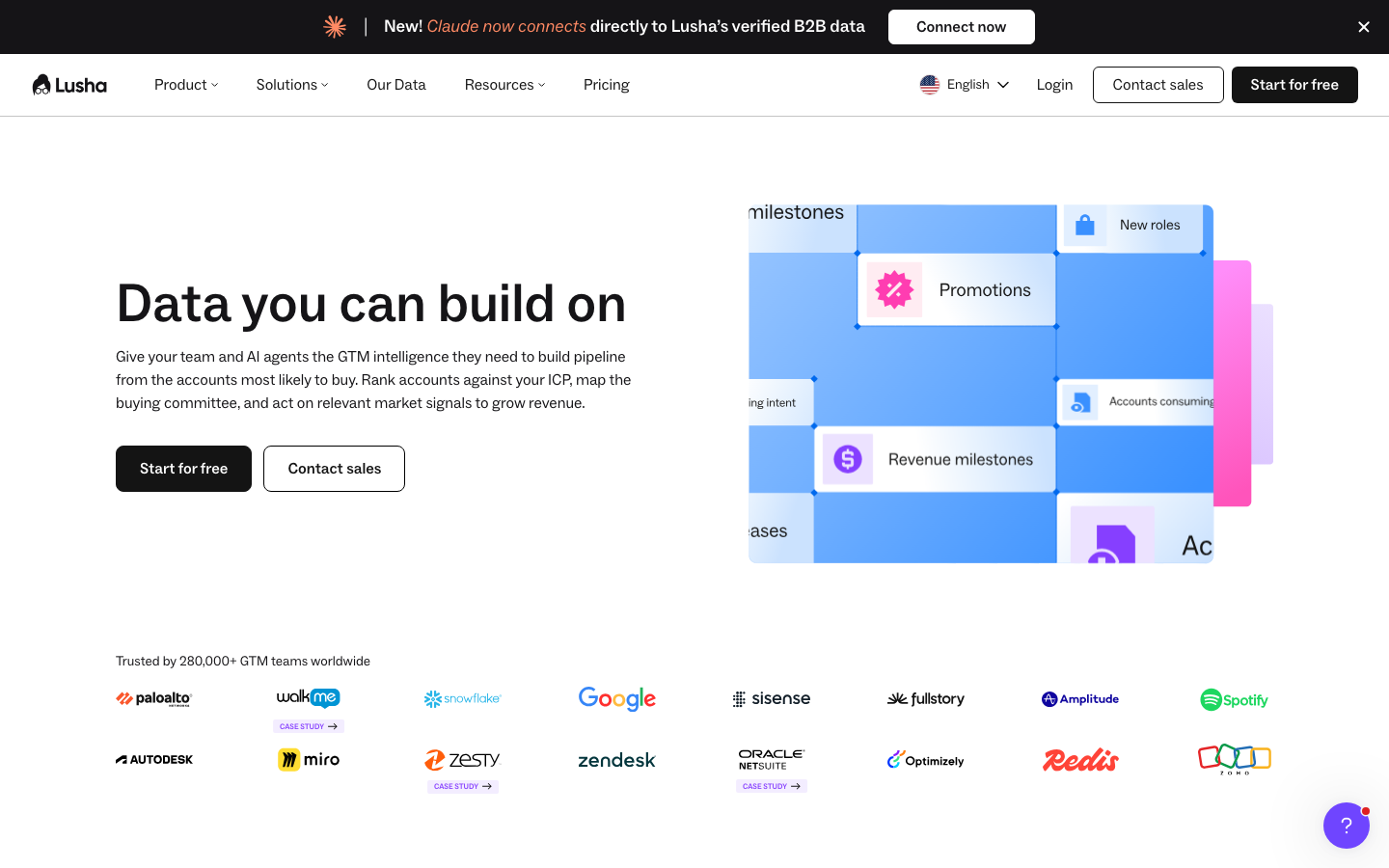
Lusha’s homepage, showing its GTM intelligence data product. (Source: Lusha)
Lusha’s database covers more than 515 million verified contacts and 29 million companies, including 132 million-plus US contacts, with the company stating 86% global phone accuracy and 85% US phone accuracy on its own data page. Phone reveals cost 10 credits each against 1 credit for an email, a steeper ratio than Apollo’s.
The tradeoff shows up in independent testing rather than in Lusha’s own numbers. A March 2026 Cleanlist test cited in third-party reviews found phone accuracy landing between 62% and 68% in its sample, well under Lusha’s own published 85%, and the same review cites a separate test that returned a working email for only 31% of lookups.
Features that matter
✓A 40-credit free tier tests real data quality against known contacts before paying anything
✓Simple, flat per-reveal pricing, 1 credit for email, 10 for phone, is easier to budget against than a tiered consumption model
✓North American contact depth is consistently the strongest part of Lusha’s coverage, by its own reviewers’ account
✓A browser extension built for fast, single-contact lookups suits reps who prospect one contact at a time
✓Four pricing tiers from $49.90 to $399.90 a month give a clearer upgrade path than vendors with only two or three tiers
Many reviewers specifically praise North American contact accuracy as a core strength (G2)
The flat, predictable credit cost per reveal is called easier to plan around than consumption models that change by action (Capterra)
A 4.3 out of 5 G2 rating across roughly 1,650 reviews reflects a broadly positive, high-volume review base (G2)
✕ Cons
Accuracy is described as inconsistent, especially for smaller companies or recently changed roles (G2)
Third-party testing has reported phone accuracy well below Lusha’s own published 85% figure, a disputed but repeated claim
Coverage outside North America and the UK is reported noticeably thinner, with more bounces and stale records (G2)
Customer proof
Recruitment firm Empiric attributes GBP 1.4 million of its 2024 revenue directly to Lusha and reports more than 90% data accuracy in its own usage (Lusha customer story).
Lusha or Owler? Owler’s crowdsourced model and Lusha’s accuracy dispute share the same root problem: data that nobody independently re-checks often enough. Lusha still gets you a phone number; Owler does not try to.
RocketReach
Best for
Teams doing high-volume, bulk contact search where database size matters most
Starting price
$19/mo billed annually (Essentials, email-only)
Free plan
Yes, 5 lookups, no card, no time limit
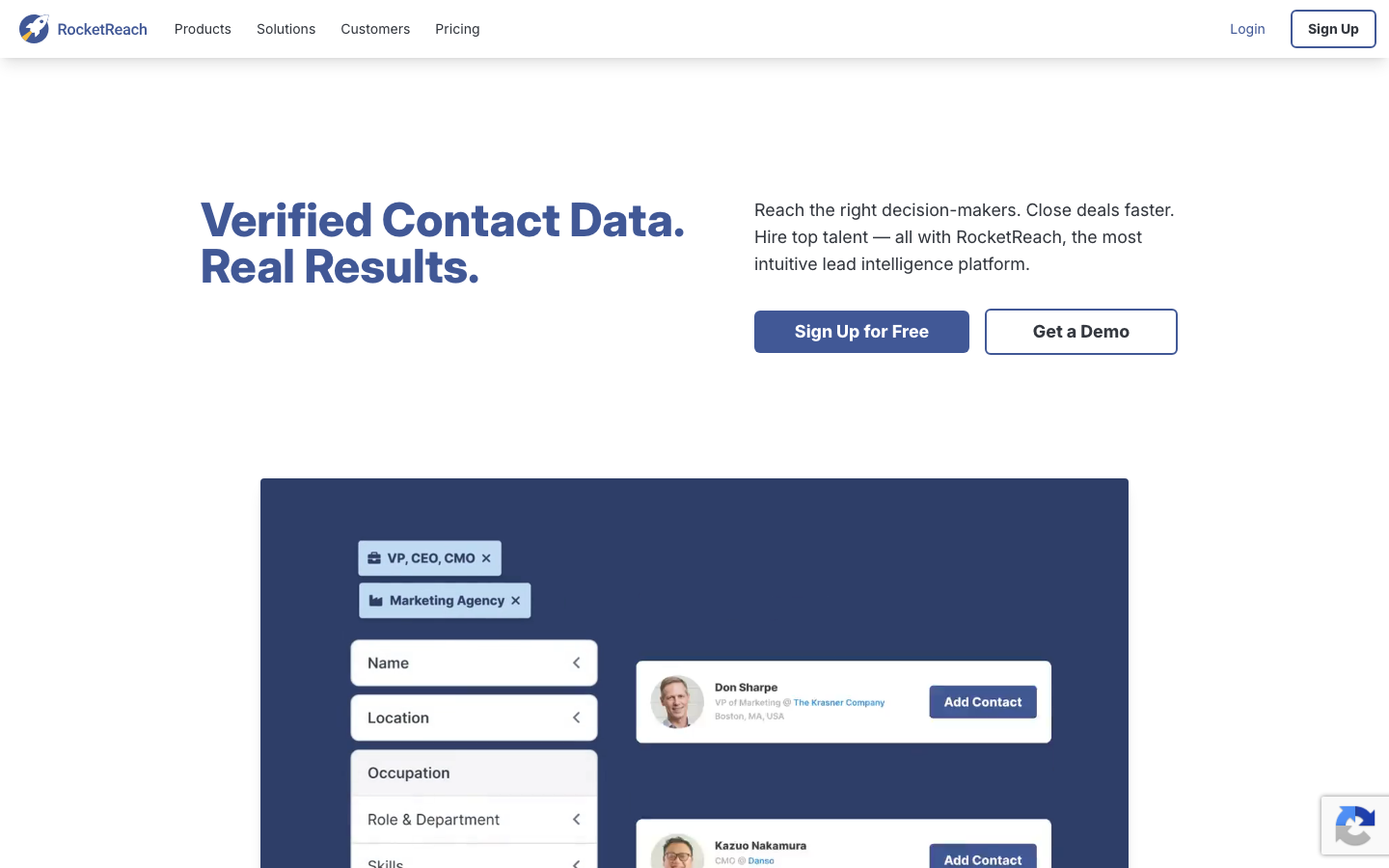
RocketReach’s homepage, showing its contact data search panel. (Source: RocketReach)
RocketReach’s database covers roughly 700 million professionals and 60 million companies, nearly three times the size of UpLead’s stated 200 million-plus leads, and the company claims 98% accuracy on its own pricing page using real-time, on-request verification across that larger pool. The free account is a standing tier, not a time-boxed trial.
The tradeoff is consistency. G2’s own con tags show inaccurate data cited in roughly 115 reviews and outdated contacts in another 110, among the higher complaint volumes in this comparison, even though accuracy also shows up as a pro in about 136 reviews, suggesting an inconsistent rather than uniformly bad experience.
Features that matter
✓A 700 million-professional database gives bulk-search teams more raw volume to filter from than any other tool here
✓A standing free tier, not a time-limited trial, lets evaluators return and retest whenever they want
✓Tiered phone-number access starting at the Pro plan separates casual email-only users from teams that need direct-dial numbers too
✓CRM integrations across Salesforce, HubSpot, Salesloft, Outreach and Bullhorn cover more sales stacks than most rivals bundle in
✓A Chrome extension under RocketReach’s integrations supports the same browser-based prospecting workflow as UpLead’s, gated to paid tiers rather than offered free
Accuracy is cited as a strength in roughly 136 G2 reviews, showing a genuinely split rather than uniformly negative experience (G2)
The sheer size of the database is repeatedly named as RocketReach’s clearest advantage over smaller, curated tools (G2)
A standing free tier with no time limit is praised for letting teams revisit the product without a new trial clock
✕ Cons
Inaccurate data is tagged in roughly 115 reviews and outdated contacts in about 110 more, among the higher counts here (G2)
Billing and auto-renewal disputes show up repeatedly in third-party complaint trackers
Email-only access on the entry tier means phone numbers require an upgrade before you can test that part of the product
Customer proof
The University of Notre Dame’s IDEA Center found 40% to 50% more contacts for customer-discovery research using RocketReach, supporting roughly 10,000 interviews over five years (RocketReach customer story).
RocketReach or Owler? Owler’s crowdsourced company data and RocketReach’s algorithm-matched contact data both trade some precision for scale. If scale is genuinely your priority on both fronts, the two tools pair reasonably well together.
LinkedIn Sales Navigator
Best for
Teams that already rely on LinkedIn for social selling and warm introductions
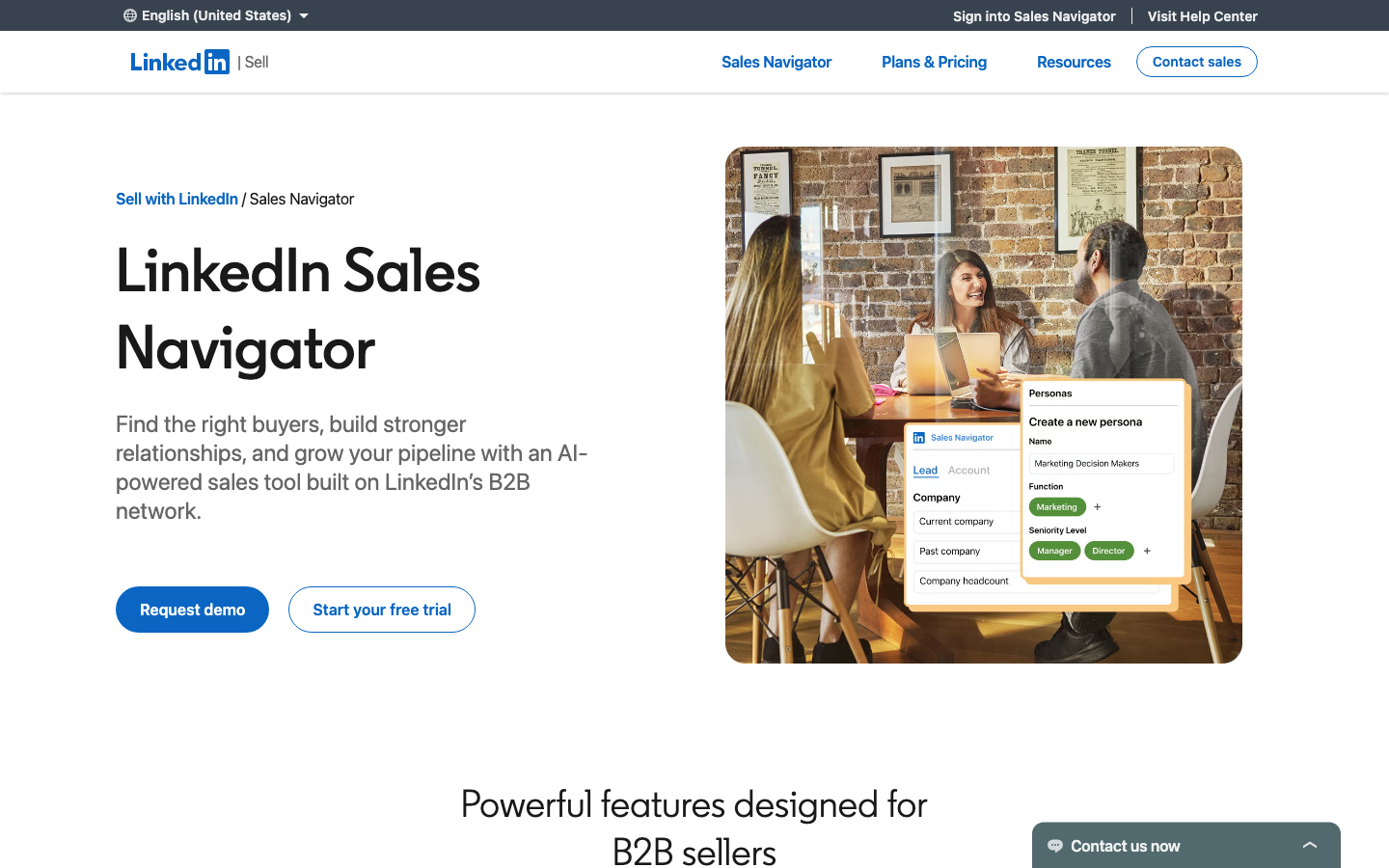
Core costs $119.99 a month or $1,079.88 billed annually, a 25% discount; Advanced costs $159.99 a month or $1,799.88 annually, a smaller 6% discount; Advanced Plus is sold only through a sales conversation. Both published tiers include 50 InMail credits a month plus more than 50 advanced search filters. Advanced Plus adds real-time CRM sync on top of that, with Salesforce, HubSpot, Dynamics and Oracle all supported.
The tradeoff is portability. Reviewers’ top complaint, tagged “Expensive” in dozens of G2 reviews, pairs with a second recurring gripe that lead lists stay inside LinkedIn’s own interface, with no native export to move them anywhere else.
Features that matter
✓TeamLink shows which of your own colleagues already has a connection to a prospect, turning cold outreach into a warm introduction request
✓50-plus advanced search filters target by seniority, function, company headcount growth and more inside LinkedIn’s own data
✓Buyer Intent signals flag when a target account is actively showing interest in your company’s content or profile
✓Real-time CRM sync on Advanced Plus keeps lead and account records current without a manual export step
✓Relationship Explorer and Map visualize an account’s internal structure using LinkedIn’s own connection graph
The underlying LinkedIn professional-network data itself is described as unmatched by essentially every reviewer who compares it (G2)
Relationship-mapping features like TeamLink are praised for turning cold outreach into warm introductions (G2)
A 4.4 out of 5 rating across roughly 2,200 reviews shows broad, sustained satisfaction at scale (G2)
✕ Cons
“Expensive” is the single most-tagged complaint, appearing in dozens of reviews across multiple G2 snapshots (G2)
Lead lists have no native export path and stay locked inside LinkedIn’s own interface (G2)
Some reviewers describe the interface as cluttered or inconsistent across its various sub-tools
Customer proof
Gainsight mapped its key buyer personas using Sales Navigator and won 42% more deals as a result (LinkedIn case study).
LinkedIn Sales Navigator or Owler? Owler maps what a company is doing publicly; Sales Navigator maps who inside that company you already have a path to reach. Together they cover more ground than either tool alone.
HubSpot Breeze Intelligence
Best for
Teams already paying for a HubSpot Hub who want enrichment without a new vendor
Starting price
$30/mo for 100 credits (add-on, requires a paid Hub)
Free plan
No standalone free tier
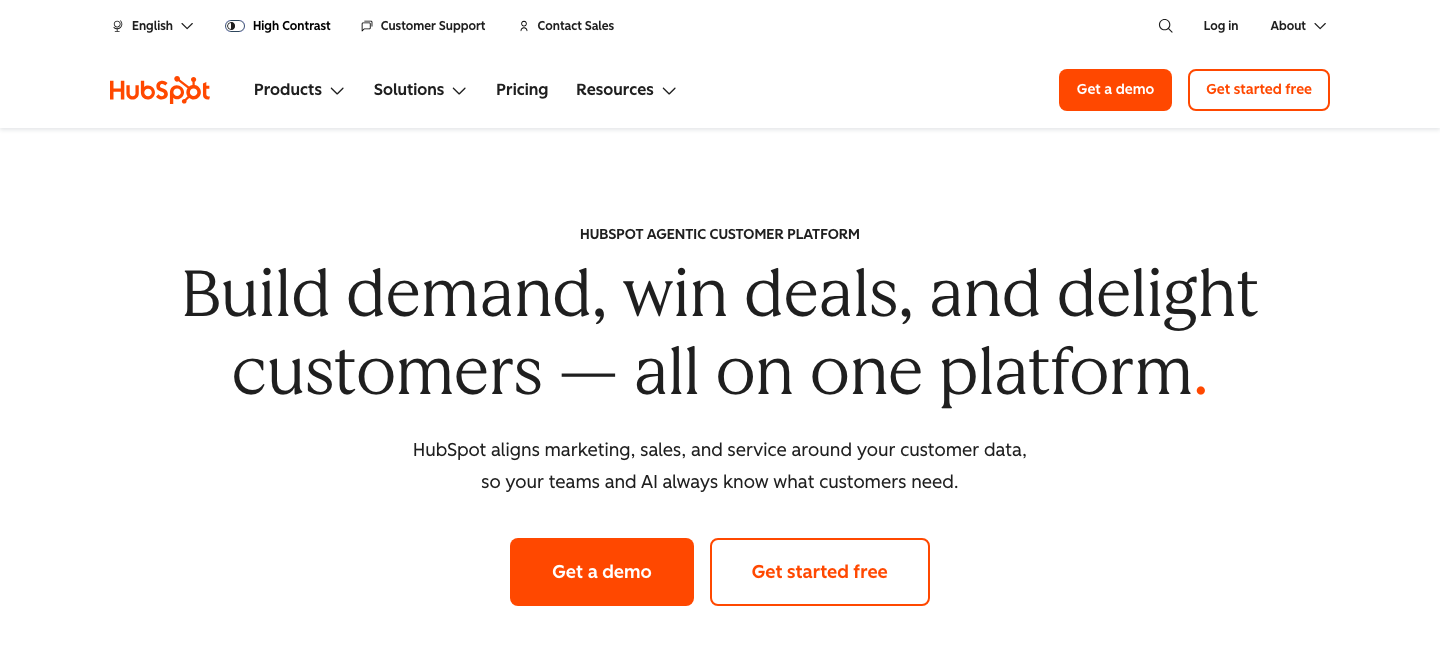
HubSpot’s homepage. Breeze Intelligence is now sold as a HubSpot add-on. (Source: HubSpot)
HubSpot acquired Clearbit for roughly $140.4 million in a deal that closed December 1, 2023, and has been retiring the old standalone product piece by piece since: free tools shut down April 30, 2025, and the Logo API followed on December 1, 2025. What remains is Breeze Intelligence, an add-on that requires a paid HubSpot Hub underneath it.
A HubSpot-hosted pricing guide dated September 2024 lists three credit packs, 100 credits for $30 a month, 1,000 for $150, and 10,000 for $700, plus a one-time $5,000 bulk-enrichment option for up to a million records. HubSpot’s own September 2026 knowledge-base article on credits and billing describes a newer, general credits system tied to Hub edition instead, and does not reconcile it against the 2024 guide anywhere the company publishes, a genuinely confusing state for a buyer to walk into.
Features that matter
✓Firmographic enrichment that fills CRM fields automatically removes manual data entry for company size, industry and revenue range
✓Form shortening uses enrichment to pre-fill known fields, cutting a signup form to the minimum needed to identify a new lead
✓Buyer Intent signals flag accounts showing active interest, similar in spirit to ZoomInfo’s intent layer but native to HubSpot
✓Native placement inside HubSpot’s own workflows means no separate login, export or sync step between enrichment and action
✓Bulk enrichment for up to a million records at a flat one-time cost suits a large data-cleanup project better than an ongoing subscription
Starter pack
Monthly$30
Credits100
Per HubSpot’s 2024 pricing guide
Growth pack
Monthly$150
Credits1,000
Per HubSpot’s 2024 pricing guide
Scale pack
Monthly$700
Credits10,000
Per HubSpot’s 2024 pricing guide
Bulk enrichment
Monthly$5,000 one-time
CreditsUp to 1M records
Separate from the credit packs
Source: HubSpot credits and billing. Confirm the active pricing model directly with HubSpot before budgeting; the 2024 guide and the newer general-credits system are not reconciled in HubSpot’s current documentation.
✓ Pros
Firmographic data quality (company size, industry, technology stack) is named as one of the stronger options in the market by direct comparisons (G2)
Ease of use scores well specifically because enrichment happens natively inside HubSpot’s own interface (G2)
A 4.4 out of 5 rating across roughly 630 reviews reflects consistent satisfaction at a smaller review volume than the market leaders (G2)
✕ Cons
Data accuracy complaints focus on contact-level and employment details rather than firmographic data, which fares better (G2)
Cost is repeatedly flagged as high for smaller teams, especially once a paid HubSpot Hub is factored in (G2)
The unreconciled 2024 and 2026 pricing systems leave buyers with no single authoritative number to budget against
Customer proof
Gong cut its demo-request form down to a single email field using the enrichment now sold as Breeze Intelligence, lifting form conversion by 70%, though this specific case study dates to 2019, before the HubSpot acquisition, and is the most recent named, quantified result available for this product (Clearbit customer story).
HubSpot Breeze Intelligence or Owler? Owler’s news alerts and Breeze’s enrichment solve adjacent but different problems. Breeze fills in facts about a company already in your CRM; Owler tells you something changed about a company you have not entered yet.
How to choose between Owler and these alternatives
Start with the split the research surfaced directly: are you tracking company news and competitors, or finding a person to contact? The decision grid below maps each situation to the tool built for it.
Which tool fits?
Tracking company news and competitors, want the closest match to Owler itself
Many teams land on keeping Owler for its free newsfeed and layering one contact-data tool on top of it, rather than replacing it outright. That combination costs less than most single enterprise contracts on this list and covers both halves of the AI Overview’s own question about what you are actually trying to do.
Find verified B2B contacts in minutes
Test the data on your own target accounts before you commit to a plan.
Crunchbase’s free tier is permanent and not a trial, though it caps every search at 5 results. Apollo.io’s free plan includes 900 credits a year with Gmail-only sending. RocketReach and Lusha both offer standing free tiers with a handful of lookups, enough to test data quality but not enough to run a real campaign.
What is the cheapest paid Owler alternative for contact data?
RocketReach’s Essentials tier starts at $19 a month billed annually, the lowest entry price in this comparison, though it is email-only; adding phone numbers requires the Pro tier starting at $52 a month.
Which tool has the most accurate contact data?
UpLead publishes a 95% accuracy guarantee backed by real-time verification and credit refunds. RocketReach claims 98% on its own pricing page. Independent third-party testing has found Lusha’s actual phone accuracy running below its own published 85% figure, so a stated number and an independently tested number are not always the same thing.
How is Crunchbase different from Owler if they both track company data?
Crunchbase goes deeper on funding and market signals through its Scout AI assistant, tracking roughly 4.7 million private companies with paid tiers for advanced research. Owler’s free Community tier covers more companies overall, 20 million-plus, but relies on crowdsourced updates rather than Crunchbase’s more structured data pipeline.
Does UpLead replace Owler?
Not entirely. UpLead is a contact-data tool, not a news-tracking or competitor-monitoring tool, so it will not replicate Owler’s newsfeed or community-sourced company alerts. Many teams run UpLead alongside Owler rather than instead of it.
Is LinkedIn Sales Navigator worth it if I already use Owler?
If your team does social selling or relies on warm introductions through existing connections, yes, since Sales Navigator’s relationship-mapping tools solve a problem Owler was never built to address. If your work is purely company research and news, the overlap with Owler is smaller and the $119.99 monthly price is harder to justify on that basis alone.
How much does Owler Pro actually cost?
Owler’s own pricing page redirects into a gated checkout flow rather than showing a public price list. Third-party trackers report figures between $35 and $39 a month for the individual Pro plan, billed annually, though sources disagree on the exact number. Owler Max, the team plan, is custom-quoted with no published price found during this research.
Strategic & Tactical Sales Advice: Straight to Your Inbox.
Join 20,000 sales leaders receiving practical & in-depth content. No fluff, just the best sales how-to guides.
I agree to receive emails from UpLead, and can unsubscribe at any time.