


Without a shadow of a doubt, it’s harder than ever to generate local leads. Larger, better-equipped multinational companies and the rise of e-commerce pose an enormous threat to local businesses. You need every tool at your disposal to fight back and succeed.
The good news? Local businesses can now leverage a greater range of lead generation techniques than ever before. You can connect with local customers, build authentic relationships and generate more leads.
In this guide, we’ll explore local lead generation and help you find the most viable tactics for your business.
What Is Local Lead Generation?
Local lead generation is the process by which businesses generate leads that are geographically close to them. Unlike normal lead generation that targets customers worldwide, local lead generation focuses on acquiring customers in a single area.
Local lead generation campaigns are highly targeted efforts designed to attract local customers, increase brand recognition, and appear in local search results.
Effective strategies for local lead generation focus on connecting with more customers in specific geographic areas, and these strategies are typically much more targeted than standard lead generation. Local lead generation strategies include local SEO, Google Business Profile optimization, physical marketing items, and community engagement. These tactics help businesses appear when potential customers search for services “near me” or in specific cities.
Local lead generation is often more cost-effective for small businesses and can significantly improve ROI by focusing marketing efforts on audiences with a higher likelihood of conversion.
Why Is Local Lead Generation Crucial for Small Businesses?
Local lead generation is crucial because it connects local business owners with customers who are ready to buy right now and helps grow their customer base within the community. When someone searches “plumber near me” or “best pizza in Austin,” they have high purchase intent.
According to a 2016 Google study, 76% of people who search for something nearby visit a business within 24 hours, and 28% of those searches result in a purchase. More recently, a 2024 study from SOCi found that 80% of U.S. consumers search for local businesses weekly.
Local lead generation also levels the playing field. You don’t need a massive advertising budget to compete with national brands. By focusing on your community, you can build trust, earn word-of-mouth referrals and establish yourself as the go-to provider in your area. Positive online reviews significantly influence customer trust and can boost your conversion rates, making it easier to turn leads into loyal customers.
For service-based businesses like plumbers, electricians, lawyers and restaurants, local lead generation is the difference between an empty calendar and a full pipeline.
Local lead generation can significantly improve ROI by reducing wasted advertising spend and increasing conversion rates.
Five Steps to Local Lead Strategy
How Do You Create a Local Lead Generation Strategy?
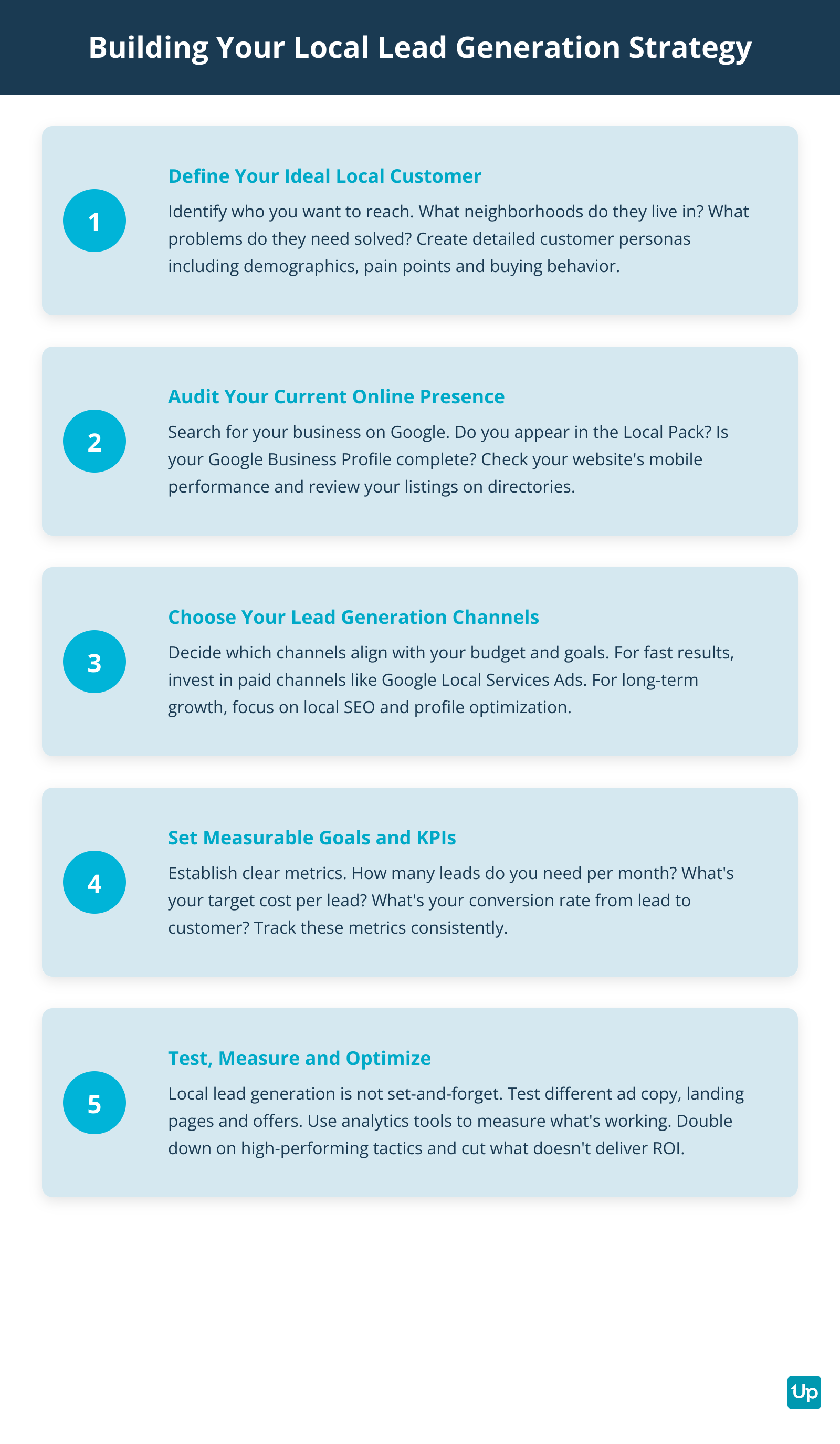
You create a local lead generation strategy through a methodical approach. Here are five steps to build a strategy that works:
1. Define your ideal local customer
Start by identifying who you want to reach. What neighborhoods do they live in? What problems do they need solved? What’s their budget? Create detailed customer personas that include demographics, pain points and buying behavior.
2. Audit your current online presence
Search for your business on Google. Do you appear in the Local Pack? Is your Google Business Profile complete? Check your website’s mobile performance and page speed. Review your listings on directories like Yelp and Bing Places.
3. Choose your lead generation channels
Decide which channels align with your budget and goals. Select effective strategies and marketing efforts based on their ability to generate qualified leads. If you need leads fast, invest in paid channels like Google Local Services Ads or Facebook Ads. If you’re building for the long term, focus on local SEO and Google Business Profile optimization.
4. Set measurable goals and KPIs
Establish clear metrics. How many leads do you need per month? What’s your target cost per lead? What’s your conversion rate from lead to customer? Track these metrics consistently. Make sure to track relevant information such as lead response rates, conversion rates, and web traffic from local searches to refine your approach.
5. Test, measure and optimize
Local lead generation is not set-and-forget. Test different ad copy, landing pages and offers. Tools like Google Analytics and GBP Insights are essential for tracking the effectiveness of local marketing efforts. Regularly review campaign performance metrics and use automated reports to help identify the most effective marketing efforts and provide insights on cost per conversion and conversion rates. Double down on high-performing tactics and cut what’s not delivering ROI.
What Are the Different Local Lead Generation Business Models?
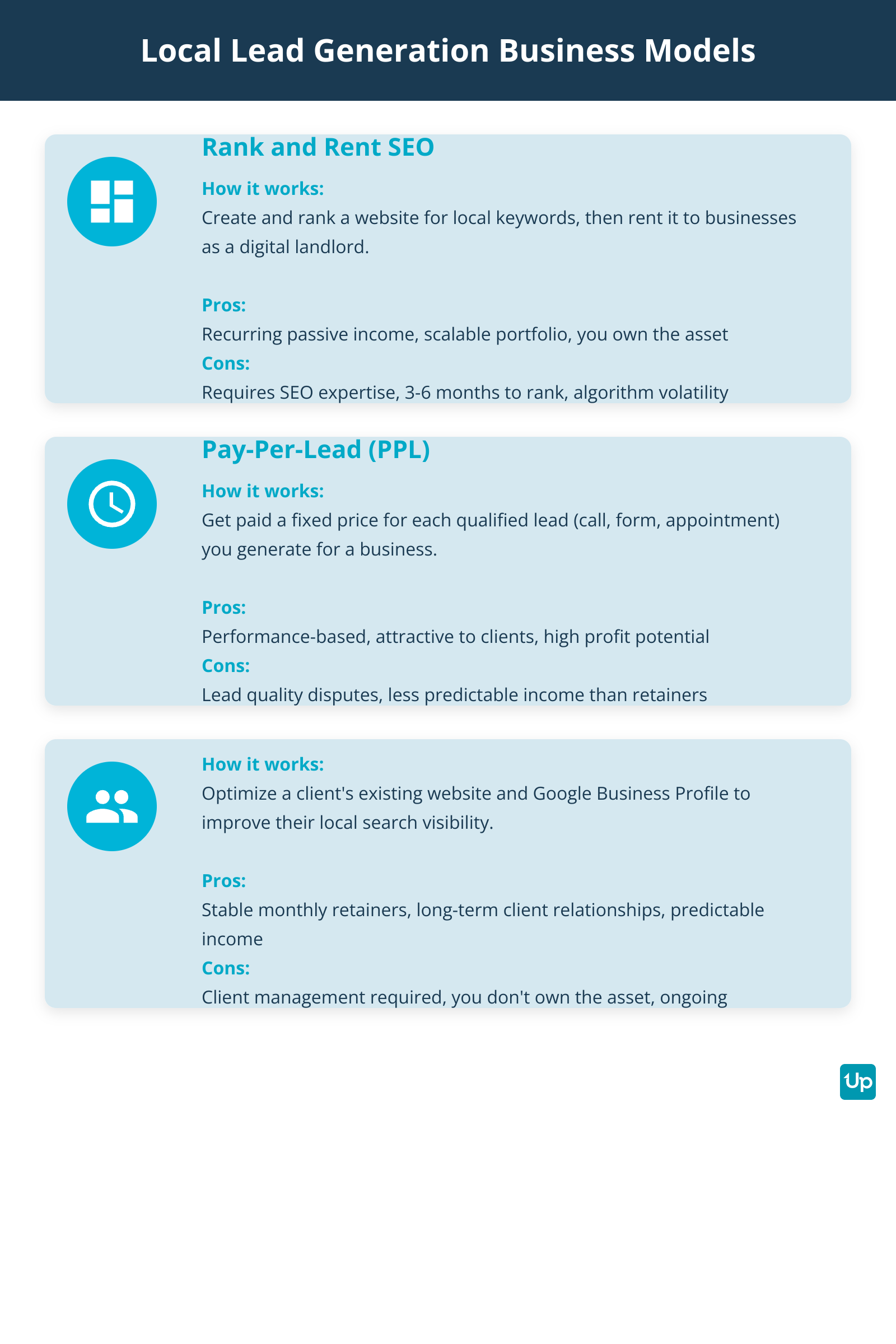
The different local lead generation business models are Rank and Rent SEO, Pay-Per-Lead, and Local Client SEO. These local lead gen business models are designed to help businesses acquire leads efficiently within a specific geographic area. There are three primary ways to monetize local lead generation skills:
Rank and Rent SEO
Rank and Rent SEO involves creating a website, ranking it on search engines for specific local service keywords (like “plumber in Dallas”) and then renting the website or selling the leads it generates to a local business. You act as a digital landlord.
You build and optimize a digital asset (website). Once it achieves high search rankings and generates traffic, you lease it to a local company for a flat monthly fee. This creates recurring, passive income and is scalable as you can build a portfolio of sites.
However, it requires significant SEO expertise and time to rank a new site. Rankings can be volatile due to Google algorithm updates. Ippei.com offers a comprehensive coaching program on this model, teaching skills in local SEO, website building, keyword research and client acquisition.
Pay-Per-Lead (PPL)
In this model, you are paid a fixed price for each qualified lead you generate for a business. A lead could be a form submission, a phone call or a scheduled appointment.
It’s a performance-based model attractive to clients because they only pay for results. It can be highly profitable if you can generate leads at a cost lower than the price you sell them for. Tracking ad spend is crucial in this model to ensure profitability and to measure the return on investment for each campaign.
However, lead quality can be a major point of contention and income can be less predictable than a flat retainer model. Increased local competition can also make it more challenging to acquire leads, as advertising costs may rise and consumers may scrutinize options more closely.
Local Client SEO
This is a traditional agency service model where a business hires you to optimize their existing online presence (website, Google Business Profile, etc.) to improve their local search visibility.
Optimizing the sales funnel is key in this model, as it helps guide potential customers from initial interest to conversion, using strategic landing pages and clear calls-to-action.
This provides stable, predictable income through monthly retainers and builds long-term relationships with clients. However, it requires client management and reporting and you don’t own the digital asset.
Focusing marketing efforts on local lead generation can significantly benefit ROI by reducing wasted spend and targeting the most relevant audience.
Three Local Lead Generation Business Models
What Are the Foundational Digital Strategies?
The foundational digital strategies are mastering your Google Business Profile, implementing hyperlocal SEO tactics, creating localized content and landing pages, managing online reviews and reputation, ensuring accurate listings in local directories and review sites to improve local search results, and leveraging local video SEO on YouTube.
When managing online reviews, focus on gathering good reviews, especially Google reviews, as they significantly influence customer trust and conversion rates. Enable customers to leave reviews by providing easy tools and reminders, and consider encouraging and rewarding customer reviews to enhance your online reputation and local lead generation.
For your Google Business Profile, remember that high-quality, geo-tagged photos and regular updates improve visibility in local search results.
Before you invest in paid ads or outreach, you need to build a strong digital foundation. These strategies are non-negotiable for any local business that wants to be found online.
1. Master Your Google Business Profile
Your Google Business Profile (formerly Google My Business) is the single most important tool for local lead generation. When someone searches “plumber near me” or “best pizza in Chicago,” Google displays a Local Pack of three businesses. Your GBP listing determines whether you appear in that pack.
A complete, optimized GBP listing builds trust with Google’s algorithm and with customers. Here’s how to master it:
Fill Out Every Single Section of Your Profile
Complete every available section in your Google Business Profile dashboard. This includes your business name (must be the exact legal name), address, phone number (NAP), website, hours (including special hours for holidays), a full 750-character business description, all services you offer with individual descriptions, all relevant attributes (like “Woman-owned” or “Online appointments”), and all relevant information such as accurate contact details, business ratings, and demographic data.
A 100% complete profile acts as a strong trust signal to Google’s algorithm. Providing all relevant information in your GBP profile helps customers find and trust your business. It shows that your business is active, legitimate and cares about providing thorough information to customers. As of November 2024, there were 4,098 categories available, with Google adding new ones frequently.
Choose Accurate and Niche Business Categories
Select one primary category that is the most specific and accurate description of your core business (like “Plumbing Contractor” instead of just “Contractor”). The primary category is the number one relevance lever and heavily influences how well the profile matches a search query.
Then, add several (up to 9, but only what’s relevant) additional categories to represent your other important services. Your primary category is one of the most significant ranking factors for local SEO.
Upload Geo-Tagged, High-Quality Photos and Videos Weekly
Upload high-quality, real photos of your business (exterior, interior, team, products, work-in-progress) on a regular basis. Before uploading, use a tool like GeoImgr to embed GPS coordinates that match your business address into the image’s EXIF data. Also, name the image files with relevant keywords before uploading.
Geotagging photos provides Google with definitive proof that your business is located where you claim it is. This reinforces your local relevance and sends a powerful trust signal. Google Maps now auto-plays videos as users scroll, making video content increasingly important.
Utilize Google Posts for Offers, Updates and Events
Use the Google Posts feature to publish short updates, offers, events or news directly to your Business Profile at least once a week. These posts can include photos or videos, a call-to-action (CTA) button and links to your website.
Regular posting is a strong activity signal to Google. It shows that your business is active and relevant, which directly helps improve your local search ranking. Post at least weekly using “Offer” or “Event” types for longer visibility.
Seed and Actively Answer the Q&A Section
Add your own frequently asked questions to the Q&A section and answer them yourself. This is called “seeding.” Also, set up alerts to monitor and answer any new questions submitted by users within 24 hours.
The Q&A section allows you to control the narrative and address potential customer concerns before they even have to ask. Upvote your official answers to ensure they appear prominently.
Enable Messaging and Respond Instantly
Activate the chat or messaging feature within your Google Business Profile dashboard. This allows customers to send you a direct message from your profile. A new WhatsApp integration feature allows businesses to add a WhatsApp contact button, providing a direct communication channel.
Enabling messaging provides a low-friction, convenient way for customers to contact you. By enabling messaging features, you enable customers to reach out quickly and conveniently, catering to those who prefer texting over calling.
2. Implement Hyperlocal SEO Tactics
Hyperlocal SEO is the process of optimizing your website to rank for location-specific search terms. This goes beyond basic local SEO and focuses on neighborhood-level targeting. A targeted approach is essential for hyperlocal SEO, as it allows you to optimize for specific locations and improve your presence in local search results.
Create unique service area pages for each city or neighborhood you serve. Each page should include local keywords (like “plumbing services in Austin”), local landmarks and testimonials from customers in that specific area. Avoid duplicating content across these pages, as this can harm search rankings.
Add structured data markup (Schema.org LocalBusiness schema) to your website. This helps Google understand your business location, hours and services.
Build local backlinks by getting featured in local media, sponsoring community events and partnering with other local businesses. These backlinks signal to Google that you’re a trusted part of the local community.
3. Create Localized Content and Landing Pages
Generic content doesn’t convert local leads. Creating content tailored to your local audience is a key part of content marketing and helps attract potential customers in your area. You need to create content that speaks directly to your local audience.
Write blog posts about local events, neighborhood guides or local industry news. For example, a roofing company could write “How Austin’s Hailstorms Affect Your Roof” or “Top 5 Neighborhoods in Dallas for Historic Homes.”
Create dedicated landing pages for each service you offer in each location you serve. These pages should include local keywords, customer testimonials from that area and clear calls-to-action.
Use local images and videos on your landing pages. Show your team working in the local area or feature recognizable local landmarks.
4. Actively Manage Online Reviews and Reputation
Online reviews are one of the most powerful trust signals for local businesses. Review sites like Google, Yelp, and Facebook are crucial for building trust and credibility. 91% of Millennials trust online reviews as much as personal recommendations.
Good reviews, especially Google reviews, can significantly influence customer trust and conversion rates. Ask happy customers to leave reviews on Google, Yelp and Facebook. Encouraging and rewarding customer reviews is essential for local lead generation, as it enhances your online reputation and helps attract more leads. Send a follow-up email or text message after a successful purchase with a direct link to your review page.
Respond to every review, both positive and negative. Thank customers for positive reviews and address concerns in negative reviews in a professional manner.
Use review management software like Podium or Birdeye to automate review requests and monitor reviews across multiple platforms.
5. Leverage Local Video SEO on YouTube
YouTube is the world’s second-largest search engine, yet most local businesses ignore it. Video content is a powerful way to build trust and demonstrate your expertise.
Create locally-relevant video content like customer testimonials from local clients, how-to videos demonstrating your services in a local context, behind-the-scenes tours of your business or videos highlighting community involvement.
Optimize your video metadata by including your primary local keyword at the beginning of the title (like “Boise Kitchen Remodeling: Project Showcase”). Write a detailed description with keywords in the first few lines. Add your full business Name, Address and Phone Number (NAP) and a link to your website.
Use a mix of broad and specific tags, including your service keywords, local keywords (city, nearby towns) and brand name. Include the city or service area in the video’s title, description and tags on a consistent basis.
Embed your optimized video on relevant pages of your business website and add your videos to your Google Business Profile listing.
What Are the Paid Lead Generation Strategies?
The paid lead generation strategies are Google Local Services Ads, geo-targeted Google Search Ads, hyper-targeted Facebook and Instagram Ads, and Nextdoor advertising. Running ad campaigns across various marketing channels—including other marketing channels like social media, Google Ads, and your website—can help you reach your target audience more effectively. Once your digital foundation is solid, paid advertising can accelerate your lead generation.
Tracking ad spend is crucial for measuring ROI and ensuring your campaigns are cost effective. Targeted campaigns in local lead generation are more cost-effective because they focus resources on a pre-filtered audience, maximizing your marketing budget and improving return on investment. These strategies deliver faster results than organic methods but require ongoing investment.
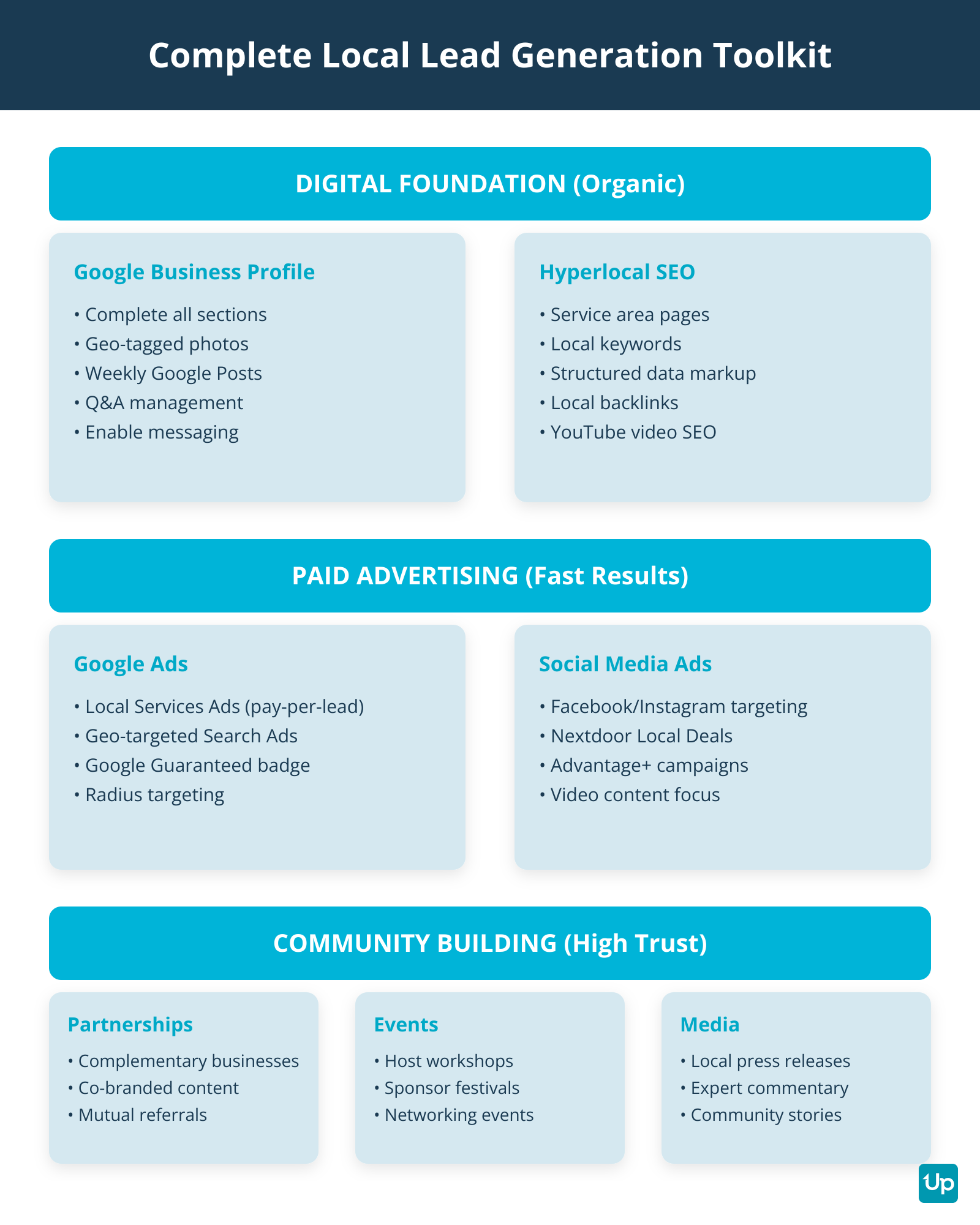
Digital vs Paid vs Community Strategies
6. Launch Google Local Services Ads
Google Local Services Ads (LSAs) are pay-per-lead ads that appear at the very top of Google search results, above traditional PPC ads and organic listings. They’re designed for local service businesses like plumbers, electricians and lawyers.
LSAs are a highly targeted way to run ad campaigns focused on specific locations, allowing businesses to reach potential customers in their immediate area. By leveraging geo-targeted advertising, such as LSAs, businesses can attract local leads effectively and ensure their ads are seen by people who are most likely to need their services.
The key advantage of LSAs is that you only pay when a potential customer initiates contact (a phone call or message) directly through the ad. You don’t pay for clicks that don’t convert.
LSAs feature a “Google Guaranteed” or “Google Screened” badge, which is earned after a vetting process (background, insurance and license checks). This badge builds significant trust with customers. Since November 2024, a verified Google Business Profile is required to run LSAs.
Here’s how LSAs compare to Google Search Ads:
| Feature | Local Services Ads (LSAs) | Google Search Ads |
|---|---|---|
| Payment Model | Pay-per-lead. Businesses pay only when a potential customer initiates contact (a phone call or message) directly through the ad | Pay-per-click (PPC). Businesses pay whenever a user clicks on their ad, regardless of whether it results in a lead or conversion |
| Best For | Local service-based businesses (plumbers, electricians, lawyers) aiming to generate high-intent, direct leads within a specific geographic area | A wide range of businesses (including e-commerce, national brands and local companies) focused on driving website traffic, building brand awareness and reaching a broader audience |
| Key Feature | Features a “Google Guaranteed” or “Google Screened” badge, which is earned after a vetting process and builds significant trust with customers. Ads are simpler, with less customization required | Offers extensive control and customization over ad campaigns, including keyword targeting, ad copy, landing page selection, audience segmentation and various ad formats |
| SERP Placement | Appear at the very top of Google search results, positioned above traditional PPC ads and organic listings | Appear below Local Services Ads but generally above the organic search results. Exact position is determined by an ad auction based on bid and Quality Score |
7. Run Geo-Targeted Google Search Ads
Google Search Ads are the traditional pay-per-click ads that appear in search results. Unlike LSAs, you pay for every click, not just leads.
The key to success with Google Search Ads for local businesses is precise geo-targeting. Set up location targeting to show ads only to users within a specific radius of your business (like 10 miles) or in specific cities or zip codes.
Use location-based keywords in your ad copy and landing pages. For example, instead of “Best Plumber,” use “Best Plumber in Austin, TX.”
Create dedicated landing pages for each location you target. These pages should include local keywords, local testimonials and a clear call-to-action.
8. Use Hyper-Targeted Facebook and Instagram Ads
Social media platforms like Facebook and Instagram are ideal for running ad campaigns to generate new leads. These platforms offer powerful targeting options for local businesses, allowing you to connect with a broader audience and amplify brand visibility. You can target users by location, demographics, interests and behaviors.
Meta offers specific objectives for local businesses including “Local Awareness or Reach” (optimized for Daily Unique Reach, showing ads up to once a day per person), “Store Traffic” (to increase foot traffic to physical locations) and “Leads and Conversions” for generating phone calls or messages.
You can target users by country, state, city, zip code or a specific radius (1 to 50 miles) around a physical address. Audience types include targeting “People Living In,” “People Recently In” or “People Traveling In” a location.
Meta’s AI-driven Advantage+ campaigns are a major focus for 2025. These campaigns automate audience targeting and creative delivery. You provide high-quality inputs (creatives, offers) and let the algorithm optimize for the best results.
Use special call-to-action buttons like “Get Directions,” “Call Now” and “Message,” which facilitate immediate local engagement.
For 2025, emphasize authentic, natural-looking video content (Reels) that shows the business owner’s face and work, rather than overly polished productions. Highlight local offers, discounts and events.
9. Advertise on Nextdoor to Reach Verified Neighbors
Nextdoor is a hyperlocal social network where verified residents connect with their neighbors. Acting as both a local directory and review site, Nextdoor helps businesses connect with local customers by enhancing local search visibility and building trust within the community.
Businesses can create a free profile and are allowed two free posts per month to their nearby neighborhood newsfeed.
In October 2024, Nextdoor introduced native video ads and lead generation ads. Lead Gen Ads include a native form directly within the platform, pre-filling up to five fields with verified user data (name, email, phone, address, zip code) and allowing up to eight total questions. This removes the need for an external website to capture leads.
Video posts on Nextdoor have shown high engagement, with an average 3-second view rate reportedly 13% higher than on the largest social networking site.
Local Deals pricing is fixed (not auction-based) depending on neighborhoods targeted and duration. The average cost is around $75, but can be as low as $3. Businesses can target a radius of up to 10 miles from their location.
The annual “Neighborhood Faves” awards can boost visibility, with winners seeing 38x more page views and 32% more clicks on their ads.
Over 20% of Nextdoor users are not on Facebook and a third are not on Instagram, offering access to a distinct local audience of verified homeowners (77% of users).
What Are the Community and Relationship-Building Strategies?
The community and relationship-building strategies are partnering with complementary local businesses, engaging in local online communities, hosting or sponsoring local events, and getting featured in local media and publications. Building relationships with other businesses and the local community is essential for long-term success in local lead generation. Actively working to build relationships—such as collaborating with other businesses, engaging on social media, and supporting local initiatives—can help foster a great relationship with the community, authorities, and local organizations. Engaging with the local community through events or partnerships can significantly enhance brand awareness and customer loyalty. Hosting local events or webinars can also establish your business as a go-to resource in the community. These strategies take time but deliver high-quality, high-trust leads.
10. Partner With Complementary Local Businesses
Strategic partnerships with complementary local businesses can create a steady stream of referrals. Partnering with other businesses not only helps build relationships but also expands your customer base by reaching new local audiences. For example, a real estate agent could partner with a mortgage broker, home inspector and moving company.
Identify businesses that serve the same target customer but offer different services. Reach out and propose a mutual referral agreement.
Co-host events or webinars together. This allows you to tap into each other’s audiences and build credibility.
Create co-branded content like guides or checklists. For example, a wedding photographer and florist could create a “Complete Wedding Planning Checklist.”
11. Engage in Local Online Communities
Local Facebook Groups and Reddit communities are goldmines for lead generation if you approach them correctly.
Facebook Groups
Join local Facebook Groups related to your industry or neighborhood. Social media platforms like Facebook are ideal for creating content tailored to your local audience, such as posts with local hashtags, tagged locations, and geo-targeted visuals. Consistently sharing valuable and relevant content helps build brand recognition within your community. Don’t spam these groups with promotional posts. Instead, provide genuine value by answering questions and offering expert advice.
When someone asks for a recommendation in your industry, respond in a helpful manner. Other members will often check your profile and reach out directly.
Reddit Organic Engagement
Focus on providing genuine value in relevant local subreddits (like r/Austin or r/ChicagoFood) by answering questions and offering expert advice without direct promotion. Reddiquette discourages blatant self-promotion.
Success comes from building a reputation as a helpful community member, with leads often coming through users viewing your profile or sending direct messages.
Reddit Ads (Paid)
Reddit Ads allow specific local targeting by country, state, city and zip code (US only). The most powerful feature is community (subreddit) targeting, where you can layer location targeting with local subreddit targeting (like showing ads to users in Austin, TX who are also members of r/Austin).
When targeting a subreddit, ads are shown to users who engage with that community anywhere on Reddit, not just within that specific subreddit.
Avoid direct promotion in organic posts, as this will likely result in downvotes and potential bans. Some local subreddits have designated “Small Business” days where promotion is allowed. Check individual subreddit rules.
12. Host, Sponsor or Attend Local Events
Local events offer a fantastic opportunity to expand your network and connect with potential customers face-to-face.
To maximize event reach, promote your events across multiple marketing channels and other marketing channels such as social media, Google ads, and your website. This ensures your event is visible to your target audience and increases overall outreach.
In the post-pandemic B2B landscape, the focus has shifted from lead volume to lead quality. A 2024 survey from Databox indicates that 41% of B2B marketers identify “improving lead quality and conversions” as their most persistent problem.
While events and webinars are still a top lead source for 37% of marketers, the fastest-growing event type is “small, hosted or owned in-person events,” with 58% of marketers planning to hold more of them.
Hybrid and virtual events are valued for their ability to generate rich engagement data which helps identify high-quality leads, with 76.8% of event marketers now prioritizing pipeline creation as their key KPI.
If hosting your own event is too expensive, sponsor a local charity event or community festival. This gets your brand in front of your target audience and shows that you care about the community.
Set specific objectives for each event. How many business cards do you want to collect? How many meetings do you want to schedule? Consider running giveaways at your booth or table to collect contact information, which can help generate local leads.
Follow up with every contact you make within 48 hours. Send a personalized email or LinkedIn message referencing your conversation.
13. Get Featured in Local Media and Publications
Getting featured in local media builds credibility, boosts brand recognition, and positions business owners as experts in their field. It also generates high-quality backlinks to your website.
Engage with the community by sponsoring or participating in community events, such as charity fundraisers, local festivals or school activities. This involvement demonstrates community commitment and often attracts local news coverage.
Craft newsworthy press releases for genuinely newsworthy events like a business anniversary, a new major partnership, a new product launch or winning a significant award. The press release should be well-written, follow AP style, have a compelling headline and state the who, what, where, when and why in the first paragraph.
Reach out to local reporters and offer to provide commentary on topics related to your industry. Building these relationships can make you the go-to source when they need an expert opinion, leading to consistent media mentions.
What Are the Direct Outreach Strategies?
The direct outreach strategies are strategic cold emailing, value-driven cold calling, and targeted direct mail campaigns. Using a targeted approach in your local lead generation efforts allows you to focus on specific geographic areas and relevant audiences, increasing the chances of connecting with qualified leads who are more likely to convert into customers. Leveraging useful tools, such as AI-powered business tools, can further streamline your outreach and make personalized communication more efficient and effective. Direct outreach can be effective when done in a strategic manner. These tactics work best when you’ve already built a strong digital foundation.
14. Strategic Cold Emailing
Cold emailing can be a powerful lead generation tool if you do it right. While the average cold email response rate hovers around 5-8%, permission-based email marketing has one of the highest returns of any digital channel, with a widely-cited 2024 average ROI of $36 for every $1 spent.
Email marketing also maintains strong engagement with an average open rate of 21.5% as of May 2025.
Here’s how to execute a successful cold email campaign:
1. Build a targeted list
Start by gathering relevant information such as accurate contact details, business ratings, and demographic data to build a high-quality list of qualified leads. Use a platform like UpLead to build a list of local prospects that match your ideal customer profile. Filter by location, industry, company size and job title.
2. Personalize every email
Generic emails get deleted. Reference something specific about the prospect’s business, like a recent news article or a mutual connection.
3. Lead with value
Don’t lead with a sales pitch. Offer something valuable, like a free audit, a helpful resource or a case study relevant to their business.
4. Keep it short
Your email should be no more than 150 words. Get to the point quickly.
5. Follow up persistently
Most people don’t respond to the first email. Send 3-5 follow-up emails spaced 3-7 days apart.
Use useful tools like Hunter.io or Mailshake to streamline your cold emailing process, making outreach and engagement more efficient while maintaining personalization.
15. Value-Driven Cold Calling
Cold calling can be intimidating, but it’s still an effective way to connect quickly on a personal level. Despite the belief that this is a frustrating contact method, 49% of buyers prefer a cold call first.
Taking a targeted approach to cold calling can help you reach more qualified leads in your local area. By focusing your efforts on specific geographic regions and relevant audiences, you can improve your marketing efficiency and foster more meaningful connections. It’s also an effective tactic for businesses looking to generate local leads. You’ll have plenty to talk about and buyers are often more enthusiastic about supporting a fellow local business.
Here’s how to succeed with cold calling:
1. Research your prospect
Before you pick up the phone, research the business. Understand their challenges and how your service can help.
2. Develop a clear value proposition
Within the first 30 seconds, you need to communicate what you do and why it matters to them. For example, “I help local plumbers in Austin get 10+ new customers per month through Google Local Services Ads.”
3. Ask qualifying questions
Don’t pitch right away. Ask questions to understand their current situation and challenges.
4. Handle objections gracefully
Expect objections like “We’re not interested” or “Send me an email.” Have prepared responses that acknowledge their concern and pivot to a question.
5. Aim for a meeting, not a sale
The goal of a cold call is to schedule a meeting, not to close a deal. Keep the ask small and easy to say yes to.
Use call tracking software like CallRail or WhatConverts to measure which calls convert into leads and customers. Here are some cold calling tips to help you get started.
16. Targeted Direct Mail Campaigns
Direct mail might seem old-fashioned, but it still works. According to the B2B Marketing Mix Report from HubSpot, direct mail is still among the most popular marketing tactics, with print advertisements making up 35% of it.
Direct mail campaigns can be highly targeted to specific locations, such as neighborhoods, zip codes, or even a location radius around your business. This makes them a cost effective way to reach local prospects who are most likely to convert.
One local delivery service saw a 500% ROI by sending targeted postcards to re-engage past customers. The company used a large-format postcard with a bold creative and a clear CTA to capture the attention of recipients.
To succeed with direct mail, create a targeted mailing list using a platform like UpLead. Filter by location, industry and company size.
Design eye-catching collateral that stands out in the mailbox. Use bright colors, bold headlines and a clear call-to-action.
Include a trackable offer, like a QR code or unique URL, so you can measure the ROI of your campaign.
Follow up with a phone call or email. Direct mail works best as part of a multi-touch campaign.
How Do You Build a High-Converting Local Lead Generation Website?
You build a high-converting local lead generation website by including prominent calls-to-action, strong trust signals, mobile-first design and fast page speed, and location-specific service area pages. Providing relevant information—such as accurate contact details, business ratings, and demographic data—on your site not only builds trust but also helps improve conversion rates, ultimately growing your customer base.
Prominent Calls-to-Action (CTAs)
Use action-oriented language like “Get a Free Quote” or “Call Now” and place CTA buttons throughout the site, not just on the homepage. Including relevant information near your CTAs can increase user confidence and positively impact conversion rates.
Strong Trust Signals
Include customer testimonials, reviews, industry certifications (like BBB), partner logos and “As Seen In” sections featuring local media. Over 87% of shoppers do online research before purchasing, highlighting the importance of these signals. Displaying relevant information and trust signals together can help convert more visitors and expand your customer base.
Mobile-First Design and Page Speed
Over half of internet traffic comes from mobile devices and Google prioritizes mobile-friendly websites in rankings. Ensure the site is responsive, with fast loading times and easy navigation on all screen sizes. Users may abandon a site that takes longer than three seconds to load.
Location-Specific Service Area Pages
Create unique content tailored to each city or neighborhood, including local keywords (like “plumbing services in Austin”), local landmarks and testimonials from customers in that specific area. Avoid duplicating content across these pages, as this can harm search rankings.
How Is AI Shaping Local Lead Generation?
AI is shaping local lead generation by enabling businesses to operate with greater precision and efficiency through predictive analytics, automated lead scoring, AI-assisted content creation and 24/7 chatbot engagement. By leveraging useful tools, such as AI-powered business solutions, companies can better identify qualified leads and optimize their marketing efforts to reach local audiences more effectively.
AI-Powered Predictive Analytics and Hyper-Personalization
AI analyzes historical data, customer behavior and local market trends to forecast which prospects are most likely to convert. This allows businesses to focus resources on high-value, qualified leads and improve the efficiency of their marketing efforts.
Automated Lead Scoring and Qualification
AI automates the process of ranking leads by their likelihood to convert. Companies using AI for lead generation report over a 50% increase in sales-ready, qualified leads.
AI-Assisted Content Creation for Local SEO
AI helps small businesses create localized content more quickly using useful tools like ChatGPT and Jasper AI.
AI Chatbots for 24/7 Engagement
AI chatbots provide immediate responses to common customer inquiries, reducing customer wait times and ensuring no potential lead is lost, even after business hours.
What Is the Essential Software for Local Lead Generation?
The essential software for local lead generation includes tools that support review sites, local directories, and a variety of marketing channels—including other marketing channels such as social media, Google ads, and event promotions. These software solutions cover local SEO and rank tracking tools, CRM and lead management platforms, review management software, call tracking services, and email automation tools. Here’s the best local lead generation software to work efficiently and boost your results:
Local SEO and Rank Tracking Tools
Local Falcon
An active local SEO intelligence platform offering geo-grid local rank tracking for Google and Apple Maps, AI visibility tracking for platforms like Google AI Overviews and ChatGPT, AI-powered review analysis and “Falcon AI” for performance insights. Pricing is credit-based with monthly plans starting at $24.99 for 7,500 credits (Starter plan).
BrightLocal
A specialized local SEO platform 100% focused on local search. Key features include Local Rank Tracking (tracking keywords in Local Pack, Organic and Map results on Google and Bing), Local Search Grid (visualizing map rankings in a specific geographic area), Citation Builder and Tracker (managing and building business listings in local directories to ensure accurate and consistent listings), and Reputation Management (monitoring and generating reviews). BrightLocal helps improve visibility in local search results by optimizing business presence across local directories, which enhances trust and drives targeted local lead generation. Pricing starts at $39/month for the “Track” plan.
Semrush Local
A dedicated “Semrush Local” toolkit that can be purchased as a standalone option or as an add-on to a full Semrush subscription. Key features include Listing Management (distributing business info to 70+ local directories for improved local search visibility), Map Rank Tracker (tracking Google Maps rankings with a grid view to monitor local search results), Review Management (centralizing review monitoring and using AI for replies), and Position Tracking (monitoring daily performance on a ZIP code level). These features help businesses appear more prominently in local search results and generate more local leads. Pricing starts at $30/month per location for the “Local Base” plan.
CRM and Lead Management
HubSpot
A comprehensive all-in-one platform suitable for small businesses focusing on inbound marketing, sales and customer service. The free CRM plan includes contact management for up to 1 million contacts, one deal pipeline, email tracking, live chat, basic reporting dashboards and the ability to send up to 2,000 marketing emails per month (with HubSpot branding). However, the free plan has limitations such as a maximum of two users, only 15 minutes of calling per month, no automation workflows and mandatory HubSpot branding. The “Starter” plans begin at around $15 per user/month (billed annually).
Jobber
A specialized all-in-one field service management software designed for small and medium-sized home service businesses such as plumbing, HVAC and landscaping. It streamlines operations by combining quoting, scheduling, dispatching, job tracking, invoicing and payment processing into a single platform. Pricing starts with a “Core” plan for one user at around $39-$49/month (when billed annually). The platform is valued for its mobile app, which allows technicians in the field to access job details, track time and process payments.
ServiceTitan
A comprehensive management platform for larger service businesses, offering advanced tools for call booking, dispatching, marketing automation and detailed performance reporting.
Review Management
Podium
An AI-powered communications and marketing platform for local businesses. Key features for review management include automated review requests via text message, monitoring and responding to reviews from over 24 review sites like Google reviews and Facebook (but not Yelp), a consolidated inbox for all customer communications (text, webchat, social media), and AI-powered tools for suggesting or automating review responses. Podium helps businesses actively request and showcase good reviews, which is crucial for building trust, enhancing credibility, and improving local SEO rankings. Pricing is customized but starts from $249-$399 per month according to 2025 reports.
Birdeye
A comprehensive all-in-one reputation management and customer experience platform. Key features include automated review generation campaigns, monitoring and managing reviews from over 200+ review sites, including Google reviews, a unified inbox for messages, business listings management, social media tools, customer surveys, and webchat. Birdeye enables businesses to solicit, manage, and display good reviews across multiple platforms, helping to boost local lead generation by improving online reputation and search visibility. Birdeye uses AI across its products (Reviews AI, Listings AI, Social AI, Chatbot AI) for functions like generating review responses and creating social posts. Pricing is per location, starting around $299/month for the base plan according to 2025 data.
Call Tracking
CallRail
A leading service in the US for call, form and text tracking and analytics, serving over 200,000 businesses. It offers several monthly pricing plans: “Call Tracking” at $45/month, “Call Tracking + Conversation Intelligence” at $95/month, “Call Tracking + Form Tracking” at $95/month and “Call Tracking Complete” at $145/month. Key features include call and text tracking, call recording, dynamic number insertion, keyword-level tracking and integrations with Google Ads, Salesforce and HubSpot. Higher-tier plans add AI-powered call transcription and analysis (“Conversation Intelligence”) and form submission tracking.
WhatConverts
A call, form and chat tracking provider offering several plans for single businesses: “Call Tracking” at $30/month, “Plus” (adds form and chat tracking) at $60/month, “Pro” (adds call flows and custom reports) at $100/month and “Elite” (adds customer journey reporting) at $160/month. Each plan includes a $30 usage credit. Key features include dynamic number insertion, call recording, keyword-level reporting and integrations with Google Ads, Google Analytics and various CRMs.
Email Automation
Mailchimp
Email automation platforms like Mailchimp are useful tools for managing campaigns across various marketing channels, such as social media, websites, and event promotions. This all-in-one marketing platform is suitable for local businesses focusing on permission-based email marketing, not cold outreach. Its terms of service prohibit sending unsolicited emails to contacts without prior consent. Key features include Marketing CRM, email automation workflows (Customer Journeys), drag-and-drop builder with customizable templates, websites and landing pages, social media integration, e-commerce tools and SMS marketing. Pricing starts with a free plan for up to 500 contacts and 1,000 email sends/month, with the “Essentials Plan” at $13/month for up to 500 contacts.
An all-in-one email outreach platform designed for finding professional email addresses and conducting cold email campaigns. Key features include Email Finder (finds specific professional email addresses), Domain Search (lists all email addresses associated with a company’s domain), Email Verifier (checks validity and deliverability), Bulk Tasks (finding or verifying large lists), Campaigns (automated personalized cold email campaigns) and integrations with CRMs. Pricing includes a free plan for 25 monthly searches and 50 verifications, with the “Starter Plan” at $49/month for 500 searches and 1,000 verifications.
Frequently Asked Questions
How Do You Generate Local Business Leads?
You generate local business leads through local lead generation campaigns that use effective strategies such as online targeted ads, localized SEO, referrals, and local marketing events. These approaches are key to attracting customers in your area and improving your business’s local visibility.
How Much Does Local Lead Generation Cost?
Local lead generation costs vary widely based on the model. Pay-per-lead (PPL) models can range from $10-$25 for simpler services like landscaping or pressure washing, to $40-$80 for trades like plumbing and HVAC, and up to $600 for high-value industries like finance and legal. Monthly retainers for agencies managing local SEO and lead generation efforts range from $2,000 to over $10,000. Google Local Service Ads (LSAs) costs for home service businesses often fall between $20-$55 per lead.
Local lead generation is often more cost effective than traditional marketing methods, as targeted local campaigns help reduce expenses and maximize your marketing budget. Tracking ad spend is crucial for budgeting and measuring return on investment, especially within pay-per-lead advertising models, so you can optimize your campaigns for better cost efficiency.
How Much Does It Cost to Start a Local Lead Generation Business?
The startup cost for a local lead generation business depends on how large the business is planning to be and which strategies it will pursue. Some local lead generation strategies can be handled online, allowing remote workers to manage multiple companies using a computer and a reliable internet connection.
Using useful tools, such as AI-powered business tools, can streamline outreach and engagement, making personalized communication more efficient and effective. Additionally, selecting the right marketing channels—like social media, Google ads, websites, and event promotions—can help minimize startup costs by focusing resources on the most effective platforms for reaching your target audience.
How Do You Create a Local Lead Generation Strategy?
You create a local lead generation strategy by first understanding what the local customer looks like, how they behave, and how they purchase. To generate qualified leads, it’s essential to use effective strategies and a targeted approach—focus your efforts on specific geographic areas and relevant audiences to improve marketing efficiency and engagement. Decide which channels you’ll use to get in touch with your customers, whether physical or digital. Finally, keep testing your approach to fine-tune it and get the most out of your local lead generation.
What Are the Types of Local Lead Generation?
The types of local lead gen include referrals, direct mail, PR, advertising and branding, online channels, physical events, and virtual events. Effective local lead generation campaigns often leverage a mix of marketing channels such as social media, Google ads, websites, and event promotions to attract potential customers within a specific geographic area.
Is a Local Lead Generation Business Profitable?
A local lead generation business can be highly profitable, with some sources claiming profit margins between 85%-90% once a digital property (like a website) is established and ranking. Local lead generation is cost effective because targeted local campaigns help attract qualified leads—potential customers who are more likely to convert—thereby reducing wasted marketing spend. This approach can significantly benefit return on investment (ROI) by ensuring marketing efforts are focused and efficient. The business model is scalable. Once a site is generating leads for a client, the process can be repeated for other niches and locations. Income potential can range from $40,000 to over $250,000 annually, depending on the niche, skill level and pricing model (PPL, retainer, commission). Startup costs can be low, under $500 for a single site (domain, hosting, call tracking).
What Is the Difference Between Local SEO and Local Lead Generation?
Local SEO is the process of optimizing a business’s online presence to rank higher in local search results on Google and Google Maps, with the goal of increasing organic visibility within a specific geographic area. Local lead gen, on the other hand, is a broader term that refers to digital marketing strategies aimed at generating leads from potential customers in a local market. While local SEO focuses on improving local search results, local lead gen is about generating leads and improving conversion rates by tracking how effectively marketing efforts turn visitors into customers. Local lead generation can also involve other methods like paid ads (Google Ads, LSAs), social media, and email marketing. In essence, local SEO builds the foundation for long-term, organic lead flow by enhancing visibility in local search results, whereas local lead gen encompasses all activities aimed at capturing leads and optimizing conversion rates, which can be both immediate (paid) and long-term (organic).
How Long Does It Take to Get Local Leads?
The time to get local leads depends on the method and several factors, including ad spend, the channels used, and the goal of attracting qualified leads. Paid channels like Google Ads and Google Local Service Ads (LSAs) can generate leads within the first week of a campaign launch, but it often takes 2-4 weeks for optimization and a consistent flow of qualified leads. Tracking ad spend is crucial in these campaigns to measure cost efficiency and maximize return on investment. LSAs can be fast, with some businesses seeing leads within 7-14 days of a properly optimized profile going live, and monitoring conversion rates helps assess the effectiveness of these efforts. For lead generation based on Local SEO, the timeline is longer. It takes 3-6 months to see initial, consistent results and increased visibility, with significant impact and lead flow—especially of qualified leads—often realized after 6-12 months of sustained effort.
Conclusion
These are tough times for local businesses, but you can generate more leads than ever by leveraging these tactics.
When it comes to getting started, you’ll need targeted business lists. Be sure to use UpLead to fuel your growth.