


Apollo.io’s reputation rests on an aggressive pricing model and a large B2B contact database. For many teams, it works. But a consistent set of complaints pushes others to look elsewhere: email bounce rates in the 15-25% range, credits that run out mid-campaign, weak mobile data outside the US and support that’s slow when something breaks.
This guide reviews the 10 best apollo.io alternatives with verified G2 ratings, accurate pricing and honest pros and cons sourced from real buyer reviews. Not every tool’s the right fit for every team. Whether you’re a sales professional whose priority is data accuracy, GDPR compliance, phone-verified mobile numbers or lower cost, one of these platforms fits your situation better than Apollo.
Why Teams Switch From Apollo.io
Teams don’t leave Apollo because of one catastrophic failure. They leave because several smaller problems compound over time. That adds up fast. Most sales engagement tools have at least one of these issues. Apollo tends to have several at once.
- Data accuracy: Apollo doesn’t publish a guaranteed accuracy rate. Users report bounce rates reaching 15-25% on some campaigns. That volume of bad contacts damages sender domain reputation over time and undermines deliverability for every email that follows.
- Credit limits: Apollo’s credit-based model means every contact lookup costs a credit, and credits expire. Credits don’t roll over. For high-volume outbound teams relying on automated outreach, running out mid-campaign is a recurring friction point rather than an edge case.
- Phone data outside the US: Apollo’s mobile number coverage weakens in Europe, APAC and LatAm. The gap is real. Teams selling internationally often discover it only after committing to an annual contract.
- Customer support: On G2, Apollo scores 8.8 in support quality. UpLead scores 9.4. The gap shows up in post-sale responsiveness, especially for teams on mid-tier plans.
- GDPR compliance: Apollo states GDPR compliance but doesn’t offer the verification depth and DNC screening that European-market teams need. That matters. For companies selling into the EU, it’s a legal and reputational risk they can’t accept.
10 Best Apollo.io Alternatives at a Glance
The table below compares all 10 alternatives on the dimensions that matter most for a buying decision.
| Tool | Best For | G2 Rating | Starting Price | Free Option |
|---|---|---|---|---|
| UpLead | Verified B2B data + accuracy guarantee | 4.7/5 | $74/mo (annual) | 7-day trial |
| Cognism | GDPR-compliant EMEA prospecting | 4.6/5 | Custom | No |
| ZoomInfo | Enterprise-scale intelligence | 4.5/5 | ~$15,000/year | Free trial |
| LinkedIn Sales Navigator | LinkedIn-first social selling | 4.3/5 | ~$90/mo (annual) | 30-day trial |
| Lusha | Quick LinkedIn enrichment | 4.4/5 | $29/user/mo (annual) | 5 credits/mo |
| Seamless.AI | Real-time AI contact search | 4.4/5 | ~$147/mo | 50 lifetime credits |
| RocketReach | Cross-platform contact discovery | 4.5/5 | ~$33/mo (annual) | 5 free lookups |
| LeadIQ | SDR teams using Sales Navigator | 4.2/5 | $36/user/mo (annual) | Free tier |
| Lead411 | Intent-driven US prospecting | 4.5/5 | $99/user/mo | 7-day trial |
| Hunter.io | Email verification and domain search | 4.4/5 | €34/mo (annual) | 50 searches/mo |
10 Best Apollo.io Alternatives (Reviewed)
Each review below draws on verified buyer feedback from G2. Every pro and con is sourced from a real reviewer, with each item linked to the individual G2 review. If you’re evaluating Apollo alternatives, that’s where the signal is.
1. UpLead: Best for Verified B2B Contact Data
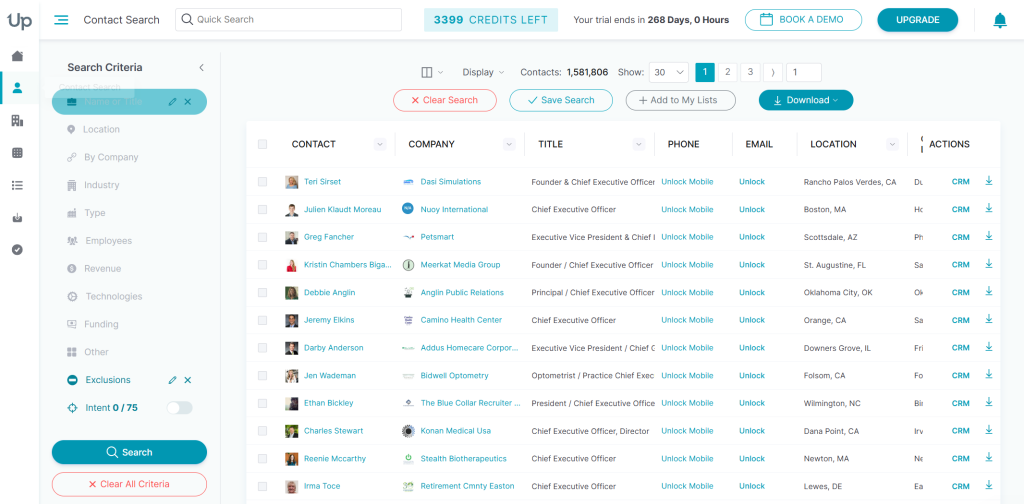
UpLead is a verified, accuracy-guaranteed B2B prospecting platform built for outbound sales teams that need reliable contact data without the bounce rates. Every email address is checked for deliverability the moment you download it, not during a batch refresh that may be weeks old. That’s the whole point. That approach drives UpLead’s 95% data accuracy guarantee and the automatic credit refund system for any contact that fails verification.
The UpLead database covers 180+ million verified B2B email addresses across 200+ countries, 16+ million company profiles and 16,000+ tracked technologies. Unlike Apollo, where accuracy claims are unguaranteed, UpLead puts its accuracy on the line with every export. That’s the difference.
Key features include:
- 95% data accuracy guarantee with real-time export verification
- 50+ search filters including technographics, firmographics and intent data
- Bombora-powered intent data to find accounts actively researching your solution
- Bulk data enrichment and CRM record cleaning
- Organizational charts to identify decision-maker hierarchies
- Chrome extension for LinkedIn and website prospecting
- CRM integrations with Salesforce, HubSpot, Pipedrive, Zoho, Outreach and Insightly
- Full API access on the Professional plan
Pros
- Real-time email verification and lower bounce rates are cited most often as the reasons users trust UpLead for outbound campaigns. (Source: G2)
- UpLead earns consistent praise for making verified data easy to find without a steep learning curve. (Source: G2)
- New users repeatedly comment on how quickly they get productive in UpLead compared to heavier enterprise tools. (Source: G2)
Cons
- Coverage gaps in niche industries and smaller regional markets are the most commonly cited limitation. (Source: G2)
- Not every contact lookup returns an email, particularly for less-indexed companies. (Source: G2)
G2 rating: 4.7/5 (816 reviews)
UpLead offers three pricing plans:
- Essentials: $74/mo (annual) or $99/mo. One user, verified emails and mobile direct dials, CRM integration and Chrome extension.
- Plus: $149/mo (annual) or $199/mo. Adds data enrichment, technographic data, advanced search filters and email pattern intelligence.
- Professional: $299/mo (annual) or $399/mo. Team account for up to 5 users, intent data, all 50+ search filters and full API access.
An Enterprise plan with custom pricing is available for larger teams. UpLead offers a 7-day free trial with full platform access. No credit card required.
Best for: Sales teams moving away from Apollo that need a verified contact database with a guaranteed accuracy rate, automatic credit refunds for bad contacts and real-time verification at export rather than stale batch data. If you’re tired of cleaning up bounced campaigns, it’s worth starting here.
UpLead vs Apollo.io
UpLead vs Apollo.io comes down to one difference: verification timing. Apollo.io doesn’t guarantee accurate contact data and relies on batch-refresh cycles that can leave contact details stale between updates. UpLead verifies every email at export and refunds credits automatically for any bad contact, giving sales professionals a reliable contact data guarantee Apollo can’t match. Most teams find this out late. On G2, UpLead scores 9.4 in quality of support versus Apollo’s 8.8. For teams where sender domain reputation and verified data accuracy are non-negotiable, UpLead is the stronger alternative.

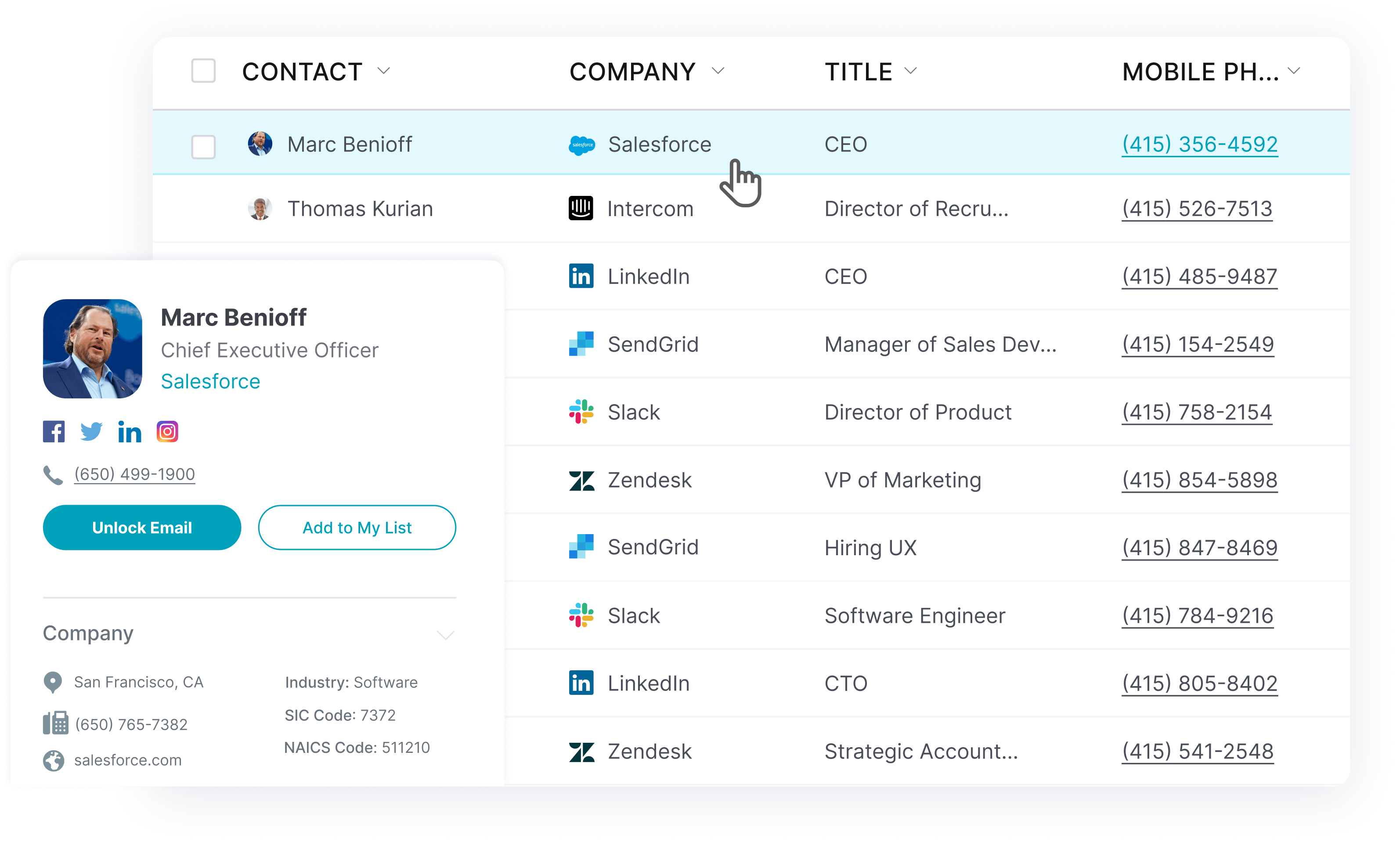
Quick watch: We’ve compared the best Apollo.io alternatives below. If you want to find hot leads actively searching for a solution like yours right now, use UpLead’s intent data. 🔥 Try it free here.
2. Cognism: Best for GDPR-Compliant EMEA Prospecting
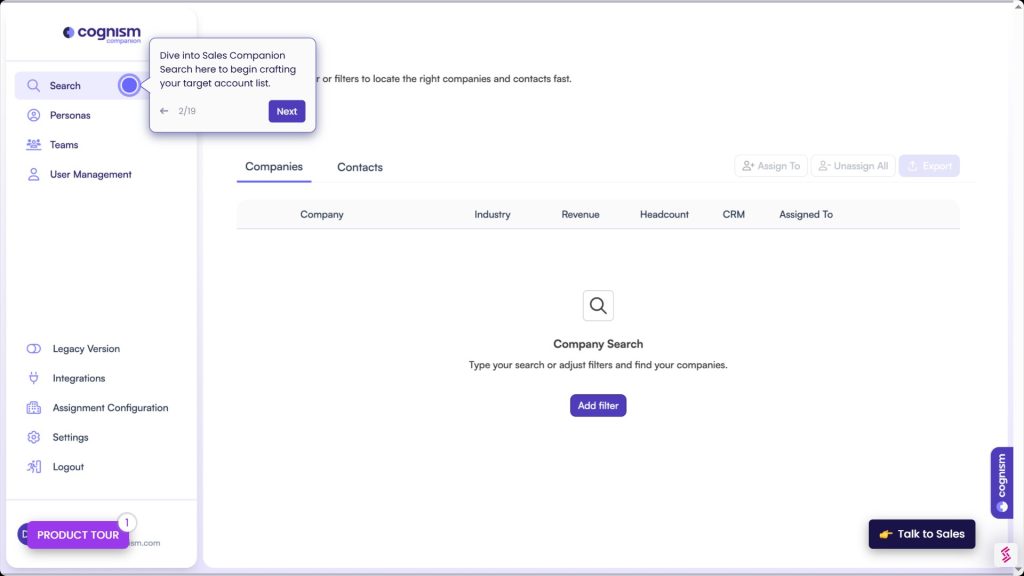
Cognism is a GDPR-compliant, phone-verified B2B intelligence platform built for enterprise and mid-market teams. It’s designed for teams that rely on cold calling and direct dial accuracy in European markets. Cognism’s Diamond Data service verifies mobile phone numbers through human calling, not just algorithmic pattern-matching. The reported connect rate on Diamond Data mobiles is 87%, well above what most databases deliver from unverified mobile lists. That number holds in practice.
Cognism runs a 16-step email check and screens contacts against DNC lists across multiple countries. It also holds ISO 27701 certification specific to GDPR data governance. Few vendors go that far. That’s what makes Cognism’s compliance auditable end to end. For teams that have received legal or compliance flags about their data sourcing, Cognism’s verification layer removes the ambiguity.
Key features include:
- Phone-verified mobile numbers with 87% reported connect rate (Diamond Data, Elevate plan)
- 16-step email verification process
- GDPR and CCPA compliance with ISO 27701 certification
- DNC list screening across the UK, US, Germany, France and other markets
- Bombora-powered intent data (Elevate plan)
- Technographic and firmographic search filters
- Chrome extension and integrations with Salesforce, HubSpot, Outreach and Salesloft
Pros
- Phone-verified mobile accuracy is the standout trait in Cognism reviews, with Diamond Data cited as the reason connect rates hold up in practice. (Source: G2)
- Data reliability comes up frequently, particularly for teams running EMEA campaigns where compliance and freshness both matter. (Source: G2)
- Cognism is regularly described as fast to navigate and easy to pick up without extended training. (Source: G2)
Cons
- Outdated job titles and contacts who have left their companies are the most cited data quality issues in Cognism reviews. (Source: G2)
- The Chrome extension’s load time on LinkedIn is a recurring friction point mentioned across reviews. (Source: G2)
G2 rating: 4.6/5 (500+ reviews)
Pricing: Quote-based. Two tiers: Grow and Elevate. Third-party procurement data estimates Grow’s platform fee at approximately $15,000/year plus $1,500/user/year. Elevate’s platform fee, which adds Diamond Data and intent signals, runs approximately $25,000/year plus $2,500/user/year. Actual costs vary with seat count, contract length and negotiation. Cognism doesn’t publish a self-serve pricing page.
Best for: Mid-market and enterprise teams with an EMEA book of business where cold calling is the primary outreach channel and GDPR compliance carries legal weight. If you’re in that situation, there’s no closer fit on this list.
Cognism vs Apollo.io
Cognism’s phone-verified mobile numbers close the gap Apollo leaves open for teams targeting key decision makers outside the US. G2 reviewers of Apollo often cite weak mobile data in European markets as a top reason they search for apollo.io alternatives. Cognism’s Diamond Data service verifies mobiles through human calling and delivers an 87% reported connect rate on direct dials. Apollo’s unverified mobile data doesn’t come close. On compliance, Apollo states GDPR adherence but doesn’t carry ISO 27701 certification or operate multi-country DNC screening. The difference is auditable. For sales and marketing teams selling into the EU, that compliance gap carries legal weight.
3. ZoomInfo: Best for Enterprise-Scale Sales Intelligence
ZoomInfo‘s built for large revenue teams that need scale. It combines a massive contact database, buyer intent signals and deep CRM automation in one system. With 321M+ contacts and 104M+ company records, ZoomInfo’s data reach is the widest on this list. It’s not close.
Key features include:
- 321M+ professional contacts and 104M+ company records
- Real-time Bombora-powered buyer intent signals
- AI Copilot for account summaries and personalized outreach recommendations
- WebSights for website visitor identification
- Organizational charts and technographic data
- 200+ search filters
- Integrations with Salesforce, HubSpot, Microsoft Dynamics, Marketo and more
Pros
- ZoomInfo’s interface draws consistent praise for being approachable despite the platform’s scale, particularly from teams managing large account lists. (Source: G2)
- High-volume enterprise prospecting teams are among the most enthusiastic ZoomInfo users, with data breadth cited as the primary reason. (Source: G2)
- The prospecting workflow and account management structure are regularly cited as strengths compared to less organized alternatives. (Source: G2)
Cons
- Stale contact records are the most common complaint, with reviewers citing calls to contacts who left companies years ago. (Source: G2)
- Data accuracy gaps come up repeatedly, particularly for smaller companies and fast-moving roles. (Source: G2)
- Contacts not recently active in ZoomInfo’s tracking sometimes don’t surface in searches, limiting completeness for certain queries. (Source: G2)
G2 rating: 4.5/5 (8,818 reviews)
There are three ZoomInfo pricing plans: Professional+, Advanced+ and Elite+. All are custom-quoted, so you’ll need to talk to sales before you see real numbers. According to third-party procurement data, ZoomInfo’s entry price runs approximately $15,000/year for a single seat on the base plan. Intent data, organizational charts and advanced features are gated behind higher tiers. ZoomInfo offers a free trial.
Best for: Large enterprise revenue teams where database breadth and deep CRM workflow integration across sales, marketing and conversation intelligence translate directly into pipeline at scale. If you’re running a team of 50+ reps, it’s likely the right fit.
ZoomInfo vs Apollo.io
ZoomInfo has a bigger contact database than Apollo (321M+ versus Apollo’s 275M+). It also adds buyer intent data, website visitor tracking and AI-powered workflow automation. Apollo’s platform doesn’t match that at enterprise scale. G2 reviewers who switched from Apollo to ZoomInfo cite database breadth and the quality of buying signals as the primary upgrade. Enterprise pricing is the tradeoff: per third-party procurement data, ZoomInfo’s average contract starts around $15,000 per seat per year versus Apollo’s far lower entry price. That gap is significant. For large revenue teams where data access at scale matters more than cost, ZoomInfo is a deliberate step up.
4. LinkedIn Sales Navigator: Best for LinkedIn-First Social Selling
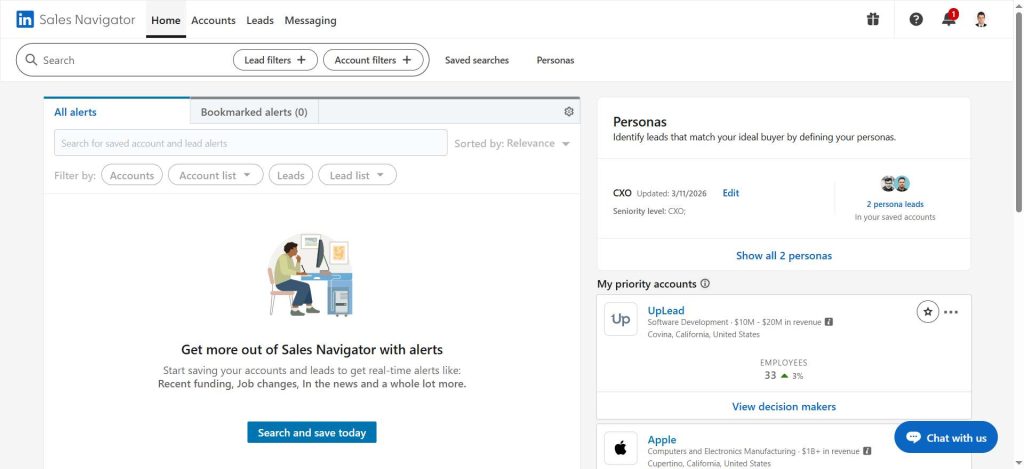
LinkedIn Sales Navigator is built for sales teams whose buyers are active on LinkedIn. It runs on job-change signals and warm introductions, not cold contact lists. It’s a different category entirely. Drawing from LinkedIn’s own database of 1 billion+ members, it occupies a fundamentally different space from traditional B2B contact databases.
Key features include:
- Access to LinkedIn’s full professional graph (1 billion+ members)
- Advanced lead and account search filters beyond LinkedIn’s standard interface
- Real-time job change alerts for tracked contacts
- InMail credits for direct outreach to second and third-degree connections
- TeamLink for surfacing warm introduction paths through your team’s network
- CRM sync with Salesforce and HubSpot (Advanced and Advanced Plus)
- Account engagement tracking and buyer intent signals
Pros
- Job change tracking and contact movement monitoring are consistently rated as top differentiators for teams managing large, long-cycle accounts. (Source: G2)
- The ability to identify and connect with specific decision-makers is a recurring theme in positive reviews, especially for complex or multi-stakeholder deals. (Source: G2)
- Advanced search and filter capabilities are the most praised workflow feature, giving reps more control over targeting than LinkedIn’s standard interface allows. (Source: G2)
Cons
- The price-to-value gap for smaller teams that don’t use all advanced features comes up repeatedly in reviews. (Source: G2)
- Interface lag and loading speed are cited as persistent friction points that slow down prospecting sessions. (Source: G2)
G2 rating: 4.3/5 (1,300+ reviews)
Pricing:
- Core: $119.99/mo or $1,079.88/year (~$90/mo annual). Individual prospecting and outreach.
- Advanced: $159.99/mo or $1,799.88/year (~$150/mo annual). Adds TeamLink and CRM sync.
- Advanced Plus: Custom. Enterprise-grade CRM integration and seat management.
Best for: Relationship-led sales teams who use it to identify, track and warm accounts over time, paired with a separate contact database for direct outreach data. It’s a complement to a prospecting stack, not a replacement.
LinkedIn Sales Navigator vs Apollo.io
Apollo.io includes a LinkedIn integration but can’t replicate Sales Navigator’s native access to LinkedIn’s social graph for identifying key decision makers. G2 reviewers note that Sales Navigator surfaces job change alerts and warm introduction paths that Apollo’s LinkedIn layer can’t match. The gap runs the other direction on direct contact data: Sales Navigator doesn’t export verified emails and phone numbers at scale for automated outreach. Most teams pair it with a contact database rather than use it as a standalone apollo alternative.
5. Lusha: Best for Quick LinkedIn Phone and Email Lookups
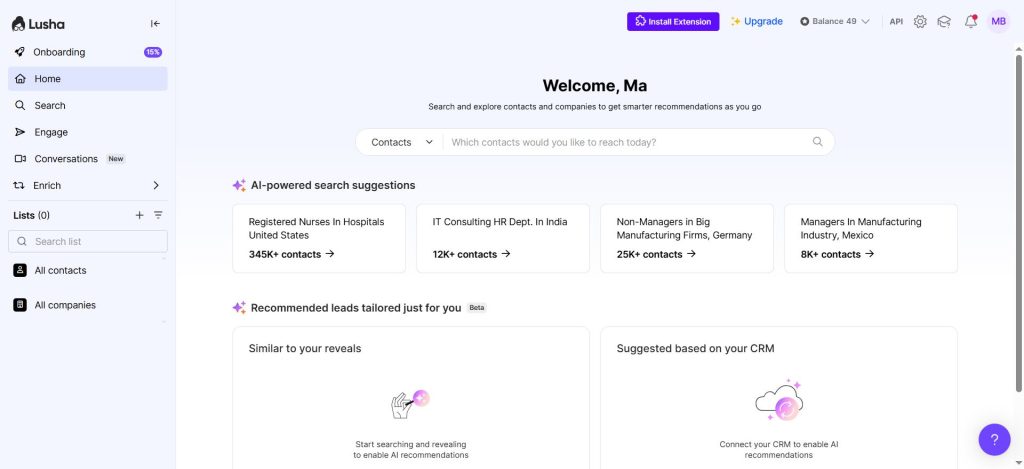
Lusha is a lightweight, LinkedIn-first B2B contact enrichment tool built for SDRs and individual reps who need fast phone and email lookups without leaving the browser. Install the Chrome extension, visit a prospect’s profile and Lusha surfaces their direct phone number and business email in a single click. For SDRs who spend most of their prospecting time on LinkedIn, it’s the tool that removes the tab-switching that slows down list building.
Lusha’s database covers 100+ million business profiles, 60+ million decision-maker email addresses and 50+ million decision-maker direct dials. It claims 81% data accuracy. That’s below UpLead’s 95% guarantee, but it’s at least a published number, which puts it ahead of tools that don’t disclose one at all.
Key features include:
- Chrome extension for LinkedIn and Salesforce data enrichment
- 100M+ business profiles, 60M+ decision-maker emails, 50M+ direct dials
- Email confidence grading system
- Bulk enrichment for list building
- Prospect intent signals
- CRM integrations with HubSpot, Salesforce, Zoho and Pipedrive
Pros
- Lusha is praised for making outbound lead qualification faster, particularly for SDRs who need to move quickly through prospect lists. (Source: G2)
- Accurate phone number retrieval directly from LinkedIn profiles is the most cited strength, especially for reps who prioritize calling over email. (Source: G2)
- General reliability in prospecting workflows is consistently highlighted, with users returning to Lusha as a dependable daily tool. (Source: G2)
Cons
- Data coverage gaps for smaller companies and niche roles are the most frequently mentioned limitation in Lusha reviews. (Source: G2)
- Credit depletion speed and inconsistent accuracy come up together in multiple reviews, particularly on higher-volume prospecting days. (Source: G2)
- Lusha doesn’t eliminate the need for a broader stack, which frustrates teams expecting an all-in-one prospecting solution. (Source: G2)
G2 rating: 4.4/5 (748 reviews)
Lusha offers four pricing plans:
- Free: 5 credits/month.
- Pro: $29/user/mo (annual) or $39/user/mo. List management, shared credit pool and team management.
- Premium: $51/user/mo (annual) or $69/user/mo. Adds CRM integrations, bulk enrichment and credits analytics.
- Scale: Custom. Includes API access.
Best for: Individual SDRs and small teams who prospect from LinkedIn and need quick phone and email lookups without the cost or complexity of a full prospecting suite.
Lusha vs Apollo.io
Lusha’s narrower than Apollo but more accurate for LinkedIn-sourced contact details. Apollo’s database covers more contact types but G2 reviewers on both platforms often cite high bounce rates on Apollo cold email campaigns as a recurring problem for sales and marketing efforts. Lusha states 81% data accuracy, lower than Apollo’s unverified claims but more transparent about what reliable contact data means in practice. For SDRs whose prospecting lives on LinkedIn who need accurate phone numbers by job title, Lusha often outperforms Apollo on the lookups that drive direct-dial outreach.
6. Seamless.AI: Best for Real-Time AI-Powered Contact Search
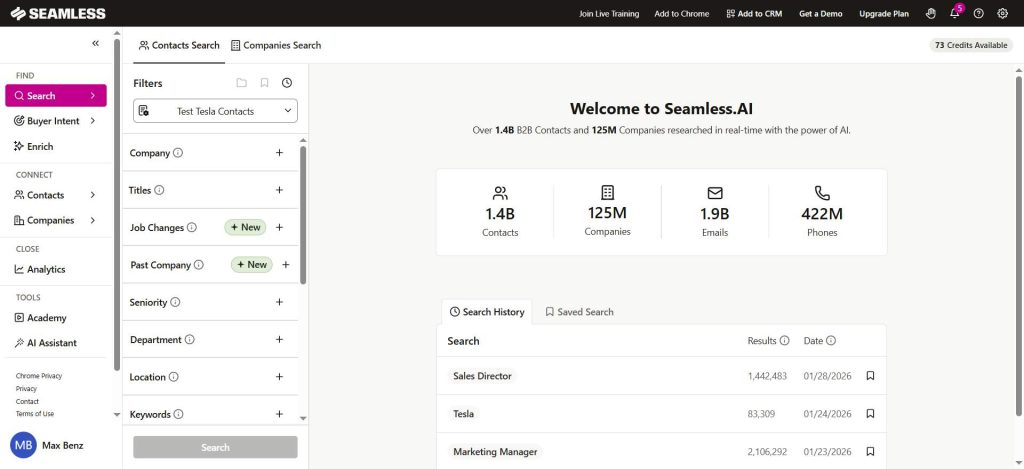
Seamless.AI is a real-time, AI-powered B2B contact search platform built for high-volume sales teams that want freshly sourced contact data rather than records from a pre-built static database. Seamless.AI’s engine searches current online sources, which means the data reflects more recent updates than batch-refresh alternatives. The tradeoff is quality variation depending on how well-indexed the target company or role is across public sources. That’s where it gets inconsistent.
Key features include:
- Real-time AI-driven contact search across live online sources
- Email, phone and social contact data
- Chrome extension for LinkedIn prospecting
- Buyer intent signals
- Job change tracking
- Data enrichment for existing CRM records
- CRM integrations with Salesforce and HubSpot
Pros
- The real-time AI search engine is the most highlighted differentiator in positive Seamless.AI reviews, with users citing it as more current than static database alternatives. (Source: G2)
- Contact data breadth comes up as a strength, with reviewers noting multiple phone options, multiple emails and additional data points per contact compared to simpler tools. (Source: G2)
Cons
- Fast lead generation paired with inconsistent accuracy is the most common tension reviewers describe, with data quality issues surfacing on specific industries and regions. (Source: G2)
- The initial dashboard experience is frequently described as cluttered, with new users reporting a noticeable onboarding curve before the interface feels manageable. (Source: G2)
G2 rating: 4.4/5 (5,277 reviews)
Pricing:
- Free: 50 lifetime credits total (not per month).
- Basic: ~$147/mo. 250 credits.
- Pro: ~$99-$299/user/mo (requires a sales conversation; pricing varies by seat count and contract terms).
- Enterprise: Custom.
Best for: High-volume prospecting teams that prioritize real-time contact data and list volume over accuracy consistency guarantees. It’s a volume play, not a precision one.
Seamless.AI vs Apollo.io
Both Seamless.AI and Apollo.io combine large contact databases with real-time data search elements, but neither publishes a guaranteed accuracy rate. G2 reviewers comparing the two as apollo.io alternatives report similar complaints about bounce rates and stale phone numbers in niche markets. Seamless.AI’s real-time sourcing in theory produces fresher company data, but accuracy in practice depends heavily on how well-indexed the target industry is across public sources. You won’t know until you’re running campaigns. Pricing transparency is also lower on Seamless.AI: you’ll need a sales call to confirm Pro plan costs and what’s included.
7. RocketReach: Best for Cross-Platform Contact Discovery
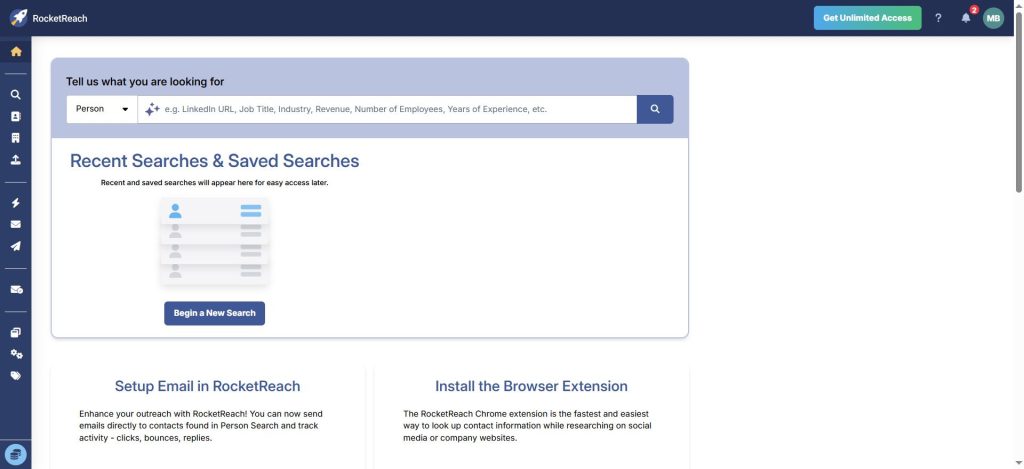
RocketReach is a broad-coverage, multi-source contact discovery platform built for agencies, recruiters and sales teams that need professional contact data drawn from LinkedIn, GitHub, AngelList and company websites in a single interface. With 700+ million professional profiles and 35+ million companies, RocketReach’s coverage spans a wider professional type range than most pure-B2B databases. It’s the broadest reach on this list.
Key features include:
- 700M+ professional profiles across LinkedIn, GitHub, AngelList and company websites
- Email and phone lookup with confidence scoring
- Advanced search filters
- Chrome extension
- Bulk lookup for list building at scale
- API access (Ultimate plan)
- CRM integrations with Salesforce, HubSpot and Pipedrive
Pros
- Reliability and accuracy for high-stakes outreach are the most cited strengths in positive RocketReach reviews, particularly for users who’ve been burned by less accurate tools. (Source: G2)
- The LinkedIn profile integration and ease of searching for contact data across professional networks are consistently highlighted. (Source: G2)
- Speed and intuitiveness of the contact lookup flow are recurring positives, with reviewers noting they can find and act on contact data without extra steps. (Source: G2)
Cons
- Data staleness is the most frequently cited criticism, with reviewers finding contacts that are outdated or have moved roles since the record was last updated. (Source: G2)
- Personal email coverage is a recurring gap, with reviewers noting limited success finding non-business email addresses. (Source: G2)
- UI quality and navigation experience come up as areas needing improvement, particularly around search result presentation. (Source: G2)
G2 rating: 4.5/5 (1,088 reviews)
Pricing (annual billing):
- Essentials: ~$33/mo ($399/year). 1,200 annual lookups, email data.
- Pro: ~$75/mo ($899/year). 3,600 annual lookups, adds phone numbers.
- Ultimate: ~$175/mo ($2,099/year). 10,000 annual lookups, API and Salesforce sync.
- Enterprise: From $6,000/year. Custom features and volume.
Monthly billing roughly doubles the annual equivalent cost.
Best for: Agencies, recruiters and cross-platform prospectors who need a wide professional contact set rather than a pure enterprise B2B database. If you’re not selling purely B2B, it’s worth evaluating.
RocketReach vs Apollo.io
Apollo.io outscores RocketReach on database size and includes a built-in sales engagement layer with email sequences and calling that RocketReach lacks. Where RocketReach competes is on lead database breadth across professional types: it aggregates from LinkedIn, GitHub and AngelList, covering contact types that Apollo’s B2B-focused database underrepresents. G2 reviewers switching from Apollo cite data accuracy as the primary driver, not feature depth. That’s where RocketReach holds its own. Per G2 review data, RocketReach’s lookup accuracy scores above Apollo’s average for users in recruiting-adjacent and agency use cases.
8. LeadIQ: Best for SDR Teams Working in Sales Navigator
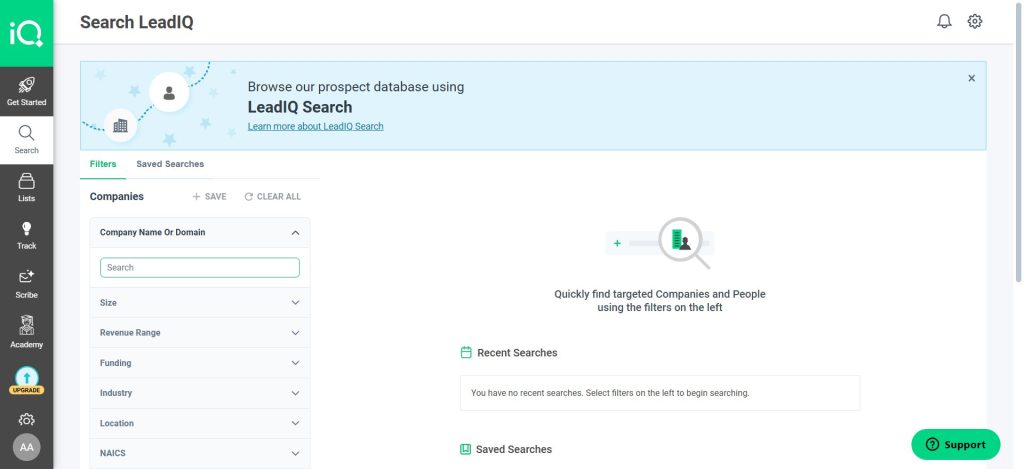
LeadIQ is a Sales Navigator-native, CRM-integrated contact enrichment platform built for SDR teams that run their daily prospecting inside LinkedIn and need verified contact data pushed directly to their CRM without manual uploads. The Chrome extension surfaces verified emails and phone numbers directly on LinkedIn profiles, and a tight bidirectional sync pushes contacts to the CRM in one step. It’s a clean workflow if you’re already living in Sales Navigator.
Key features include:
- Chrome extension deeply integrated with LinkedIn Sales Navigator
- Verified email and phone number enrichment from LinkedIn profiles
- Job change tracking and alerts for saved contacts
- Scribe AI for personalized email draft generation
- Tracked accounts with engagement signals
- CRM sync with Salesforce, HubSpot, Outreach and Salesloft
Pros
- Eliminating manual CRM data entry is the most cited workflow benefit in LeadIQ reviews, with SDRs pointing to automatic contact sync as the primary time saver. (Source: G2)
- AI-powered verification improving data quality is regularly mentioned as a measurable business impact, particularly for teams that previously relied on manual list building. (Source: G2)
- Ease of use and the Chrome extension experience are consistent positives, with reviewers noting the learning curve is short even for less technical reps. (Source: G2)
Cons
- Quality gate rejections that block contact uploads are a recurring source of friction, with users occasionally losing contacts they expected to capture. (Source: G2)
- The in-browser UI is frequently cited as less polished than competing tools, with reviewers noting it lags behind the overall product quality in other areas. (Source: G2)
G2 rating: 4.2/5 (1,147 reviews)
Pricing (annual billing):
- Free: 1 user, 50 credits/month.
- Essential: $36/user/mo. 1,000 verified emails and 50 mobile numbers per month.
- Pro: $79/user/mo. 2,000 verified emails, 100 phone numbers, 500 AI-generated emails and 100 tracked accounts.
- Enterprise: Custom.
Best for: SDR teams whose primary prospecting surface is LinkedIn Sales Navigator and who need verified contact data with automatic bidirectional CRM sync, eliminating manual data entry. It’s built around that exact workflow.
LeadIQ vs Apollo.io
Apollo has a built-in sales engagement layer with email sequences and integrated calling tools that LeadIQ doesn’t include. LeadIQ’s advantage is its Sales Navigator integration depth and CRM sync quality for sales professionals who live inside LinkedIn. G2 reviewers who have used both report that LeadIQ’s contact capture is more accurate for LinkedIn-sourced leads, but Apollo covers more target accounts and contact discovery use cases outside LinkedIn. For SDR teams standardized on Sales Navigator, LeadIQ’s workflow efficiency outweighs the missing sequencing layer, which can be handled by a separate tool.
9. Lead411: Best for Intent-Driven Prospecting With Bombora Data
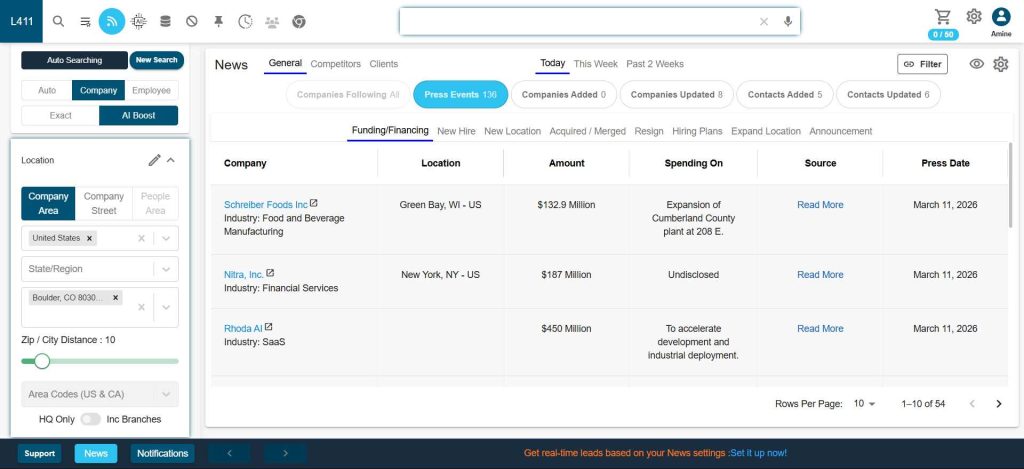
Lead411 is an intent-driven, trigger-based B2B prospecting platform built for US-market sales teams that want to time outreach around Bombora-powered buyer signals rather than static firmographic filters. You’re not filtering by company size alone. You’re filtering by what buyers are actively reading across 3,500+ B2B content sites.
The Lead411 database covers 450+ million contacts, 20+ million companies and 30,000+ searchable technologies. Real-time email verification reduces bounce rates, and sales trigger alerts (funding rounds, leadership changes, hiring surges) surface timing-driven outreach opportunities automatically. It’s the trigger layer that sets it apart.
Key features include:
- 450M+ contacts and 20M+ companies
- Bombora-powered intent data (Enterprise plan)
- Real-time email verification
- Sales trigger alerts for funding, leadership changes and hiring events
- Lead scoring
- Chrome extension
- Data enrichment and API access
- CRM integrations with Salesforce, HubSpot, Pipedrive and Zoho
Pros
- Workflow efficiency and time savings on lead research are the most cited benefits, with teams pointing to faster list building as a direct impact on selling time. (Source: G2)
- Lead411’s price-to-value ratio is repeatedly highlighted in reviews, particularly by teams comparing it to ZoomInfo or Cognism. (Source: G2)
- Data accuracy for mainstream use cases comes up consistently as a positive, with reviewers finding the contact data reliable for standard US-market prospecting. (Source: G2)
Cons
- Outdated phone data in niche and smaller-market segments is the most common complaint, with reviewers finding direct dials less reliable outside mainstream industries. (Source: G2)
- Data staleness is a recurring criticism across reviews, with some users finding records lag behind personnel changes more than expected. (Source: G2)
- Smaller company data freshness is a consistent gap, with contacts from sub-100-employee companies more likely to be out of date. (Source: G2)
G2 rating: 4.5/5 (477 reviews)
Pricing:
- Basic: $99/user/mo or $900/user/year. 2,400 contacts/year, verified emails and direct dials, Chrome extension and API access.
- Pro: $199/mo or $1,800/user/year. 5,400 contacts/year, lead scoring and chat support.
- Enterprise: Custom. Unlimited contacts, technology tracking, growth intent triggers and Bombora intent data.
A 7-day free trial is available.
Best for: US-focused sales teams that want to pair verified contact data with Bombora intent signals to prioritize outreach toward accounts actively researching solutions like theirs. If you’re timing outreach around buying signals, it’s a strong fit.
Lead411 vs Apollo.io
Lead411 provides Bombora buyer intent data at the Enterprise tier, where Apollo includes intent signals at lower plan levels, giving Apollo an advantage for teams that want buying signals without committing to enterprise pricing. Lead411’s trigger-based alerts (funding rounds, leadership changes, hiring surges) add a layer Apollo’s intent data doesn’t replicate. For US-focused teams timing outreach around buying signals, that distinction matters. On lead data quality, G2 reviewers who’ve used both often rate Lead411’s contact verification above Apollo’s for US-market sales and marketing teams, though at a higher base price per user.
10. Hunter.io: Best for Email Verification and Domain-Based Prospecting
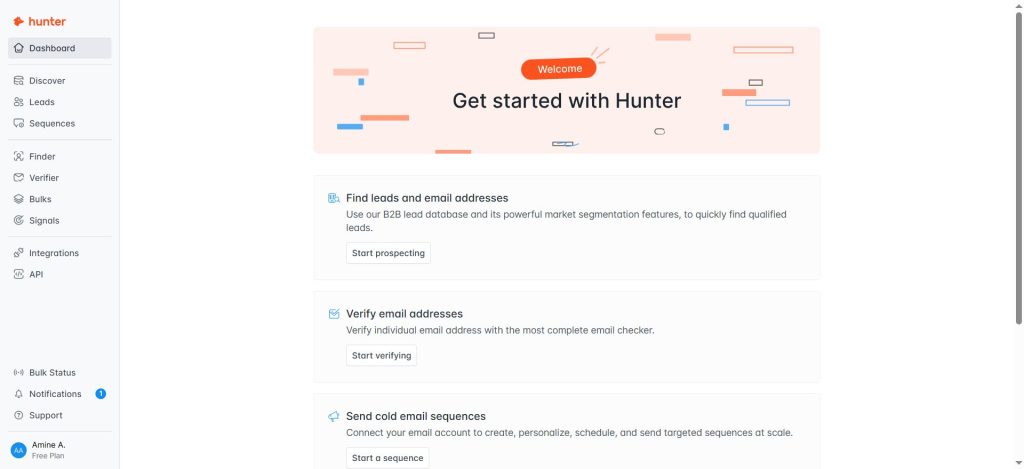
Hunter.io is a specialized, email-first B2B discovery and verification platform built for teams whose primary outreach need is finding and validating professional email addresses by domain at scale. Hunter.io’s Domain Search function extracts contact emails from any company website, and the Email Verifier checks deliverability before you send. Hunter doesn’t compete with full B2B databases on phone numbers or firmographics, but for teams that need verified emails above all else, it’s one of the most reliable and cost-efficient options available.
Key features include:
- Domain Search to extract contact emails from company websites
- Email Finder for individual contact lookup by name and company
- Email Verifier with deliverability checking before send
- TechLookup to find companies by the technologies they use
- Chrome extension
- CRM integrations with HubSpot, Salesforce, Zoho and Pipedrive
- Gmail and Outlook sync for direct outreach from the platform
Pros
- Simplicity and efficiency in email discovery and verification are the most praised aspects of Hunter across reviews, with users citing it as the easiest tool to get results from quickly. (Source: G2)
- The domain-based email scraping capability is regularly highlighted by outreach-focused teams who need to build contact lists from target company websites. (Source: G2)
- Reliability and a clean, no-friction UX come up repeatedly as reasons users stick with Hunter rather than switching to more complex tools. (Source: G2)
Cons
- Credit limits becoming a friction point at scale are the most cited drawback, with users on larger campaigns running into ceilings more frequently than expected. (Source: G2)
- Email discovery gaps for smaller companies and less common addresses are a consistent limitation, with Hunter performing less reliably outside well-indexed domains. (Source: G2)
G2 rating: 4.4/5 (632 reviews)
Pricing (prices in EUR; Hunter is a European-founded platform):
- Free: 50 searches/month.
- Starter: €34/mo (annual) or €49/mo. 2,000 searches/month.
- Growth: €104/mo (annual) or €149/mo. 10,000 searches/month.
- Scale: €209/mo (annual) or €299/mo. 25,000 searches/month.
- Enterprise: Custom pricing and credit allocation.
Best for: Email-focused outreach teams that need domain-based email discovery and pre-send verification as a standalone tool or as a lightweight stack addition alongside a broader prospecting database. It’s also the lowest-cost entry point on this list.
Hunter.io vs Apollo.io
Hunter.io covers email discovery and verification only. Apollo’s a comprehensive sales engagement platform with contact data, email sequences, calling and CRM sync. For teams needing a direct Apollo replacement, Hunter doesn’t qualify. But for teams that need to verify email addresses as a standalone function, Hunter is more reliable and costs far less. G2 reviewers report that Apollo’s email accuracy has declined on specific campaign types, which pushes email-focused marketing efforts teams to verify contacts through a dedicated tool before sending.
How to Choose the Best Apollo.io Alternative for Your Business
The right choice depends on what broke with Apollo, not just which platform has the highest G2 score. Six factors matter most. Here’s what to look at.
Data Accuracy and Verification Method
Look past headline accuracy claims and ask how each platform verifies its data. A large database is only useful if the contacts in it are current and reachable. UpLead’s real-time verification at export guarantees 95% accuracy with automatic credit refunds. Cognism checks mobiles via human calls and runs a 16-step email check. ZoomInfo uses a large data graph but doesn’t publish a guaranteed rate. If bounce rates are your primary pain point, the verification method matters more than database size.
Geographic Coverage
Apollo’s mobile data weakens outside the US. Cognism is the strongest option for European markets, with phone-verified data and DNC screening across multiple EU countries. ZoomInfo’s strength is US enterprise coverage. UpLead’s database covers 200+ countries with verified contact data. LeadIQ and Lusha skew US-centric. If international prospecting is a meaningful part of your book of business, verify coverage in your specific target regions before committing.
Pricing Model
Credit-based models (Apollo, UpLead, Lusha, RocketReach) mean unused credits expire and data access is capped at your plan’s credit ceiling. Seat-based unlimited models (Cognism) remove credit anxiety but cost more upfront. Seamless.AI and ZoomInfo both require sales conversations before showing real pricing numbers. Know which model suits your team’s prospecting volume before you’re locked into an annual contract. High-volume teams often find credit-based models create more friction than the base plan cost suggests.
GDPR and Compliance
If you sell into the EU, GDPR compliance isn’t optional. Cognism is the strongest here, with ISO 27701 certification, a dedicated legal team and multi-country DNC list screening. Apollo states GDPR compliance but lacks Cognism’s verification depth and manual screening layer. UpLead’s verification process removes personal emails and focuses on business contact data, which reduces some compliance exposure compared to platforms that include personal email addresses.
Integration Depth
Every tool on this list connects to Salesforce and HubSpot. The difference is in bidirectional sync quality, automatic field mapping and real-time updates. LeadIQ and Cognism score high on integration quality in G2 reviews. ZoomInfo’s integrations are the most extensive across the full CRM and sales engagement ecosystem. Before deciding, confirm that your specific CRM and outreach platform are supported at the tier you’re considering. It’s easy to miss tier-gated limitations in demos.
Outreach Capabilities
Most tools on this list are data platforms, not outreach platforms. They’re built for targeted list building, not running sequences inside the same tool. UpLead, Cognism, ZoomInfo, LeadIQ and Lusha all integrate with major sales engagement platforms (Outreach, Salesloft, Klenty) because they don’t build sequencing natively. For sales professionals who want one platform for prospecting and email sequences, pairing a data tool with a dedicated outreach platform produces better results than an all-in-one that compromises on both.
Hunter.io’s free plan includes 50 email searches per month. LinkedIn Sales Navigator offers a 30-day free trial. UpLead offers a 7-day trial with full platform access. Lusha’s free plan provides 5 credits per month. None of these fully replicate Apollo’s free tier, but each lets you evaluate the product before committing to a paid plan.
UpLead guarantees 95% data accuracy with real-time verification at the point of export and automatic credit refunds for bad contacts. Cognism’s Diamond Data service verifies mobile phone numbers through human calling and reports an 87% connect rate on verified mobiles. Both platforms are rated higher than Apollo on data accuracy in G2 head-to-head comparisons.
Cognism outperforms Apollo for European market prospecting, GDPR compliance and phone-verified mobile data. Apollo has broader overall database coverage and a larger US contact set. The better choice depends on where your target market is concentrated and whether cold calling is a primary outreach channel for your team.
Cognism’s Diamond Data service provides phone-verified mobile numbers with a reported 87% connect rate, making it the strongest cold-calling option for European markets. Lead411 pairs Bombora intent signals with verified direct dials to help time cold calls around active buying periods. UpLead’s Professional plan includes mobile direct dials across 200+ countries with its 95% data accuracy guarantee.
Users report Apollo email bounce rates reaching 15-25% on some outbound campaigns. Apollo does not publish a guaranteed accuracy rate. The platform updates its database using a mix of algorithmic and crowd-sourced verification rather than real-time export verification, which means some contact data can be stale at the moment of use.
UpLead’s Essentials plan at $74/mo (annual) suits small teams with a single user and provides verified B2B contact data with the 95% accuracy guarantee. Lusha’s Pro plan starts at $29/user/mo for teams that prospect primarily from LinkedIn. Hunter.io works for email-only teams at low cost. All three offer free trials or free tiers before requiring a paid commitment.
Find the Right Apollo.io Alternative for Your Team
The tools in this guide cover every major use case: verified data with an accuracy guarantee, GDPR-compliant EMEA prospecting, enterprise-scale intelligence, LinkedIn-first enrichment, real-time AI search and email-only verification. The right fit depends on your team’s size, target geography and primary outreach channels. There’s no universal answer.
If data accuracy and bounce rate reduction are your primary concerns, UpLead’s 95% accuracy guarantee and real-time export verification make it the strongest replacement for teams moving away from Apollo’s unguaranteed database. It’s the most direct upgrade on that specific dimension.
Start with verified data. Try UpLead free for 7 days.