

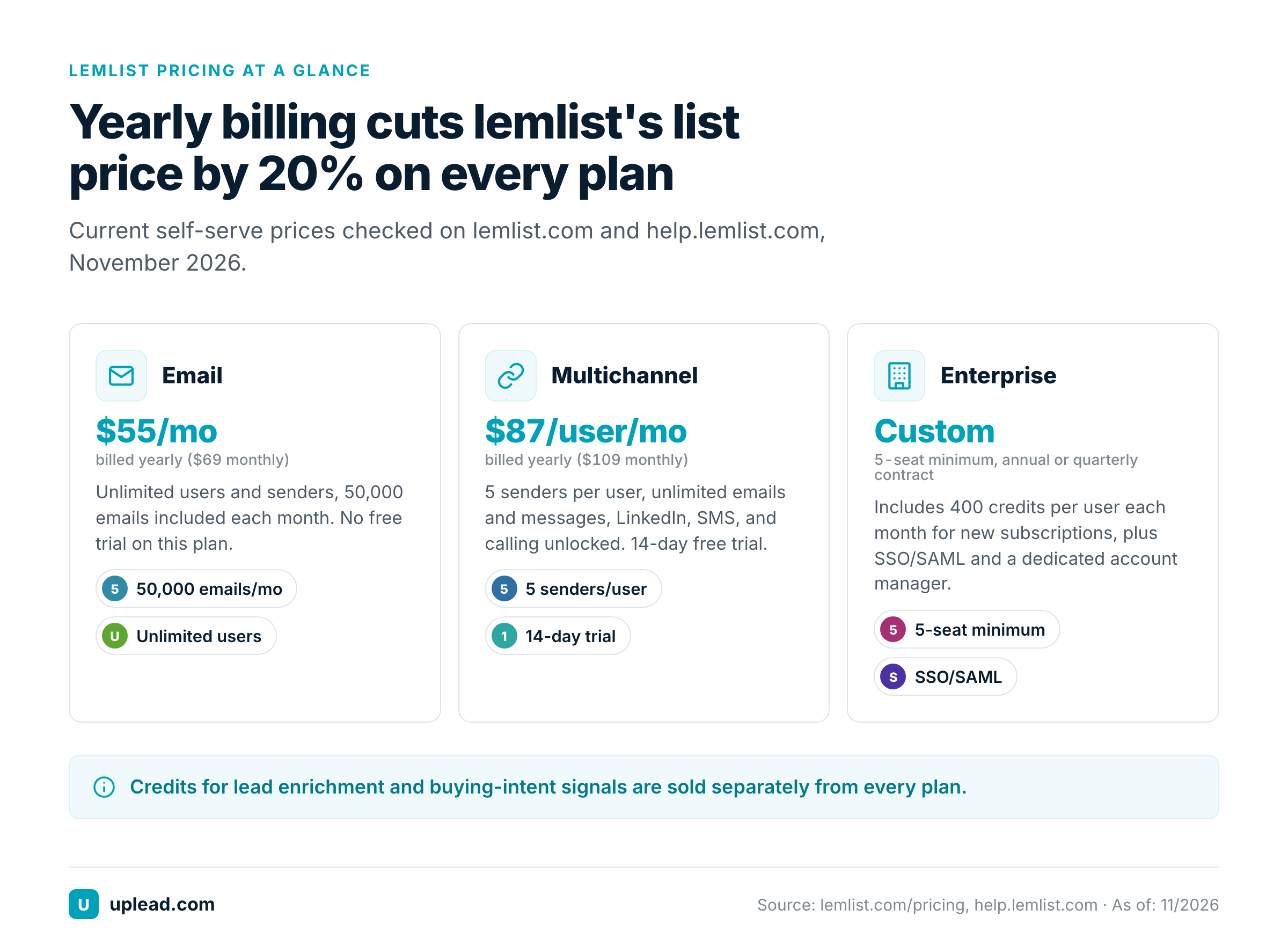
Lemlist runs two self-serve plans and one custom Enterprise tier. Email costs $55 a month on yearly billing ($69 month-to-month), and Multichannel costs $87 a month on yearly billing ($109 month-to-month). Enterprise is quote-only, with a 5-seat minimum. None of the three plans is free, and credits for lead enrichment and buying-intent signals are sold as separate add-ons.
How much does lemlist cost?
Billing runs on a monthly, quarterly, or yearly cycle for both self-serve plans. Quarterly billing cuts the monthly list price by 10%, and yearly billing cuts it by 20%, a consistent discount structure across both self-serve tiers. Enterprise skips the self-serve checkout entirely and goes through a sales quote.
| Plan | Billed yearly | Billed monthly | Best for |
|---|---|---|---|
| $55/mo | $69/mo | Cold email only, unlimited users and senders | |
| Multichannel | $87/user/mo | $109/user/mo | Email plus LinkedIn, SMS & calling |
| Enterprise | Custom | Custom | Larger teams needing SSO, roles, and support |
Source: lemlist pricing.
Lemlist Email plan: what you get for $55-69 a month
Email is lemlist’s entry plan for teams that only send cold email. It includes unlimited users and unlimited sending addresses, which is unusual: most sequencing tools price by seat, and lemlist’s own help center still lists the price as “per user” even though the plan itself caps nothing by headcount.
- 50,000 emails a month across the whole team, with higher volume available by contacting sales
- Lead generation and enrichment tools built into lemlist, a step up from the Email Pro plan previously sold to new customers
- Email warm-up and deliverability monitoring included at no extra charge
- No LinkedIn automation, calling, or WhatsApp sending at this tier
One detail that trips up existing customers: lemlist retired the old “Email Pro” plan for new signups, but current Email Pro subscribers keep their original plan and pricing. If your lemlist account still shows the plan you previously signed up for as Email Pro, you’re not forced onto the newer Email plan.
Lemlist Multichannel plan: what you get for $87-109 a month
Multichannel opens up the channels that most buyer guides point to when they compare lemlist against cheaper, email-only tools. It is also the only self-serve plan with a free trial attached.
- 5 sending addresses per user, with unlimited emails and messages sent
- LinkedIn automation and SMS automation, plus a built-in call dialer
- WhatsApp automation available as a paid add-on on top of the plan price
- A 14-day free trial, with Multichannel features and no credit card required
Lemlist enforces a one-account-per-person rule on this plan and on Enterprise: every sending address tied to a seat has to belong to the person using it, and the company says misuse can lead to suspension. That really matters if you were planning to share a single login across a team to save on seats.
Lemlist Enterprise plan: custom pricing explained
Enterprise is lemlist’s plan for larger teams, and it comes with real minimums the smaller plans do not have. Lemlist’s help center states that Enterprise requires at least 5 seats and is billed monthly or quarterly under a one-year contract, not month to month.
- SSO/SAML and custom user roles, plus a dedicated account manager
- New Enterprise subscriptions include 400 credits per user each month; existing accounts created before December 18, 2025 keep a legacy allocation of 1,500 or 2,500 credits instead
- Pricing is quoted directly by lemlist’s sales team, not shown on the pricing page
If your team is under 5 seats, lemlist’s own guidance is to start on Email or Multichannel and contact sales later if you outgrow them.
How lemlist’s credit system and add-ons work
Every lemlist credit is worth $0.01, and you are only charged when lemlist successfully returns a result; a failed lookup does not spend a credit. That single rule is easy to miss, but it’s the reason the credit system costs less in practice than the sticker price suggests.
Credits aren’t included free with the Email or Multichannel plans, so they come on top of whatever plan you pay for, not instead of it. Lemlist sells them through two named add-ons, and unused credits carry over for as long as your subscription stays active, consistent with how the rest of lemlist’s billing works.
Source: lemlist pricing and how much do leads cost in lemlist. WhatsApp automation is also sold as an add-on, though lemlist does not publish its price on the pricing page.
Monthly, quarterly, or yearly billing: which saves the most
The list price assumes monthly billing. Switching to quarterly billing saves 10%, and switching to yearly billing saves 20%, on both the Email and Multichannel plans. That is why the Email plan shows as $69 one place and $55 another: it is the same plan at two different commitment lengths, not two different products.
For a single-seat Email plan, that gap is $168 a year ($828 billed monthly versus $660 billed yearly). On Multichannel, where lemlist prices per user, the same 20% gap scales with every seat you add, so a 5-person Multichannel team saves roughly $1,320 a year by committing annually instead of paying month to month.
Is lemlist worth the price? Reviews, alternatives & where UpLead fits in
Lemlist is a French company, built by the Paris-based firm Lempire and running since 2018, so the pricing structure above is not a new experiment, it is a mature, established product line. As of November 2026, lemlist holds 4.6 out of 5 on G2 across 2,841 reviews. Reviewers most often praise the LinkedIn integration and the personalization tools; the most common complaints are about contact-data accuracy and limited reporting depth.
Price-wise, lemlist sits above some lighter alternatives. Instantly’s Growth plan costs $47 a month on monthly billing as of November 2026, but it caps out at 1,000 uploaded contacts and 5,000 emails a month at that tier, a tighter volume limit than lemlist’s 50,000-email Email plan. Neither tool is a straight substitute for the other, especially once you factor in what each one locks behind its higher tiers; a full breakdown of lemlist’s direct competitors is in our lemlist alternatives guide.
As a product, lemlist is a sending and sequencing tool, not a data provider: its 650M+ database is built in, but reviewers flag accuracy issues. If your outbound results are limited by who you can actually reach, not by which channel you send from, a dedicated enrichment tool like UpLead finds and verifies emails and phone numbers before those contacts ever reach your lemlist upload screen. The two tools are complementary rather than competing, and most outbound teams that run lemlist still need a separate source for clean contact data.
Frequently asked questions
No. Lemlist sells the Email and Multichannel plans only, plus a custom Enterprise tier. The only no-cost option is a 14-day free trial, and it’s only available through the Multichannel plan.
Pricing depends on the plan: Multichannel and Enterprise are seat-based, with a set number of sending addresses per user. Email is billed at a single price per month with unlimited users and senders, even though lemlist’s own pricing page still labels it ‘per user.’
Each credit costs $0.01 and is only spent when lemlist returns a successful result. Unused credits carry over for as long as your subscription stays active; they aren’t included free with the Email or Multichannel plan, so you have to buy them through the enrichment or buying-intent-signal add-ons.
No. Lemlist’s help center states that the 14-day Multichannel trial doesn’t require a credit card and won’t auto-charge you when it ends.
Not necessarily. Instantly’s Growth plan starts lower, at $47 a month on monthly billing, but caps sending volume and contact uploads well below lemlist’s Email plan. Which one costs less depends on how many emails and contacts your team actually sends each month.
Usually, yes, if you need verified contacts beyond what lemlist’s built-in database offers. Lemlist handles sequencing and sending; UpLead is the complementary piece that finds and verifies the contacts themselves. Most teams running lemlist pair it with a dedicated data source rather than relying on lemlist’s built-in database alone.