

Kaspr and Lusha are both Chrome-extension tools that pull verified emails and phone numbers off LinkedIn profiles for SDRs and recruiters (and plenty of founders doing their own prospecting). Kaspr starts at $49 a month and leans European; Lusha starts at $49.90 a month and has a larger reviewer base in North America. Pick Kaspr if your list is LinkedIn-first and EU-heavy. Pick Lusha if you want a slightly larger free plan and a broader platform to grow into.
Kaspr vs Lusha at a glance
Both tools do the same core job: install a Chrome extension, then open a LinkedIn profile to reveal that person’s work email and direct phone number. Both charge with credits. Both have a free tier. Where they split is depth. Kaspr stays almost entirely a LinkedIn prospecting layer. Lusha has grown into a broader “Workspace” that adds buying-signal data and an API. MCP support and ChatGPT connectors sit on top of the same credit system.
UpLead is a different kind of tool: a searchable B2B contact database rather than a LinkedIn-profile lookup extension, so it is worth a line in this table even though it is not a LinkedIn-first tool.
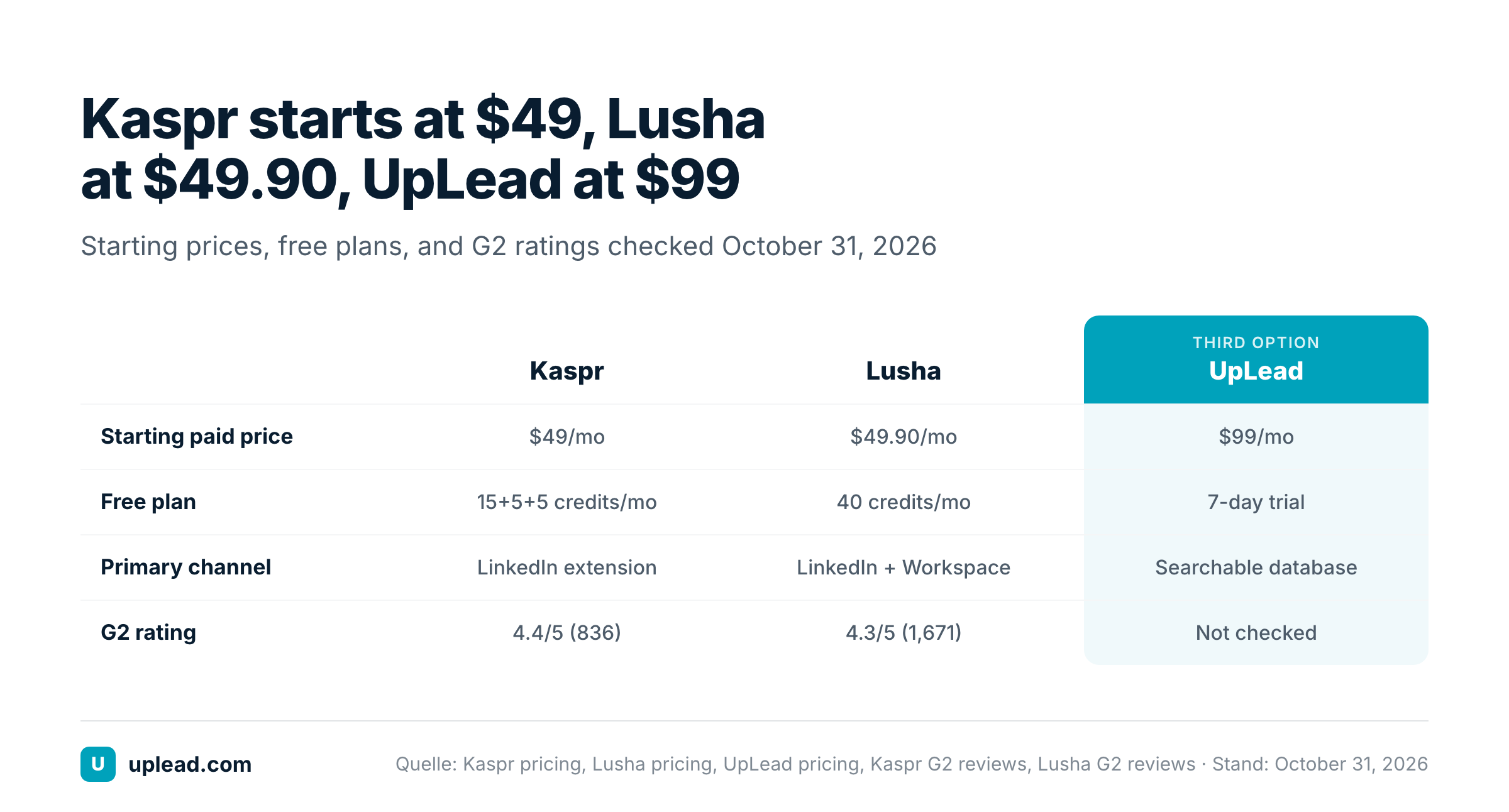
| Kaspr | Lusha | UpLead | |
|---|---|---|---|
| Starting paid price | $49/mo (Starter; see note below) | $49.90/mo (Starter) | $99/mo, or $74/mo billed annually (Essentials) |
| Free plan | Yes, 15 email + 5 phone + 5 direct-email credits/month | Yes, 40 credits/month | 7-day trial, 5 credits (not a recurring free plan) |
| Primary channel | LinkedIn Chrome extension | LinkedIn Chrome extension + Workspace platform | Searchable B2B database + Chrome extension |
| G2 rating | 4.4/5 (836 reviews) | 4.3/5 (1,671 reviews) | Not checked in this comparison |
| Best for | LinkedIn-first SDRs and recruiters, EU-heavy lists | Teams that want a bigger free plan and room to grow into signals/API | Teams that want to build lists by filters, not just LinkedIn profile-by-profile |
Source: Kaspr pricing, Lusha pricing, UpLead pricing, Kaspr G2 reviews, Lusha G2 reviews. Checked October 31, 2026.
What Kaspr and Lusha actually do
Both products solve the same problem the same way: you are looking at a LinkedIn profile, and you want that person’s work email and mobile number without leaving the tab.
The Kaspr extension sits on LinkedIn and Sales Navigator. It also works inside Recruiter Lite, and reveals contact details with one click. Kaspr says it draws on “real-time verified data from over 150 sources,” though the homepage is inconsistent about database size, citing “200m+ profiles” in one section and “500m+” verified phone numbers and emails in another. That inconsistency is worth knowing before you treat either number as precise, and honestly, it’s a reason to verify any headline figure against the live pricing or compare page rather than quoting it from memory. Kaspr also runs CSV bulk-enrichment and automation launches from a dashboard, not just one-profile-at-a-time lookups.
The core mechanic is the same: Lusha’s extension works the same way on LinkedIn, but Lusha has built more around it. A “Workspace” layer combines contact data with buying signals and CRM history, and a separate API connection (plus MCP and ChatGPT/Claude connectors) lets the same credit-based lookups run outside the browser. Lusha states over 300 million business contacts and 30 million company profiles. Its coverage spans four regions: North America, EMEA, APAC, LATAM.
Sources: Kaspr homepage, Kaspr G2 profile, Lusha G2 profile.
Kaspr pricing
At the entry tier, Kaspr’s cheapest paid plan is listed at either $49 or $65 a month, depending on which of the two unlabeled figures on Kaspr’s own pricing page you land on. That pricing page shows two prices per plan (for example, €45 or €59 for Starter) without a clear “monthly” vs. “annual” label on the plan cards themselves, and the FAQ only says subscriptions renew monthly. We’re flagging this rather than guessing which figure applies to which billing term; check the live checkout page for your billing cycle before you buy.
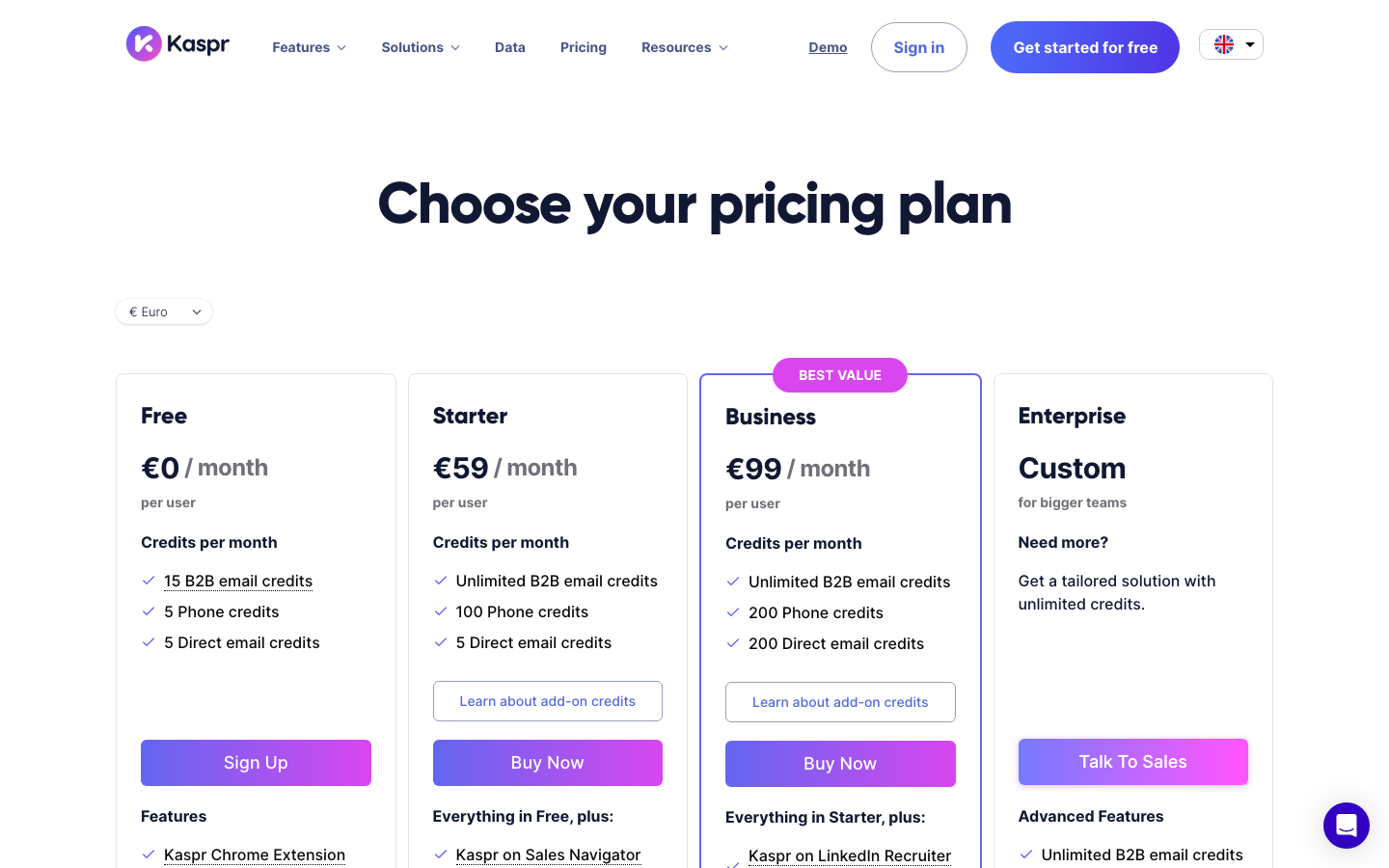
Pricing source: Kaspr pricing. Checked October 31, 2026.
Beyond the plan tiers, Kaspr also sells add-on credit packs if you run out mid-cycle, though the per-credit price drops as volume rises: one published row shows roughly €0.35 per phone credit at 2,500 credits, falling toward €0.20 at 100,000. A phone reveal costs more credits than an email reveal on Kaspr’s own compare table, so teams that call heavily burn through plans faster than teams that only email, even though both start from the same monthly allowance. There’s also an annual-only Organization tier that requires a minimum of five users and isn’t shown in Kaspr’s main plan cards.
Lusha pricing
On the paid side, Lusha’s cheapest plan, Starter, lists at $49.90 a month, or $37.45 a month ($449.10 a year) if you pay annually. A verified-email reveal costs 1 credit; a phone-number reveal costs 5 credits, so Lusha’s own credit math makes phone lookups five times more expensive than email lookups.
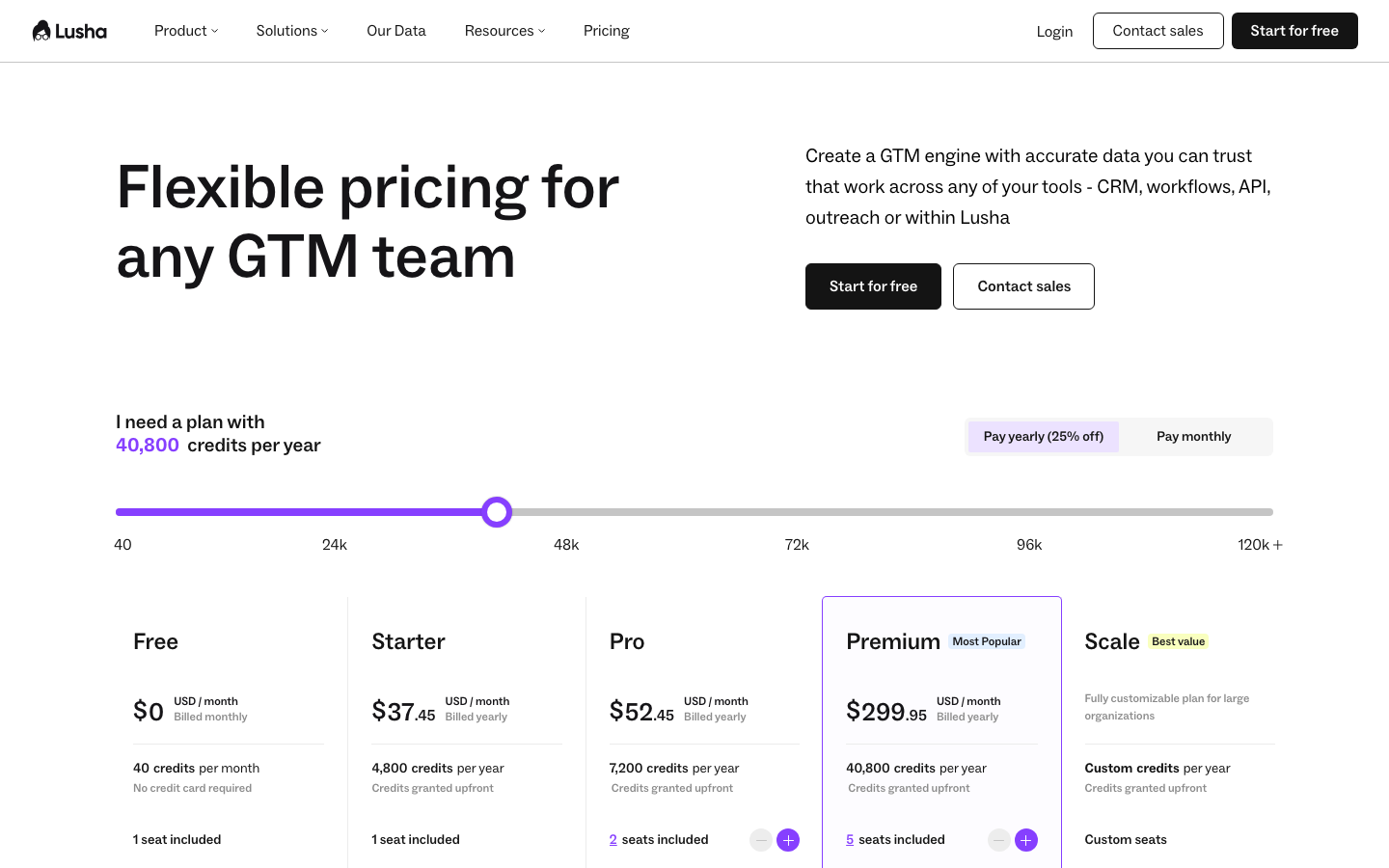
Pricing source: Lusha pricing. Checked October 31, 2026.
On monthly billing, unused Lusha credits roll over, up to twice your plan’s monthly limit, for as long as you stay subscribed. On annual billing, Lusha issues the full year of credits up front and any unused credits reset at the end of the annual cycle instead of rolling forward. Lusha’s pricing page doesn’t publish seat counts for the self-serve plans, whereas Kaspr at least names its Enterprise tier as quote-only rather than leaving it unstated; teams larger than five users on Lusha are routed to sales all the same.
Features compared
Sources: Kaspr homepage, Kaspr G2 profile, Lusha G2 profile. Checked October 31, 2026.
Lusha’s compliance list is longer and more specific. It names two ISO certifications and SOC 2 Type II on top of GDPR and CCPA. Kaspr states GDPR alignment without naming a third-party audit standard on its own site. If your company has a formal vendor-security review process, Lusha’s page gives your security team more to work with out of the gate.
Kaspr pros and cons
Lusha pros and cons
Which should you choose: Kaspr or Lusha?
Choose Kaspr if your prospecting is LinkedIn-first and your list is Europe-heavy. It also fits if you want a tool that stays narrowly focused on profile-by-profile lookups plus bulk CSV enrichment. Choose Lusha if you want a slightly bigger free plan (40 credits vs. Kaspr’s split 15/5/5) and plan to connect contact data to AI tools or your CRM’s buying-signal workflow. Its entry paid plan does run a few cents more per month, but frankly, that’s a rounding error for most teams.
Neither tool replaces a searchable database, though, when your bottleneck is building a list from scratch by firmographic filters rather than LinkedIn profile-by-profile. That’s the gap UpLead fills: instead of starting from a LinkedIn profile, you start from filters (industry, company size, title, technology used) and get a list of matching contacts with verified emails and mobile direct dials attached.
Frequently asked questions
At $49.90 a month, Lusha’s cheapest paid plan is listed slightly higher than Kaspr’s headline Starter figure. Kaspr’s pricing page shows a lower $49 figure for its Starter plan, but also a second, higher $65 figure for the same plan with no clear label distinguishing monthly from annual billing, so confirm the exact price at checkout before comparing further.
In a single pool, Lusha’s free plan gives 40 credits a month. Kaspr’s free plan splits three ways instead: 15 B2B email credits, 5 phone credits, 5 direct-email credits a month, which is more restrictive for phone lookups specifically.
Lusha doesn’t publish an independent accuracy percentage on its pricing page; a customer testimonial cited there claims “close to 100% accuracy,” and Lusha’s G2 profile states direct dials are over 90% accurate and business emails are 95-98% verified across regions, as Lusha’s own stated figures. Lusha’s G2 review summary also lists “data inaccuracy” and “outdated contacts” among recurring reviewer complaints, so treat per-record accuracy as variable rather than guaranteed.
Kaspr’s own site states it is GDPR aligned and displays GDPR and CCPA badges. It does not publish a third-party compliance audit (such as SOC 2 or ISO) on its own homepage, which is one practical difference from Lusha’s compliance page.
Yes for both. Kaspr’s free plan and Lusha’s free plan are both available without entering a credit card, based on their own pricing pages.
Kaspr stays narrowly focused on LinkedIn profile lookups and bulk CSV enrichment, with a European market lean. Lusha has grown into a broader “Workspace” that layers buying signals and API access on top of the same LinkedIn-lookup core. It also ships AI-tool connectors (MCP, ChatGPT, Claude) and carries a larger reviewer base: 1,671 G2 reviews vs. Kaspr’s 836.