


Is your sales pipeline empty? Many B2B companies struggle to generate a consistent flow of high-quality leads. Sales teams scramble and revenue goals slip out of reach. You spend a large portion of your budget on marketing, but the leads that trickle in are often low-quality, unqualified or uninterested.
This constant struggle is frustrating and costly. Every hour your sales team wastes on dead-end leads is an hour they could have spent closing deals with prospects who are ready to buy. This misalignment leads to low morale, wasted resources and the fear that your competition is pulling ahead.
But you can break this cycle.
Imagine having a direct line to prospects who fit your ideal customer profile and are searching for a solution like yours. An inbound lead is a potential customer who initiates contact with your company after discovering you through content marketing, search engines, social media or other channels.
This guide introduces a strategic approach and the tools you need to fill your pipeline with high-intent, qualified leads.
In this guide, we’ll cover what inbound leads are, how to qualify them, how to build an inbound lead generation strategy, 9 proven tactics to generate them, real-world examples and the tools you can use. It’s time to stop chasing ghosts and start having conversations that lead to real revenue.
What Are Inbound Leads?
An inbound lead is a potential customer who initiates contact with your company through your marketing efforts. These prospects discover your brand through content marketing, search engines, social media or other inbound marketing strategies and engage with your business on their own.
Unlike outbound leads who are contacted directly through cold calls or emails, inbound leads have already shown interest in your solutions. They may have downloaded a whitepaper, attended a webinar, subscribed to your newsletter or filled out a contact form on your website.
What’s the Key Difference Between Inbound vs. Outbound Leads?
The fundamental difference lies in who initiates the first contact. Outbound lead generation focuses on your sales team reaching out to prospects through phone calls, direct mail and cold emails. Here, salespeople pursue potential customers who may not be aware of your company or solutions.
Inbound marketing focuses on creating valuable content and experiences that attract prospects to establish their first contact with your company. Your sales team receives inquiries from leads who are already interested and seek more information about your products or services.
Most successful lead generation strategies combine both approaches. This allows marketing and sales efforts to target users who are ready to convert now while nurturing leads who require more education before they make a purchase decision.
| Inbound Leads | Outbound Leads | |
|---|---|---|
| Initiation | Prospect contacts you | You contact prospect |
| Awareness | Already aware of problem and seeking solutions | May not be aware of your company |
| Cost | Around 60% less than outbound | Higher cost per lead |
| Quality | Higher intent and qualification | Lower initial qualification |
| Timeline | Long-term asset building | Immediate but requires constant effort |
How Does the Inbound Marketing Funnel Work?
The inbound marketing funnel guides potential customers through three main stages that align with their buyer journey. Understanding this funnel helps you create targeted content for each stage and move prospects closer to conversion.
Top of Funnel (TOFU) – Awareness Stage: Prospects experience a problem and seek educational content. Create blog posts, infographics and social media content that addresses their pain points without promoting your product directly.
Middle of Funnel (MOFU) – Consideration Stage: Leads research solutions and compare options. Offer gated content like ebooks, case studies and webinars that demonstrate your expertise and capture contact information.
Bottom of Funnel (BOFU) – Decision Stage: Qualified leads are ready to make a purchase decision. Provide free trials, product demos, customer testimonials and consultations to convert them into paying customers.
What Are the Different Types of Inbound Leads?
Not all inbound leads are the same. Understanding different lead types helps you segment your audience and apply the right nurturing strategies. Leads are categorized based on their actions and engagement level, with lead scoring systems assigning points for behaviors like visiting pricing pages or downloading case studies.
New Lead
A new lead is a potential customer with little knowledge about your company or solutions. These are first-time website visitors who have subscribed to your newsletter or downloaded an introductory resource.
Working Lead
A working lead is a potential customer with whom your company has already established a conversation. These users have interacted with your live chat, responded to emails or engaged with your sales team directly.
Nurturing Lead
Nurturing leads are users who engage with your inbound marketing strategies but are not ready to make a purchase yet. These may be social media followers, newsletter subscribers or prospects who show interest but need more education before they convert.
Unqualified Lead
Unqualified leads are prospects who do not fit your ideal customer profile or have shown they are uninterested in your business offers.
Qualified Lead
Qualified leads are potential customers who have shown genuine interest in making a purchase and meet your ideal customer criteria. A lead’s qualification level is determined by a lead scoring system that assigns points for actions and demographic fit.
Marketing Qualified Lead (MQL)
Marketing-qualified leads have engaged with your marketing efforts and meet basic qualification criteria but are not ready for direct sales contact yet.
Sales Qualified Lead (SQL)
Sales-qualified leads have been vetted by both marketing and sales teams and are ready for direct sales engagement. They have shown clear purchase intent.
Product Qualified Lead (PQL)
Product qualified leads are users who have experienced your product through free trials or freemium models and have taken actions that signal strong buying intent, like using key features. PQLs often convert at higher rates because they have already experienced the product’s value.
Service Qualified Lead
Service-qualified leads are users who have told your customer service team they are interested in purchasing, such as asking about upgrading their service or acquiring additional products.
What Is the Difference Between an MQL and an SQL?
The difference between Marketing Qualified Leads (MQLs) and Sales Qualified Leads (SQLs) lies in their readiness for sales engagement and the criteria used to evaluate them.
A Marketing Qualified Lead is a potential customer who has shown initial interest through marketing efforts but is not yet ready to engage with sales. MQLs are qualified based on engagement with marketing content, demographic fit with your ideal customer profile and behavioral indicators like downloading resources or attending webinars.
A Sales Qualified Lead is a prospect vetted by both marketing and sales teams and deemed ready for direct sales engagement. SQLs meet stricter criteria like requesting a demo, visiting pricing pages multiple times or expressing purchase intent.
The progression from MQL to SQL involves lead scoring systems that track engagement and assign points. When a lead reaches a predefined threshold, they become an MQL. As they show stronger buying signals, their score increases and they are passed to sales for qualification as an SQL.
A Sales and Marketing Service Level Agreement (SLA) should govern this handoff process with shared definitions, lead qualification criteria, sales follow-up responsibilities (typically within 24 hours) and feedback loops to improve lead quality over time.
How Do You Qualify an Inbound Lead?
Qualifying an inbound lead determines if a prospect fits your Ideal Customer Profile (ICP) and has a high likelihood of becoming a customer. This process involves evaluating both demographic fit and behavioral indicators. For best results, follow up with inbound leads 6 or more times over 10 to 14 days to maximize conversion.
Your Ideal Customer Profile should include firmographics (industry, company size, revenue), technographics (technology stack) and behavioral attributes (pain points, goals). Lead scoring systems automate this process by assigning points based on ICP match and engagement level.
Several qualification frameworks can guide your process:
BANT (Budget, Authority, Need, Timeline): Evaluates if the prospect has budget allocated, decision-making authority, a clear need for your solution and a defined timeline for purchase.
CHAMP (Challenges, Authority, Money, Prioritization): Focuses on understanding the prospect’s challenges first, then evaluating their authority to make decisions, available budget and how your solution ranks in their priorities.
MEDDIC (Metrics, Economic Buyer, Decision Criteria, Decision Process, Identify Pain, Champion): A comprehensive framework for complex enterprise sales that identifies quantifiable metrics, economic decision-makers, formal decision criteria, the buying process, specific pain points and internal champions.
Each framework provides specific questions to assess prospects systematically and ensure your sales team focuses on the highest-value opportunities.
What Are the Main Benefits of Inbound Lead Generation?
Inbound lead generation offers significant advantages over traditional outbound methods, particularly in cost-effectiveness and lead quality.
- Cost-effective: Industry data shows inbound leads cost around 60% less than outbound leads (originally reported by HubSpot and confirmed in newer inbound marketing benchmarks). Content marketing generates over three times as many leads per dollar as traditional outbound marketing.
- Higher quality leads: Inbound prospects are already aware of their problem and seek solutions, which makes them more qualified and likely to convert than cold outbound leads.
- Improved nurturing results: Companies that excel at lead nurturing generate 50% more sales-ready leads at a 33% lower cost (Marketo / Adobe). Additionally, 80% of marketing automation users report an increase in the number of leads and 77% see an increase in conversions (VB Insight).
- Brand authority building: Inbound tactics ensure prospects find your brand during their research process, which helps you establish authority and thought leadership in your industry.
- Long-lasting impact: Unlike outbound campaigns that require constant effort, inbound marketing assets like SEO-optimized content and lead magnets can generate leads for months or years after creation.
How to Build an Inbound Lead Generation Strategy
Before you jump into tactics, you need a clear strategy that ties your inbound efforts into a coherent system. Here are the five steps to build an inbound lead generation engine:
Define Your ICP and Positioning
Start by defining your Ideal Customer Profile with firmographics, technographics and behavioral attributes. Document the pain points your solution solves and the outcomes your customers care about. This foundation ensures every piece of content and every campaign targets the right audience.
Map Your Inbound Funnel (TOFU–MOFU–BOFU)
Map content and offers to each stage of the buyer journey. At the top of the funnel (TOFU), focus on awareness content like blog posts and social media. In the middle of the funnel (MOFU), offer consideration content like webinars and case studies. At the bottom of the funnel (BOFU), provide decision content like demos and free trials. This ensures you have the right content to move prospects through each stage.
Choose Your Inbound Channels and Content Formats
Select 3 to 5 channels where your target audience spends time. Common inbound channels include SEO and organic content, webinars and virtual events, social media, email marketing, chatbots and conversational marketing, podcasts and video content, and AI-powered lead scoring. Do not try to do everything at once. Start with the channels that align best with your audience and resources.
Set Up Lead Capture, Scoring and Routing
Build the infrastructure to capture, qualify and route leads. Set up lead capture forms and landing pages for each offer. Implement a lead scoring system that assigns points based on demographic fit and behavioral signals. Define clear MQL and SQL criteria and establish a Sales and Marketing SLA that governs handoff timing, follow-up responsibilities and feedback loops. Tie your qualification frameworks (BANT, CHAMP or MEDDIC) into this step to ensure consistent evaluation.
Measure, Iterate and Scale
Track key metrics like cost per lead, MQL to SQL conversion rate, lead to customer conversion rate and customer lifetime value. Review performance monthly and identify which channels and content types deliver the best ROI. Double down on what works and cut or improve what does not. Inbound lead generation is a long-term strategy that builds momentum over time.
How to Generate Inbound Leads: 9 Inbound Lead Generation Strategies
Once you have a strategy in place, these nine tactics will help you attract high-quality inbound leads and build a sustainable pipeline. The tactics below span the full funnel: strategies 1, 2, 3 and 7 are strong for top-of-funnel awareness, strategies 4, 5 and 6 work well for middle-of-funnel consideration, and strategies 8 and 9 excel at bottom-of-funnel conversion.
1. Create High-Value Content (Blogs, eBooks, Case Studies)
Best for: B2B companies with longer sales cycles who need to educate prospects over time.
Content creation is the foundation of inbound lead generation. Focus on creating SEO-friendly, evergreen content that answers questions your prospects search for throughout their buyer journey.
Blog posts should target specific keywords and address pain points at different funnel stages. Case studies demonstrate real results and build credibility with prospects who evaluate solutions. eBooks and whitepapers serve as lead magnets that capture contact information in exchange for valuable insights.
Example: ClearVoice revamped their blog strategy to focus on high-intent keywords and saw a 1,000% increase in organic traffic and a 400% increase in leads within 12 months.
2. Optimize Your Website with Search Engine Optimization (SEO)
Best for: Companies targeting prospects who search for solutions online before they buy.
SEO ensures your content appears when prospects search for solutions. Research keywords your target audience uses, optimize your website structure and create content clusters around main topics.
Focus on both informational keywords (top of funnel) and commercial keywords (bottom of funnel) to capture prospects at every stage. Local SEO is particularly important for businesses that serve specific geographic markets.
Example: Ahrefs built a YouTube SEO strategy that ranks videos in both YouTube and Google search results, which drives thousands of qualified leads each month to their SEO tool.
3. Engage Your Audience on Social Media
Best for: B2B and B2C brands that want to build relationships and community before prospects are ready to buy.
Social media platforms allow you to share valuable content, engage directly with prospects and build relationships before they are ready to buy.
Use social media listening tools to monitor conversations about your industry and identify opportunities to provide helpful insights. Respond to comments and messages promptly and share a mix of educational content, industry news and behind-the-scenes content to humanize your brand.
4. Host Webinars and Virtual Events
Best for: B2B companies that sell complex solutions and need to demonstrate expertise to qualified prospects.
Webinars are effective for generating qualified leads, with conversion rates that typically range from 20 to 40% of attendees. They allow you to demonstrate expertise while capturing contact information from engaged prospects.
Choose topics that address specific challenges your target audience faces. Promote webinars across multiple channels and create gated recordings for ongoing lead generation. Platforms like Livestorm offer browser-based video engagement with pricing based on monthly active contacts.
Example: Spektrix ran an integrated webinar campaign that resulted in a 260% increase in lead generation in the first month, transforming from a few weekly leads to daily MQLs.
5. Offer Gated Content & Lead Magnets
Best for: Companies that want to capture contact information from prospects who are researching solutions.
Gated content provides valuable resources in exchange for contact information. The key is ensuring the perceived value matches what you ask for in return.
Create content that solves specific problems: templates, checklists, industry reports or exclusive research. The more valuable and specific the content, the more information you can request from prospects.
Example: Cisco created a gated graphic novel called “SuperSmart Security” for cybersecurity education and achieved 60% higher engagement than traditional whitepapers, generating over 2,000 qualified leads in Q1 2024.
6. Build a Lead Nurturing Email Strategy
Best for: All companies, especially those with longer sales cycles who need to stay top-of-mind with prospects.
Email marketing remains one of the most effective inbound tactics, with some studies showing up to $42 return per $1 spent. The key to success is audience segmentation and personalized messaging.
Create automated email sequences based on lead behavior and interests. Send educational content to nurture prospects and use behavioral triggers to identify when leads are ready for sales engagement.
7. Launch a Podcast or YouTube Channel
Best for: Brands that want to build thought leadership and reach audiences who prefer audio or video content.
Audio and video content are less competitive than written content and can help you reach audiences who prefer these formats.
Podcasts allow you to build relationships with industry experts through interviews while positioning yourself as a thought leader. YouTube videos act like SEO-friendly content and can rank in both YouTube and Google search results.
Example: Rocketship.fm launched a podcast that interviews startup founders and marketers. Each episode drives qualified traffic back to their site and generates leads who are interested in their growth marketing services.
8. Use AI-Powered Chatbots for Instant Engagement
Best for: Companies that want to qualify leads 24/7 and provide immediate responses to common questions.
Chatbots can qualify leads around the clock and provide immediate responses to common questions. They are particularly effective for capturing leads outside business hours.
Program chatbots to ask qualifying questions and route high-intent prospects to your sales team immediately. Platforms like qikchat specialize in omnichannel communications across WhatsApp and Instagram for customer interactions.
9. Leverage AI for Predictive Scoring and Hyper-Personalization
Best for: Companies with large lead volumes who need to prioritize the highest-intent prospects and personalize at scale.
Companies that use AI in their lead generation processes report up to a 50% increase in lead generation effectiveness. AI transforms both lead qualification and content personalization.
Predictive lead scoring uses AI to analyze behavioral and demographic data and assign likelihood-to-convert scores that learn from past successes. Unlike static rule-based scoring, AI models identify complex patterns and can increase conversion rates by 30 to 50%.
Hyper-personalization uses real-time data to deliver individualized content and experiences at scale, with marketers seeing up to 25% lift in engagement rates. Tools include Salesforce Einstein and HubSpot AI for scoring, plus Dynamic Yield and Adobe Target for personalization.
Challenges of Inbound Lead Generation (and How to Avoid Them)
Inbound lead generation is powerful, but it comes with challenges that can derail your efforts if you are not prepared. Here are the most common pitfalls and how to avoid them:
Expectation mismatch on timelines
Inbound lead generation is not a quick fix. It typically takes 6 to 12 months to see full impact as your content gains search visibility and your brand builds authority. Fix: Set realistic expectations with stakeholders and run a small paid campaign in parallel to generate leads while your inbound engine ramps up.
Underfunded content and SEO
Many companies underestimate the resources required to produce high-quality content and execute effective SEO. Fix: Allocate budget for content creation, keyword research tools and technical SEO. Consider hiring specialists or agencies if you lack in-house expertise.
No SLA or follow-up process for inbound leads
Inbound leads lose interest fast if they do not receive a timely response. Without a clear handoff process, leads fall through the cracks. Fix: Establish a Sales and Marketing SLA that defines MQL criteria, response time (ideally within 24 hours) and follow-up cadence (6 or more touches over 10 to 14 days).
Poor offer–audience fit
Creating content on the wrong topics or offering lead magnets that do not resonate with your ICP wastes time and budget. Fix: Validate content ideas with customer interviews, keyword research and competitor analysis before you invest in production.
Over-reliance on one channel
Depending solely on SEO or only on webinars makes your pipeline vulnerable to algorithm changes or market shifts. Fix: Diversify across 3 to 5 inbound channels (SEO, social, email, webinars, chatbots) to build a resilient lead generation engine.
What Are Real-World Examples of Inbound Lead Generation?
Here are proven examples of successful inbound lead generation strategies from real companies:
HubSpot’s Freemium Strategy (gated content & product-led)
HubSpot generates massive leads through their comprehensive suite of free tools including CRM (up to 1 million contacts), Live Chat, Online Form Builder, Email Marketing, Website Builder, AI Content Writer and Meeting Scheduler. This freemium model encourages users to upgrade to paid tiers as their needs grow.
Cisco’s Creative Content Approach (gated content)
Cisco created a gated graphic novel called “SuperSmart Security” for cybersecurity education and achieved 60% higher engagement than traditional whitepapers, generating over 2,000 qualified leads in Q1 2024.
Spektrix’s Webinar Campaign (webinars)
This B2B company ran an integrated webinar campaign that resulted in a 260% increase in lead generation in the first month, transforming from a few weekly leads to daily MQLs through strategic promotion and gated webinar recordings.
These examples demonstrate the power of providing genuine value first, whether through free tools, creative educational content or expert knowledge sharing.
How Do You Measure Inbound Lead Generation Success?
Measuring inbound lead generation success requires tracking both quantity and quality metrics to ensure your efforts generate profitable results.
| Metric | Good Benchmark | Why It Matters |
|---|---|---|
| Cost Per Lead (CPL) | B2B SaaS: $188–$237; Tech: $45–$80 | Measures efficiency of your spend |
| MQL to SQL Conversion | 13–51% depending on source | Shows lead quality and alignment |
| Lead to Customer Rate | B2B SaaS: 1–5%; above 5% is high-performing | Measures overall funnel effectiveness |
| Customer Lifetime Value | 3:1 to 5:1 LTV to CAC ratio | Ensures long-term profitability |
| Email Marketing ROI | Up to $42 per $1 spent | Validates nurturing investment |
- Cost Per Lead (CPL)B2B SaaS companies typically see CPLs between $188 and $237, while technology companies average $45 to $80. Organic leads generally cost less ($164) than paid leads ($310).
- Conversion Rates: MQL to SQL conversion rates range from 13% to 51% depending on source, with SEO-generated leads showing higher conversion rates. Lead-to-customer conversion rates for B2B SaaS typically range 1 to 5%, with rates above 5% considered high-performing.
- Customer Lifetime Value (CLV): Maintain a 3:1 to 5:1 LTV to Customer Acquisition Cost ratio to ensure profitability. Track how different lead sources perform in terms of long-term customer value.
- Return on Marketing Investment: Email marketing can show up to $42 return per $1 spent, while content marketing generally provides higher ROI than traditional advertising methods.
What Are the Best Inbound Lead Generation Tools?
The right tools can improve your inbound lead generation results. Here are the key categories and recommended platforms:
What Are the Best Inbound Lead Generation Tools?
The best inbound lead generation tools are Salesforce for CRM, HubSpot for marketing automation, UpLead for B2B contact data, Semrush for SEO & Content, Dashly for convesational marketing, Sender for email marketing and Zapier for workflow optimization.
| Tool | Category | Best for | Pricing from |
|---|---|---|---|
| Salesforce | CRM | Enterprise sales teams needing comprehensive contact and pipeline management | Contact sales |
| HubSpot Marketing Hub | Marketing Automation | Mid-market B2B companies wanting integrated email, landing pages and lead scoring | Contact sales |
| UpLead | B2B contact data | B2B teams needing verified contact data with high accuracy and intent signals | Essentials plan from $974/month for 170 credits |
| Semrush | SEO & Content | Content marketers and SEO teams doing keyword research and competitive analysis | Pro $139.95/month |
| Dashly | Conversational Marketing | Companies wanting live chat, chatbots and email campaigns in one platform | Conversation plan from $39/month for up to 1,000 monthly visitors (discounted on annual billing) |
| Sender | Email Marketing | Small to mid-size teams needing affordable email and SMS automation | Free plan for 2,500 subscribers; paid plans with higher limits and additional features (pricing depends on list size) |
| Zapier | Workflow Automation | Teams connecting multiple tools to automate lead routing and data sync | Paid plans start around $19.99/month (depending on tasks and billing) |
Customer Relationship Management (CRM) Tools
Salesforce – Best for enterprise sales teams needing comprehensive contact and pipeline management
Salesforce provides comprehensive contact management, lead management and workflow automation to track prospects throughout their journey.
- Key features: Contact and account management, lead scoring and routing, sales pipeline tracking, workflow automation, reporting and dashboards
- Pros: Highly customizable, robust integrations, enterprise-grade security
- Cons: Steep learning curve, can be expensive for small teams
- Pricing: Contact sales
Marketing Automation Tools
HubSpot Marketing Hub – Best for mid-market B2B companies wanting integrated email, landing pages and lead scoring
HubSpot Marketing Hub offers email automation, landing page creation and campaign management with integrated analytics and lead scoring capabilities.
- Key features: Email marketing automation, landing page builder, lead scoring, CRM integration, analytics and reporting
- Pros: User-friendly interface, strong free tier, excellent support and training
- Cons: Can get expensive as you scale, some advanced features locked to higher tiers
- Pricing: Contact sales
B2B Contact Data Tools
UpLead – Best for B2B teams needing verified contact data with high accuracy and intent signals
UpLead provides access to over 160 million business contacts with 95% data accuracy guarantee and real-time email verification. It offers over 50 search filters including technographics and buyer intent data powered by Bombora.
- Key features: 160M+ contacts, 95% accuracy guarantee, real-time email verification, 50+ filters including technographics, Bombora intent data
- Pros: High data accuracy, real-time verification, intent data integration
- Cons: Credit-based pricing can add up for high-volume users
- Pricing: Essentials plan from $74/month for 170 credits
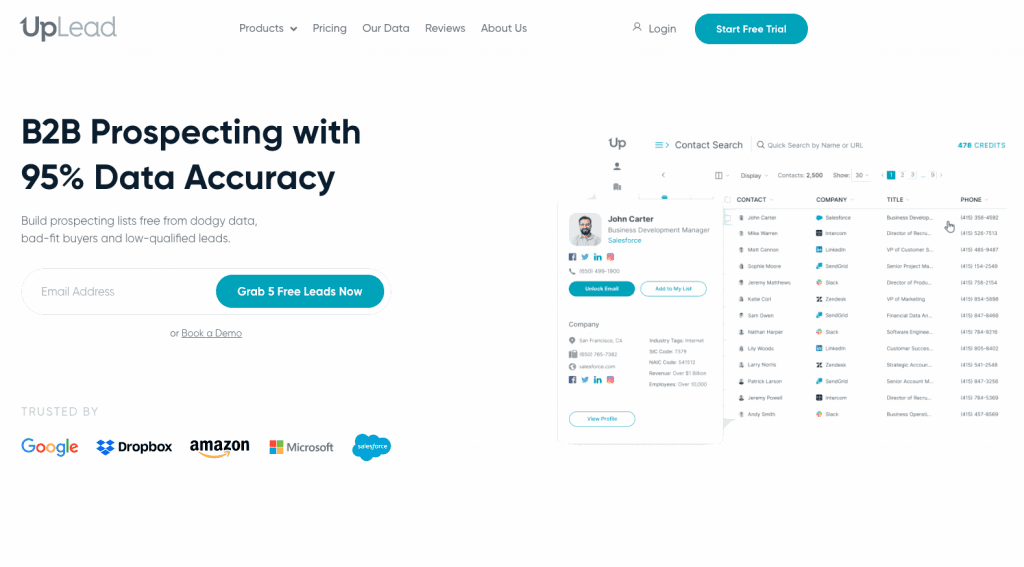
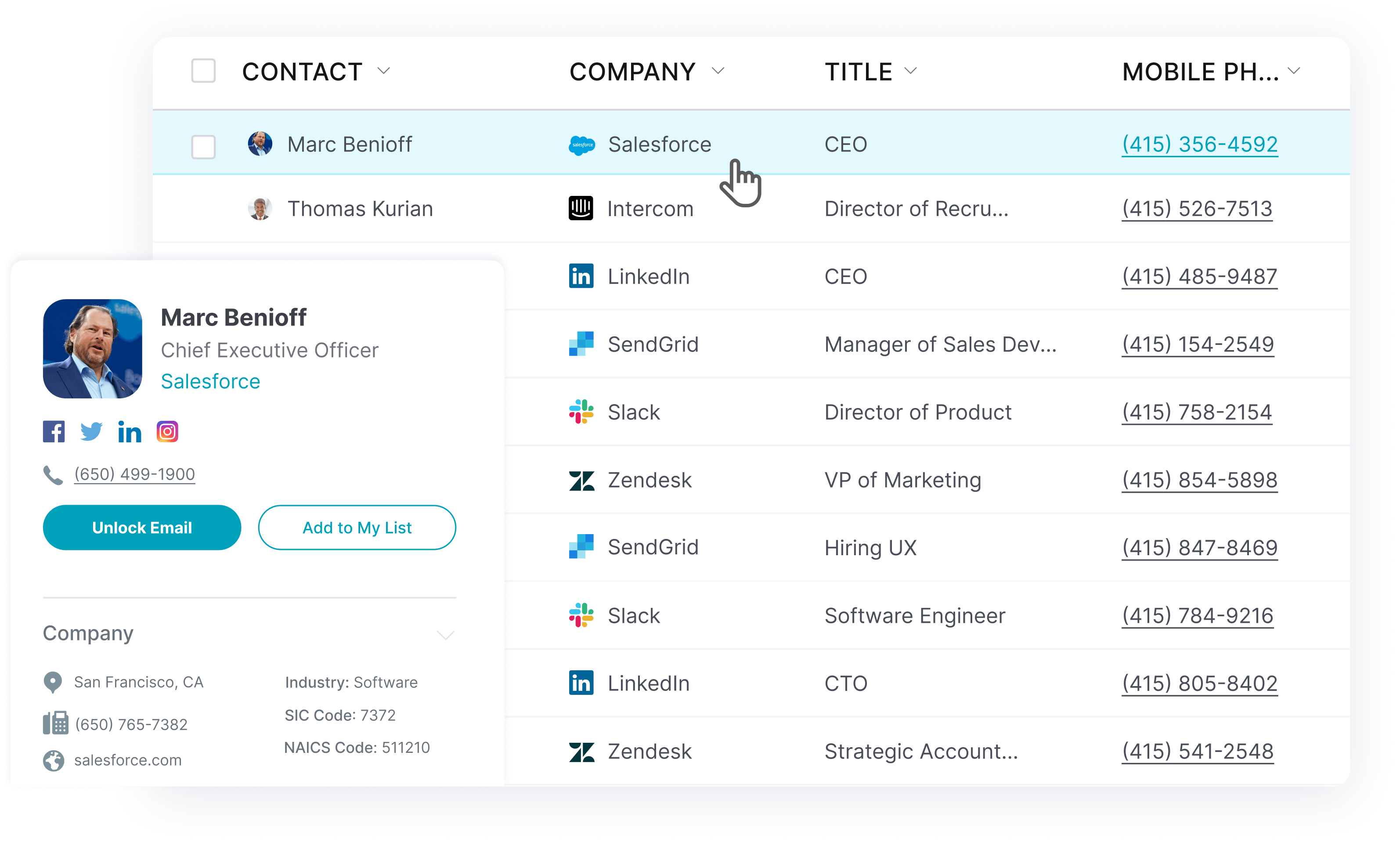
With UpLead, you can enrich your inbound leads with relevant business information like job titles, industries, technographic data and more. Simply upload your email list and let UpLead append valuable details to help you segment leads into the right nurturing strategies.
Try UpLead for free today and see if it fits your needs.

Leadfeeder – Best for identifying anonymous website visitors and turning traffic into leads
Leadfeeder identifies website visitors and turns anonymous traffic into company leads.
- Key features: Website visitor identification, company data enrichment, CRM integrations, lead scoring
- Pros: Uncovers hidden leads from existing traffic, easy setup, free plan available
- Cons: Identifies companies, not individual contacts; requires additional tools for outreach
- Pricing: Free plan available; paid plans from €99/month (around $100/month)
SEO and Content Analytics Tools
Semrush – Best for content marketers and SEO teams doing keyword research and competitive analysis
Semrush offers keyword research, competitive analysis and content optimization.
- Key features: Keyword research, competitive analysis, site audit, backlink analysis, content optimization
- Pros: Comprehensive SEO toolkit, strong competitive intelligence, content marketing features
- Cons: Can be overwhelming for beginners, higher price point
- Pricing: Pro $139.95/month, Guru $249.95/month, Business $499.95/month
Conversational Marketing Tools
Dashly – Best for companies wanting live chat, chatbots and email campaigns in one platform
Dashly.io provides conversational marketing with live chat, chatbots and email campaigns.
- Key features: Live chat, chatbots, email campaigns, lead qualification, analytics
- Pros: All-in-one conversational platform, affordable entry point, good automation
- Cons: Smaller user base than major competitors, fewer integrations
- Pricing: Conversation plan from $39/month for up to 1,000 monthly visitors (discounted on annual billing)
Email Marketing Automation
Sender – Best for small to mid-size teams needing affordable email and SMS automation
Sender.net provides email and SMS marketing automation with a free plan for up to 2,500 subscribers and 15,000 emails per month.
- Key features: Email and SMS automation, drag-and-drop builder, segmentation, analytics
- Pros: Generous free plan, affordable paid tiers, easy to use
- Cons: Fewer advanced features than enterprise platforms
- Pricing: Free plan for 2,500 subscribers and 15,000 emails/month; paid plans with higher limits and additional features (pricing depends on list size)
Interactive Content Creation
involve.me – Best for creating interactive quizzes, calculators and forms to capture leads
involve.me creates interactive sales funnels with quizzes and forms using AI.
- Key features: Interactive quizzes, calculators, forms, AI-powered creation, analytics
- Pros: Engaging interactive content, AI assistance, good templates
- Cons: Learning curve for advanced features
- Pricing: Free plan available; Starter plan from $29/month (when billed annually)
weavely.ai – Best for quickly generating forms and surveys with AI
weavely.ai is an AI form and survey builder that generates forms from text prompts.
- Key features: AI form generation, unlimited forms and responses (free plan), customization, analytics
- Pros: Fast form creation with AI, generous free plan, simple interface
- Cons: Fewer advanced features than specialized form builders
- Pricing: Free plan with unlimited forms and responses; Pro plan at around €180/year
Sales Engagement Platforms
lemlist – Best for multichannel outreach with email, LinkedIn and calls plus AI personalization
lemlist offers multichannel outreach across email, LinkedIn and calls with a built-in lead database of over 450 million contacts and AI-powered personalization.
- Key features: Multichannel sequences, 450M+ lead database, AI personalization, deliverability tools
- Pros: Strong personalization features, multichannel capability, built-in lead data
- Cons: Can be complex for beginners, pricing scales with team size
- Pricing: Email Pro from around $69/user/month, Multichannel Expert from around $99/user/month (exact price depends on billing cadence)
Workflow Automation
Zapier – Best for teams connecting multiple tools to automate lead routing and data sync
Zapier connects thousands of web apps to create automated workflows.
- Key features: 5,000+ app integrations, multi-step workflows, conditional logic, scheduling
- Pros: Huge integration library, no-code automation, flexible workflows
- Cons: Can get expensive with high task volumes, some integrations are limited
- Pricing: Free plan available; paid plans start around $19.99/month (depending on tasks and billing)
Inbound Lead Generation FAQs
What is an inbound lead?
An inbound lead is a potential customer who initiates contact with your company after discovering you through content marketing, search engines, social media or other inbound channels. Unlike outbound leads, inbound leads have already shown interest in your solutions before you reach out to them.
Are inbound leads better than outbound leads?
Inbound leads are often higher quality and more cost-effective than outbound leads. Industry data shows inbound leads cost around 60% less than outbound leads and convert at higher rates because they are already aware of their problem and seeking solutions. However, the best lead generation strategies combine both inbound and outbound approaches.
How long does inbound lead generation take to work?
Inbound lead generation typically takes 6 to 12 months to show full impact. SEO and content marketing need time to gain search visibility and build authority. However, some tactics like paid social ads and webinars can generate leads within weeks. The key is to set realistic expectations and run a mix of short-term and long-term tactics.
How many inbound leads do I need per month?
The number of inbound leads you need depends on your average deal size, sales cycle length and conversion rates. Work backward from your revenue goal: if you need $1M in new revenue, your average deal is $50K and your lead-to-customer rate is 2%, you need 1,000 leads per year or about 84 per month. Track your funnel metrics to refine this over time.
How do I measure inbound lead generation success?
Measure inbound lead generation success with these key metrics: Cost Per Lead (CPL), MQL to SQL conversion rate, lead to customer conversion rate, Customer Lifetime Value (CLV) and Return on Marketing Investment. Track these metrics by channel to identify which inbound tactics deliver the best ROI and double down on what works.
Does inbound lead generation work for B2B and B2C?
Yes, inbound lead generation works for both B2B and B2C, but the tactics and timelines differ. B2B inbound often focuses on longer sales cycles with content like whitepapers, webinars and case studies. B2C inbound tends to emphasize shorter cycles with social media, email marketing and product demos. Both benefit from SEO, content marketing and lead nurturing.
Conclusion
Inbound leads are the foundation of sustainable business growth. By creating valuable content, optimizing for search engines and implementing the right qualification processes, you can attract prospects who are already interested in your solutions.
The key to success lies in understanding your audience, providing genuine value at every touchpoint and using data to improve your approach over time. Start with one or two strategies from this guide, measure your results and scale what works best for your business.
Remember that inbound lead generation is a long-term strategy that builds momentum over time. The content you create today will continue to generate leads for months or years to come, which makes it one of the most cost-effective approaches to sustainable growth.