


The world of sales is often complex and difficult to navigate. If you’re going to seize sales success, it’s critical to learn from the best in the business. In this piece, we’ll work our way through 30+ actionable sales tips shared by the best minds in sales—updated for the challenges of 2025.
What Are Actionable Sales Tips?
This blog post provides actionable sales tips—specific, practical techniques that sales professionals can implement immediately to improve their performance. These tips are based on actionable data that sales professionals and managers can use to enhance coaching effectiveness, tailor messaging, and make strategic adjustments. Unlike vague advice, these tips provide clear steps backed by data and proven methodologies that help you prospect smarter, engage deeper, close faster and exceed your quota.
Key Takeaways
- Adopt a Modern Sales Methodology: Shift from transactional selling to a consultative, value-based approach. Act as a trusted advisor rather than just pushing products.
- Embrace Digital and AI-Driven Selling: Leverage AI for prospecting, lead scoring and automating repetitive tasks. Integrating digital tools like personalized video and robust CRM platforms is essential for engaging modern B2B buyers.
- Optimize Your Funnel with Data-Driven Efforts: Use data analytics and relevant data to understand customer behavior, identify high-value leads and personalize the sales journey for consistent buyer experiences.
- Cultivate a Growth and Collaborative Mindset: Foster continuous team development and strong alignment between sales, marketing and customer success. Focus on improving skills and adapting to market changes.
What Sales Methodologies Should You Master?
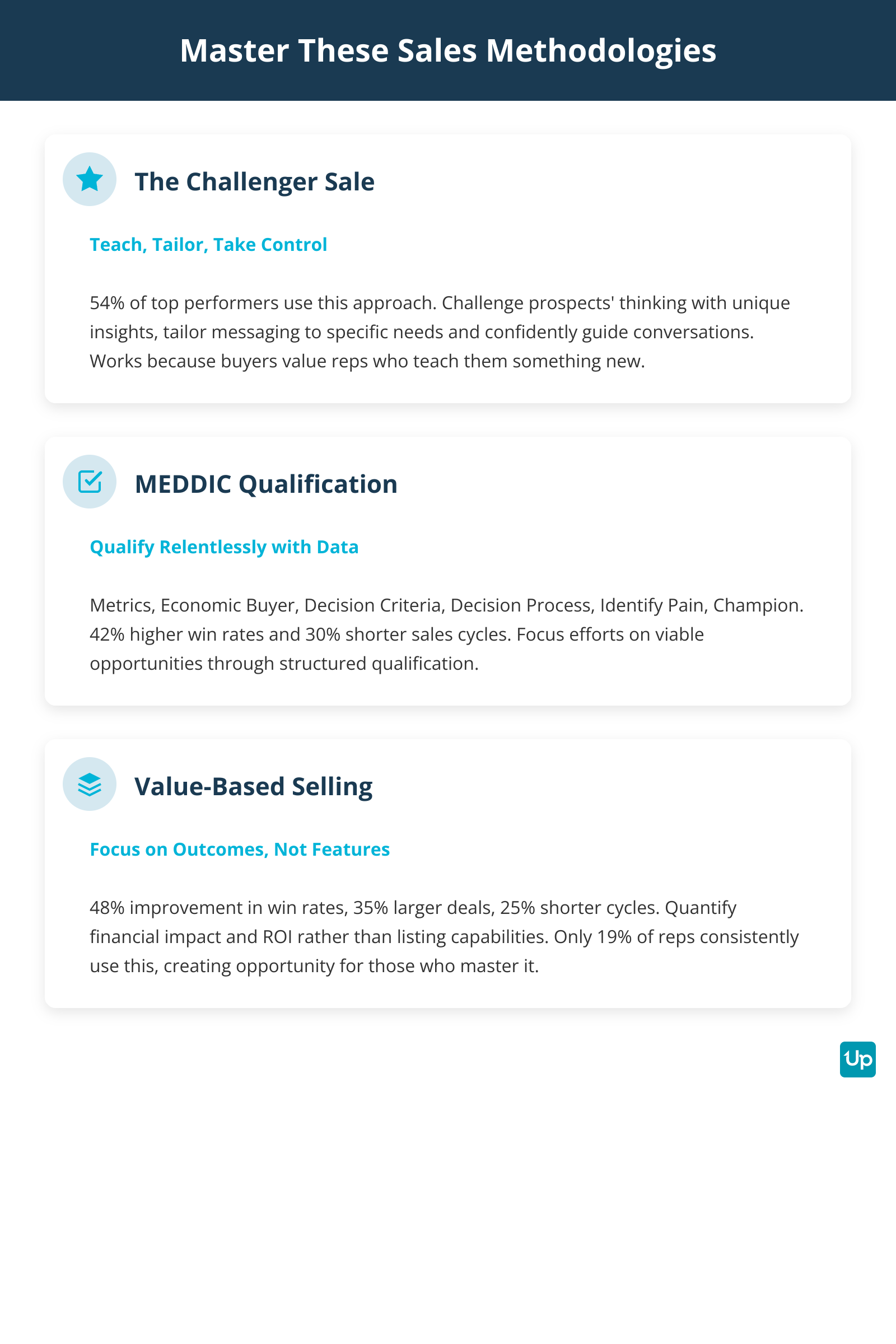
Sales methodologies provide a strategic framework for your selling efforts. Mastering the right methodology helps you navigate complex B2B sales environments, qualify prospects effectively and close deals with confidence. Top methodologies empower sales teams to challenge the status quo by offering unique value—not just features—to prospects, which is essential for disrupting complacency and driving continual improvement. Here are three proven methodologies that top-performing sales teams use in 2025.
Three Essential Sales Methodologies Framework
The Challenger Sale: Teach, Tailor and Take Control
The Challenger Sale methodology focuses on a “Teach, Tailor, Take Control” approach. Reps teach prospects new insights about their business, tailor messaging to specific needs and confidently guide the sales conversation. Effective reps steer discussions toward the prospect’s desired outcome, such as closing a deal or booking a demo, ensuring each interaction is purposeful and aligned with targeted results. According to research from Gartner (formerly CEB), 54% of top-performing reps in complex B2B sales environments use the Challenger profile, making it the most successful approach. In contrast, Relationship Builders account for only 7% of high performers.
This methodology works because modern buyers are overwhelmed with information. They value sales professionals who can challenge their thinking and provide unique insights that help them make better decisions.
MEDDIC: Qualify Relentlessly with Data
MEDDIC is a B2B qualification framework that stands for Metrics, Economic Buyer, Decision Criteria, Decision Process, Identify Pain and Champion. A crucial part of this approach is identifying and engaging with key decision makers within the target organization, which increases the chances of closing a deal and allows for more customized outreach strategies. This structured approach helps sales teams focus their efforts on the most viable opportunities.
Sales teams using structured qualification frameworks like MEDDIC report up to 42% higher win rates and 30% reduction in sales cycle length. The methodology forces reps to gather critical information early in the sales process, preventing wasted time on deals that were never going to close.
Value-Based Selling: Focus on Outcomes, Not Features
Value-Based Selling shifts focus from product features to tangible business outcomes and ROI. Instead of listing capabilities, you quantify the financial impact your solution will have on the prospect’s business. The only difference between buyer and seller is often the approach to achieving the desired business outcome, not the end goal itself—both want a solution that delivers real value.
A 2024 study found salespeople consistently applying value selling see 48% improvement in win rates, 35% increase in deal sizes and 25% reduction in sales cycle length. However, only 19% of reps consistently use this methodology, creating a significant opportunity for those who master it.
To apply value selling, conduct thorough discovery to understand customer challenges, quantify value by connecting solutions to measurable ROI like “reducing costs by 20%” and use storytelling with case studies to demonstrate proven results.
How Can You Improve Prospecting?
Prospecting is the lifeblood of sales, especially in outbound sales, where salespeople proactively reach out to prospects who may not yet be familiar with your company or offerings. Without a healthy pipeline, even the best closers will miss quota. Modern prospecting requires a multi-channel approach, data-driven targeting and persistent follow-up. Daily outreach, including consistent prospecting and follow-up, is crucial for maintaining sales efficiency.
Modern Multi-Channel Prospecting Strategy
Focus on High-Quality, High-Intent Leads
High-quality leads are prospects who match your ideal customer profile and show buying intent. The key to sales success is learning to balance your priorities and focus your attention on the right prospects.
To only focus on the most valuable and viable prospects, you need to use key information and insights. This approach will help you close the right deals and push your revenues higher.
“Quality always wins in sales,” notes Erica Stritch, Vice President at the RAIN Group. She uses her seasoned insight to help companies improve their sales performance and increase their revenues.
Use intent data, technographic filters and firmographic criteria to identify prospects who are actively researching solutions like yours. Tools like UpLead’s Prospector allow you to layer over 50 filters to build laser-targeted lists from a database of 160+ million contacts with 95% accuracy.
Master Multi-Channel Prospecting
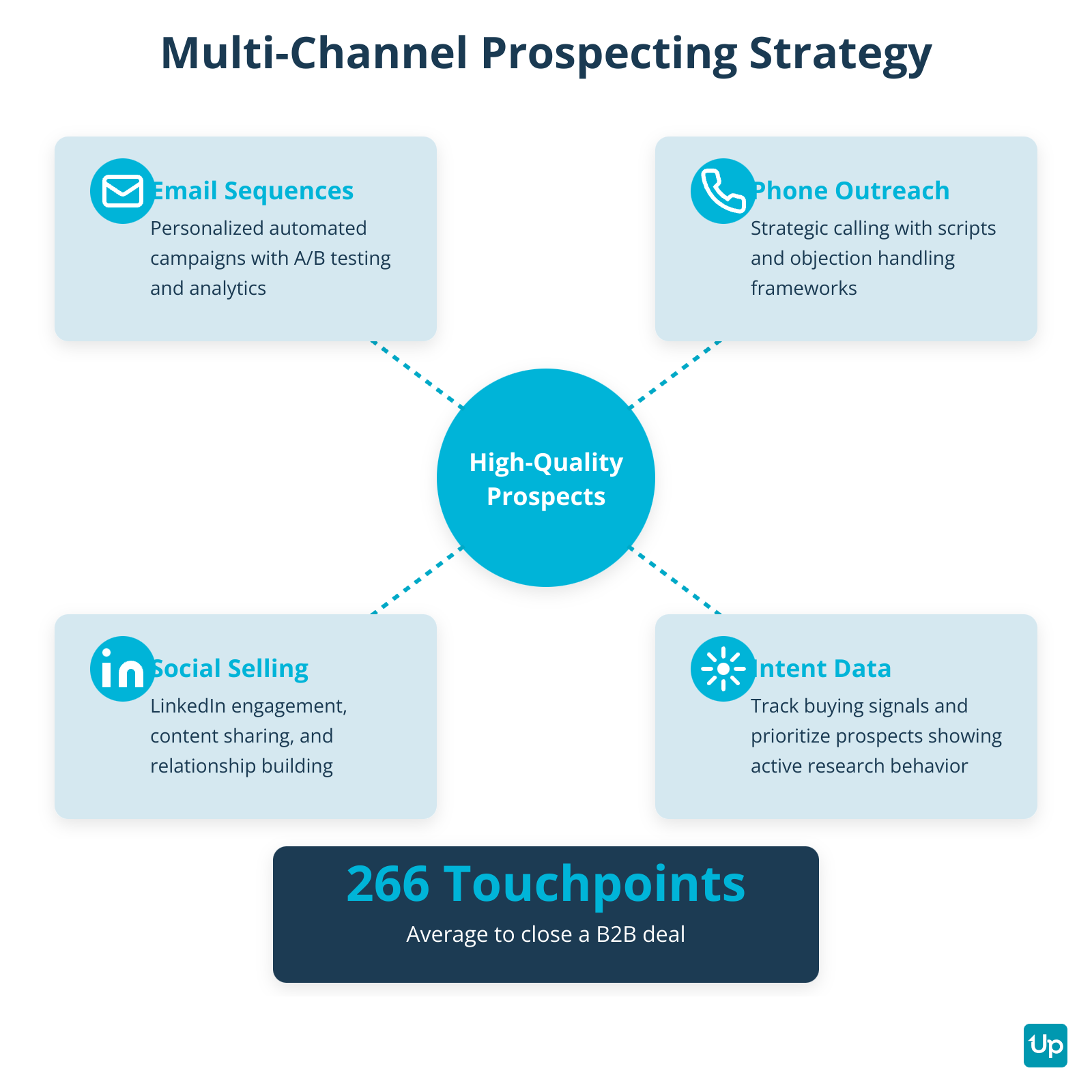
Multi-channel prospecting uses email, phone, LinkedIn and direct mail to reach prospects where they are most responsive. Many sellers successfully use multi-channel prospecting to generate new deals and expand their pipeline. According to a HockeyStack report, it takes an average of 266 touchpoints to close a B2B deal, rising to over 400 for large deals over $100,000. McKinsey’s 2024 research shows buyers now use 10+ channels during their purchasing journey.
Your prospecting cadence should include email, phone calls, LinkedIn messages and direct mail. Tools like Woodpecker.co can help automate personalized email sequences with A/B testing and analytics. GMass enables mass email campaigns directly within Gmail, used by over 300,000 users.
“A baseball team won’t win a game if they hit the ball once,” explains Jeff Kalter, founder and CEO of 3D2B, a lead generation and follow-up company.
Create a structured cadence that touches prospects across multiple channels over 2-3 weeks. Track response rates by channel and adjust your approach based on what resonates with your target audience.
Use Intent Data to Find Active Buyers
Intent data identifies prospects who are actively researching solutions in your category. This allows you to prioritize outreach to companies showing buying signals, dramatically improving conversion rates. Additionally, using AI to prioritize leads can free up time selling, enabling salespeople to focus on engaging with the most promising prospects.
UpLead’s Intent Data feature (available on the Professional Plan) tracks prospects across 27,000+ technologies and buying signals. When a prospect visits review sites, searches for solution comparisons or downloads competitor whitepapers, they enter your target list.
Combine intent data with personalized messaging that references the specific research they’ve been conducting. For example: “I noticed your team has been evaluating sales intelligence platforms. Here’s how companies like yours have reduced their prospecting time by 50%.”
Leverage Social Selling on LinkedIn
Social selling on LinkedIn builds relationships and credibility before making direct sales outreach. LinkedIn is 277% more effective for B2B lead generation than other social platforms. According to LinkedIn, 78% of salespeople who use social selling outperform their peers. Social selling leaders create 45% more opportunities and are 51% more likely to reach quota.
Here are three actionable strategies:
- Optimize your profile as a value-centric resource: Your headline should state how you help target audiences, not just your title. For example: “Helping SaaS Companies Cut Prospecting Time by 50% | Sales Intelligence Expert.”
- Engage authentically before connecting: Comment on prospects’ posts 2-3 times over several weeks to build familiarity before sending a connection request.
- Follow the 80/20 rule: Spend 80% of your time engaging with others’ content and 20% sharing your own insights. This builds credibility without appearing overly promotional.
Know Your Competitors’ Weaknesses
Understanding competitor weaknesses helps you position your solution effectively and handle objections with confidence. Your product or service exists within a complex and competitive environment. If you’re going to seize sales success, you’ll need to understand where your product fits and what makes it unique compared to the alternatives.
Research key competitors and identify specific areas where your solution is stronger. Tools like Apify or Zapier can help automate competitor analysis by extracting data on pricing, positioning, and customer signals at scale.Create a competitive battle card for each major competitor that includes their typical pricing, key weaknesses, customer complaints and your differentiated value proposition.
Marcia Neese, a business partner for the Brooke Group with over 25 years of experience, recommends that sales teams conduct thorough competitor analysis to help clients improve the overall performance of their sales departments.
Use this intelligence to position your solution effectively during discovery calls and handle competitive objections with confidence.
How Do You Build Trust During Engagement?
Building trust is the foundation of successful selling. Modern buyers are skeptical and well-informed. They can spot inauthentic salespeople immediately. Positioning yourself as a sales expert helps establish credibility and builds trust with prospects.
Sales professionals should also create a buyer persona to better understand and engage with their target customers.
Forge Genuine Connections to Build Trust
Genuine connections are built on authenticity and shared understanding. As human beings, we are highly social creatures and we’ve evolved to trust the people around us.
“When people get to know and like you, people begin to trust you,” explains Mike Schultz, President at the RAIN Group and a true sales veteran who has co-authored several books on sales.
If your salespeople can forge genuine connections with prospects, you’ll be in a better position to sell and launch a fruitful partnership. Focus on finding common ground, showing genuine curiosity about their business and being transparent about how you can help.
Learn to Listen More and Talk Less
Listening more and talking less helps you understand prospect needs and build deeper relationships. The most successful salespeople learn when to talk and when to listen. Monitoring how much time you spend talking versus listening during sales calls is essential for improving engagement and understanding your prospects. This sales skill is fundamental and if you master it, you could truly transform your sales fortunes.
Top performers talk only 43% of the time during successful sales calls, highlighting the importance of listening more and talking less.
Linda Richardson, president of The Richardson Company and author of Stop Telling, Start Selling: Using Customer Focus Dialogue to Close Sales, emphasizes that learning to listen is critical for sales success.
Improve your listening skills by taking detailed notes, paying attention to non-verbal cues and learning not to jump to conclusions. Ask open-ended questions and resist the urge to fill every silence. Often, the most valuable insights come after a pause when the prospect shares what’s really on their mind.
Personalize Every Interaction at Scale
Personalization at scale uses technology to tailor messaging to individual prospects without sacrificing efficiency. According to a 2021 McKinsey report, companies that excel at personalization generate 40% more revenue from these activities than average players. The same research notes that 71% of consumers expect personalized interactions and 76% get frustrated when this doesn’t happen.
Modern personalization goes beyond using a prospect’s first name. Reference specific details from their LinkedIn profile, mention a recent company announcement and tailor content to their industry challenges.
Mike Michalowicz, author and founder of Profit First Professionals, advises: “Speak your prospect’s language. Research the prospect and identify keywords they use, so your sales pitch resonates.”
Use tools like UpLead’s Data Enrichment to append 50+ fields to your contact records, giving you the context needed to personalize at scale without spending hours on manual research.
Research Your Prospect’s World
Researching your prospect’s business, industry and challenges demonstrates professionalism and helps you provide relevant insights. Salespeople should become experts on their prospects in order to really capture their attention. Take the time to build a clear picture of their business, industry trends, competitive pressures and strategic initiatives. This research enables you to anticipate and address the prospect’s concerns during sales conversations, allowing you to adjust your approach in real-time based on their reactions or hesitations.
It’s also important to ask open-ended questions to uncover your prospects’ needs, ensuring you fully understand their situation and can provide tailored solutions.
Jim Keenan, CEO of A Sales Guy Inc with over 20 years of sales experience, recommends that salespeople “research and delight your customers. Have a full understanding of the way your product or service can deliver practical value to the prospect.”
Before every call, spend 10-15 minutes reviewing the prospect’s LinkedIn profile, recent company news, their website and any content they’ve published. Use UpLead’s Company Search to access firmographic data like revenue, employee count, technologies used and funding status.
Leverage Social Proof and Customer Testimonials
Social proof and testimonials overcome buyer skepticism by showing real results from similar customers. Your prospects might not always believe in your product or service. Sales teams can conquer that disbelief by providing testimonials from existing customers. This social proof could inspire your prospects to act and see the true value of your product or service.
Bob Bly, an independent copywriter and consultant who has authored more than 50 books, emphasizes the power of customer testimonials in overcoming buyer skepticism.
Create a library of case studies organized by industry, use case and company size. During discovery, identify which testimonial will resonate most with your prospect’s specific situation. Video testimonials are particularly powerful because they add authenticity and emotional connection.
What Techniques Close Deals with Confidence?
Closing is where all your prospecting and engagement efforts pay off. Refining your closing techniques makes sense as a logical strategy for sales success. Modern closing techniques are collaborative rather than manipulative. They focus on creating clarity and mutual agreement. To avoid delays in the sales process, sales professionals should always wrap up calls with a clear next step.
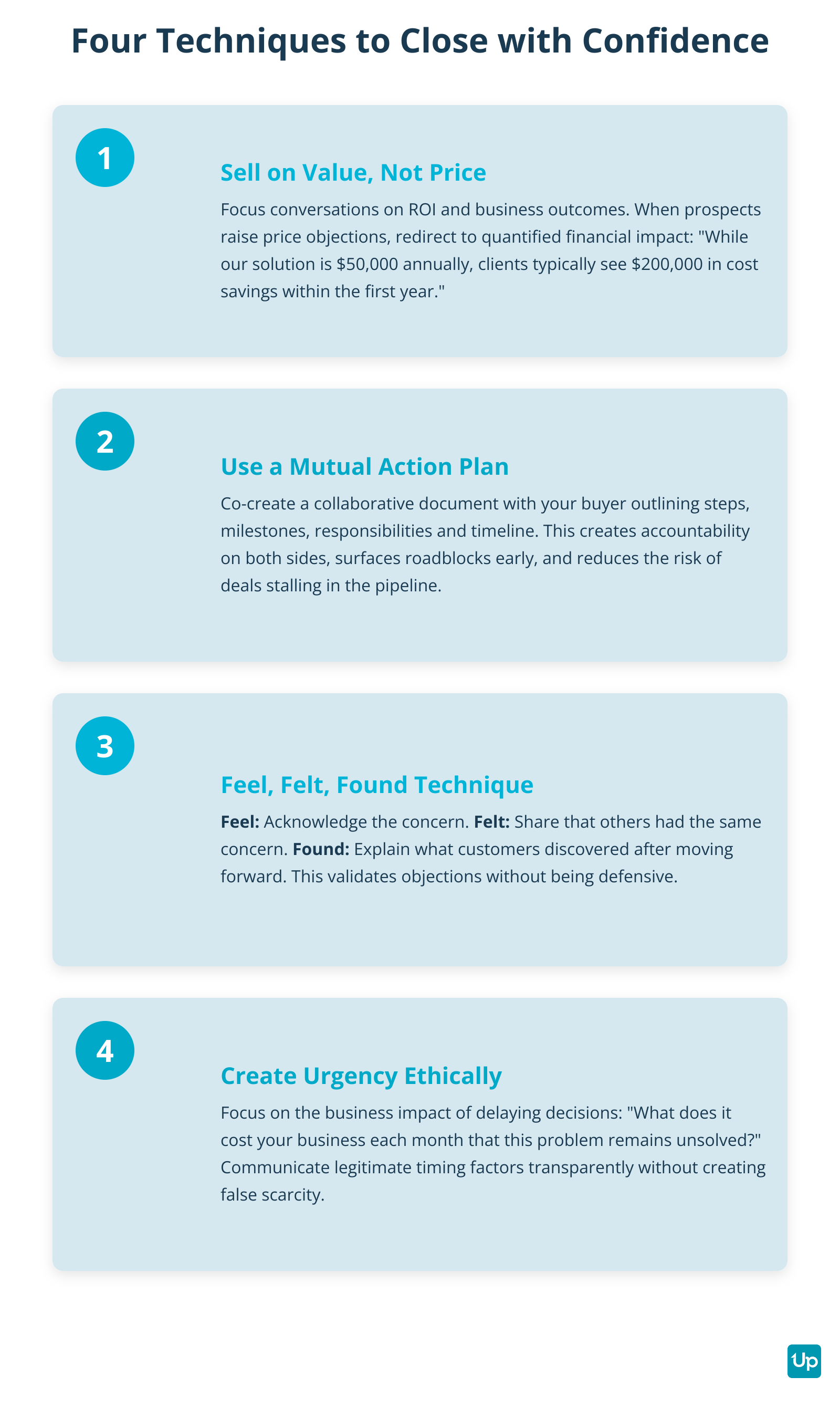
Modern Deal Closing Framework
Sell on Value, Not on Price
Selling on value focuses conversations on ROI and business outcomes rather than cost alone. Your prospects will assess the suitability of your product or service from a range of angles. They’ll consider how it fits in with their existing tools and what additional value it can bring. While price is an important factor, you can’t afford to exclusively focus on it.
Geoff Ficke, a sales guru and serial entrepreneur who runs a consulting firm, explains: “Don’t sell on price alone. If you do, you might not highlight the true value of your product or service.”
When prospects raise price objections, redirect the conversation to ROI. Quantify the financial impact of solving their problem. For example: “While our solution is $50,000 annually, our clients typically see $200,000 in cost savings within the first year through improved efficiency.”
Use a Mutual Action Plan to Guide the Close
A Mutual Action Plan (MAP) is a collaborative document between seller and buyer that outlines steps, milestones, responsibilities and timeline required to close a deal. It’s co-created with the buyer using their language and focusing on their desired outcomes and go-live date.
Key components of an effective MAP include objectives and success criteria, stakeholders and decision-makers, milestones and action items (such as scheduling a follow up meeting), timeline and dates, roles and responsibilities, relevant resources and a communication plan.
A MAP creates accountability on both sides and reduces the risk of deals stalling. It also surfaces potential roadblocks early, allowing you to address them proactively. Sales professionals should follow up promptly after meetings to maintain engagement with prospects and relationships.
Handle Objections with the Feel, Felt, Found Technique
The “Feel, Felt, Found” technique handles objections with empathy by acknowledging concerns, normalizing them and providing resolution. The technique follows three steps:
- Feel: Acknowledge and validate the customer’s concern. “I understand how you feel about the price.”
- Felt: Share that others had the same concern. “Many of our clients initially felt the same way.”
- Found: Explain what those customers discovered after moving forward. “But what they found was that the ROI within six months made the initial investment worthwhile.”
This technique works because it validates the prospect’s concern without being defensive, normalizes the objection and provides a path forward based on real customer experiences.
Create Urgency Ethically
Creating urgency ethically helps prospects understand the cost of inaction without manipulative pressure. The modern approach is about creating clarity around timing through mutual agreement.
Instead of artificial deadlines, focus on the business impact of delaying the decision. Ask questions like: “What does it cost your business each month that this problem remains unsolved?” or “What opportunities are you missing while this issue persists?”
If there are legitimate timing factors (like upcoming price changes, limited implementation capacity or fiscal year budgets), communicate them transparently. The goal is to help prospects make informed decisions on a timeline that serves their business needs, not to create false scarcity.
How Do You Master Virtual Selling?
Virtual selling adapts traditional sales techniques to digital channels like video calls and online presentations. According to Gartner’s 2020 forecast, 80% of B2B sales interactions occur in digital channels by 2025. By 2022, 83% of B2B buyers already preferred ordering or paying via digital commerce. Mastering virtual selling requires adapting your engagement strategies to the digital environment.
Set Up a Professional Workspace
A professional virtual workspace includes quality equipment, proper lighting and an uncluttered background. Your virtual workspace is your new office. Poor lighting, unprofessional backgrounds and technical issues undermine your credibility before you even start your pitch.
Invest in quality equipment: a high-definition webcam, a professional microphone and ring lighting. Choose a clean, uncluttered background or use a professional virtual background. Test your setup before every call to ensure your audio and video are working properly.
Position your camera at eye level and look directly into it when speaking to create the feeling of eye contact. This small adjustment makes a significant difference in building connection through a screen.
Master Your Virtual Meeting Tools
Mastering virtual meeting tools means becoming proficient with screen sharing, breakout rooms, polling and recording features. Fumbling with screen sharing, muting and unmuting or losing your place in a presentation signals a lack of preparation. Become proficient with your virtual meeting platform’s features.
Learn how to use breakout rooms for larger group discussions, polling features for engagement, whiteboarding for collaboration and recording for follow-up. Tools like Zoom Revenue Accelerator use AI-powered conversational intelligence to analyze speaking pace and talk-to-listen ratios, helping you optimize your virtual selling technique.
Create a pre-call checklist that includes testing your audio and video, loading your presentation, having backup contact information ready and preparing your note-taking system.
Keep Buyers Engaged with Visuals and Interaction
Keeping buyers engaged virtually requires pattern interrupts, frequent questions and interactive content. The most common mistake in virtual selling is failing to adapt engagement strategies to the digital environment, leading to buyer distraction and disengagement. This manifests in keeping conversations one-way instead of collaborative, insufficient preparation and technical issues.
Use “pattern interrupts” by stopping screen shares every 4-6 minutes for face-to-face conversation. Ask questions frequently to ensure the prospect is following along. Use relevant virtual backgrounds that reinforce your message without being distracting.
Create asynchronous interactive content experiences through virtual showrooms where clients can explore products in 3D at their own pace. Send personalized video messages using tools like Vidyard or Loom to stand out in crowded inboxes.
What Should Your Sales Tech Stack Include?
A modern sales tech stack includes CRM, sales engagement platforms, conversation intelligence tools and prospecting platforms. The right technology stack amplifies your sales team’s effectiveness. According to the latest Salesforce “State of Sales” report, reps spend only 30% of their time actively selling. The right tools automate administrative tasks and free up time for high-value activities.
Your CRM Is Your Single Source of Truth
Your CRM serves as the central hub for customer data and interactions. Salesforce has been the #1 CRM provider for 12 consecutive years with 20.7% market share. HubSpot offers a robust freemium model with powerful free tools that make it accessible for smaller teams.
A properly implemented CRM provides visibility into your entire pipeline, tracks all customer interactions and enables accurate forecasting. The key is ensuring your team actually uses it. Make data entry as frictionless as possible through mobile apps, email integrations and automation.
Tools like Scratchpad provide an AI-powered workspace for Salesforce users that reduces administrative work, with pricing from $19-$49 per user per month. It offers a modern interface for managing pipelines, updating records and taking notes with real-time Salesforce sync.
Automate Tasks with Sales Engagement Platforms
Sales engagement platforms automate multi-channel outreach and streamline sales activities. SalesLoft is an AI-powered Revenue Orchestration Platform with features including Cadence for multichannel outreach automation, Conversations for call recording and analysis, and its AI engine ‘Rhythm’ that prioritizes tasks based on real-time buyer signals.
Outreach is another leading platform at around $100 per user per month. These tools allow you to create sequences that automatically send emails, schedule calls and trigger tasks based on prospect behavior.
The key benefit is consistency. Every prospect receives the same high-quality experience regardless of which rep is handling the account. You can also A/B test messaging at scale to continuously improve performance.
Uncover Insights with AI and Conversation Intelligence
Revenue intelligence platforms capture and analyze customer conversations to extract actionable insights and coaching opportunities. Gong has evolved beyond conversation intelligence to analyze all customer interactions for deal insights, team performance tracking and AI-powered forecasting. It serves over 4,000 customers including LinkedIn and Shopify.
Chorus by ZoomInfo, acquired for $575 million in 2021, provides conversation intelligence with deep integration to ZoomInfo’s B2B database. These platforms record, transcribe and analyze sales calls, allowing managers to identify best practices and deliver personalized, data-backed coaching at scale.
The insights go beyond individual calls. You can identify which talk tracks work best, which objections are most common and which competitors are mentioned most frequently. This intelligence informs your entire go-to-market strategy.
Enrich Data with Prospecting Tools
Data enrichment and prospecting tools automatically supplement customer data from external sources for better lead scoring and personalization. UpLead offers a 95% data accuracy guarantee and a database of 160+ million B2B contacts with 50+ filters for precise targeting, starting at $99 per month.
ZoomInfo’s SalesOS provides access to 321 million professional contacts with premium pricing starting at $15,000-$25,000 annually. Cognism offers a B2B sales intelligence platform with phone-verified mobile numbers through Diamond Data® and strong European data coverage.
Additional specialized tools include SuperAGI’s AI-native platform offering autonomous AI SDR capabilities at $49 per user per month, with features including multi-channel sequence orchestration and a prospect database of over 450 million contacts.

How Do You Enable Your Sales Team for Success?
Sales enablement creates systems, training and resources that help every rep succeed consistently. Individual rep performance matters, but consistent team performance requires strong enablement. Sales leaders must create systems that help every rep succeed.
Build a Scalable Sales Onboarding Process
A scalable sales onboarding process combines technology and structured training to ramp new hires quickly. Modern sales onboarding combines technology to create a scalable, consistent and data-driven process. New hires should receive significant amounts of training when they join the sales team, but that training must be structured and leverage modern tools.
Key techniques include self-paced learning with a Sales Enablement Platform (tools like Seismic, Highspot or Showell act as a central repository for all training content, playbooks and product information), virtual role-playing with AI (platforms like Second Nature, Virti and Happysales allow reps to practice sales conversations with virtual customers on-demand) and AI-analyzed call recordings (conversation intelligence tools like Gong and Chorus.ai record, transcribe and analyze real sales calls).
Allego, an AI-powered sales enablement platform operating for over 12 years, unifies sales training, content, coaching and virtual selling into a single solution that can reduce costs by up to 50% by consolidating 7+ tools. Use a structured 30-60-90 day plan where reps focus on product knowledge and buyer personas in the first 30 days, begin conducting calls independently by 60 days and own a quota by 90 days.
Wiley Cerilli, CEO and Founder of Good Uncle, explains that with the appropriate preparation, new salespeople will be able to make an immediate impact on your results.
Use Data to Keep Your Team on Track
Using data to keep your team on track means monitoring leading indicators and intervening early when reps fall behind. Sales managers should foster a sense of urgency in their department to keep the team on track. Schedule regular meetings to review new opportunities and sales progress.
Mark Roberge, an advisor to HubSpot and award-winning author of The Sales Acceleration Formula, recommends that sales managers experiment by scheduling regular pipeline review meetings.
Use your CRM data to identify leading indicators of success. Track metrics like activity levels (calls, emails, meetings), pipeline velocity (how quickly deals move through stages) and win rates by stage. When you spot a rep falling behind on activity or a deal stalling, intervene early.
Create dashboards that make key metrics visible to the entire team. Transparency drives accountability and allows reps to learn from top performers.
Create Consistent Sales Enablement Content
Consistent sales enablement content ensures all reps deliver the same high-quality messaging and have access to relevant resources. You’ll attract your sales prospects with great marketing content, then nurture them with sales content. It’s important to make sure materials reflect your overall messaging and are consistent with the way you communicate.
Tim Riesterer, Chief Strategy Officer at Corporate Visions, uses science-backed research and experience to improve sales and marketing messaging. He emphasizes that this strategy can help your business tell a cohesive story and avoid confusion along the way.
Create a content library organized by sales stage and buyer persona. Include one-pagers, case studies, ROI calculators, competitive battle cards and demo scripts. Make this content easily accessible through your sales enablement platform.
Regularly update content based on win/loss analysis and feedback from reps about what resonates with prospects.
How Can You Cultivate a High-Performance Mindset?
A high-performance mindset combines curiosity, resilience and commitment to continuous improvement. Skills and tools are important, but mindset separates good salespeople from great ones. Top performers approach sales with curiosity, resilience and a commitment to continuous improvement.
Find a Mentor to Accelerate Your Growth
Finding a mentor accelerates your growth by learning from someone who has already achieved the success you’re pursuing. No matter how much experience you have, sales is a very complex field and there’s always something new to learn. You should try to find a mentor who can guide and expedite your learning.
Jordan Belfort, author, speaker and former stockbroker who was the subject of the movie The Wolf of Wall Street, returns to this idea again and again. He advises salespeople to try and connect with a mentor they respect.
Look for someone who has achieved the level of success you aspire to and who is willing to invest time in your development. This could be a manager, a senior rep at your company or someone in your professional network.
Come to mentorship meetings prepared with specific questions and challenges. Take notes and implement their advice. The best mentorship relationships are mutually beneficial, so look for ways to add value in return.
Learn from Every Lost Deal
Learning from lost deals turns failures into valuable insights that improve future performance. All too often, sales professionals view lost opportunities as nothing more than failures. These situations provide lots of chances to learn. The best sales departments encourage reflection and knowledge-sharing between team members.
Jill Konrath, a frequent speaker at sales conferences and author of award-winning books, emphasizes the importance of learning from mistakes.
After every lost deal, conduct a brief post-mortem. What signals did you miss? What objections could you have handled better? What did the winning competitor do differently? Document these insights and share them with your team.
Reach out to lost prospects after a few months. Ask for honest feedback about why they chose a different solution. This information is invaluable for improving your approach.
Become a True Advocate for Your Product
Becoming a true product advocate means genuinely believing in the value you provide and using your own solution. Businesses and salespeople need to truly believe in the power and potential of their offering. Salespeople are only able to properly commit to the selling process and forge long-term relationships with their prospects if they become product advocates.
Keith Ferrazzi, founder and CEO of Ferrazzi Greenlight and author of Never Eat Alone and Who’s Got Your Back?, argues that true belief in your product is essential for sales success.
Use your own product or service whenever possible. Understand it deeply, including its limitations. When you genuinely believe in the value you’re providing, that conviction comes through in every conversation.
If you don’t believe in what you’re selling, it’s time to find a product you can get behind. Authentic enthusiasm cannot be faked and prospects can sense when you’re just going through the motions.
Stay Humble and Be a Lifelong Student
Staying humble and being a lifelong student means viewing challenges as learning opportunities and continuously developing your skills. Anyone with sales experience will understand just how complex the world of sales really is. It’s important for sales professionals to utilize this complexity as a way to motivate themselves to learn more.
Aaron Ross, co-CEO at Predictable Revenue and respected author on sales, recommends that salespeople remain humble and try to build on their skills.
Adopt a growth mindset, viewing challenges as learning opportunities. Read sales books, listen to podcasts, attend conferences and participate in online communities. Set aside time each week for professional development.
Respect your prospect’s time and approach every interaction as an opportunity to learn something new about their business, their industry or their challenges. This curiosity will make you a better salesperson and a more valuable partner.
Frequently Asked Questions
What is the difference between a sales process and a sales methodology?
A sales process is the ‘what’—a structured, repeatable sequence of stages from lead to close. A sales methodology is the ‘how’—the philosophy and techniques used to navigate that process. The process is the roadmap, while the methodology is how you drive. For example, your process might include stages like Prospecting, Discovery, Proposal and Close. Your methodology (like Challenger or MEDDIC) determines how you execute each stage.
How can I improve my sales mindset?
Improving your sales mindset involves adopting a growth mindset, building resilience, being customer-centric and committing to continuous learning. Adopt a growth mindset by viewing challenges as learning opportunities rather than failures. Build resilience by focusing on what you can control (your effort, preparation and attitude) rather than what you can’t (market conditions, prospect decisions). Be customer-centric by listening actively and genuinely trying to help rather than just closing deals. Commit to continuous learning through books, podcasts, mentorship and reflection on your wins and losses.
What is the most common mistake in virtual selling?
The most common mistake in virtual selling is failing to adapt engagement strategies to the digital environment, leading to buyer distraction and disengagement. This manifests in keeping conversations one-way instead of collaborative, insufficient preparation and technical issues like poor lighting or unprofessional backgrounds. Combat this by using pattern interrupts (stopping screen shares for face-to-face conversation), asking questions frequently and investing in quality equipment and setup.
How do you apply value-selling in practice?
Applying value-selling in practice means conducting thorough discovery, quantifying value and using storytelling to demonstrate results. Apply value-selling by conducting thorough discovery to understand customer challenges and business priorities. Quantify value by connecting your solution to measurable ROI, such as “reducing costs by 20%” or “increasing revenue by $500,000 annually.” Use storytelling with case studies to demonstrate proven results with similar customers. Focus every conversation on business outcomes rather than product features. Create ROI calculators or value assessments that make the financial impact concrete and specific to their situation.
Conclusion
Success in 2025 hinges on combining a customer-centric mindset with modern strategy. By adopting a proven methodology, mastering virtual selling and leveraging the right tech stack, you can turn these 30+ tips into consistent revenue growth. If you want to improve your sales results even further, be sure to start your free UpLead trial today.
Understanding Sales Fundamentals
Mastering the fundamentals of sales is the foundation for any successful sales professional or team. The sales process typically unfolds in several key stages: prospecting for new leads, qualifying those leads, presenting your product or service, and ultimately closing the deal. Understanding each stage allows sales reps to navigate the sales cycle with confidence and purpose.
Sales professionals who excel know that building rapport with potential customers is essential from the very first interaction. By identifying and addressing pain points, you can tailor your sales pitch to resonate with your audience and clearly communicate your value proposition. A well-structured sales pitch doesn’t just list features—it connects your product or service to the specific needs of the customer, making the benefits tangible and relevant.
Sales managers play a crucial role in guiding their sales teams through ongoing sales training and support. They ensure that every team member is equipped with the latest sales tips, techniques, and resources needed for sales success. By fostering a culture of continuous learning and open communication, sales managers help their teams stay agile and effective throughout the sales process.
Ultimately, understanding and applying these sales fundamentals enables sales professionals to build trust, address customer concerns, and move deals forward efficiently. Whether you’re new to sales or a seasoned expert, revisiting these basics can help you refine your approach and achieve consistent results.
Taking the First Step to Start Selling
The journey to sales success begins with taking the first step: making initial contact with potential customers. This outreach can take many forms, from cold calling and personalized sales emails to engaging prospects on social media platforms. Regardless of the channel, the key is to approach each interaction with genuine curiosity and a desire to understand the prospect’s unique challenges.
Sales professionals and sales reps should focus on active listening during these early conversations. By asking thoughtful questions and paying close attention to the prospect’s responses, you can uncover valuable insights about their pain points and business goals. This information is critical for crafting an effective sales pitch that speaks directly to the needs of your target audience.
A clear picture of your ideal customer and their specific challenges will help you tailor your messaging and increase your chances of success. Sales experts recommend that new reps receive comprehensive onboarding, including training on proven sales techniques, in-depth product knowledge, and customer data analysis. This preparation ensures that every sales rep is ready to start selling with confidence and deliver value from the very first interaction.
Remember, the initial contact sets the tone for the entire sales relationship. By demonstrating that you are genuinely interested in helping potential customers solve their problems, you lay the groundwork for trust and long-term partnership.
Tracking Progress and Following Up
Consistently tracking progress and following up with potential customers is essential for moving deals through the sales cycle and achieving sales success. Sales professionals must stay up to date with changes in customer needs, industry trends, and any new developments that could impact the buying decision. Regular follow-up calls or meetings provide opportunities to address lingering concerns, overcome objections, and deliver additional value that keeps your solution top of mind.
A well-structured sales process, supported by the right tools and accurate information, enables sales teams to monitor every stage of the customer journey. Sales managers and chief strategy officers play a pivotal role in developing strategies that prioritize building long-term relationships with satisfied customers, rather than just chasing a quick sale. By focusing sales conversations on understanding the customer’s evolving needs and offering tailored solutions, you can foster loyalty and generate more leads.
Leveraging actionable insights from CRM data and encouraging knowledge sharing among team members helps identify potential objections early and develop effective strategies to address them. Regular meetings and open communication within the entire team ensure everyone is aligned and equipped to increase productivity and close more deals.
Ultimately, the goal is to build strong relationships, provide ongoing value, and guide potential customers toward a successful outcome. By following a structured approach and staying focused on the customer, sales professionals can drive consistent results and long-term sales success.